


 Alert!

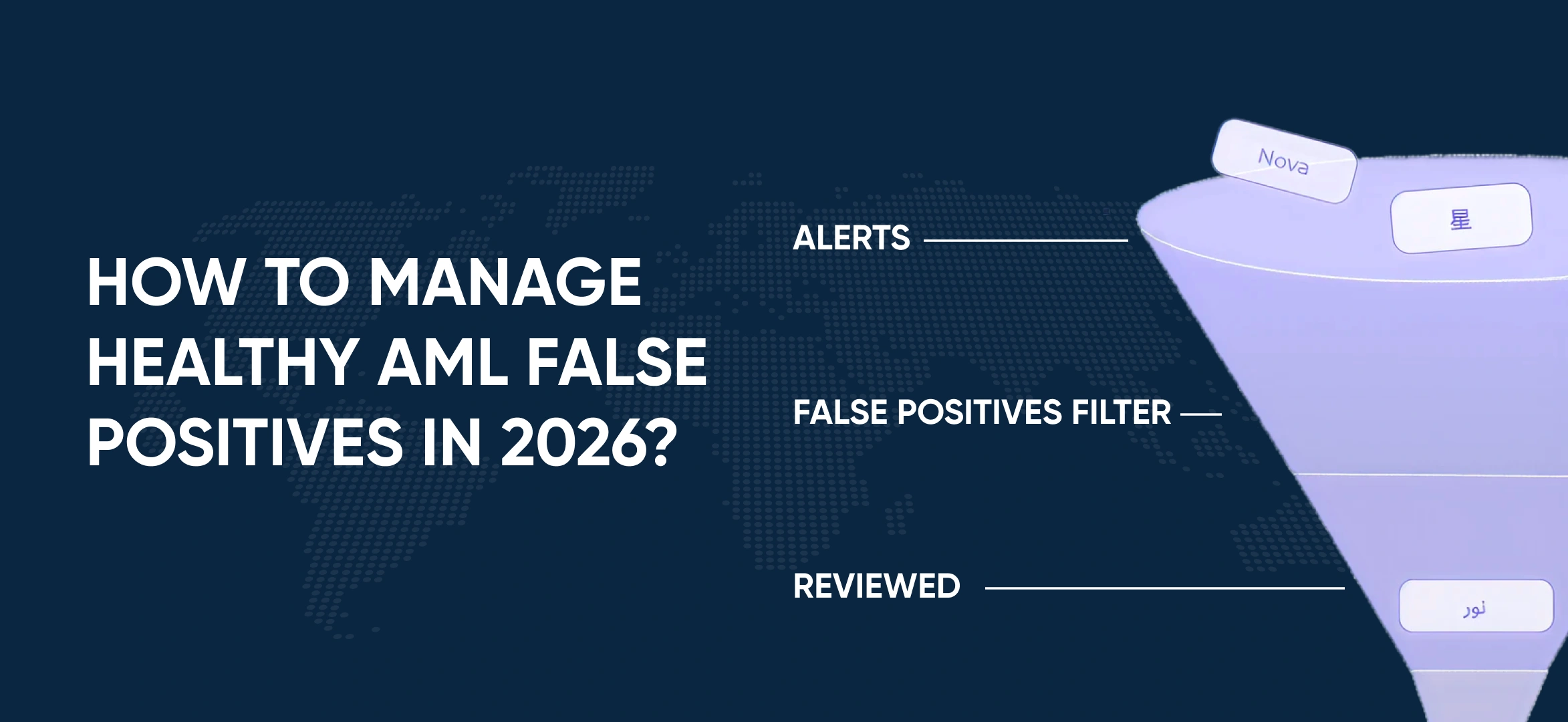
How to Manage Healthy AML False Positives in 2026?
Anti Money Laundering
June 08, 2026
March 27, 2024


Taxes and death have been named the most uncertain things by an economist, Benjamin Franklin. If we expand the horizon to compliance and the fight against money laundering and financing for terrorism, AML’s false positives add to the existing uncertainties.
What is a false positive? Precisely, an operational error that generates a false alarm by identifying increased AML risk when actually it is not. Increasing the compliance burden on institutions, false positives cause financial exhaustion by requiring excessive resources and time for manual verification of generated alarms.
In an effort to protect global financial stability and prevent criminals from violating global regulatory protocols, European banks annually spend around $20 billion to establish AML compliance. On the other hand, U.S. banks surpass this amount and spend more than $23 billion to combat financial crime and fraud.
Despite spending billions of dollars to combat money laundering and other predicate crimes, an estimated $26 billion in AML fines was levied on banks globally over the past 10 years. Struggling to find a balance between compliance measures and optimized resources to implement them, banks and other financial institutions are flipping the coin, with false positives and false negatives on both sides.
As AML regulations and transaction monitoring expectations continue to evolve in 2026, financial institutions are under pressure to reduce false positives without compromising detection accuracy.
What is a False Positive in AML?
A false positive in AML occurs when a legitimate customer or transaction is incorrectly flagged as suspicious by an AML screening or transaction monitoring system. These alerts are generated when customer activity matches predefined risk indicators, even though no actual financial crime exists.
False positives usually occur when AML systems rely on rigid rules, outdated customer information, or poorly configured transaction thresholds. For financial institutions, this creates operational pressure because compliance teams must manually review alerts that do not represent genuine money laundering risks.
For example, a customer transferring a large amount after selling property may trigger an alert because the transaction exceeds a monitoring threshold. After investigation, the transaction may prove legitimate, making the generated alert a false positive instead of a true suspicious activity case.
High false positive rates continue to challenge compliance teams globally. According to industry estimates, the majority of AML alerts generated by monitoring systems require manual review despite involving legitimate activity. Excessive alert generation increases investigation costs, slows customer onboarding, and shifts compliance attention away from actual high-risk cases.
Modern AML compliance programs now focus on reducing unnecessary alerts through contextual analysis, customer risk profiling, intelligent transaction monitoring, and continuous tuning of AML systems.
3 Reasons False Positives Must Be Reduced
Verification of false positives in AML, which can cause operational losses in time and resources if left unchecked, can attract regulatory scrutiny and non-compliance fines. Below are the major impacts businesses face from false positives.
Increased Operational Strain
With heightened screening for false positives in anti-money laundering, businesses need more resources in terms of more compliance officers to verify these incorrect alerts when they could have been utilized in other productive tasks. Along with increased financial expenses, businesses experience a decline in operational efficiency when resolving diverging positives manually.
Compromised Customer Relationships
Dealing with false positives increases operational strain on a business, while investigating a valid client on the basis of false alerts can erode mutual trust between the client and management. Your business might lose a major client because your AML tool flagged them as suspicious when they were legitimate. Delays in business operations might cause client frustration, contribute to reputational damage, and compromise the ability to maintain business financial security.
Heightened Regulatory and Reputational Risks
When a business spends most of its operational time resolving false positives, the actual AML risks might get compromised and overlooked. Increased investigations and extended verification can lead to reputational damage if compliance demands are not met. The rising rate of false positives also motivates regulatory audits and increased scrutiny of in-house AML controls.
Having the impacts explained, reducing these false positives has become a non-negotiable task for optimized business operations. Below are the key areas where optimal and healthy AML false positives can benefit your business.
Before digging into ways businesses can effectively reduce false positives and increase AML check efficiency, it is crucial to understand why they occur in the first place.
5 Reasons False Positives Occur in AML Controls
The efficiency of valid detection of AML risks relies on the defined rules, the quality and diversity of the data to be screened, and optimized rules for operating the customer or transaction monitoring process. The above-mentioned factors, in addition to those listed below, when compromised, give rise to AML false positives.
Contextual Analysis
AML tools and systems that fail to employ contextual analysis tend to generate more false positives. For instance, a transaction might be falsely flagged because the client’s history or the behavioral context of his transactions was not considered in the tools’ operation.
Diversification of AML Rules
A financial institution serves clients across different regions and jurisdictions, making it difficult to align AML systems under a single rule. Hence, the fickle application of AML rules might cause false positives in AML.
Configuration of Threshold
An optimal threshold for transactions, particularly in transaction monitoring, significantly affects alert generation. Understanding your financial system’s risk appetite and transaction patterns is crucial. For instance, a high threshold might generate many alerts for multiple transactions, while a low threshold can create a blind spot for potentially suspicious transactions.
Customer Risk Profiling
Regular upgradation of customer risk profiles enables AML tools to make more informed judgments before issuing an alert. The configuration of customers’ changing profile features, such as transactional behavior, source of income, and business relationship, is crucial to avoid false alarms.
Tuning of AML Systems
AML systems that lack adjustment to changing financial patterns, regulatory requirements, and financial crimes are more prone to generating false alerts. The ability of tools to accommodate feedback and tech evaluation plays a pivotal role in its optimization and generates reliable results.
Effective AML screening and smooth onboarding of new clients depend on healthy AML false-positive rates. Let’s take a look at the factors that affect the efficiency of screening for sanctioned entities and Politically Exposed Persons.
Let’s not wait to look out for options to reduce AML false positives. Even though the occurrence of false alerts is inevitable, businesses need to automate their AML systems to reduce operational burdens and move past the constant fear of non-compliance consequences.
3 Strategic Ways to Reduce False Positives in AML Screening
When coupled, human intelligence and technology integration can resolve the challenges faced by the compliance team. Striking the right balance is crucial.
Acquire the Master Data
Data is the king. Collecting or acquiring data through third-party vendors that are competitive and adaptable to changes in your business market and client base empowers compliance with reduced AML false positives. The configured data should be,
Complete: The data your compliance and screening relies on must cover all the networks and services your business is associated with. The completeness of data can be assessed through its alignment with regulatory requirements and sufficiency to match your business needs.
Structured: The way data is stored in the database tells a lot about its effectiveness. Unlike automated data upgradation, manual data entry may lead to human errors or incomplete user information. It can lead to false matches and, hence, increased false positives.
Accessible & Adaptable: Acquiring and integrating data that is both accessible and adaptable to changes is the ultimate goal of mastering compliance. For instance, to meet efficient sanction screening requirements, the entities on global sanctions lists are constantly added and removed by sanctioning bodies. Right changes in the data at the right time define the efficiency of screening and AML case management.
For optimized false-positive reduction, it is important to screen data aligned with data management strategies, with easy-to-navigate access to coded information.
Leverage Technology That Meets Precision
Does your AML screening tool operate on search-matching algorithms? What makes it so special that technology integration into the fight against financial crimes has become the right hand of compliance watchdogs? Biometric AML, risk profiling that meets the dynamic needs of your client base, data analysis that reads between the lines and contexts, and last but not least, name matching screening while utilizing fuzzy logic and natural processing language (NPL).
Below is a comprehensive roadmap showing how search-matching algorithms are changing the course of screening, optimizing for fewer false positives and eliminating false negatives.
Employ Robust AML Screening Solutions
Business success is measured by many factors, including customer satisfaction and market value, as well as optimized operational costs through resource allocation and enhanced efficiency of your compliance teams. Businesses have concluded that it is acceptable to accept false positives if they miss a true alert of potential compliance breaches. Robust seems like a demanding term; therefore, I would rather replace it with efficient, easy-to-use AML screening solutions that not only meet technical and regulatory expectations but are also easy to use.
AML Watcher empowers your compliance efforts by reducing false positives and integrating cutting-edge technology into our screening tools. The compliance experts who understand the regulatory demands and tech geeks who leverage fuzzy logic and natural language processing in AML tools make a powerful team against compliance weaknesses. Additionally, AML Watcher provides a dataset that not only meets the dynamic needs of the regulatory landscape but also enables your compliance team to identify and mitigate true financial crimes in real time.
For a better user experience, explore our Live Search Tool and look beyond the uncertainties.
- No commitment needed
- Complete AML Database at your service
- Access our all-in-one dashboard


Tier-2 PSPs in ... must demonstrate automated monitoring, layered CDD, &...
See the Full Regulatory Expectation70–80% less manual work, 95% less fatigue, TruRisk Agent makes compliance effortless.
Experience Agentic AMLMove Beyond Articles. Activate AML Intelligence.
Switch to AML Watcher today and reduce your current AML cost by 50% - no questions asked.
- Find right product and pricing for your business
- Get your current solution provider audit & minimise your changeover risk
- Gain expert insights with quick response time to your queries