

 Alert!

Why Sanctions Screening Is Essential for Business Success?
Sanctions
Aug 07, 2026
December 5, 2023


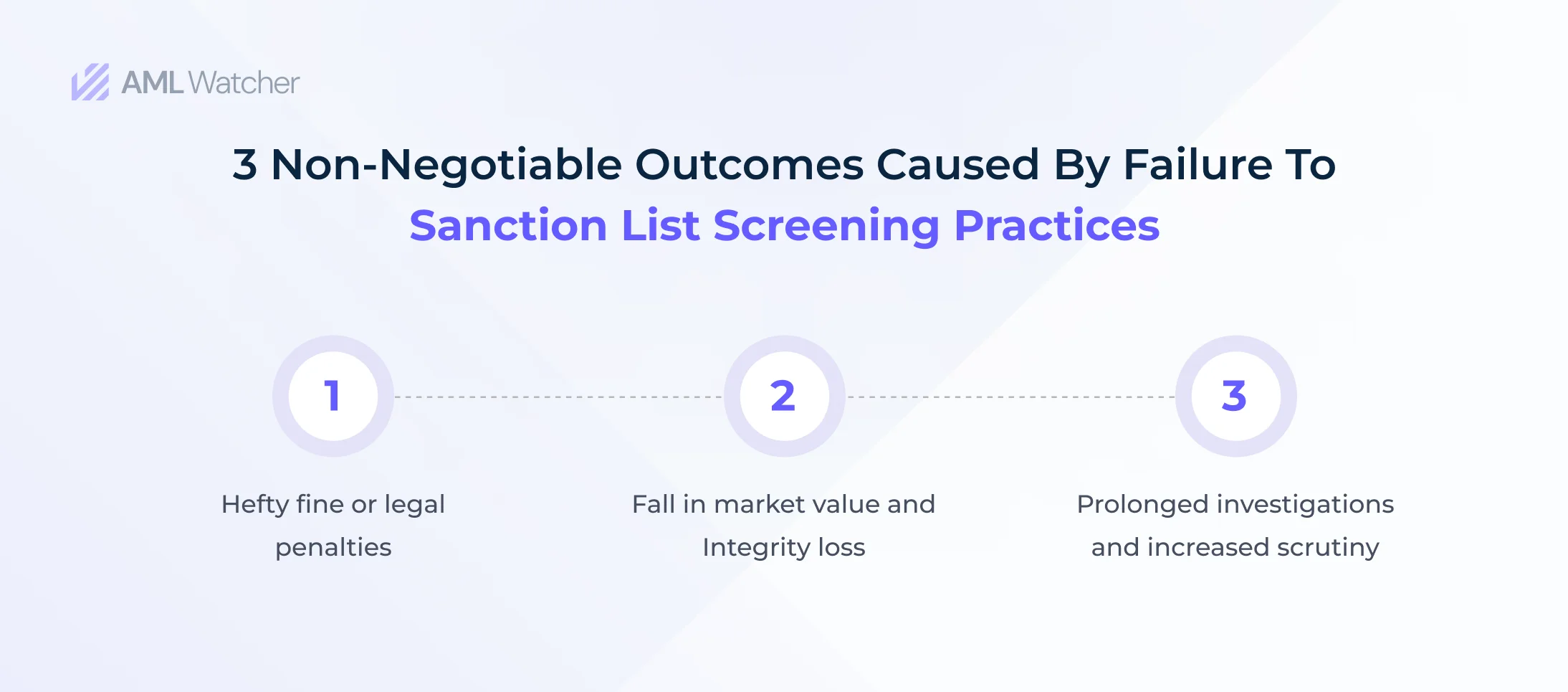
Expanding sanctions programs and rapidly changing geopolitical developments have made sanctions screening a core compliance requirement for organizations operating across borders. Financial institutions and regulated businesses must identify sanctioned individuals, entities, vessels, and beneficial owners before establishing or maintaining business relationships. Failure to do so can result in regulatory penalties, operational disruption, and reputational damage.
As sanctions programs expand across jurisdictions, it is important to highlight the crucial role sanctions screening plays in helping organizations manage regulatory risk while operating internationally.
As sanctions lists continue to evolve, organizations require screening solutions that can identify sanctioned entities across multiple jurisdictions while reducing manual effort and false positives. Effective sanctions screening not only helps organizations meet regulatory expectations but also supports stronger due diligence and risk management.
How Sanctions Compliance Has Become More Challenging
Recent geopolitical developments have accelerated the expansion of sanctions programs across the United States, the United Kingdom, the European Union, Canada, Australia, and other jurisdictions.
In addition to already-imposed sanctions and the global sanction lists maintained by OFAC’s Specially Designated Nationals (SDN) List, in 2022. The United Kingdom and the European Union also expanded their own sanctions programs through their respective sanctions lists. These ever-increasing regulations have posed a significant challenge for institutions to meet compliance requirements, casting doubt on screening practices. Where the list-based sanctions allow the institutions to prohibit business with sanctioned entities instead of the whole region or countries, it poses measurable challenges against the identification of entities present in the targeted lists, such as name matching and screening against those who fulfill the 50% rule of OFAC. In the sanctions regime, whether your business is under the OFAC or OFSI in the UK, mitigating sanctions compliance risks requires your institution to have a robust automated sanctions screening solution.
The Cost of Sanctions Compliance Failures
Regretting its failure to comply with US sanctions, the Royal Bank of Scotland was fined $100 million in 2010 for violating sanctions against Cuba, Burma, Sudan, and Iran, as reported by World Finance. Upon investigation, DFS (Department of Financial Services) found that RBS’s investigators found that employees had concealed customer information to process prohibited transactions.
For non-compliance with sanctions, Standard Chartered Bank processed around 60,000 transactions involving sanctioned entities, including Iran (a US-sanctioned country), and was allegedly charged with a $164 million fine. The transactions totaling $250 billion over the decade were carried out by falsifying payment instructions and replacing sanctioned clients’ data with false information, as reported by the BBC.
In other news, the BBC reported that British American Tobacco was fined $635 million for violating the US sanctions imposed on North Korea. The tobacco company was found defrauding the FIs (Financial Institutions) to facilitate transactions and was charged with the largest penalty under North Korea sanctions compliance.
OFAC enforcement actions brought to light sanctions violations by daVinci (Swift Prepaid Solutions, Inc.). This financial company issued reward cards used in sanctioned areas like Iran, Cuba, Syria, and Crimea. OFAC settled with daVinci, imposing a $206,213 penalty and requiring a robust compliance program, as reported by Global Trade and Sanctions Laws.
Business Consequences Beyond Regulatory Penalties
Globally recognized cryptocurrency exchange Binance faced extensive regulatory action after authorities found the company had knowingly violated sanctions and anti-money laundering (AML) requirements. Investigations revealed shortcomings in its compliance framework, including inadequate sanctions controls and failures to prevent prohibited transactions. As part of the enforcement action, Binance agreed to a multi-billion-dollar settlement, while its former CEO pleaded guilty and stepped down from his position. The case demonstrates how weak sanctions governance can lead to regulatory penalties, reputational damage, and years of increased regulatory oversight.
How Regulatory Enforcement Changes Business Operations
In addition to agreeing to a $4.3 billion settlement, one of the largest corporate penalties in U.S. history, Binance faced lasting regulatory consequences beyond financial losses. Following the enforcement action, the exchange became subject to extensive regulatory oversight and was required to strengthen its sanctions and anti-money laundering compliance program. The case demonstrates how sanctions failures can reshape an organization’s compliance obligations, governance practices, and regulatory relationships for years after the initial violations are identified.
Why Effective Sanctions Screening Matters
In-practice screening protocols and the chances of undermining compliance standards are intertwined. In the ever-changing financial landscape and compliance regulations, adopting an automated sanctions list screening system has become crucial to the success of your business, especially if you are operating in the global market. Let’s take a brief look at how a consolidated sanction screening solution can be the blueprint for your business success.
Strengthening Corporate Governance
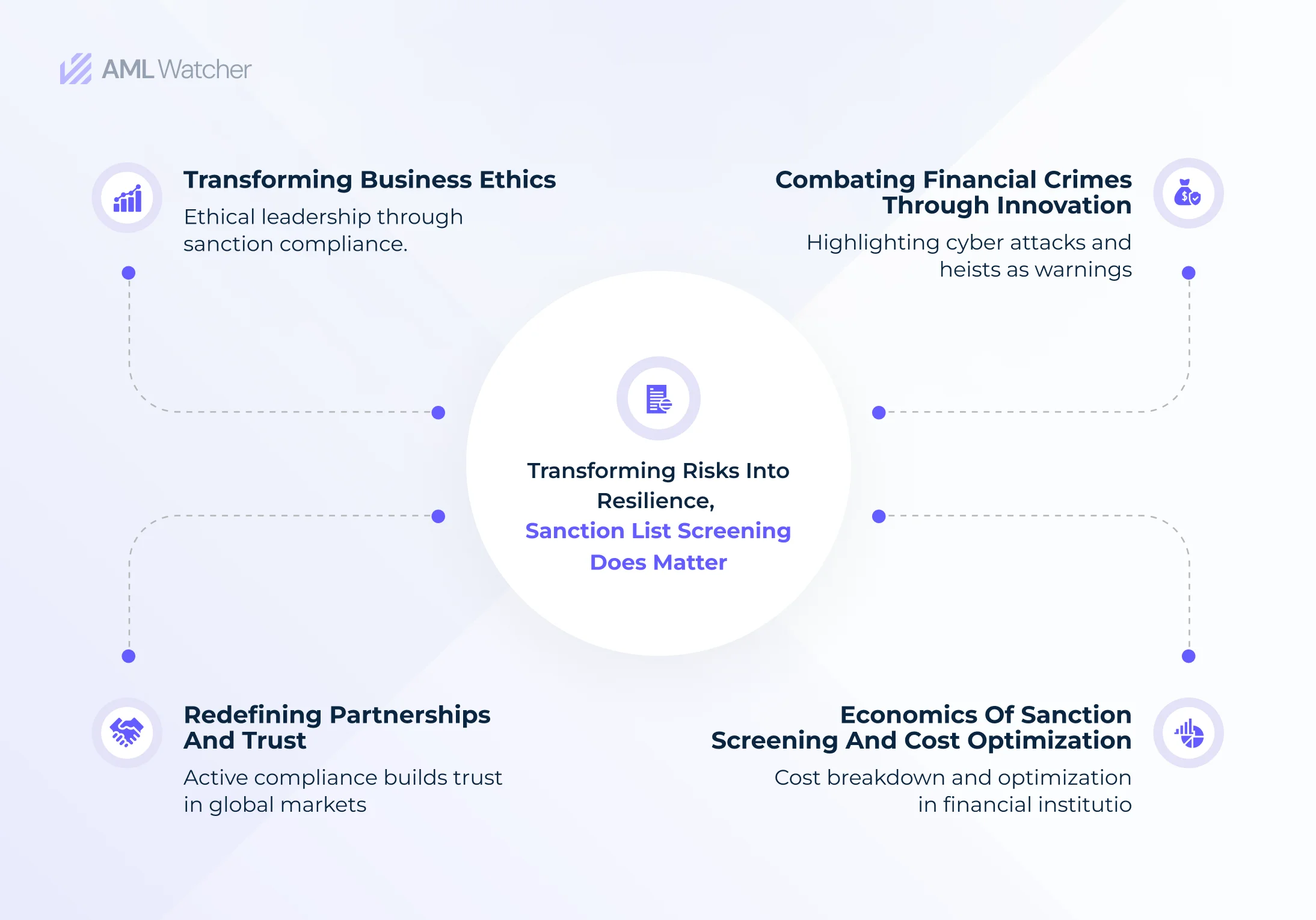
Implementing a screening solution to meet sanctions compliance requirements enables your business to demonstrate stronger governance and compliance culture. The hefty non-compliance charges against Standard Chartered and Royal Bank of Scotland pushed organizations to take unavoidable screening measures and become ethical leaders in the unforgiving economic sphere.
Building Trust with Customers and Partners
With an active, rigorous compliance and sanctions screening solution in place, your business fosters a healthy partnership in the global market. Policies alone cannot reduce sanctions risk unless supported by effective screening controls. Binance, facing a major outflow of funds from its market, is a real-time example of our narration, highlighting the need for evolving, game-changing screening measures.
Economics of Sanctions Screening and Cost Optimization
Maintaining an effective sanctions screening program requires organizations to balance compliance obligations with operational efficiency. Manual screening processes often demand substantial time and resources, particularly when compliance teams must review large volumes of alerts generated by outdated or rule-based systems. High false positive rates can slow customer onboarding, increase investigation workloads, and divert resources away from higher-risk cases.
As sanctions programs continue to expand across jurisdictions, compliance teams face growing pressure to screen larger datasets while responding quickly to regulatory updates. Relying solely on manual reviews becomes increasingly difficult, especially for organizations operating across multiple markets or managing high transaction volumes.
Automated sanctions screening solutions help address these operational challenges by reducing manual intervention, improving screening accuracy, and supporting continuous monitoring of sanctions list updates. This enables organizations to allocate compliance resources more effectively, streamline investigation workflows, and maintain a scalable sanctions compliance program as regulatory requirements evolve.
How AML Watcher Supports Sanctions Screening
Keeping pace with evolving sanctions regulations requires more than periodic list checks. Financial institutions need screening solutions that combine comprehensive sanctions data with continuous monitoring to identify risks as they emerge.
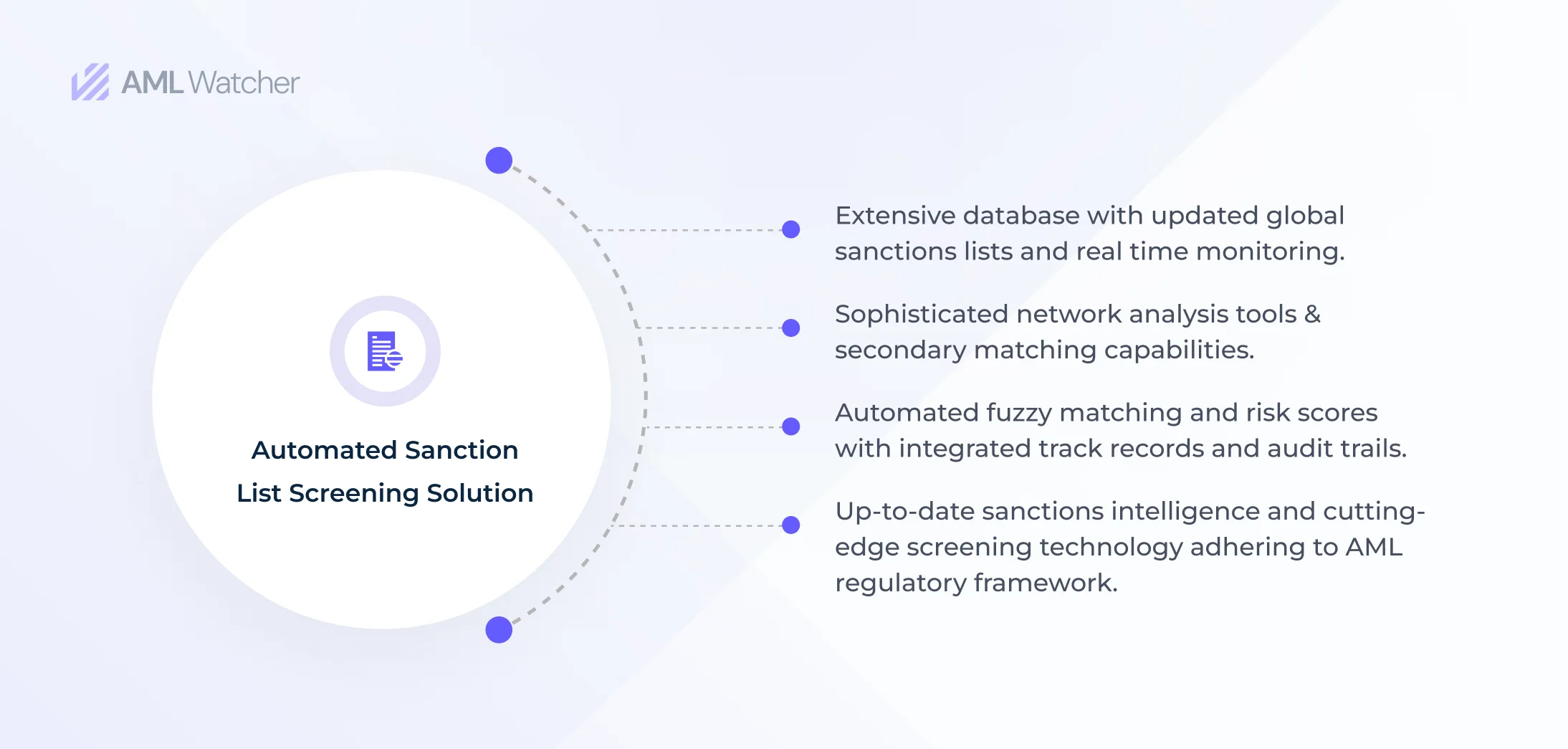
AML Watcher’s sanctions screening solution enables organizations to screen customers and counterparties against global sanctions lists using regularly updated, multi-jurisdictional data.
Advanced matching capabilities help improve screening accuracy, reduce manual reviews, and support faster compliance decisions. By continuously monitoring sanctions updates, organizations can respond promptly to regulatory changes while strengthening their AML/CFT compliance framework.
Request a demo to discover how AML Watcher helps organizations build a more effective and resilient sanctions screening program.
- No commitment needed
- Complete AML Database at your service
- Access our all-in-one dashboard


Tier-2 PSPs in ... must demonstrate automated monitoring, layered CDD, &...
See the Full Regulatory Expectation70–80% less manual work, 95% less fatigue, TruRisk Agent makes compliance effortless.
Experience Agentic AMLMove Beyond Articles. Activate AML Intelligence.
Switch to AML Watcher today and reduce your current AML cost by 50% - no questions asked.
- Find right product and pricing for your business
- Get your current solution provider audit & minimise your changeover risk
- Gain expert insights with quick response time to your queries