

 Alert!


How Sanction Checks Mitigate Cross-Border Financial Risks
Sanctions
January 18, 2024


Cross-border transactions have become a cornerstone of global commerce, allowing financial institutions to serve international customers and support economic growth. However, the expansion of global financial networks has also increased exposure to money laundering, terrorist financing, sanctions evasion, and proliferation financing. Criminal organizations often exploit differences between jurisdictions, making cross-border financial activities one of the most challenging areas of AML compliance.
Recent geopolitical events, including the Russia-Ukraine conflict, have led governments worldwide to expand sanctions programs and strengthen enforcement actions. As sanctions lists continue to evolve, financial institutions are expected to identify sanctioned individuals and entities before establishing business relationships or processing transactions. A single missed sanctions match can expose businesses to regulatory penalties, financial losses, and reputational damage.
According to the United Nations Office on Drugs and Crime (UNODC), between 2% and 5% of global GDP, or approximately $800 billion to $2 trillion, is estimated to be laundered each year. This highlights the importance of effective sanctions screening as part of a broader AML compliance program that helps institutions detect prohibited relationships and reduce cross-border financial risks.
This article explains how sanctions screening helps financial institutions mitigate cross-border financial risks, meet evolving regulatory expectations, and strengthen compliance across international operations.
Why Cross-Border Transactions Require Stronger Sanctions Controls
Every cross-border transaction introduces additional compliance challenges that domestic payments may not present. Financial institutions often deal with customers, counterparties, intermediaries, and beneficial owners across multiple jurisdictions, each subject to different sanctions regimes and regulatory expectations. This complexity makes it more difficult to identify sanctioned parties before funds move through the financial system.
Sanctions lists are updated frequently in response to geopolitical developments, regulatory actions, and national security concerns. Businesses that rely on outdated data or manual review processes may fail to identify newly designated individuals or entities, increasing the likelihood of prohibited transactions and regulatory breaches.
The challenge extends beyond screening a customer’s name. Financial institutions must also identify sanctioned beneficial owners, connected entities, vessels, and other parties involved in cross-border transactions. Criminal networks often use complex ownership structures, shell companies, and intermediary businesses to obscure their involvement, making effective sanctions controls an important safeguard against financial crime.
International standards reinforce these expectations. FATF Recommendation 6 requires countries to implement targeted financial sanctions in line with United Nations Security Council Resolutions (UNSCRs). To meet these obligations, financial institutions incorporate sanctions controls into customer due diligence (CDD), enhanced due diligence (EDD), and ongoing monitoring to identify sanctioned parties throughout the customer lifecycle.
Illicit Flows through Financial Institutions (Banks & Insurance Firms)
The following example demonstrates how complex cross-border transactions can conceal financial crime risks and why effective sanctions screening remains an essential control.
Case Study: Cross-border Financial System Exploitation
Issued by the Malta Institute of Accountants, a cross-border trade was executed between a company in Malta having no employees and a German construction company. The transaction involved crediting €6 million for specialized construction equipment, which was immediately resold to another Turkish company for €6.1 million. The equipment was sent from Germany to Turkey, with payments delayed for no stated reason. The report identified a close connection between the supplier in Germany and the second buyer in Turkey, with a similar correspondence address and legal advisory.
The transaction displayed several financial crime red flags, including a company with no employees, rapid resale of goods with little commercial justification, delayed payments, and closely connected counterparties. These characteristics are commonly associated with trade-based money laundering and sanctions evasion. They also demonstrate how complex ownership structures and cross-border transactions can obscure the true parties involved, making sanctions screening, customer due diligence, and beneficial ownership verification essential controls.
Sanctions Legislation for Insurance Firms
Insurance providers play an important role in the global financial system and are subject to the same sanctions compliance obligations as other regulated financial institutions. Providing insurance coverage to sanctioned individuals, vessels, or organizations can expose firms to regulatory enforcement actions and financial penalties.
In the United Kingdom, insurance firms must comply with sanctions regulations administered by HM Treasury and the Office of Financial Sanctions Implementation (OFSI). In the United States, sanctions compliance is enforced by the Office of Foreign Assets Control (OFAC). These authorities expect firms to implement effective sanctions screening programs, maintain appropriate internal controls, and promptly identify sanctioned customers and transactions.
Sanctions Regulations and Lists
Sanctions programs differ across jurisdictions, requiring financial institutions operating internationally to comply with multiple regulatory regimes simultaneously.
Regulators around the world maintain sanctions lists that financial institutions are expected to screen against during customer onboarding and throughout the business relationship. One of the most widely recognized lists is the Office of Foreign Assets Control (OFAC) Specially Designated Nationals (SDN) List, which identifies individuals, entities, vessels, and organizations subject to U.S. sanctions.
Depending on where a business operates, organizations may also need to screen against sanctions lists published by the United Nations, the European Union, the United Kingdom, and other national authorities to meet local regulatory requirements.
How to Check the Sanction List?
Financial institutions typically screen customers and counterparties against applicable sanctions lists during customer onboarding and continue screening throughout the customer lifecycle. While regulators such as OFAC provide free sanctions search tools, organizations handling large customer volumes generally rely on automated sanctions screening solutions that monitor multiple global watchlists simultaneously, reducing manual effort.
When Should Financial Institutions Perform Sanctions Screening?
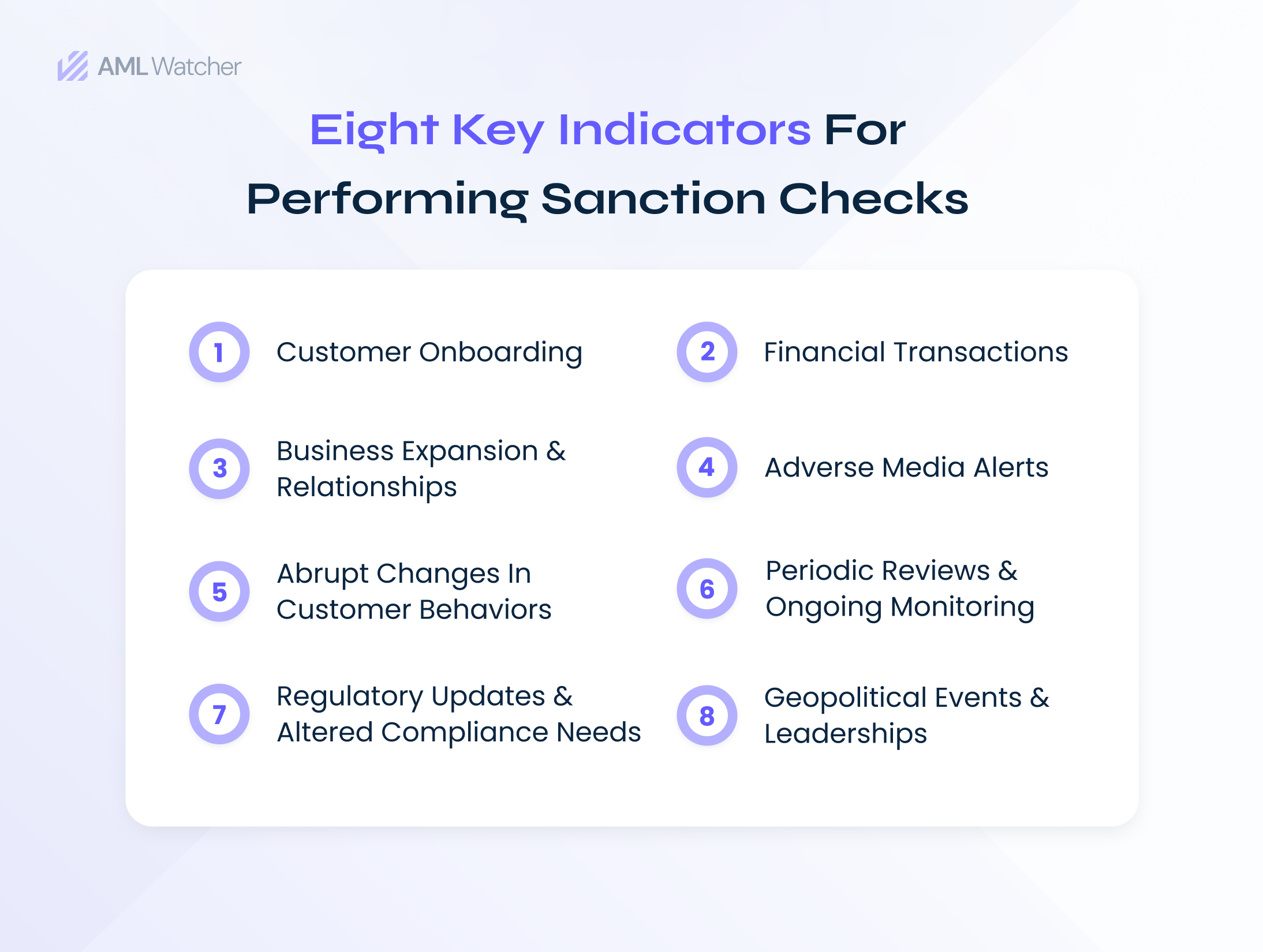
Sanctions screening should begin before establishing a business relationship as part of customer due diligence (CDD). Higher-risk customers, including politically exposed persons (PEPs), complex ownership structures, and customers operating in high-risk jurisdictions, may require enhanced due diligence (EDD) alongside sanctions and PEP screening.
Because sanctions lists are updated frequently, financial institutions should also conduct ongoing monitoring to identify newly sanctioned individuals or entities throughout the customer relationship.
Challenges in Cross-Border Sanctions Compliance
Despite well-established regulatory frameworks, many financial institutions continue to face operational challenges when implementing effective sanctions screening across multiple jurisdictions. Differences in regulatory requirements, fragmented data sources, resource limitations, and rapidly changing sanctions lists can all affect compliance effectiveness.
Data Sharing & Cross-Border Collaboration
Cross-border sanctions screening depends on access to accurate and up-to-date customer, ownership, and transactional data across multiple jurisdictions. However, fragmented beneficial ownership records, varying disclosure requirements, and inconsistent data standards often make it difficult for financial institutions to identify sanctioned individuals or entities hidden behind complex corporate structures. The challenge becomes even greater when organizations must screen against multiple sanctions lists maintained by regulators such as OFAC, the United Nations, the European Union, and the UK Office of Financial Sanctions Implementation (OFSI). Differences in naming conventions, aliases, transliterations, and unique identifiers across these lists can lead to false positives, missed matches, and delayed compliance decisions. Financial institutions operating internationally, therefore, require reliable data sources and advanced screening capabilities to manage sanctions risks effectively.
Compliance Priorities and Resource Constraints
Financial institutions operating across multiple jurisdictions often face differing regulatory expectations, limited compliance resources, and varying levels of AML maturity. Smaller organizations may rely on outdated screening systems or manual review processes that struggle to keep pace with rapidly expanding sanctions lists.
Maintaining effective sanctions screening requires ongoing investment in technology, employee training, and regulatory awareness. Without these resources, organizations may experience higher false-positive rates, slower customer onboarding, and greater regulatory exposure.
Divergent AML/CFT Rules
Conducted in 2021, the survey on FATF standards implementation shows the impact of divergent AML/CFT rules on the efficiency of cross-border payments, with increased costs and slower, less transparent processing. It also highlighted that financial sanctions screening is the second-largest obstacle to AML/CFT compliance, after the identification and verification of beneficial ownership information. Differences in regulations across jurisdictions hinder consistent AML compliance.
Emerging Technologies and Sanctions Compliance
Digital payment channels, virtual assets, and increasingly sophisticated financial crime techniques continue to reshape the global risk landscape. Criminal organizations frequently exploit complex ownership structures, digital payment methods, and cross-border networks to conceal illicit activity and evade sanctions.
Modern sanctions screening solutions, powered by artificial intelligence, automation, and continuously updated data, help financial institutions respond more effectively to evolving financial crime risks while improving screening accuracy and operational efficiency.
Ensure Sanction Check with AML Watcher: A Consolidated and Simple Solution
Financial institutions often struggle to keep pace with rapidly changing sanctions lists, fragmented regulatory requirements, and increasing screening volumes. These challenges can slow customer onboarding, increase operational costs, and expose organizations to unnecessary compliance risks.
AML Watcher helps businesses strengthen sanctions compliance through continuously updated global sanctions data, intelligent screening capabilities, configurable risk settings, and comprehensive audit trails. The platform helps organizations identify sanctioned individuals and entities more efficiently while adapting to evolving regulatory requirements across jurisdictions.
Request a demo to learn how AML Watcher can help strengthen sanctions screening and support compliance across global operations.
- No commitment needed
- Complete AML Database at your service
- Access our all-in-one dashboard


Tier-2 PSPs in ... must demonstrate automated monitoring, layered CDD, &...
See the Full Regulatory Expectation70–80% less manual work, 95% less fatigue, TruRisk Agent makes compliance effortless.
Experience Agentic AMLMove Beyond Articles. Activate AML Intelligence.
Switch to AML Watcher today and reduce your current AML cost by 50% - no questions asked.
- Find right product and pricing for your business
- Get your current solution provider audit & minimise your changeover risk
- Gain expert insights with quick response time to your queries