


 Alert!

What is Sanctions Evasion and How it Works
Sanctions
January 13, 2026


Napoleon Bonaparte’s obsession with power and the idea of “taking over” Europe led him to ban trade of most of the continent with Britain. His sole aim was to cripple Britain’s economy.
However, his plan failed to materialize when evasion of those sanctions gradually became an industry. Food remained scarce, as a result countries resorted to evading those sanctions through smuggling, neutral ships and transshipping through different ports.
That was the year 1806. The contemporary world thrives on the foundation of what was left behind by the predecessors but with modern twists and turns. Modern-day sanctions are powerful tools used by governments and international organizations like the United States, the United Nations, and EU.
But an increase in use of sanctions as a pressure tool has led to multiple sanctioned states resorting to tactics that enable them to still function despite restrictions, through the evasion of sanctions.
A recurring evasion playbook has worked throughout centuries, be it the era of Napoleon Bonaparte or Donald Trump.
What is Sanctions Evasion?
Sanctions evasion typically occurs when any person/entity through willingness dodges the sanctions. These restrictions include but are not limited to asset freezes, travel bans or any other financial restrictions or measures imposed by authorities like OFAC, UN and EU etc.
No single watchdog provides a universal definition for sanctions evasion. The very effectiveness of sanctions has been jeopardized by relatively sophisticated circumvention practices.
According to Article 12 of Council Regulation (EU) No 833/2014 it is prohibited to participate knowingly or intentionally in activities whose purpose or effect is to circumvent prohibitions.
The EU has since 2014 imposed restrictive measures against Russia and as of 23rd Oct 2025, it adopted a 19th package of this series of sanctions. Similarly the United States, also defines evasion through legal operational terms and prohibits any transaction that has the purpose of evading or avoiding authorities.
What is the difference between Sanctions Evasion and Sanction Breaches?
Sanctions evasion and sanctions breaches are two sides of the same coin that differ in their nature and meaning. Sanctions breaches refer to violations or non-compliance due to entering into a prohibited dealing even if it’s negligent or inadvertent. On the other hand, sanctions evasion refers to deliberate or intentional practices whose object or effect is to circumvent sanctions. The evasion attempts could involve multiple breaches of sanctions restrictions.
The Commonly Identified Methods of Sanctions Evasion
Sanctions evasion networks exploit weak financial oversight for their own gain. The process of relies on tactics that are designed in a way to hide a business transaction or deal with a sanctioned party or do a complete makeover of the source, origin and the designated destination of the goods or services.
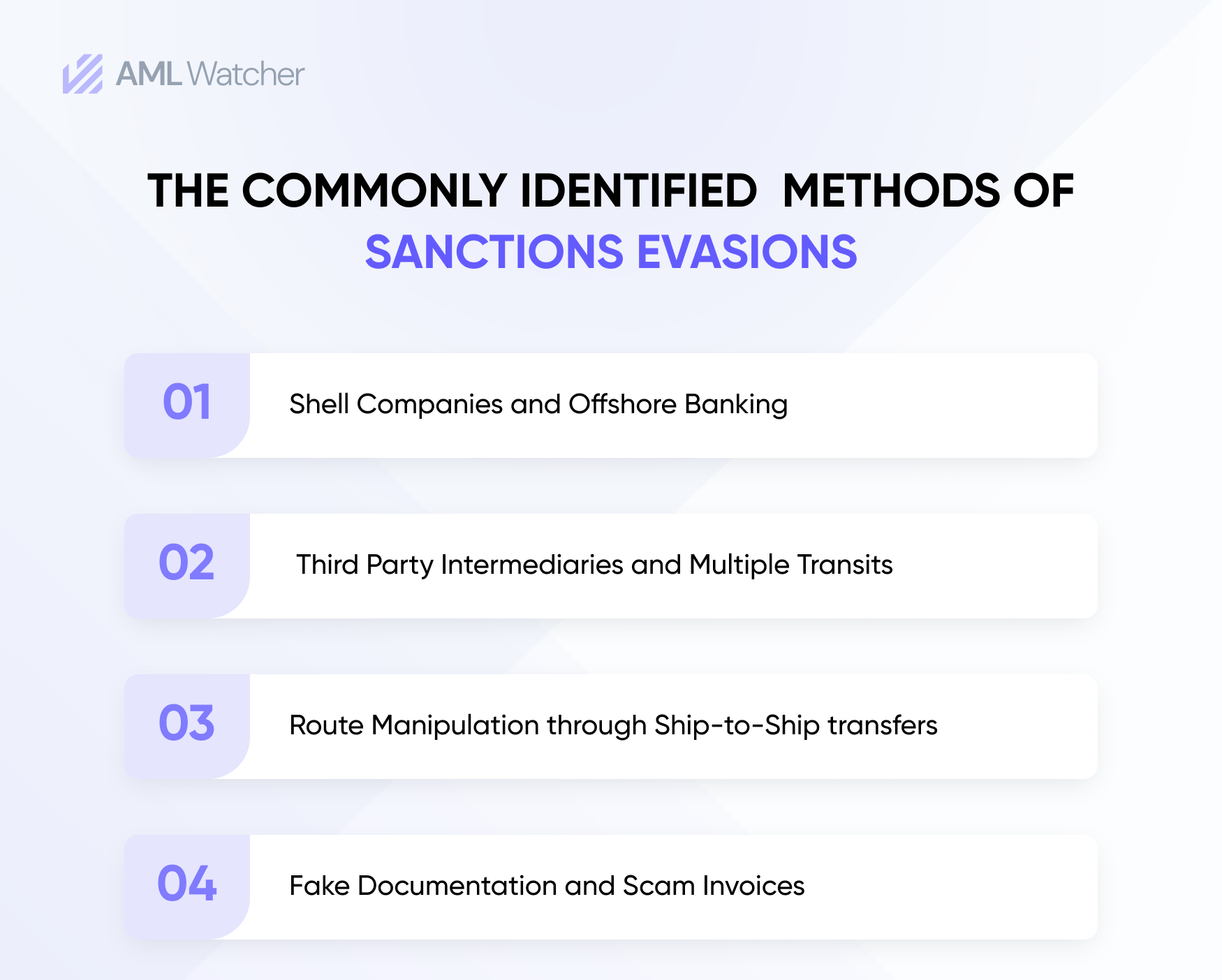
These tactics are subject to change in proportion to whatever regulatory changes are made.
Shell Companies and Offshore Banking: A Dangerous yet Common Union
A shell company is a business enterprise that exists only on paper, it has no operations, workers or a physical presence like usual companies do. It is as the name suggests a rather hollow existence.
The reason why shell companies become an easy target for exploitation and manipulation is the fact that they are legal in many countries due to their substantially beneficial purposes like asset protection and timely risk management. Some businesses may choose to protect certain assets from any liabilities or lawsuits and shift them to shell companies.
Illegal activities like tax evasion and money laundering through shell companies spike because of their ability to hide ownership and any financial transactions. Their structure makes them a relatively soft target for misuse especially in money-laundering schemes.
Use of Third Party Intermediaries and Multiple Transits
Evasion networks in order for the product to reach a sanctioned country or an entity re-route their shipments through countries in order to conceal their final destination.
The United States Department of Commerce, Department of the Treasury and the Department of Justice collectively released a compliance note on March 2nd, 2023 “Cracking Down on Third-Party Intermediaries used to evade Russia-related Sanctions and Export Controls” that highlighted the red flags that indicate a third party intermediary engaged in efforts to evade sanctions.
Route Manipulation through Ship-to-Ship transfers
The most common tactics for sanctions circumvention is the use of the sea. Oil, military essentials and latest sensitive technologies are all transported through waters. According to a North Korea Sanctions Advisory published by the Department of Treasury following are the illicit tactics that are used to obfuscate the identities of vessels and cargo:
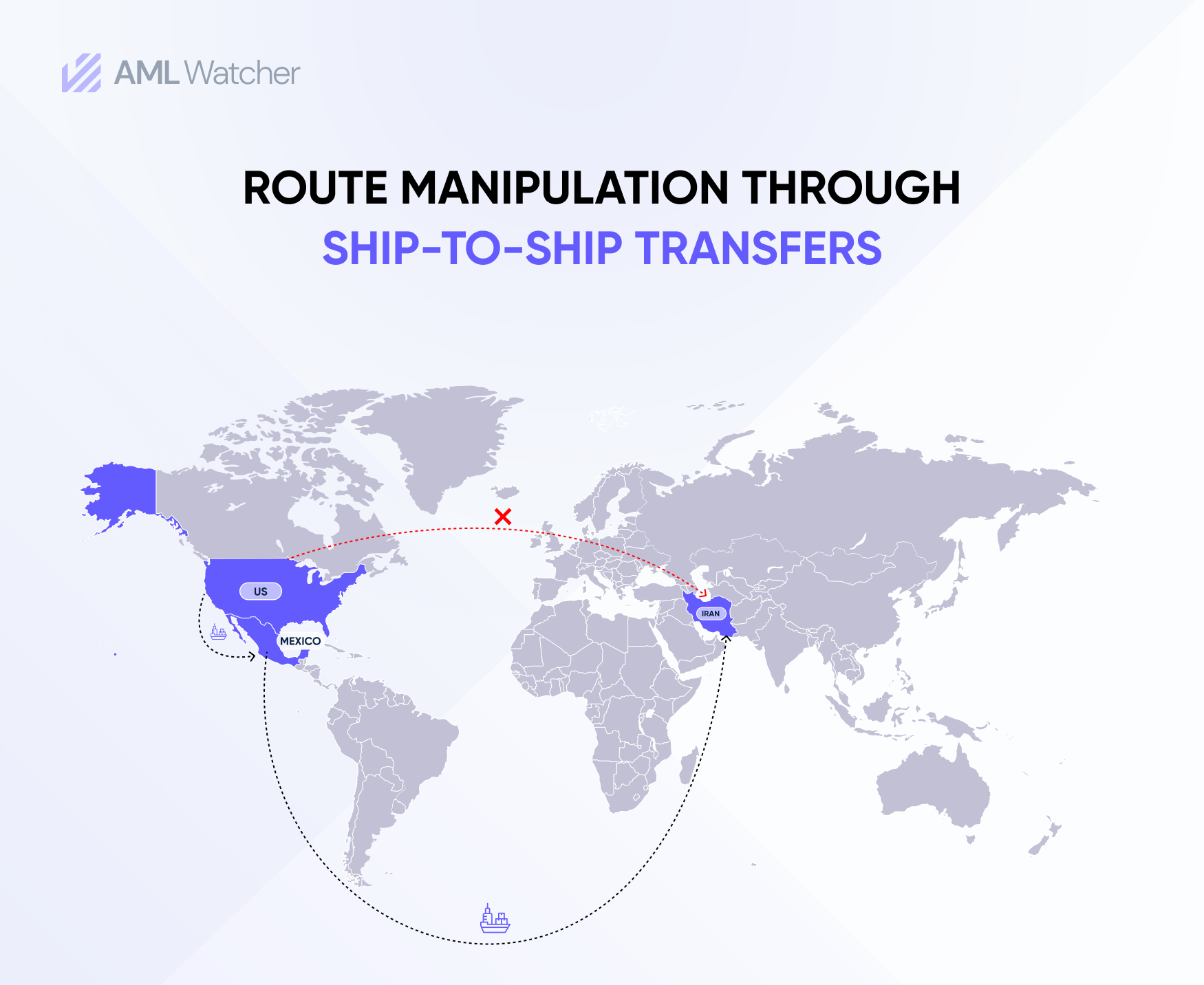
- Disabling Automatic Identification System (AIS), the International Convention for the Safety of Life at Sea requires certain vessels to maintain automatic broadcasts. Flagged vessels like that of North Korea often intentionally disable their AIS transponders.
- Physical Alterations in vessel identification, a change in IMO numbers that ideally is required to be at a visible position of the vessel like the hull. In this case, for example North Korea illegitimately painted over vessel names and identification numbers.
- Ship-to-Ship transfers are another well practiced tactic for facilitating a violation. The cargo is basically shifted from one ship to another while being at sea, rather than a port, which is the acceptable standard.
Fake Documentation and Scam Invoices
The falsification of documents and any important or relevant invoices is a go to tactic of criminals to proceed with their motive of evading sanctions. Usually when criminals resort to this means, they usually fake invoices or certificates of origin or insurance documents. According to the FATF Guidance on Trade-Based Money Laundering such frauds have the potential to appear relatively harmless on paper.
How to Timely Detect Sanctions Evasion
The inherent purpose of sanctions circumvention is to commit illicit activities activities right under the authorities’ nose, without them having any time to register about the lengths of the crimes committed under “supervision”. FinCEN issued a March 7, 2022 alert with examples of red flags to identify potential Russian sanctions evasion attempts. It could involve:
- sudden changes in counterparties, shipping routes, or end users
- transshipment hubs inconsistent with customer profile
- opaque ownership, shell companies, nominee directors, recently formed entities
- mismatch between goods and customer business
- payment structures that avoid usual channels (multiple small payments, third-party payers)
Sanctions circumvention remains a significant challenge for international trade and the modern financial regime. It is a mesh of deliberate unethical strategies in order to overcome sanctions and global pressure.
Strengthen Sanctions Compliance with AML Watcher
Sanctions evasion often hides behind layered ownership, third-party intermediaries, and trade documentation that looks routine, which is why compliance teams need screening and monitoring that stays current and reduces false positives without missing name variations. AML Watcher supports sanctions compliance with real-time sanctions screening, enriched profiles, and name-matching designed for spelling variations and multilingual risk.
Request a demo to see how AML Watcher can strengthen sanctions controls across onboarding and ongoing monitoring.
- No commitment needed
- Complete AML Database at your service
- Access our all-in-one dashboard


Tier-2 PSPs in ... must demonstrate automated monitoring, layered CDD, &...
See the Full Regulatory Expectation70–80% less manual work, 95% less fatigue, TruRisk Agent makes compliance effortless.
Experience Agentic AMLMove Beyond Articles. Activate AML Intelligence.
Switch to AML Watcher today and reduce your current AML cost by 50% - no questions asked.
- Find right product and pricing for your business
- Get your current solution provider audit & minimise your changeover risk
- Gain expert insights with quick response time to your queries


