

 Alert!

Here is What Changed in the U.S. Sanctions on Venezuela in 2026
Sanctions
January 27, 2026


As of yet, there are no sanctions on Venezuela enforced by the United Nations. However, the sanctions put in place by the European Union and United Kingdom remain in force since 2017. The United States has also imposed sanctions on Venezuela since 2005.
If seen through a historic lens such punitive measures have remained impactful to dominate international diplomacy. The Cuban Trade Embargo imposed in 1960 remains active till now, following the Cuban Revolution and its alliance with the Soviet Union. Similarly the sanctions on Iraq from 1990 to 2003, sanctions on countries like Iran, Russia and North Korea remain in action till date.
Sanctions programs shape how financial institutions are to assess any counter-party risk, especially when energy trade, state-owned entities and politically exposed persons intersect.
Venezuela continues to remain one of the most complex sanctions environments in the world. It focuses on blocking measures, sector-focused restrictions and time-bound authorizations that change what is permissible for specific transactions.
What does Venezuela Export?
Venezuela ranks number one in the world in terms of oil reserves with the numbers exceeding 303 billion barrels of oil. Its exports remain overwhelmingly dominated by and reliant on crude oil and petroleum related products.
The oil industry is a crucial and pivotal component of Venezuela’s economy, 90% of its export revenues are generated by oil and petroleum exports.
Due to increased exposure to sanctions risk, foreign investments are negligible in Venezuela.
Why did the US Sanction Venezuela?
The US sanctioned Venezuela on multiple occasions due to its concerns about violations of human rights and democratic values. During the term of President George Bush in 2006 sanctions were imposed on the Venezuelan government’s lack of cooperation and limited anti-narcotics efforts.
In 2014, President Obama following the subsequent reports of abuse by Venezuelan police forces imposed sanctions on individuals involved in human rights violations. The next year, he declared Venezuela a national security threat and imposed sanctions on several high-ranking officials.
Following the footsteps of previous administrations, the Trump administration also has labelled criminal groups with origins in Venezuela as terrorist organizations.
The Sanctions that Remain Still in Force and What they Restrict
The US has imposed individual, financial and sectoral sanctions on the current Venezuelan government as well as the former Maduro government and its supporters.
Large-Scale Visa Restrictions
As per CRS, the State Department since late 2025 has privately revoked the visas of thousands of Venezuelans that includes current and former officials. As of yet, a total of fourteen Venezuelan officials have been penalized with visa restrictions since they were suspected for corruption and human rights abuses.
Sanctions Associated with Drug-Trafficking
OFAC imposed asset blocking sanctions on 11 individuals and 27 entities that had connections to Venezuela and addressed them as Specially Designated Narcotics Traffickers. This enabled these entities to not be able to access or utilize any assets that they possessed within the United States. In December, 2025 OFAC imposed sanctions on 2 more individuals one of whom was a relative of the Maduro-Flores family.
Sanctions Centered Around Terrorism
The United States since 2006 believes the notion that Venezuela is not “cooperating fully with the United States’ terrorism efforts”. While upholding this notion it has prohibited companies to sell or transfer military equipment or technology to Venezuela without explicit government approval.
OFAC also identified two individuals and two travel agencies as Specially Designated Nationals (SDNs) and they are subjected to asset blocking. This is because these entities were found to be actively supporting and financing Hezbollah, a US designated Foreign Terrorist organization (FTO).
On February 20th’ 2025, Tren de Aragua is a Venezuela-origin gang that has been recognized as an FTO as per the Executive Order “Designating Cartels and other Organizations as Foreign Terrorist Organizations and Specially Designated Global Terrorists” by the US Secretary of State Marco Rubio. This designation exposes the organization to new sanctions, law enforcement and any sort of immigration actions it deemed necessary against the gang and its members. It also seeks to disrupt the finances of the cartel.
In mid-2025 OFAC had sanctioned TdA leaders and in late December 2025 it sanctioned an entire network of individuals for providing material support to TdA.
Specific Sanctions for Anti-Democratic Actions, Corruption and Human Rights Violations
To address Maduro’s autocratic control within Venezuela, the Congress and the American government introduced the Venezuela Defense of Human Rights and Civil Society Act of 2014. One of its provisions stated that the law required for the President to enforce sanctions on people they identified were responsible for any acts of violence or involvement in human rights abuses. As of now, OFAC has imposed sanctions on a total 160 Venezuelans and 8 additional entities, this includes the Acting President Delcy Rodriguez, the Defense Minister Vladimir Padrino Lopez and the Interior Minister Diosdado Cabello.
The Additional Sectoral Sanctions on the Maduro Government
OFAC sanctions on Venezuela extended in 2025 when it authorized the winding down of certain transactions related to Chevron Corporation’s Joint Ventures in Venezuela. Licenses that allowed other companies to work in Venezuela also expired. The Trump administration since mid-2025 has warned that any country that imports Venezuelan oil is liable to pay at least 25% tariff on its exports to the United States, this tariff however, has been subject to legal challenge.
The Implications for Financial Institutions
The US sanctions on Venezuela leave a layered and complex challenge for Venezuela to face. This is because restrictions for financial institutions extend beyond named-individuals, state-owned entities, or through indirect exposure to third countries. The Venezuela program, however, relies on three things
- targeted designations
- ownership rules
- activity-based restrictions
This increases the risk of any unintentional breaches especially when controls are sufficiently comprehensible.
Key Compliance Risks Faced by Institutions
Indirect Exposure through Ownership and Control
Many Venezuelan entities function through tiered corporate structures in third countries. Institutions make themselves vulnerable to breaches when a sanctioned individual holds a share of more than 50% regardless of whether the entity itself is exclusively listed or not. This ownership rule is consistently applied but is not limited to energy, logistics and trading companies that have impactful regional footprints.
Impending Trade risk for energy and commodities
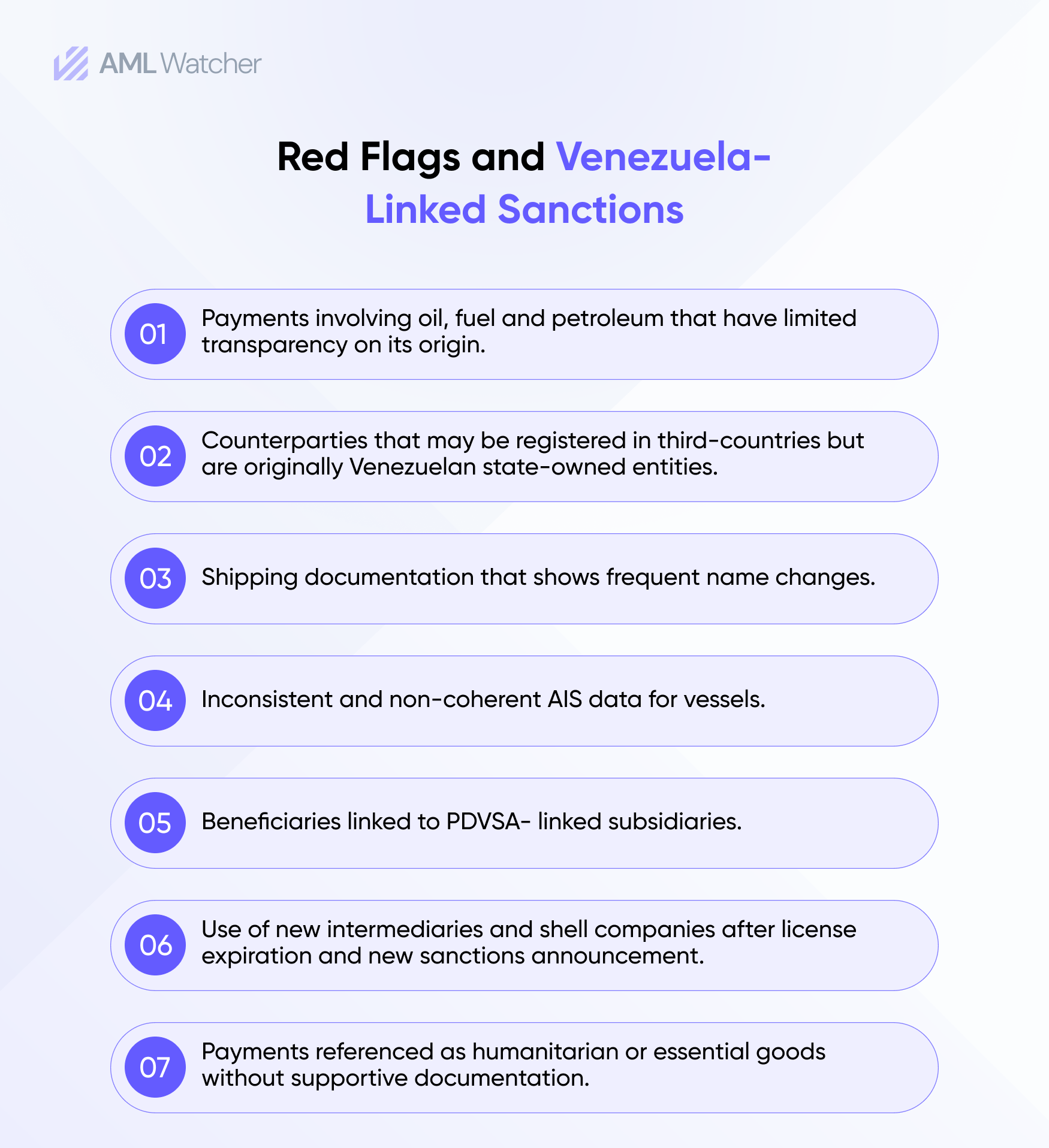
Oil and petroleum related sanctions remain a primary trigger for sanctions. The payments that involve crude oil, shipping brokers are eligible to fall within restricted activity especially if the licenses have expired.
Use of Third-Country Corridors
Transactions that are routed through intermediary countries or thor jurisdictions that are known to be regional financial centers can obscure the true and original beneficiary of funds.
Politically Exposed Persons
Senior Venezuelan officials, their relatives, close associates who have been tied to corruption and sanctioned on the charges of human rights violations. The risk prevails when direct account relationships and informal payment channels act on their behalf.
Shipping Obfuscation
Venezuela linked sanction evasion has historically been linked to vessel identity change, ship-to-ship transfers and AI system manipulation. Financial institutions tied to maritime trading have to adhere to extra caution since they face more exposure when data is either inconsistent or incomplete.
- No commitment needed
- Complete AML Database at your service
- Access our all-in-one dashboard


Tier-2 PSPs in ... must demonstrate automated monitoring, layered CDD, &...
See the Full Regulatory Expectation70–80% less manual work, 95% less fatigue, TruRisk Agent makes compliance effortless.
Experience Agentic AMLMove Beyond Articles. Activate AML Intelligence.
Switch to AML Watcher today and reduce your current AML cost by 50% - no questions asked.
- Find right product and pricing for your business
- Get your current solution provider audit & minimise your changeover risk
- Gain expert insights with quick response time to your queries