

 Alert!

What is Continuous Compliance Monitoring and Why It Matters for FIs
AML Compliance
January 28, 2026


While annual audits are essential in compliance, continuous monitoring has become an operational requirement for regulated businesses. It helps organizations in actively complying with the changing regulations. In the rapidly evolving sectors such as Fintech systems and cloud networks one missed misconfiguration or outdated record could lead to material enforcement actions and reputational damage. Continuous compliance monitoring plays a crucial role in reducing the emerging risks and limiting regulatory, financial, and reputational exposure over time.
Regulated businesses and compliance teams need to understand the importance of continuous compliance monitoring in mitigating financial crimes, particularly within the context of evolving regulatory and anti-money laundering (AML) regulations.
What is Continuous Compliance Monitoring?
Continuous compliance monitoring is an operating model that continuously checks controls, data, and workflows against regulatory obligations, rather than relying on periodic reviews alone. It allows financial institutions to determine the effectiveness of AML controls when customer risk profiles, transactional activity, and regulatory expectations change over time.
This model needs continuous gathering and evaluation of customer risk data, transactional data, and external risk indicators to function successfully. Ongoing compliance monitoring is ensured by keeping the risk assessment, real-time monitoring of the transactions, and screening of the transactions and processes on time. One of such important pillars is AML transaction monitoring, although the larger goal is to detect control deficiencies, compliance drift, or rising risks in their early stages to enable institutions to act before regulatory findings lead to regulatory penalties.
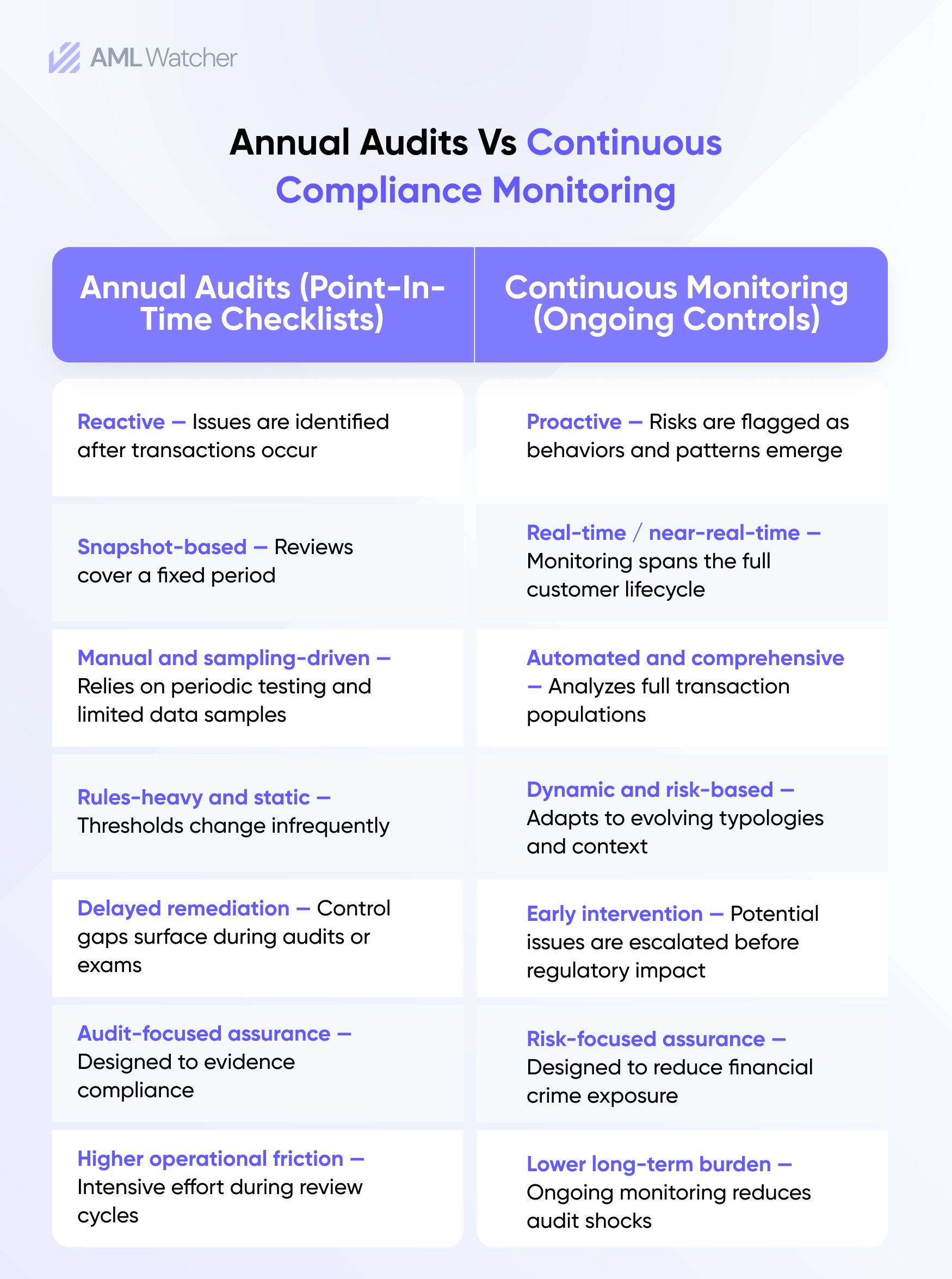
Core Components of Continuous Compliance Monitoring
A continuous compliance monitoring framework usually contains:
- Continuous customer risk review (CDD refresh triggers): Reassessing customer risk when behavior, exposure, or external indicators change.
- Transaction monitoring and alert QA: Monitoring transactions and ensuring alerts remain accurate and relevant.
- Watchlist, PEP, and Sanctions: Refreshing the list and re-screening customers to reflect new risks.
- Case management and governance metrics: Centralized workflows with metrics for timely and consistent decision-making.
- Evidence capture for audits and exams: Recording actions and decisions to demonstrate control effectiveness.
How Continuous Compliance Monitoring Helps in Avoiding Regulatory Actions
Continuous compliance monitoring is no longer optional; it has become a core requirement of modern regulatory frameworks. Standard setters such as the Financial Action Task Force (FATF) emphasize in Recommendation 10 the importance of ongoing due diligence, continuous transaction scrutiny, and the immediate identification of suspicious activity. These measures ensure that compliance programs adapt to evolving risks in real time.
Failures in continuous monitoring can lead to severe regulatory consequences.
In November 2025, the Central Bank of Ireland fined Coinbase Europe Limited €21.46m after faults in its transaction monitoring configuration meant more than 30 million transactions worth over €176bn were not properly monitored over a 12-month period. Suspicious transaction reports were only submitted retrospectively.
Continuous compliance monitoring helps financial institutions:
- Prevent compliance drift by keeping monitoring rules aligned with regulatory expectations.
- Minimize regulatory fines by ensuring timely reporting and transaction scrutiny.
- Build regulatory trust by demonstrating that AML controls operate effectively as risks evolve.
In short, continuous compliance monitoring is a key element of regulatory risk management. It helps institutions ensure AML controls are effective, align with supervisory expectations, and enable real-time identification and reporting of suspicious activity, keeping regulators confident and reducing the risk of enforcement action.
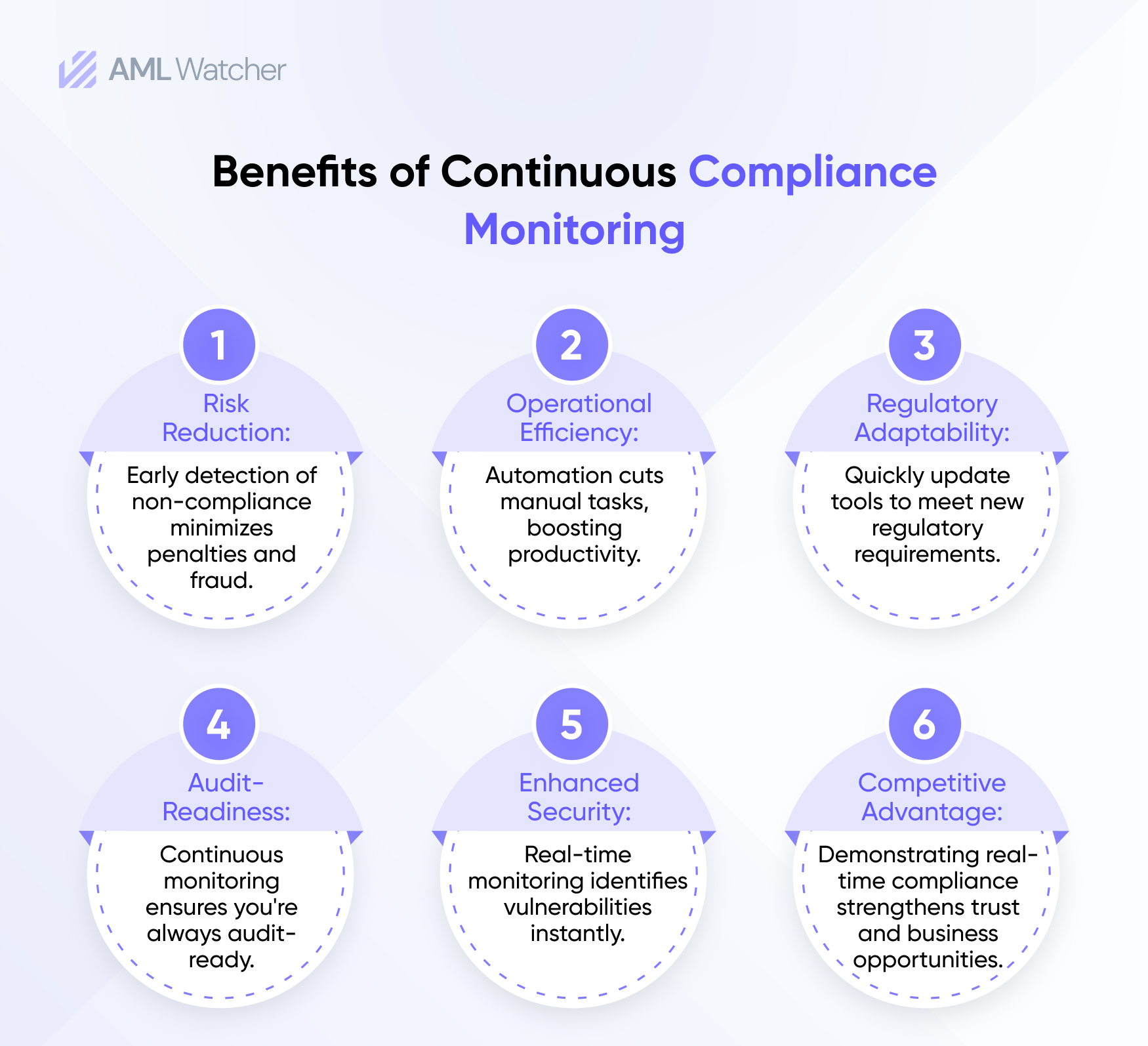
Key Features to Help Maintain Compliance
Key features to look for in AML solutions that support compliance include:
- Real-Time Data Integration: Continuous compliance tools should integrate real-time data feeds, such as updated regulatory changes, sanctions lists, and global watchlist updates, to ensure timely detection of compliance risks.
- Machine Learning Capabilities: Solutions with machine learning capabilities are able to recognize anomalies in transaction behavior, such as an abrupt spike in activity or unusual layering, and be able to deal with new fraud schemes and new regulatory demands.
- Integration Capabilities: Find software that can easily integrate with your current systems via APIs, can support both modern IT infrastructure, such as cloud solution and containers, and older systems.
- Scalability: The tool must be scalable to your organization, including the new regulatory needs and geographical areas, without any dramatic system redesign.
- Comprehensive Coverage: Preferably, opt to have a single compliance platform that combines AML screening (sanctions, PEP, watchlists, adverse media) and regular transaction monitoring in one platform. This will avoid operational silos and mean that the area of risk will not be left out.
- Easy to use Reporting: Select tools with customizable dashboards and reports, based on various stakeholders. Executives should see a high-level set of KPIs, and analysts should receive more detailed alerts. The ability to customize and export reports is also essential.
- Vendor Support and Updates: The vendor should update and maintain the sanctions list and compliance rules on a regular basis, which should be automatically incorporated as regulations change. It is important to update on a timely basis to be in line with the evolving legal requirements.
Strengthen Compliance Monitoring with AML Watcher
Many businesses discover monitoring gaps during audits, supervisory reviews, or after an incident takes place. However, at this stage remediation becomes expensive, time-sensitive and sometimes comes in combination with enforcement actions.
AML Watcher supports continuous compliance monitoring through transaction monitoring and screening across sanctions, watchlists, PEPs, and adverse media, helping compliance teams identify risk signals early and maintain stronger evidence for audits.

- No commitment needed
- Complete AML Database at your service
- Access our all-in-one dashboard


Tier-2 PSPs in ... must demonstrate automated monitoring, layered CDD, &...
See the Full Regulatory Expectation70–80% less manual work, 95% less fatigue, TruRisk Agent makes compliance effortless.
Experience Agentic AMLMove Beyond Articles. Activate AML Intelligence.
Switch to AML Watcher today and reduce your current AML cost by 50% - no questions asked.
- Find right product and pricing for your business
- Get your current solution provider audit & minimise your changeover risk
- Gain expert insights with quick response time to your queries