

 Alert!

How to Reduce AML Compliance Costs without Budget Cuts
AML Compliance
January 28, 2026


- What is typically the Cost of AML Compliance?
- 5 Key Factors Influencing the Rise of AML Costs for Compliance Teams
- Major Direct or Indirect Cost Components to be Considered
- Varied Costs: Subject to Different Industries (Banks, Fintechs, Cryptos)
- Impact on Compliance Costs When A Businesses Expands from a Local Level to Global Scale
- Is There Any Way For Companies to Reduce their Compliance Costs?
- How AML Watcher Supports Cost-Defensible Compliance

The advent of technology has resulted in a spike in technology-driven crimes too. In order to overcome emerging challenges like financial crimes AML compliance programs have been mandated to ensure the integrity of the financial system remains intact.
The United Nations Office on Drugs and Crime declared that money laundered globally in one year is approximately 2-5% of the global GDP which translates to an amount of 800 billion to 2 trillion USD.
Escalating-regulatory demands and sophisticated fraud schemes, have driven compliance costs sky-high each year. This has resulted in increased manual reviews and high false-positives overload for compliance teams which completely undermines timeliness and cost-efficiency.
So what exactly is driving the cost of AML compliance as the world enters 2026?
What is typically the Cost of AML Compliance?
In order to comprehend the cost of AML compliance, the wide spending range remains noteworthy especially when working in a regulated and monitored environment. The compliance budget is directly in proportion to the transaction volumes and the increased risk exposure.
The AML budget grows across more categories than one could have initially intended for. Direct expenses show up explicitly in one’s financial planning; however, it is the indirect expenses that catch compliance officers off guard since they silently accumulate as compliance workload increases.
These hidden costs influence the total compliance budget massively, it can easily surpass a monthly salary of a software analyst.
5 Key Factors Influencing the Rise of AML Costs for Compliance Teams
Real-time Monitoring Expectations
Suspicious activity is expected to be highlighted as soon as it happens. This only creates higher-data processing demands which in turn means usage of such tools that can monitor even micro transactions that happen instantly.
The Evolving Typologies of Crime
There are coordinated and synced fraud rings and master minds that can create synthetic identities using AI generated deepfake elements. Compliance systems in contrast need to be equally sharp and expand their detection sources to compete with this negative use of Artificial Intelligence.
Increased Alerts Equals Increased Review Time
A high number of alerts due to increased false positives means the team needs more time for reviews, investigation and verification. For fast-paced sectors like crypto or neo-banking, increased alerts result in an overload of work for analysts.
Slow Legacy Processes means Slow Compliance Progress
Outdated systems set for olden times can not compete with the pace demanded by modern risk environments. Relying on legacy systems and older software platforms for performing critical business functions can result in false matches that only interrupt the workflow rather than speeding it up.
Complex Global Compliance Architecture
If a financial institution’s system is onboarding clients from various regions across the globe then it is only fitting for them to handle multiple data formats and risk profiles that expand through regions and be well-equipped with their local guidelines whatever they may be.
Governance Failures Compliment Increased Compliance Costs
Operations across jurisdictions is a complex phenomenon but one that is necessary. While complexity is acknowledged it does not validate the cost inflation, that is primarily a result of misgovernance and mishandling.
Lack of defined responsibilities leads to different interpretations by different teams that build their own processes. Added gaps in policy result in conflicting operations resulting in inflated false positives.
Major Direct or Indirect Cost Components to be Considered
Platform Subscriptions, Technology Transfers and Infrastructural Demands
Platforms that support monitoring and screening require subscriptions or pricing according to the extent of usage of the platforms. Technology transfers like replacing legacy screening systems and licensing new softwares. Infrastructural demands are a major driver for enhanced compliance costs because computing needs grow rapidly when sanctions, PEP, adverse media screening are all run together. Costs vary due to diversity in infrastructural demands.
Specialized Compliance Staffing
Skilled investigators, officers, analysts, diligence officers that can give relevant solid input become the pivotal need for businesses like crypto thus, leading to increased hiring budgets.
Lost Operational Cost
Investigations take time. Increased alerts, especially unclear ones and the collection of ungathered and missing context slows down the process yet requires operations to work. This can further be amplified by an increase in onboarding requests.
Acquirement of Data and Maintenance Costs
In order to be able to access updated data and information for thorough screening and any analysis, it all requires more spending. This is especially common and prevalent when growing into new diversified regions like for example in this case there remains an added need for data providers.
Varied Costs: Subject to Different Industries (Banks, Fintechs, Cryptos)
AML expenses vary across industries; it is not necessary for all industries to have streamlined and similar budgets and requirements. This is because each industry has its own behaviour, risk threshold as well as regulatory expectations.
But, the top four industries that have varied but relatively high compliance costs are banks, fintechs, crypto platforms and PSPs.
- Banks because they have diverse account types and offer different services like for example remittances, thus, require separate monitoring needs.
- Rapid onboarding in fintechs results in increased verification demands.
- Consistent checking for the correct source of funds can result in a surge of movement meaning increase in verification demands, one of the reasons why crypto platforms are left with higher compliance budgets.
- Since PSPs primarily cater to merchant ecosystems their compliance budget also soars because each merchant category has a unique risk pattern to it.
Impact on Compliance Costs When A Businesses Expands from a Local Level to Global Scale
Compliance costs do not rise gradually with global expansion. They compound across regulation, operations, technology, and oversight.
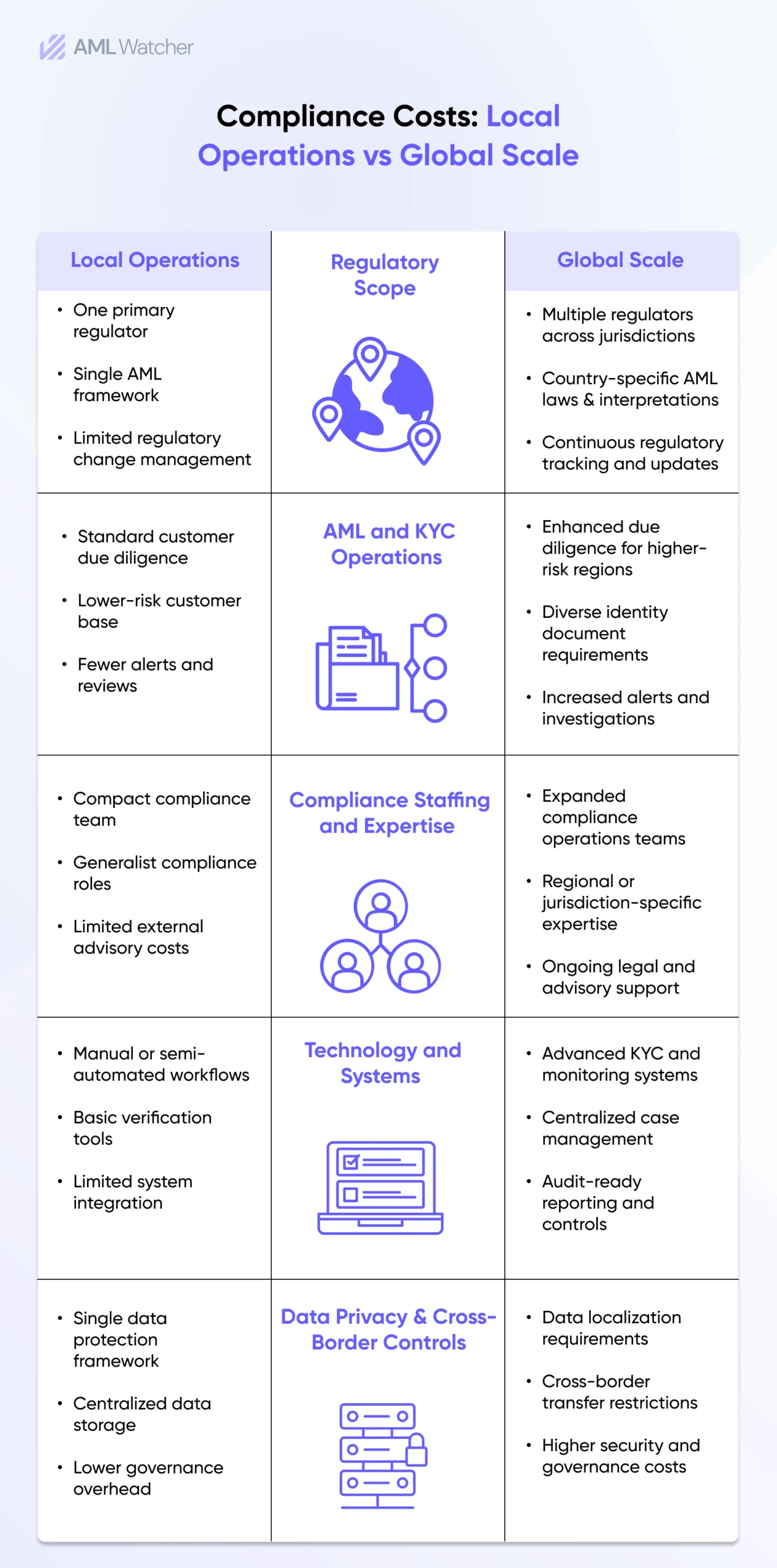
Businesses that adopt scalable and centralized compliance frameworks early are better positioned to control long-term costs while meeting regulatory expectations across markets.
Is There Any Way For Companies to Reduce their Compliance Costs?
Cutting costs in AML compliance requires a complete shift in approach which centers around thorough integrated and smart risk management.
Some of the most effective strategies for reducing costs include:
Merged Compliance System (all-in-one Platform)
AML tasks management through different tools results in a loop of repetition and increased effort by teams and duplicated results. The merger of systems gives officers a single, lone view of the customer’s user profile, the sort of activity they engage in and any suspicious pattern that emerges. This ends in coherent results and lowered operational costs.
Risk-Based Controls
Not all customers of a business pose the same level of risk and the risk is determined by multiple factors (such as geography, customer type, transaction volume & frequency, service delivery channels). Risk-based approach means controls (like screening, monitoring and identity verification) are matched to the level of risk a customer profile has. Relaxed controls for low risk customers means less friction on the customer end and optimal use of resources on the business end. Additionally, available resources then can be directed towards more higher risk activities.
Precision over Volume in Screening
High number of false positives means either the screening engine is inefficient (software problem) or screening logic doesn’t match the real risk a business faces (governance issue). Every unnecessary alert and false-positive consumes an analyst’s time and takes away attention from higher-risk activities. Reducing false positives with better match precision doesn’t weaken control, it sharpens it.
Utilization of Global Sanctions
A dependence on fragmented, disconnected data that requires separate manual checks is an almost guarantee for increased compliance costs. In its stead aggregating global lists as a unified resource results in a magnified, diverse reach with much finer results. The best use of these lists is that they are consistent across all jurisdictions, they lower time spent and spending costs alike.
Smart Governance and Leaner Compliance Operations
Clear ownership and properly defined guidelines creates a singular interpretation of rules, this helps teams to abide by a unanimous process rather than building entirely their own. A set of comprehensive, well-maintained policies addresses all gaps limiting scope for any sort of duplication.
Firms that regain control over prioritisation, context, and proportionality do not just spend less. They spend better, defend their decisions more confidently, and withstand regulatory scrutiny with greater credibility.
How AML Watcher Supports Cost-Defensible Compliance
No AML Solution is a cost-cutting shortcut. The capability that matters for an AML solution is that it should support a governance-led approach to AML efficiency.
AML Watcher combines sanctions intelligence, customer risk context and monitoring signals in one platform which helps compliance teams to:
- Reduce repetitive investigations
- Improve alert relevance
- Automate low-value repetitive tasks
- Apply proportional controls across jurisdictions
- Strengthen auditability without inflating headcount
This is exactly what compliance leaders need to demonstrate that reduced manual effort is the result of an operationalized risk-based approach, not weaker controls. These capabilities also enable businesses to focus on expansion goals without having to worry about proportional increase in compliance budgets.
Request a demo to discover how AML Watcher supports a cost efficient compliance approach.
- No commitment needed
- Complete AML Database at your service
- Access our all-in-one dashboard


Tier-2 PSPs in ... must demonstrate automated monitoring, layered CDD, &...
See the Full Regulatory Expectation70–80% less manual work, 95% less fatigue, TruRisk Agent makes compliance effortless.
Experience Agentic AMLMove Beyond Articles. Activate AML Intelligence.
Switch to AML Watcher today and reduce your current AML cost by 50% - no questions asked.
- Find right product and pricing for your business
- Get your current solution provider audit & minimise your changeover risk
- Gain expert insights with quick response time to your queries