

 Alert!


Top AML Job Roles for 2026
AML Compliance
February 26, 2026


When it comes to fighting financial crimes, AML compliance officers remain integral to the financial industry. They are the ones who are responsible for detecting suspicious activities, preventing terrorist financing and looking out for any unusual transactions.
It is their work that keeps the global financial system away from the collapsing and significant financial loss. Each role carries a complexity from within.
These jobs have gradually emerged to be of immense significance since the revolutionization of technology and the growing fame of maintaining digital assets.
Key AML Job Roles for 2026
1. Sanctions Compliance Officer/ Sanctions Advisor
Sanctions compliance officers perform sanctions compliance related roles and responsibilities. They are responsible for managing sanctions risks including where a company needs to obtain prior approval or a license from authorities to conduct a business. They also serve as a subject matter expert and can provide departments with advice for sanctions related regulations and issues.
2.Transaction Monitoring Lead
Transaction monitoring lead is a senior compliance professional who oversees the transaction monitoring system. To improve the overall reporting capacity of the compliance department they define all necessary risk parameters and identify the “red flags” that can trigger alerts in the transaction monitoring systems.
They also tune systems in a way that leads to a significant reduction in false positives. Transaction monitoring leads also ensure quality assurance and adherence to applicable regulations.
3. KYC/EDD Specialist
KYC/EDD specialists are professionals that verify client identity and their risk levels in order to prevent the occurrence of any financial crimes. KYC analysts usually are responsible for handling client onboarding that are of “lower-risk”; an EDD specialist on the other hand is focused on higher-risk cases offering relatively deeper-insight investigations like figuring out the exact source of wealth.
4. Chief Compliance Officer
The Chief Compliance Officer or the CCO is a senior executive position, who is responsible for the building, planning and changing a company’s entire AML compliance model. The strategically aimed long-term vision for compliance is meant for the CCO.
The highlight of the CCO’s job description is proactive oversight, however important tasks like fraud prevention, data protection obligations, compliance to sanctions and other similar tasks are also under their domain.
The CCO has to conduct thorough risk governance. It essentially means controlling risks in order for a company’s alignment with their strategic objectives. It ensures that compliance risks are identified and in turn targeted on every operational level that exists. The Chief Compliance Officer also remains the point of contact for top regulators and auditors.
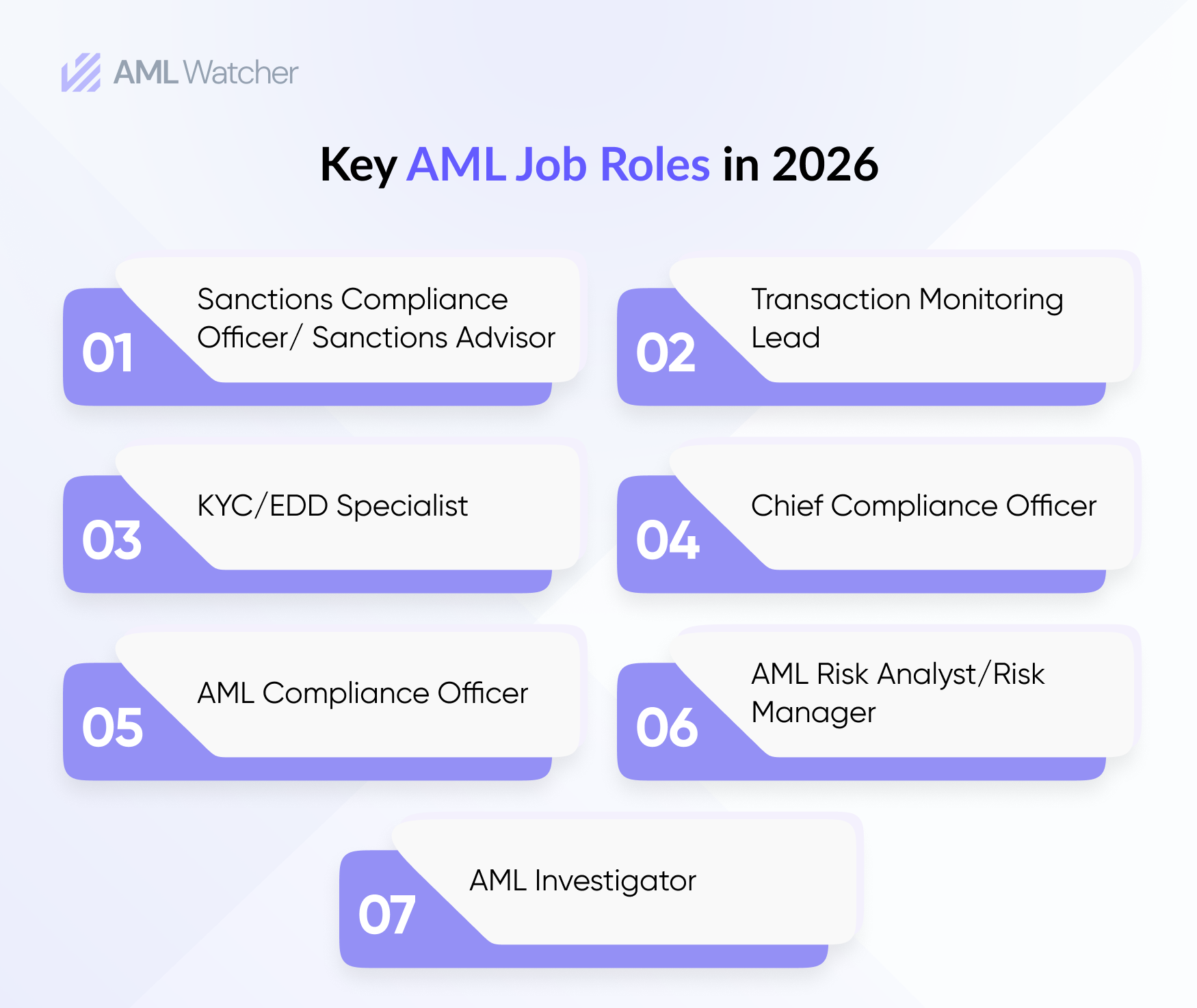
5. AML Compliance Officer
AML compliance officers implement AML policies across the whole company. Their priority is the internal systems of a company and reporting any illicit activities to higher authorities. The duties and responsibilities of an AML officer vary from company to company and their regulatory environment.
An AML compliance officer is the one who drafts policies specifically for AML compliance and other financial crimes and ensures their smooth implementation. The officer must also ensure that the policies and procedures comply with all the pertinent laws and regulations that can be updated whenever need be.
Officers’ core responsibilities are conducting due diligence for customers, vendors and any other counterparties involved in transactions.
6. AML Risk Analyst/Risk Manager
A risk analyst or a risk manager identifies financial crime and the potential compliance risks that a company could face. They conduct a thorough risk-exposure analysis by identifying any potential risks that can surface regarding financial crime. The point of the analysis is to draft the necessary and relevant mitigation plans for potential risks.
The internal control frameworks of a company are also designed by the risk manager. Risk manager is responsible for designing controls in a way that helps meet regulatory obligations without hindering core operations of the company.
7. AML Investigator
More specialized investigator roles are expanding due to complex cases centered around financial crime. AML investigators dive into the minute details of transactions that were initially flagged by the systems. The investigator conducts enhanced due diligence (EDD) to ensure the safety of clients. The AML investigator, if approached by the law enforcement, must be able to provide whatever information that is asked for, therefore, they must ensure accuracy and precision in the process of documentation.
AML Governance Roles in Banking
According to Basel Guidance for Banking effective ML/FT risk management requires proper governance arrangement. In order for financial institutions to effectively implement AML controls, to preserve their repute and to avoid regulatory fines, effective governance becomes crucial. The governance structure consists of the following aspects:
1. Board of Governors Accountability and Oversight
The Board of directors conduct the oversight of a financial institution’s AML system. They are meant to supervise the thorough and efficient application of rules and also the dispersal of sufficient resources in order to fight off money laundering threats.
2. Senior Management Ownership and Resourcing
While the board provides general supervision, it is the senior management that is liable to implement AML policies and procedures daily. Senior executives like the CEO and other team leads are mandated to carry out the board’s authorized AML plans and ensure the required resources be it staffing, technology or training are all fulfilled to attain compliance.
3. Independent Audit and Assurance
Senior management is to be in contact with the board on a regular basis. Details like the results of regulatory assessments or audits must be shared with board members. Senior management must also provide any practical analysis necessary on how AML risks are being reduced and whether any present tactics are bearing the required results or not.
- No commitment needed
- Complete AML Database at your service
- Access our all-in-one dashboard


Tier-2 PSPs in ... must demonstrate automated monitoring, layered CDD, &...
See the Full Regulatory Expectation70–80% less manual work, 95% less fatigue, TruRisk Agent makes compliance effortless.
Experience Agentic AMLMove Beyond Articles. Activate AML Intelligence.
Switch to AML Watcher today and reduce your current AML cost by 50% - no questions asked.
- Find right product and pricing for your business
- Get your current solution provider audit & minimise your changeover risk
- Gain expert insights with quick response time to your queries