


 Alert!

Top Sanctions Screening Software Companies to Evaluate in 2026
Sanctions
September 4, 2026


- Why Choosing Sanctions Screening Software Has Gotten Harder
- What to Look for in the Best AML Sanctions Software
- Top Sanctions Screening Software Companies to Know
- How Sanctions Screening Software Companies Differ on False Positives
- How AML Watcher Approaches Sanctions Screening
- Choosing the Right Fit for Your Compliance Program

A compliance analyst opens a sanctions alert queue on a Monday morning and finds hundreds of potential matches waiting. When false positives account for the majority of sanctions alerts, the real challenge is not generating more matches. It is identifying which alerts warrant investigation without allowing a genuine sanctions match to disappear in the noise. This is why the choice of sanctions screening software matters beyond a feature checklist.
Sanctions programs are also getting more sophisticated as regulators add new designations, toughen anti-circumvention rules, and remain vigilant about existing sanctions. As of August 2026, the UK Financial Conduct Authority (FCA) had imposed £17.96 million in fines for regulatory breaches, including failures involving financial crime, conduct, market abuse, systems and controls, KYC and AML, CDD, sanctions, and ESG-related matters. The correct answer is thus determined by the platform capabilities with respect to detection, investigation and on-going sanctions compliance.
Why Choosing Sanctions Screening Software Has Gotten Harder
Sanctions regimes are frequently subject to rapid adjustment in response to geopolitical changes, regulatory activity, and emerging sanctions-evasion risks. That makes the timeliness of sanctions data an important part of a firm’s screening controls. Authorities, including OFAC, OFSI, the EU, and the UN, regularly introduce or amend sanctions measures. A screening system that relies on infrequent data updates can therefore create a longer gap between a new designation and its availability within the firm’s screening process.
Sanctions risk also extends beyond exact name matching. Complex ownership structures, aliases and differences in how names are written across languages can make potential exposure harder to identify. Therefore, effective sanctions screening needs to combine current sanctions data with matching and investigative capabilities that go beyond basic list searches.
What to Look for in the Best AML Sanctions Software
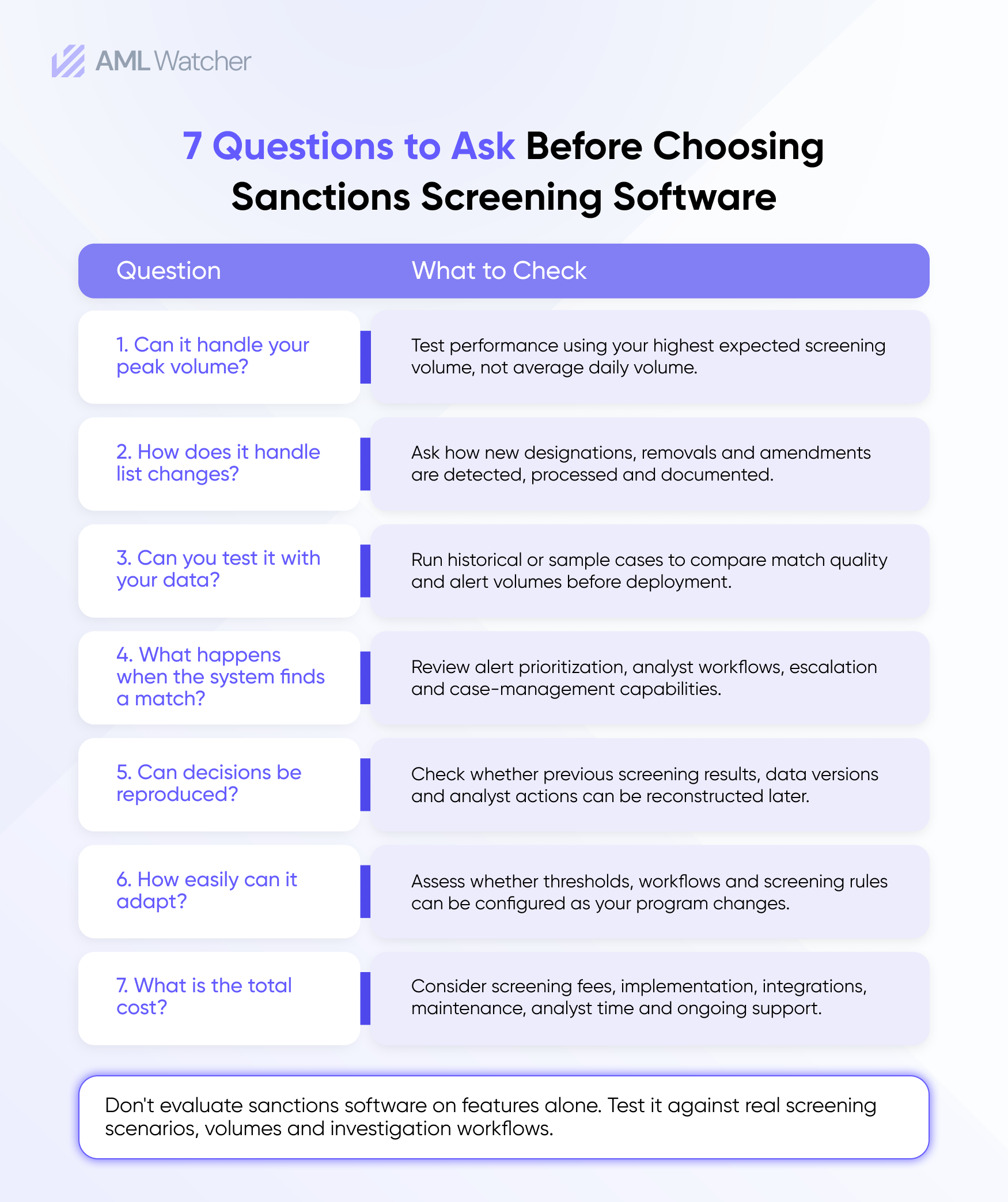
Before comparing sanctions screening vendors, compliance teams need to assess the capabilities that directly affect detection quality, investigation workload and sanctions risk.
Update Frequency
Sanctions data needs to reach the screening environment promptly after new designations or amendments are published. More frequent data refreshes can reduce the gap between a regulatory change and its availability for screening.
Name-Matching Accuracy
Phonetic matching, transliteration handling, aliases and alternative spellings help identify potential matches across languages and naming conventions. The objective is not simply to generate more alerts, but to identify relevant matches without creating unnecessary investigation volume.
Identifier-Based Matching
Two names, without any other context, may not be sufficient to identify two people or entities. Additional identifiers, such as date of birth, nationality, address, and other details, can assist compliance teams in deciding whether the potential match requires further investigation.
Alert Review and Prioritization
Screening technology should help analysts prioritize alerts according to the likelihood of a genuine match while maintaining the sensitivity required for sanctions detection.
Ownership and Control Analysis
Sanctions exposure can extend beyond an entity’s name. Ownership and control relationships can help identify indirect exposure that straightforward name screening may not capture.
Coverage Breadth
Depending on the firm’s risk profile, screening may need to cover individuals, companies, vessels, aircraft, crypto wallets and sanctions regimes across multiple jurisdictions.
Auditability
Screening decisions should have a clear rationale and supporting information so that compliance teams can demonstrate how alerts were assessed, resolved and escalated.
Top Sanctions Screening Software Companies to Know
Leading sanctions screening vendors take different approaches to data coverage, matching, risk intelligence, integration and investigation workflows. The following companies represent different positions within the market.
AML Watcher combines sanctions screening with AI-assisted alert assessment, covering sanctions data, multilingual matching, identifiers, and non-traditional entities. Its TruRisk capability adds AI-driven alert assessment to support compliance review and reduce unnecessary investigation workload.
SymphonyAI takes an AI-focused approach to sanctions screening through SensaAI for Sanctions. Its model is designed to work with existing screening and case-management environments, using AI-driven entity extraction and match scoring to help improve alert review. This positioning may appeal to larger financial institutions that want to introduce AI capabilities without replacing their existing compliance infrastructure.
Moody’s positions sanctions screening within a broader risk intelligence ecosystem. Its GRID platform combines sanctions, PEP, watchlist and other risk data, while Moody’s Orbis database provides corporate and ownership information. This approach is relevant for financial institutions that need sanctions screening alongside broader entity intelligence and ownership analysis.
Sanctions IO is an API-first approach for companies looking to embed sanctions screening into their existing onboarding or compliance processes. It highlights the significance of programmatic screening and automated matching, features that are crucial for fintechs and other tech-driven companies that place a high value on API integration.
Sanction Scanner focuses on AML and sanctions screening for businesses that need sanctions, PEP and other risk checks within their compliance workflows. Its offering includes API-based screening alongside broader AML compliance functionality, making it relevant to fintechs, financial services firms, and other regulated businesses seeking an integrated screening platform.
These vendors differ primarily in their approach to deployment, data intelligence and compliance workflows. SymphonyAI and Moody’s have broader enterprise and risk-intelligence positioning, while Sanctions IO emphasizes API-based integration and Sanction Scanner combines sanctions screening with broader AML compliance capabilities. These differences make vendor evaluation particularly dependent on the firm’s existing compliance infrastructure and screening requirements.
How Sanctions Screening Software Companies Differ on False Positives
False positives can turn sanctions screening into a resource-intensive investigation process. A system may correctly identify a potential match at the name level while still lacking sufficient information to determine whether the individual or entity is actually the sanctioned party.
Context therefore matters when an initial name match is ambiguous. Additional identifiers and entity relationships can help analysts determine whether an alert represents the sanctioned party or a coincidental similarity.
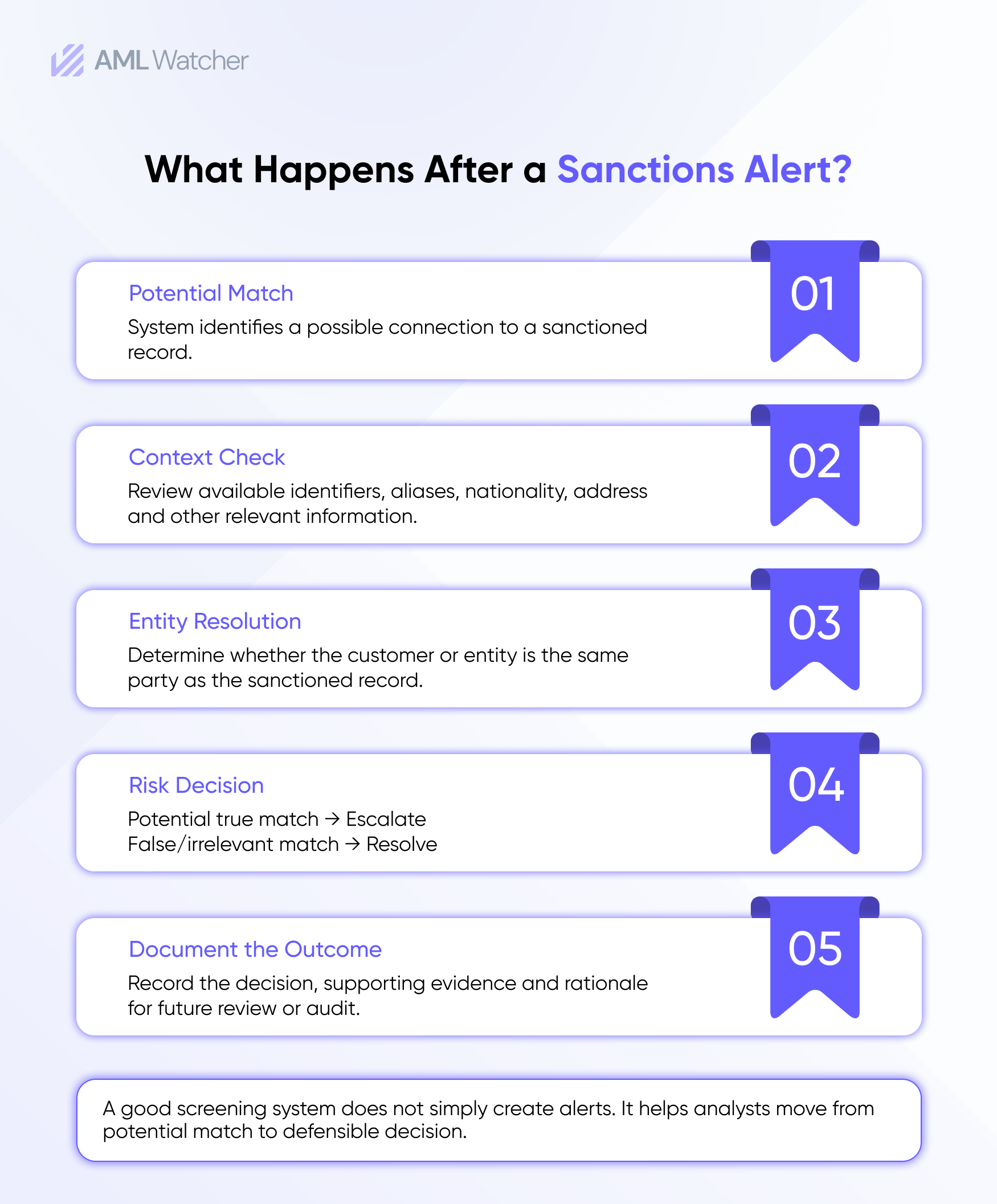
The objective should therefore not be to reduce alert volumes at any cost. A screening system needs to reduce irrelevant alerts while preserving the sensitivity required to identify genuine sanctions exposure. For compliance teams, that balance directly affects both analyst workload and the quality of sanctions controls.
How AML Watcher Approaches Sanctions Screening
AML Watcher combines broad sanctions coverage with matching and AI-assisted alert assessment to support sanctions screening and alert review.
The platform provides access to 215+ global and domestic sanctions regimes, with sanctions data refreshed every 15 minutes. Screening supports multiple name variations, aliases and transliterations, with identifiers available as additional matching context.
Screening also extends beyond individuals and companies to vessels, aircraft and crypto wallets, supporting sanctions use cases involving non-traditional entities.
The platform’s TruRisk capability adds an AI-driven layer to alert assessment. It evaluates screening results and provides compliance reasoning to help analysts identify potential true matches and reduce unnecessary manual investigation. AML Watcher’s published product materials report reductions in false positives and manual review, although outcomes depend on the screening workflow, baseline alert volumes and implementation.
The difference is not just the number of sanctions records that a platform can search, however, for compliance teams looking at sanctions screening software. The better question to ask is how well the technology integrates existing data, supports multilingual matching, uses contextual identifiers, and automates alert assessment while retaining an audit trail of compliance.
Choosing the Right Fit for Your Compliance Program
There is no single best sanctions screening software for every compliance program. The appropriate choice depends on the institution’s size, screening volume, regulatory footprint, customer and transaction risk, technical architecture, and investigation requirements. A bank with complex ownership structures may need deeper entity intelligence, while a fintech may prioritize API integration and rapid deployment.
The strongest evaluation starts with real screening scenarios rather than a vendor feature list. Compliance teams should test how each platform handles difficult name matches, multilingual data, new sanctions designations, ownership relationships and high alert volumes. This provides a clearer view of how a solution will perform within the firm’s actual sanctions compliance process.
- No commitment needed
- Complete AML Database at your service
- Access our all-in-one dashboard


Tier-2 PSPs in ... must demonstrate automated monitoring, layered CDD, &...
See the Full Regulatory Expectation70–80% less manual work, 95% less fatigue, TruRisk Agent makes compliance effortless.
Experience Agentic AMLMove Beyond Articles. Activate AML Intelligence.
Switch to AML Watcher today and reduce your current AML cost by 50% - no questions asked.
- Find right product and pricing for your business
- Get your current solution provider audit & minimise your changeover risk
- Gain expert insights with quick response time to your queries


