

 Alert!

How to Choose the Best Transaction Monitoring Software Providers in 2026
Transaction Monitoring
July 29, 2026


- Why Transaction Monitoring Software Vendors Are Under More Pressure Than Ever
- The Regulatory Forces Behind Today’s Best Transaction Monitoring Software Providers
- Where Legacy Monitoring Systems Break Down
- Best Transaction Monitoring Software Providers: Vendor Breakdown
- What Actually Makes a Transaction Monitoring Solution “Best”
- Why AML Watcher’s Transaction Monitoring Platform Stands Out

A single missed transaction pattern can expose a financial institution to regulatory action, financial losses, and reputational damage. AML enforcement actions continue to cost financial institutions billions of dollars each year, with ineffective transaction monitoring frequently cited as an underlying compliance failure. Many enforcement actions have identified ineffective transaction monitoring, poor alert management, and inadequate investigations among the contributing weaknesses. Choosing between the best transaction monitoring software providers is no longer a back-office IT decision. It is the decision that determines whether an examiner finds your program defensible or finds a gap that turns into a headline.
This comparison examines what separates a transaction monitoring platform that improves detection accuracy and investigation efficiency from one that primarily generates false positives. It is written for compliance officers evaluating a switch, not for readers who just want a feature list copied from a vendor site.
Why Transaction Monitoring Software Vendors Are Under More Pressure Than Ever
Money moves faster than most review cycles were built to handle. Instant payment rails, digital wallets, and cross-border remittance corridors mean funds can clear in seconds, while a legacy monitoring system built on quarterly rule updates still relies on last quarter’s typologies.
Australia’s AML/CTF Amendment Act 2024 expands AML obligations to additional designated businesses from 2026, increasing the number of organizations that require scalable transaction monitoring capabilities.
Modern transaction monitoring platforms increasingly combine rule-based detection for known typologies with machine learning models that identify previously unseen transaction patterns.
Institutions, therefore, need monitoring platforms capable of analyzing fiat payments, digital wallets, and blockchain transactions within the same risk model. They will be unable to identify laundering methods that span digital wallets, blockchain networks, and conventional payment systems.
The Regulatory Forces Behind Today’s Best Transaction Monitoring Software Providers
While no regulatory body mandates a specific transaction monitoring platform, supervisors are increasingly expecting institutions to demonstrate that their monitoring systems can effectively identify emerging financial crime risks. These systems should also equip investigators with adequate context to review alerts, document their decisions, and prove compliance during regulatory examinations.
United States
FinCEN’s Customer Due Diligence (CDD) Rule under the Bank Secrecy Act links ongoing transaction monitoring with beneficial ownership identification. For virtual asset service providers (VASPs), the Financial Action Task Force’s (FATF) Recommendation 16, known as the Travel Rule, requires that originator and beneficiary information accompany qualifying crypto transactions.
European Union
The Sixth Anti-Money Laundering Directive (6AMLD) expanded the list of predicate offenses and introduced criminal liability for legal persons. Looking ahead, the EU’s Anti-Money Laundering Authority (AMLA) and the Anti-Money Laundering Regulation (AMLR) will introduce more consistent AML supervision and compliance expectations across member states.
Asia-Pacific
MAS Notice 626 in Singapore and AUSTRAC’s supervisory guidance in Australia expect institutions to demonstrate that transaction monitoring continues to detect suspicious activity accurately while keeping false positives under control. The Wolfsberg Group’s principles and the UK’s Money Laundering Regulations 2017 further reinforce risk-based monitoring and robust suspicious activity reporting, setting the baseline for modern transaction monitoring platforms.
Where Legacy Monitoring Systems Break Down
One operational challenge sits behind these regulatory expectations: excessive false positives. False-positive rates approaching 90% continue to overwhelm investigation teams, consuming analyst capacity while slowing the review of genuinely suspicious activity. An analyst reviewing 400 alerts a day is not doing a compliance investigation. They are doing triage, and 380 of those alerts are dead ends that still consume the same documentation time as a genuine match.
Much of this comes down to calibration that never happens after go-live. A system tuned to the customer base and risk profile that existed at implementation stays static while the business, its products, and its customer mix change around it. Add poor data quality, missing counterparty identifiers, incomplete records, inconsistent field mapping across source systems, and even a well-built rule set starts missing what it was designed to catch. The result is a queue that grows every quarter, making it harder to identify genuine suspicious activity before it escalates.
The consequences often become visible only after regulatory enforcement actions expose weaknesses in monitoring controls. Regulatory actions involving institutions, including Westpac, Deutsche Bank, and TD Bank, demonstrate that ineffective transaction monitoring and poor AML controls can result in substantial financial penalties and long-term reputational damage.
Best Transaction Monitoring Software Providers: Vendor Breakdown
AML Watcher
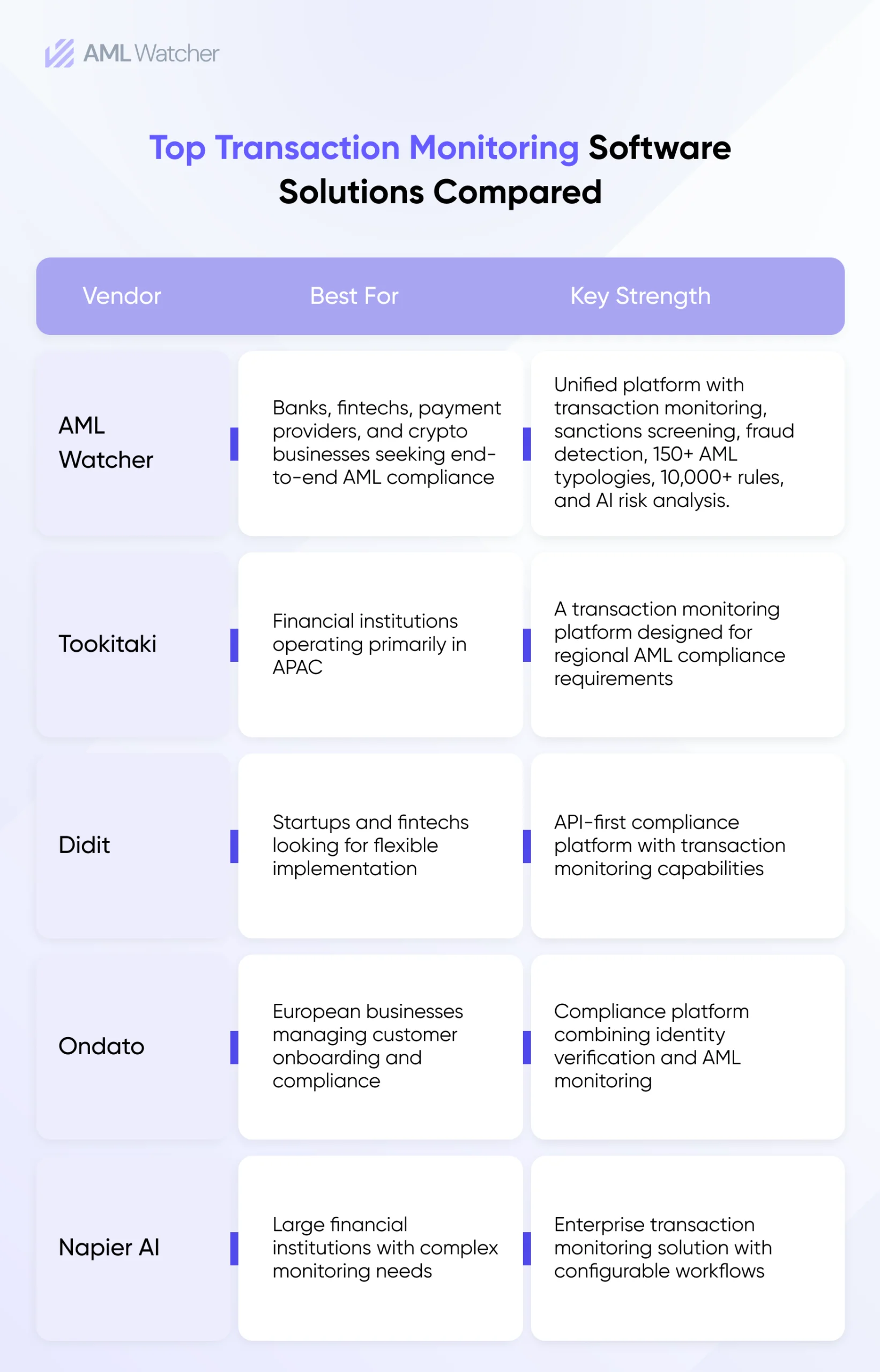
AML Watcher’s transaction monitoring module integrates 150+ pre-built AML typologies and 10,000+ fully customizable detection rules, enabling financial institutions to identify suspicious activity across retail banking, payments, correspondent banking, and fintech and virtual asset transactions. The system automatically adjusts its compliance monitoring levels to reflect customers’ activities across different jurisdictions and regional payment habits. It also integrates transaction monitoring, payment screening, and fraud detection into a single compliance platform, including a fraud-detection module that can screen up to 1,000 transactions per second. Integrated into the platform, TruRisk offers explainable AI-driven risk assessments and has lowered false-positive rates by 44% in deployments and reduced manual review workload by 70-80%.
Tookitaki
Tookitaki’s FinCense platform is one of the established transaction monitoring software vendor options for institutions operating across the Philippines, Singapore, Australia, and other APAC markets. Its distinguishing feature is the AFC Ecosystem, a shared network of typologies that incorporates typologies contributed by participating financial institutions on money laundering patterns. This network feeds real-world typologies from over many regional institutions into the detection engine. Additionally, it includes FinMate, an AI copilot that helps investigators summarize alert context. It is pre-configured for regulators, which shortens implementation for banks already operating in that footprint.
Didit
Didit’s developer-first approach includes a pay-as-you-go pricing model for their KYC, Know Your Business, AML, and transaction monitoring modules, without communication. It supports both fiat and crypto transaction flows and has an auto-reverification loop that re-screens a flagged user rather than outright freezing their account. This model is especially well-suited for early-stage fintechs seeking to prepare for integration on a rapid timeline before agreeing to an enterprise contract.
Ondato
Ondato, headquartered in Lithuania, positions itself around a single “Compliance OS” that unifies Know Your Customer, AML screening, and Know Your Transaction monitoring under a single dashboard. For EU-regulated fintechs, gambling platforms, and telecom operators, the appeal lies in consolidating onboarding, screening, and monitoring under a single vendor rather than separate onboarding and monitoring tools. Reported accuracy sits around 99.8% across 192 countries, though buyers should confirm methodology directly, since these figures are self-published rather than independently audited.
Napier
Napier AI’s Continuum platform is built for institutions processing hundreds of millions of transactions, with a no-code rule builder, a sandbox for testing scenarios before deployment, and many inbuilt typologies. Its recently launched Insights AI feature, tested through the Financial Conduct Authority’s Supercharged Sandbox program, surfaces natural-language explanations of why an alert triggered directly within the investigation workflow.
What Actually Makes a Transaction Monitoring Solution “Best”
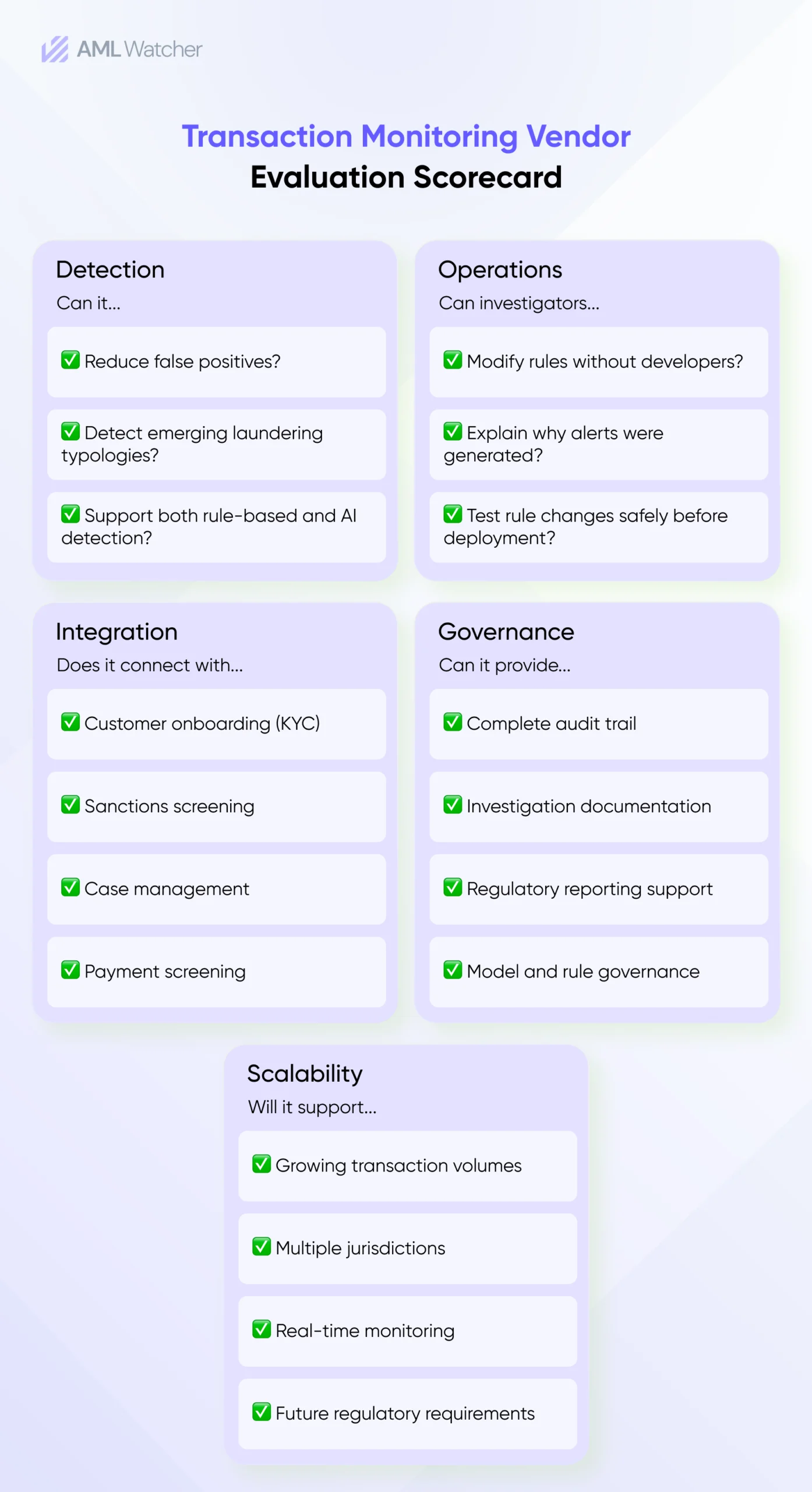
There is no universal best transaction monitoring solution, only the one that fits your institution’s risk profile. Four factors separate a genuinely strong platform from a rebranded rules engine.
Detection Quality Matters More Than Alert Volume
A large rule library has little value if it generates excessive false positives. Institutions should prioritize vendors that can demonstrate measurable improvements in detection accuracy through independent validation or customer outcomes.
Typology Coverage That Reflects Actual Criminal Behavior
Structuring, layering, mule networks and cross-border corridor abuse do not look the same in every region. Pre-built typologies curated from real investigations save months of manual rule-building.
Rule Flexibility Without Engineering Dependency
AML investigators need to adjust thresholds and build new scenarios themselves. If every change requires a developer ticket, the system will always lag behind evolving financial crime typologies.
Integration Depth
Transaction monitoring is rarely done in isolation; it should be integrated with onboarding data, sanctions screening, and case management. This integration ensures that analysts don’t have to juggle four different systems to resolve a single alert efficiently.
Why AML Watcher’s Transaction Monitoring Platform Stands Out
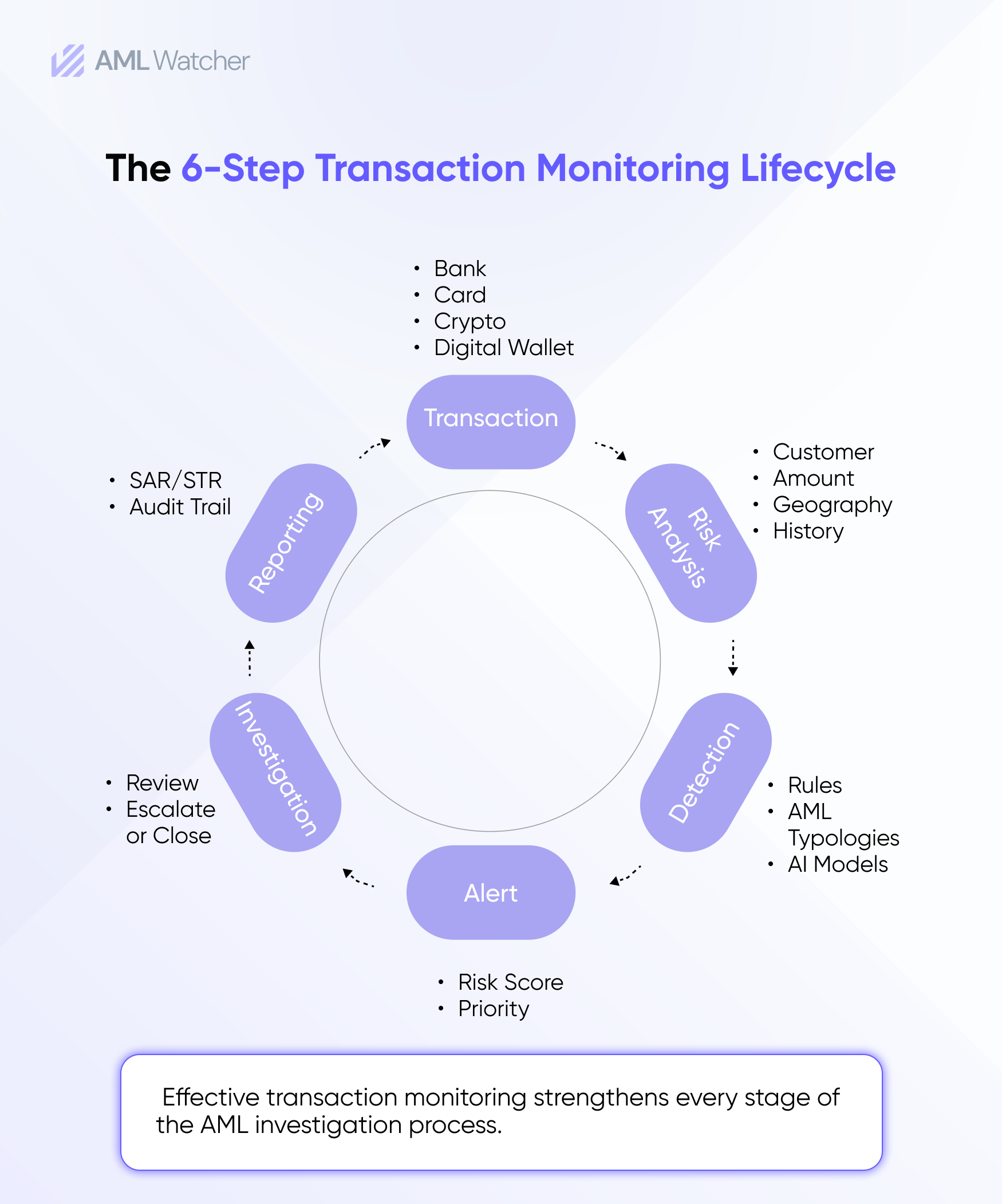
AML Watcher’s platform includes the full AML investigation lifecycle in a single workspace beyond detection. Compliance teams can review alerts, access customer risk information, adapt detection rules as risks change, record investigation results, and maintain a comprehensive audit trail for regulatory examinations.
The platform’s core element is TruRisk, AML Watcher’s compliance AI agent, which explains why alerts are raised, outlines the corresponding customer risk factors and detection logic, and maintains an audit trail for all investigations. Analysts spend less time gathering context and more time assessing genuine financial crime risk.
Recalibration is a natural and intuitive part of the process, enabling AML investigators to update detection thresholds as customer behavior, payment techniques and financial crime patterns evolve. Continuous monitoring automatically re-evaluates customer risk profiles using more recent activities, not just during onboarding. Every disposition, whether cleared or escalated, feeds into case management with a complete audit trail, providing the documentation expected during regulatory examinations.
The strongest transaction monitoring systems are evaluated on their ability to identify suspicious activity, support investigations, and adapt to new financial crime types in the real world. The factors to consider when evaluating vendors include detection capabilities, efficiency, and the ability to create a comprehensive audit trail that meets regulatory standards.
- No commitment needed
- Complete AML Database at your service
- Access our all-in-one dashboard


Tier-2 PSPs in ... must demonstrate automated monitoring, layered CDD, &...
See the Full Regulatory Expectation70–80% less manual work, 95% less fatigue, TruRisk Agent makes compliance effortless.
Experience Agentic AMLMove Beyond Articles. Activate AML Intelligence.
Switch to AML Watcher today and reduce your current AML cost by 50% - no questions asked.
- Find right product and pricing for your business
- Get your current solution provider audit & minimise your changeover risk
- Gain expert insights with quick response time to your queries