Alert!

Enhancing AML Compliance with the Power of Data Enrichment
AML Compliance
February 13, 2026


AML systems generate alerts at scale, but too many alerts arrive without the context needed to decide whether a match is real. In the case where screening is based on limited identifiers, minor differences in names, addresses, or entity information may cause unnecessary false positives, due to which the high-risk links may be missed. This gap is bridged by data enrichment, which contributes the verified context based on the trusted sources. Thus, screening and monitoring decisions are not based on the surface-level data.
What Is Data Enrichment?
Data enrichment is a process of augmenting available datasets with additional information from either outside or internal sources to add more context in order to make better decisions.
Within the context of AML, data enrichment refers to associating the static customer identifiers with credible external data sources such as sanctions, watchlists, PEP databases, adverse media feeds, corporate registry data, and device or IP intelligence, so that risk assessment is based on context and not on surface data.
Enrichment in AML terms augments raw KYC/KYBs inputs, such as the potential candidate’s name, email, or transaction, with verified contextual intelligence that supports more accurate risk assessment and that highlights genuine concerns while filtering safe matches. In the absence of enrichment layers, compliance engines waste resources on surface-level signals that generate false positives.
Why Data Enrichment is Essential for Stronger AML Controls
Financial institutions worldwide are required to adopt risk-based AML programs that go beyond basic identity collection to develop an in-depth understanding of customers’ risk profiles and transaction behaviors.
Frameworks such as FATF Recommendations, AML Directives in the EU, and national laws require customer information to be verified against official and trusted third-party sources. This level of cross-verification is only achievable through data enrichment. Data enrichment strengthens AML controls across several critical areas:
-
Improved Customer Due Diligence
Basic identifiers such as name and address are insufficient on their own. Enrichment strengthens customer due diligence by attaching contextual risk signals to these identifiers.
-
Integrated Data Visibility
Data enrichment integrates internal and external intelligence, reducing blind spots across systems.
-
Reduced False Positives
The rule engines are enabled by enriched identity attributes like date of birth, aliases, and jurisdiction indicators which help to validate potential matches and minimize false positives.
-
More Efficient Investigations
Ultra-enriched transaction data enhances the accuracy of monitoring as it enriches surveillance system with geographic, counterparty and historical risk information.
-
Risk-Based Customer Segmentation
Instead of applying a uniform risk weight to all customers, enrichment enables risk stratification based on:
- Geographic risk
- Sanctions and PEP linkages
- Behavioral signals
This allows AML teams to allocate investigative resources proportionately to actual risk exposure.
How Data Enrichment Works in AML
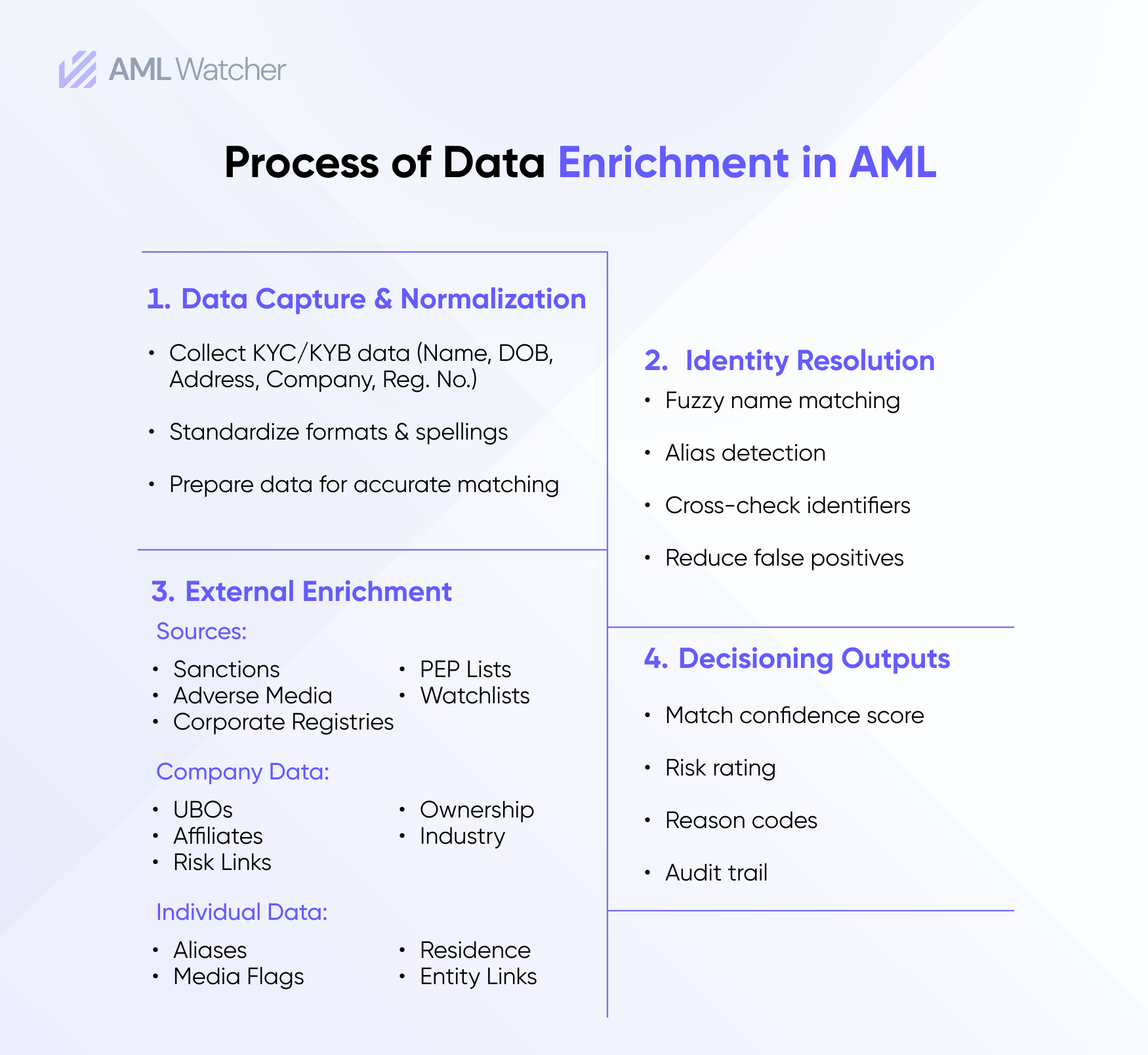
The process of data enrichment in AML follows four structured steps:
1. Data Capture and Normalization
Data enrichment begins when a customer submits basic information during onboarding or monitoring.
At this stage, the system:
- Gather raw data (name, DOB, address, company name, registration number, etc.)
- Normalizes and standardizes formats (e.g., date formats, name order, abbreviations, etc.)
- Normalizes spelling variations and transliterations
This ensures consistency and prepares the data for accurate matching across multiple sources.
2. Identity Resolution and Matching
Once normalized, the data is analyzed using entity resolution techniques to determine whether the customer matches an existing record.
This includes:
- Fuzzy name matching
- Alias detection
- Cross-referencing identifiers (DOB, nationality, registration numbers).
- Getting rid of false positives.
This step enhances better matching and minimizes unnecessary escalations.
3. Enrichment Sources Applied
Once identity resolution has been achieved, the system includes more intelligence provided by the authoritative sources, such as:
- Sanctions lists (OFAC, UN, EU, etc.)
- Global PEP registries
- Adverse media databases
- Corporate registries
- Law enforcement and watchlists
Company Enrichment Data
For legal entities, enrichment may include:
- Ultimate Beneficial Owners (UBOs)
- Corporate registration status
- Subsidiaries and affiliate relationships
- Industry classification
- Sanctions or PEP associations
This provides visibility into ownership structures and hidden risk exposure.
Person Data Enrichment
For individuals, enrichment may append:
- Date of birth
- Known aliases
- Country of residence
- Adverse media risk indicators
- Links to other flagged entities
These attributes help distinguish genuine matches from common-name false positives.
4. Decisioning Outputs
Finally, the enriched data feeds into AML risk engines to generate structured outputs such as:
- Match confidence scores
- Risk ratings
- Reason codes
- Audit trails
- Escalation recommendations
These outputs support defensible compliance decisions and ensure full regulatory traceability.
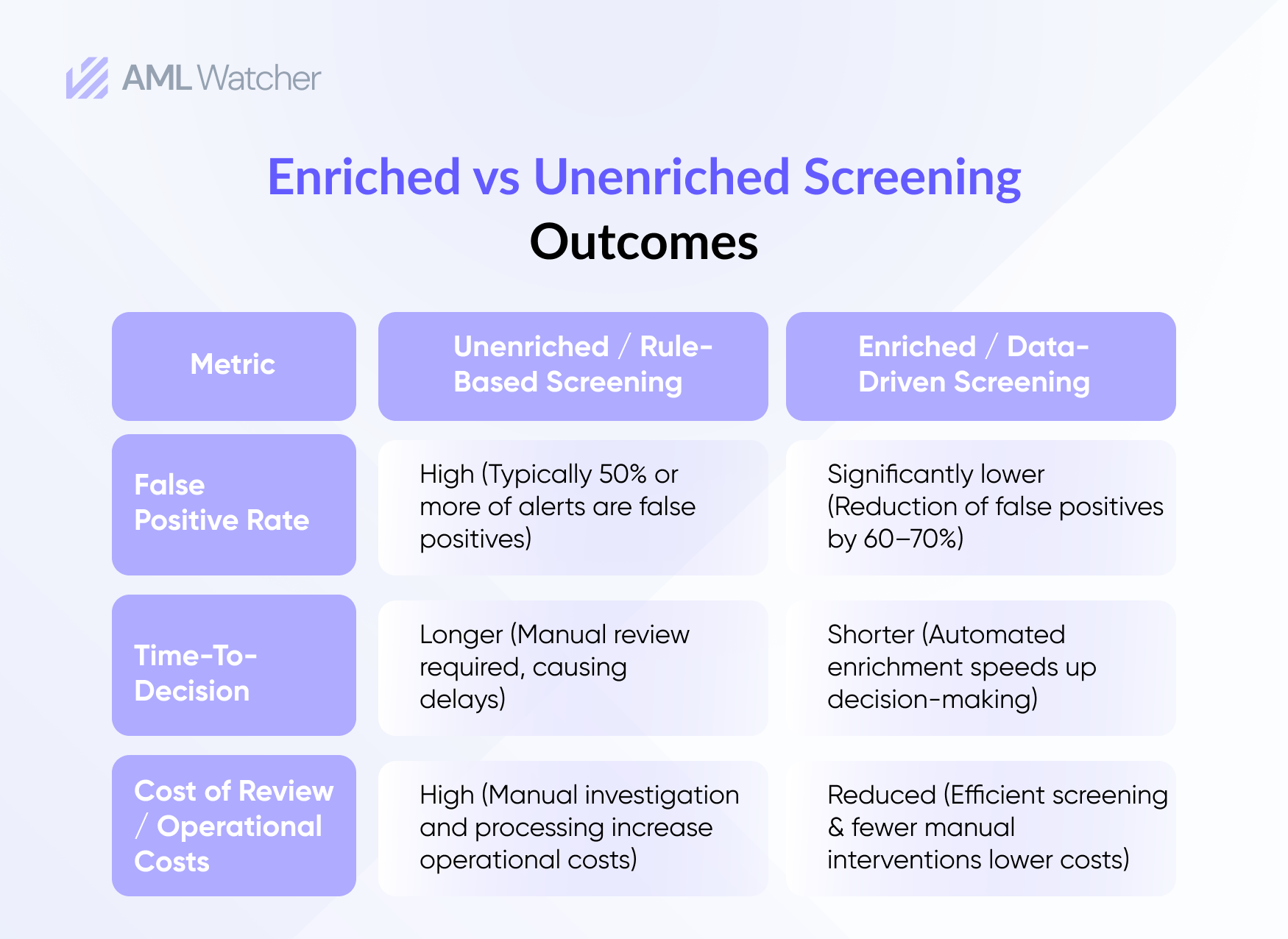
Business Impact and Real-World Value
The quantifiable advantages of data enrichment in AML are quite evident:
Operational Efficiency: Enriched datasets minimize the manual workload for analysts since the automated context offers more structured signals that guide to proactive decision-making.
Cost Avoidance: Risk-based enrichment model (instead of bulk data application) is a way of putting your resources in the areas that are important and not spending on irrelevant data feeds.
Risk Accuracy: Enrichment adds depth to risk profiling, enabling compliance activities to be defensible and in tandem with regulatory expectations.
AML programs can transform the reactive screening process into a proactive method of dealing with risks by focusing on data quality and relevance.
AML Data Enrichment Industry Trends and Future
AML technology is evolving towards real-time, API-driven enrichment, which enriches decision engines and enhances them with contextual signals in real-time. Enrichment sources are increasingly combined with machine learning and graph-based link analysis to reveal more complex patterns of risks across networks that span, something that cannot be offered solely by raw data.
With the increase in financial crime sophistication, enriched identity resolution and contextual intelligence will be inseparable from effective AML frameworks.
In short, data enrichment in the AML is no longer an option. Organizations that are still running on stagnant, surface-level datasets risk false positives, operational inefficiencies, and regulatory non-compliance. Strategic enrichment, which is backed by APIs, best practices of governance, and risk-based applications, converts raw inputs into risk-based actionable risk intelligence, which can be used effectively to comply and conduct sustainable operations.
How AML Watcher is Addressing the Growing Complexity in AML Compliance
As alert volumes rise, many compliance teams struggle to separate meaningful risk from noise when screening is based on limited identifiers.
AML Watcher supports context-driven screening across sanctions, PEP, watchlists, and adverse media, helping compliance teams review matches using clearer signals.
TruRisk is designed to surface true positives and explain the reasoning behind results, while Custom Search Profile helps institutions tailor screening to relevant risk exposure.

- No commitment needed
- Complete AML Database at your service
- Access our all-in-one dashboard


Tier-2 PSPs in ... must demonstrate automated monitoring, layered CDD, &...
See the Full Regulatory Expectation70–80% less manual work, 95% less fatigue, TruRisk Agent makes compliance effortless.
Experience Agentic AMLMove Beyond Articles. Activate AML Intelligence.
Switch to AML Watcher today and reduce your current AML cost by 50% - no questions asked.
- Find right product and pricing for your business
- Get your current solution provider audit & minimise your changeover risk
- Gain expert insights with quick response time to your queries