Alert!

Gift Card Fraud: Schemes, Red Flags, Detection and Investigation
Anti Money Laundering, Fraud Prevention
November 11, 2026


Gift card fraud can turn a simple prepaid card into a rapid, hard-to-track payment channel for criminals. It is a major challenge for financial institutions like banks, fintechs, retailers, and compliance teams because stolen funds usually move through mule accounts, shell companies, and digital assets before they reenter the financial system.
This blog explains the main gift card fraud schemes, the warning signs that AML compliance teams must take into account, and the control measures that help detect and prevent them.
Why Gift Cards Attract Criminals
Gift cards are attractive to criminals because they are easy to buy and resell, and difficult to reverse once the code has been shared. A victim may be told to buy cards from a renowned retailer and then read the numbers over the phone. By the time the victim gets to know something is wrong, the balance has often already been spent or moved.
The magnitude of this challenge is extremely high, as can be identified by the fact that in 2025, consumers reported $233.4 million in fraud losses involving gift and reloadable prepaid cards to the Federal Trade Commission’s Consumer Sentinel Network across 35,321 reports. Losses continued to rise in the first half of 2026, reaching $154.1 million across 20,383 reports, according to the report of Federal Trade Commission, 2026.
Gift card fraud is also linked to broader financial crimes, as shown by FinCEN’s September 2026 alert on scam centres. FinCEN noted that scammers may direct victims to buy gift cards to exploit them and extract payments.
Gift Card Fraud Statistics
| Metric | Figure | Source |
| Gift Card Fraud Losses (Full Year 2025) | $233.4 million | Federal Trade Commission (FTC) Consumer Sentinel Network |
| Gift Card Fraud Reports (Full Year 2025) | 35,321 reports | Federal Trade Commission (FTC) Consumer Sentinel Network |
| Gift Card Fraud Losses (H1 2026) | $154.1 million | Federal Trade Commission (FTC) Consumer Sentinel Network |
| Gift Card Fraud Reports (H1 2026) | 20,383 reports | Federal Trade Commission (FTC) Consumer Sentinel Network |
| Top Scam Type Paid via Gift Cards (2025) | $63.5 million (Romance Scams) | Federal Trade Commission (FTC) |
| Second Top Scam Type Paid via Gift Cards (2025) | $42.2 million (Government Imposter Scams) | Federal Trade Commission (FTC) |
| Primary Victim Contact Channel | Phone Calls (37% of gift card scam reports) | Federal Trade Commission (FTC) |
| Targeted Law Enforcement Operations | 200th arrest / Operation Double Tap (~$7M in seized fraud) | Homeland Security Investigations (HSI) |
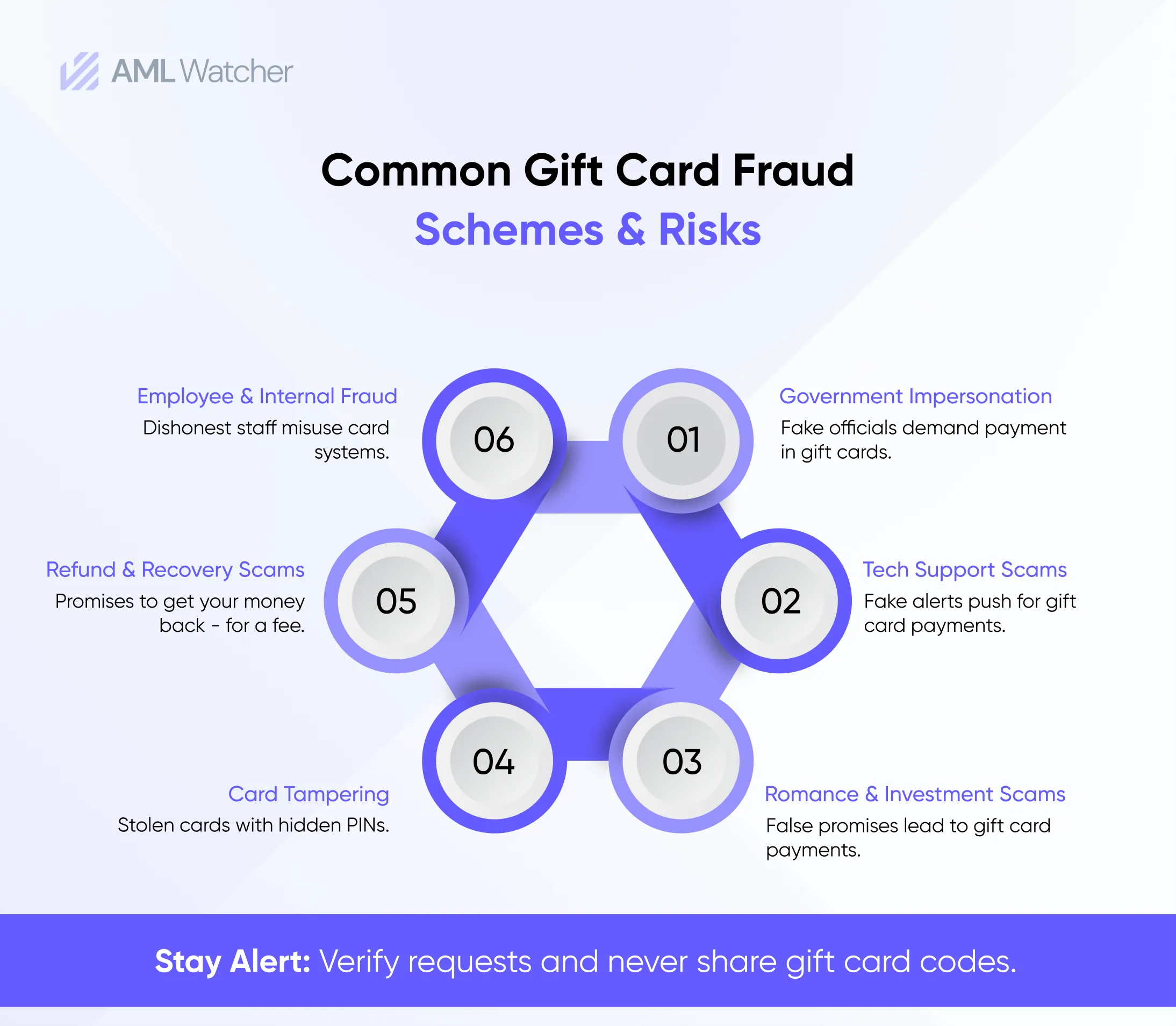
Common Gift Card Fraud Schemes & Risks
- Government Impersonation: Scammers call pretending to be from official agencies like tax offices, courts, or police and demand immediate payments through gift cards while threatening them with arrest. Victims panic and quickly reveal gift card codes.
- Tech Support Scams: Criminals display fake security alerts and tell the user that their computer is infected, demanding gift card payments to solve issues that do not exist. This misuses trust in familiar tech companies to drain money or gain remote access to a computer.
- Romance & Investment Scams: One of the most used methods of scammers is establishing fake online romantic relationships or promising unrealistic investment returns before asking for gift card funding. Emotional or financial manipulation keeps victims transferring funds repeatedly over weeks or months.
- Card Tampering: Criminals secretly steal unactivated gift cards from store racks, record the hidden PIN passwords and silently return them to the shelves. The moment a real customer buys and activates the card, they automatically drain the funds.
- Refund & Recovery Scams: Fraudsters contact individuals who have already lost money to previous scammers by promising to recover the lost funds in exchange for an upfront gift card fee. This trap targets vulnerable victims a second or even multiple times.
- Employee & Internal Fraud: Another notable gift fraud type is the involvement of dishonest retail staff who misuse the system’s access and steal card inventory and manipulate balance activation codes. Another common practice by them is that they can also generate fake refund invoices.
Why this is an AML Issue
A gift card payment can look like a small consumer transaction, but it can also be the first step in a laundering scheme. FinCEN identified in its official advisories and through FIN-2026-Alert005 on scam centres and CMLN-2025-A003 on laundering networks that gift cards often serve as an initial value-transfer mechanism to extract funds from victims before those proceeds are converted into crypto or layered through money mules, shell companies, and underground banking systems.
Anti-money laundering is triggered here, and AML controls and plans are important in this context. A customer who has a frequent habit of buying high-value gift cards, makes unusual cash deposits, or sends funds to high-risk counterparties may need closer review. The purpose must not be to treat every gift card purchase as suspicious. It is to find out the patterns that do not fit the customer’s profile or his declared purpose of the business.
Four Layers of Gift Card Fraud Detection
- Onboarding (CDD and EDD). Applying CDD to every reseller, marketplace and bulk buyer creates a great balance. Escalate to EDD for high-value, cross-border or opaque-ownership customers. Verify Ultimate BOs and screen them, and directors, against sanctions, PEP, watchlist and adverse media data.
- Transaction monitoring. Make and implement rules for velocity, balance-check-then-redeem sequences, purchases structured just under the $2,000 closed-loop line, and value-versus-profile mismatches. AML Watcher’s Transaction Monitoring offers 150+ pre-built AML typologies and 10,000+ no-code custom rules.
- Ongoing monitoring. Re-screen customers continuously so changes in sanctions, PEP or adverse media status raise alerts.
- Feedback loop. Feed confirmed cases back into thresholds so false positives fall.
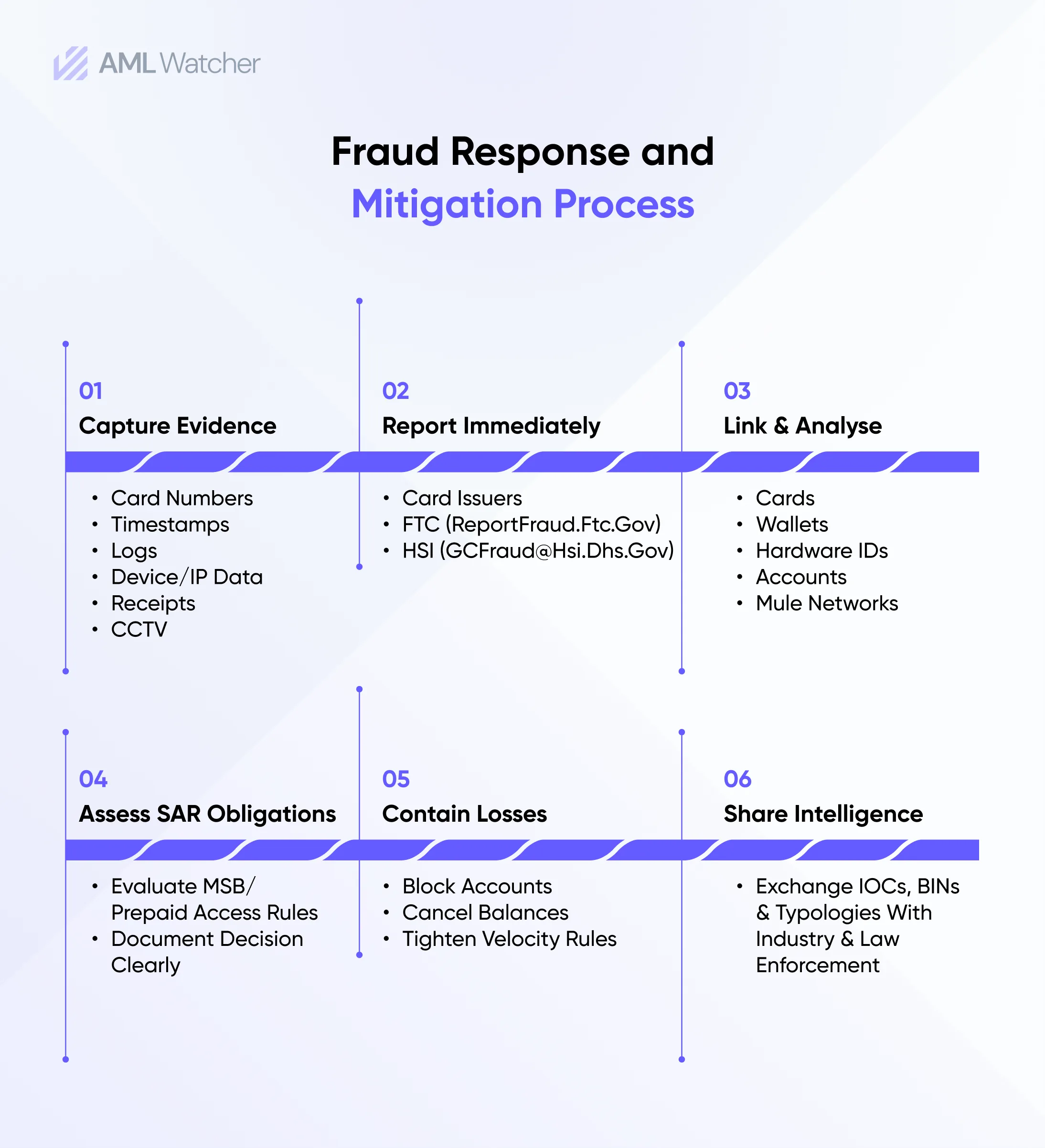
Gift Card Fraud Investigation: Six Steps
- Preserve evidence: card numbers, activation and redemption logs, device and IP data, receipts and CCTV.
- Notify the issuer immediately. The FTC says payments made with gift cards should be reported to the card issuer right away, and consumers can file at ReportFraud.ftc.gov and report organised tampering to HSI at GCFraud@hsi.dhs.gov
- Link the network: connect cards, wallets, devices, accounts and counterparties to find the wider ring.
- Assess reporting duties. Providers and sellers of prepaid access must file SARs under the MSB rules. Document your rationale in case management.
- Freeze & mitigate: Block related accounts, revoke compromised PINs/balances, and update internal velocity and fraud rules to prevent further losses.
- Share intelligence. Exchange operational trends, compromised BIN lists, and IOCs with industry peers, retailers, and law enforcement task forces.
Gift Card Fraud Prevention Checklist
- Train staff to detect, halt and inquire about large or pressured card purchases.
- Inspect packaging before sale and initiate a system of limits on value and purchase velocity.
- Tell and educate customers plainly that gift cards are for gifts, not payments.
- Apply risk-based CDD and EDD to bulk, reseller and marketplace customers.
- Review rules quarterly against new typologies.
Final Thoughts
Gift card fraud is not only a consumer scam problem. It is a financial crime risk that can feed money laundering networks through mule accounts, opaque corporate structures, and digital asset channels.
The most effective and valuable defence is layered by educating customers through different channels, monitoring any unusual behaviour, verifying identities and beneficial owners, applying EDD where risk rises, investigating alerts with full context, and implementing a fast reporting system for suspicious activities.
How AML Watcher helps
AML Watcher unifies AML screening (sanctions, PEPs, watchlists, adverse media), ongoing monitoring, Transaction Monitoring, risk evaluation and case management on one platform. Screen buyers and their UBOs at onboarding, monitor activity against custom gift card rules, and keep every alert and decision in an auditable case file. Book a demo now!
- No commitment needed
- Complete AML Database at your service
- Access our all-in-one dashboard


Tier-2 PSPs in ... must demonstrate automated monitoring, layered CDD, &...
See the Full Regulatory Expectation70–80% less manual work, 95% less fatigue, TruRisk Agent makes compliance effortless.
Experience Agentic AMLMove Beyond Articles. Activate AML Intelligence.
Switch to AML Watcher today and reduce your current AML cost by 50% - no questions asked.
- Find right product and pricing for your business
- Get your current solution provider audit & minimise your changeover risk
- Gain expert insights with quick response time to your queries