Alert!

How AML Watcher’s AI Compliance Agent Solves Key Screening Challenges
Others
December 9, 2025


Compliance teams are facing mounting pressure in anti-money laundering (AML) compliance. The sheer number of false positives, a significant issue in AML screening, continues to be the most daunting problem for compliance analysts.
With traditional screening systems flagging large volumes of irrelevant alerts, compliance teams waste time investigating false positives. This growing problem not only inflates compliance costs but also risks slowing down critical regulatory responses.
These issues were highlighted in a poll conducted by AML Watcher, asking compliance professionals about the most significant screening issues in 2025:
- 50% of the respondents voted that too many false positives were their biggest challenge.
- 30% identified outdated and incomplete data as the primary issue.
- 11% pointed out difficulties with transliteration and aliases.
- 9% selected adverse media noise as the most significant compliance headache in 2025.
For compliance analysts, the burden of false positives, transliteration issues, and incomplete data, continues to create an inefficient workflow and heighten the risk of overlooking genuine threats.
That’s where AML Watcher’s new AI Compliance Agent fits in. Designed to solve the challenges, the new AI Compliance Agent works in tandem with our high-quality data layer to screen customers with greater accuracy.
What are the Key Challenges of AML Screening?
Financial activity has been on an upward trend. The Global Findex Database 2025 notes that 79% of adults worldwide held a financial account for transactions in 2024, up from 74% in 2021.
However, the growth of monetary activity creates room for emerging crime tactics. Compliance teams are therefore under constant pressure to remain effective while balancing the increase in monetary activity with novel financial crime techniques.
1. Overwhelming False Positives:
In AML compliance, an automated screening system generates alerts for compliance teams to review. A false positive alert is generated when the screening system incorrectly flags a legitimate activity as potentially suspicious or high-risk.
False positives are the number one pain point for many compliance teams. In fact, the estimated percentage of alerts flagged by typical AI solution systems is 95%! That means that, for every 100 alerts flagged by static screening systems, only 5 cases were accurately flagged as legitimate suspicious activity.
For compliance teams, this is particularly worrisome. Each alert requires an investigation, documentation, reporting, and submission before finally filing a Suspicious Activity Report (SAR).
On the other hand, hiring more human resources for AML compliance is simply not feasible or efficient to fully address the sheer volume of financial activity in today’s world.
The result? Institutions can either integrate an automated AML screening system that generates up to 95% of false alerts or employ extensive human compliance teams that cannot keep pace with the volume of financial activity in the modern world.
Neither option effectively solves the problem of false positives.
2. Outdated and Incomplete Data
The quality of AML data is another major issue that hampers effective screening. Outdated data layers do not reflect the latest version of sanction lists, for instance, which causes the screening engine to produce unreliable results. 30% of our poll respondents selected poor data quality as their biggest screening headache in 2025.
3. Transliteration and Alias Issues
For compliance teams, individual search results across multiple countries and linguistic backgrounds, transliteration issues, and alias discrepancies can pose significant hurdles. A name may be spelled differently in different scripts, complicating the screening process. 11% of our respondents noted it as their largest concern.
Traditional rule-based systems struggle with name matching due to the diversity of dialects and naming conventions, but AI-driven solutions can detect various name variants and match identities more accurately.
4. Adverse Media Noise
Adverse media screening is an essential component of AML compliance, but constant news updates generate too much noise. Compliance teams find themselves perusing through irrelevant stories and headlines that do not pose any real risk, which leads to alert fatigue and inefficiencies. 9% of our poll respondents identified adverse media noise as the most concerning screening headache in 2025.
How AML Watcher AI Compliance Feature Transforms Compliance Screening
AML Watcher’s AI Compliance Agent is designed to solve the pressing issues identified in our poll and supported by industry research.
Here’s how it works:
1. Tackling False Positives:
AML Watcher’s AI Compliance Agent uses advanced strategies to accurately distinguish between true and false positives. Through cross-referencing key data points such as names, addresses, and date of birth, the AI agent noticeably reduces the number of irrelevant matches flagged during screenings.
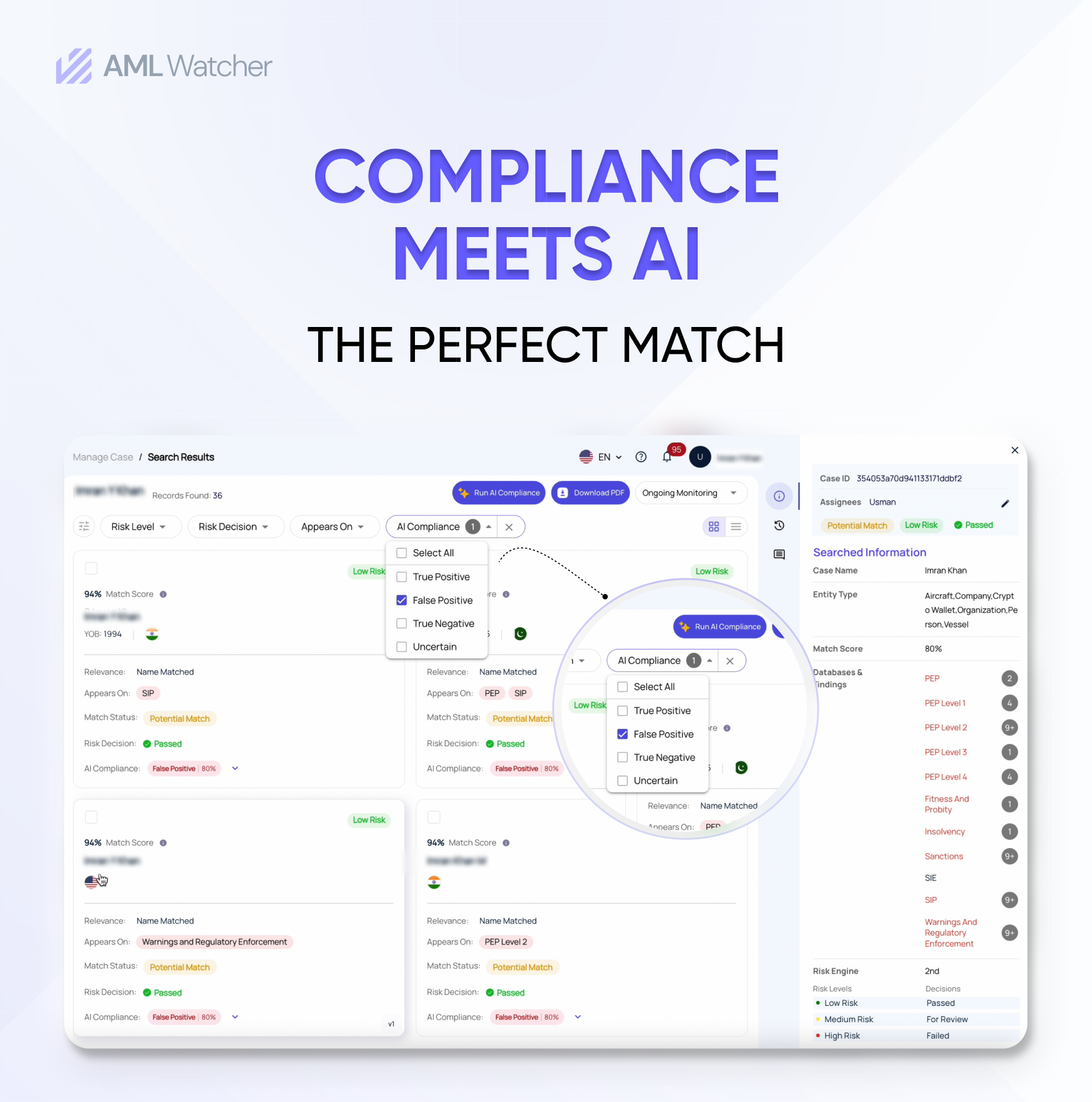
Upon searching an individual, compliance officers are able to select true positives from a list of search results,, along with the AI Agent’s justification for its categorization.
2. Real-Time Data Updates
AML Watcher’s data layer continuously refreshes and enriches data during every match, so that your compliance teams are always working with the most accurate and up-to-date data.
The AI Compliance Agent works with an updated data layer to apply the latest information for every search result to determine whether the case is a false positive or not.
This dynamic approach is relevant to the 30% of poll respondents who identified outdated data as a major headache in compliance workflows.

3. Accurate Categorization with Transliteration, Alias Variation, and Adverse Media Noise:
AML Watcher leverages the results of AML Watcher’s existing screening tools, which handle complex name variations, aliases, transliterations, and adverse media noise. It then applies this information to accurately categorize search results as true positives or false positives.
The compliance agent that understands linguistic differences, whether in Cyrillic, Arabic, or Latin-based alphabets, does not misclassify information. Consequently, the agent can filter through multiple adverse media reports, allowing only pertinent information to be considered in the decision-making process.
Through categorizing each result and displaying the reason for the decision, the AI Compliance Agent helps compliance teams determine confidently whether a match is legitimate so that no critical threats are missed while reducing the overall alert fatigue – catering to the 11% of our poll respondents who identified issues with transliteration, aliases, and media noise.
How AML Watcher’s AI Compliance Feature Benefits Businesses?
An AI compliance agent introduces a range of advantages that address the core challenges of AML screening:
- Prioritizing Actual Risks: The agent uses AI to highlight alerts with higher risk scores, ensuring compliance officers focus on the most significant threats first rather than sifting through large volumes of low-risk matches.
- Reducing False Positives: Data analysis of information such as names, DOB, adverse media signals, and addresses, the AI agent accurately classifies each alert. If the search query finds an exact match (e.g., based on name and date of birth), the AI Compliance Agent will categorize it as a true positive.
- Lowering Costs: Automation of the review process minimizes both the time and resources previously spent on manually investigating false alerts. This further allows compliance teams to handle higher case volumes without proportional staffing increases.
- Governance and Auditability: While compliance officers retain final decision-making authority, the AI agent providers provide clear justifications for each classification. This ensures transparency in decision-making and supports regulatory audit requirements.
- Scalability: For growing businesses, the AI agent can handle increasing volumes of alerts and transactions, supporting expansion into new markets without requiring a larger compliance team or further investment.
The AI Compliance Agent also works seamlessly with a search dashboard. When a user inputs search parameters for an individual, the agent evaluates each result and provides a short AI evaluation message. Analysts can then select alerts by category, filtering the results to focus on the relevant matches.
This combination of AI evaluation, categorization, and filtering ensures that compliance teams spend their time where it matters most.
Why AML Watcher’s AI Compliance Agent Is the Future of AML Screening
At AML Watcher, we understand the unique challenges financial institutions face regularly. AI-driven solutions like AML Watcher’s AI Compliance Agent help compliance teams work more efficiently and effectively. Our Compliance Agent is a comprehensive solution that directly addresses the challenges of legacy AML screening systems, turning a mountain of alerts into clear, actionable insights.
Move Beyond Articles. Activate AML Intelligence.
Switch to AML Watcher today and reduce your current AML cost by 50% - no questions asked.
- Find right product and pricing for your business
- Get your current solution provider audit & minimise your changeover risk
- Gain expert insights with quick response time to your queries