Alert!


How Offshore Networks Enable Sanctions Evasion in Aviation
Sanctions
February 2, 2026


In a bold move that challenged international sanctions, Mahan Air, Iran’s second-largest airline, successfully acquired five Boeing 777 aircraft. What proved to be a complex operation involving a network of shell companies across multiple continents, the Islamic Revolutionary Guard Corps (IRGC)- linked airline bypassed international sanctions to expand its aircraft fleet.
The fact that this acquisition went unnoticed until the planes reached Iran is a glaring example of how international sanctions can be bypassed when screening efforts fail. How did Mahan Air manage to pull off this daring acquisition? And what does this mean for broader AML screening efforts?
Why Was Mahan Air Sanctioned?
On 12th October, 2011, the U.S. Department of the Treasury designated Mahan Air for providing financial, material, and technological support to Iran’s IRGC-QD (IRGC Qods Force).
“Mahan Air’s close coordination with the IRGC-QF – secretly ferrying operatives, weapons, and funds on its flights – reveals yet another facet of the IRGC’s extensive infiltration of Iran’s commercial sector to facilitate its support for terrorism.”
Under Secretary for Terrorism and Financial Intelligence
David S. Cohen
Further, in 2019, the Department of the Treasury issued an Advisory highlighting deceptive practices by Iran in the Civil Aviation Industry. The Advisory imposed secondary sanctions on both U.S or Non.U.S entities that are engaged in transferring U.S.-origin aircraft goods to Iranian Airlines.
Despite such restrictions, Mahan Air managed to acquire five Boeing 777s through complex intermediary transactions by using shell companies to complete the purchase, concealing the true ownership of the planes until the delivery had been completed.
Mahan Air managed to acquire U.S-made aircrafts from a U.S.-registered firm, with an established operation that has not yet been disrupted.
How Offshore and Shell Companies Enable Sanctions Evasion:
A popular method of evading sanctions is to create offshore and shell companies to serve as fronts. A common tactic is to incorporate in jurisdictions with loose regulatory oversight, enabling sanctioned entities to hide behind legitimate operations on paper.
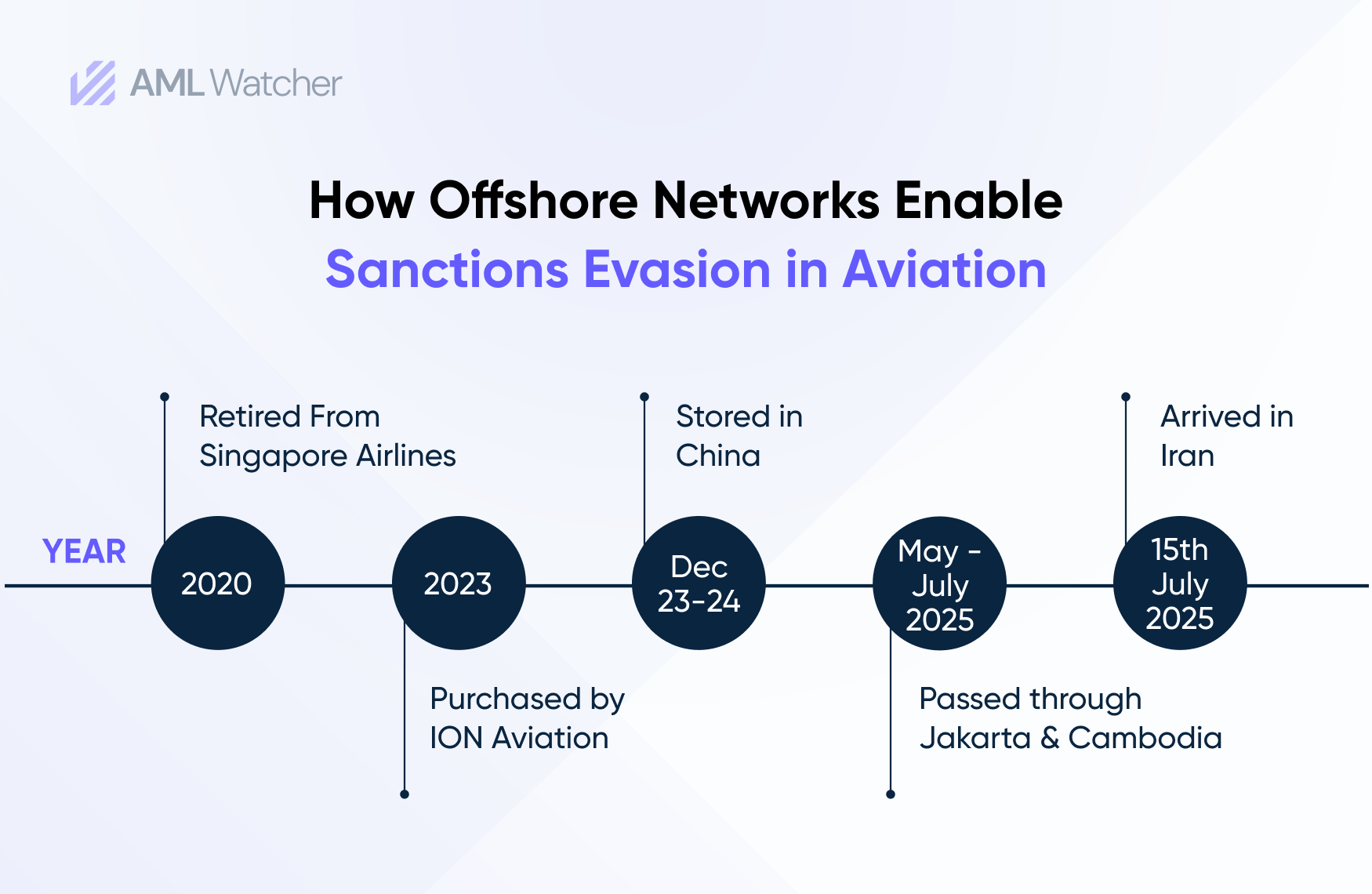
In the case of Mahan Air, the airline bypassed U.S. sanctions through a network of shell companies, with Udaan Aviation as the central front company. Udaan Aviation, a Malagasy-based shell company, was set up solely to facilitate the transfer of the Boeing 777 aircraft to Mahan Air. The front company held the aircraft under provisional registration in Madagascar before being flown to Iran. This layered strategy enables Mahan Air to disguise the true ownership of the planes and acquire prohibited U.S. origin aircrafts.
This strategy isn’t unique to Mahan Air. Sanctioned entities worldwide layer transactions through a network of shell companies, evading alarms that would otherwise ring if prohibited transactions were flagged directly to a sanctioned entity.
How Poor AML Screening Solutions Allow Sanctions Evasion:
This case has far-reaching consequences for both the financial and aviation industries. The use of shell companies conceals transactions, a significant risk for institutions that fail to implement robust screening mechanisms.
FIs equipped with traditional AML screening solutions struggle due to outdated, ineffective, and vague data that cannot identify the complex methods deployed by sanctioned entities to evade sanctions. Such AML solutions are characterized by:
- Inadequate Due Diligence:
When sanctioned entities create complex shell company structures that are layered on top of one another, AML solutions with inadequate due diligence processes fail to identify the true owner of these dubious entities.
- Lack of Global Compliance Integration:
The world does not follow one specific AML standard; every jurisdiction has a unique threshold for whether an entity is to be sanctioned or not. Therefore, regulations vary greatly from one jurisdiction to another. Without a comprehensive global compliance AML solution, FIs may miss transactions that involve entities in jurisdictions with weak regulations, as was the case with Mahan Air.
The challenge is that these transactions are hidden by layers of intermediaries and shell companies to conceal the true beneficiaries of the deal. FIs must therefore conduct accurate CDD to ensure they do not engage in transactions that could pose risks to their operations.
How AML Watcher Can Help
AML Watcher’s Aircraft Screening and Offshore Company Detection services are designed to help institutions detect suspicious transactions in high-value asset acquisitions, such as aircraft. Here’s how we help meet those regulatory standards:
- Sanctions List Integration
- Aircraft and Vessel Screening
- Real-time monitoring
- On-going screening
In an era where sanctions evasion and money laundering are becoming increasingly sophisticated, AML Watcher offers the expertise and technology FI’s need to uncover sanction

- No commitment needed
- Complete AML Database at your service
- Access our all-in-one dashboard


Tier-2 PSPs in ... must demonstrate automated monitoring, layered CDD, &...
See the Full Regulatory Expectation70–80% less manual work, 95% less fatigue, TruRisk Agent makes compliance effortless.
Experience Agentic AMLMove Beyond Articles. Activate AML Intelligence.
Switch to AML Watcher today and reduce your current AML cost by 50% - no questions asked.
- Find right product and pricing for your business
- Get your current solution provider audit & minimise your changeover risk
- Gain expert insights with quick response time to your queries