Alert!

Maritime Sanctions Evasion Risks for FIs with the Rise of Dark Fleet
AML Compliance
March 4, 2026


In the current geopolitics landscape, sanctions and trade restrictions have become a foreign policy tool to exert pressure on states. One such way is maritime sanctions, that target specifically the shipping routes, vessels and related maritime activities because a large share of global trade moves through the sea.
Countries like Iran and Venezuela with some of the largest oil reserves have long faced sanctions enforcement from the United States that limit their export of oil in the open market. Due to abundant oil resources and absence of an open market, reportedly these markets sell oil at “discounted” prices or below the market value, making it a lucrative trade option. This environment encouraged the emergence of a dark or shadow fleet to facilitate maritime sanction evasion and support movement of restricted oil through non-traditional shipping routes.
The Dark Fleet and Rise of AIS Manipulation
What is AIS and why does it matter?
Automatic Identification System, also known as AIS, supports safety and navigation at sea by vessel tracking, broadcasting necessary voyage details, location data and vessel identity to other vessels and monitoring stations. It helps in tracking vessels and avoiding collisions with other vessels present at sea.
What is the Dark Fleet?
Shadow fleet is usually used as an umbrella term for vessels operating outside normal compliance controls. Whereas dark fleet can be referred to as a subset which relies on deceptive shipping practices such as AIS manipulation, vessel renaming and changing IMO numbers to move sanctioned cargo.
They operate in legal and regulatory grey zones. The dark fleet delivers much of the world’s oil from countries under international sanctions. According to IFSMA, the shadow fleet is estimated to already be more than 10% of the world’s tanker fleet. The dark fleet is estimated to have around 1300 ships, as it continues to expand.
How AIS Manipulation Works in Maritime Sanctions Evasion?
AIS deception can involve multiple tactics. “Going dark” means turning off the transmission of AIS data to avoid visibility on the monitoring systems. Although, in some regions this may be done for legitimate safety reasons, continued irregularities are signs of deceptive behaviour. “AIS spoofing” means broadcasting incorrect location and identity data that appears normal on the tracking system, however, actual cargo moves somewhere else.
The dark fleet uses these deceptive practices due to which maritime operators face a continued threat of compromise on safety and compliance in maritime operations.
AIS spoofing directly hampers the sanctions implementation that had been put in place. The primary reasons behind spoofing AIS and going dark are accounted as:
- Sanctions evasion
- Grey-zone operations near disputed waters and critical infrastructure
- Smuggling or trafficking
Common Hotspots Linked to AIS Manipulation
1. The Gulf of Oman
This region has become a hub for the transshipment of Russia’s crude oil. The tankers involved use AIS manipulation, ship-to-ship transfers and other similar tactics to move oil off the radar. The delivery is made to their respective destinations like India or China on apparent “clean” and non-sanctioned ships or vessels. The spoofed data is a depiction of plain, normal sailing patterns that results in troubled monitoring without any sophisticated tools.
2. Malaysia and the South China Sea Region
Waters near Malaysia and some parts of South China Sea have also been linked to ship-to-ship transfers and other deceptive practices. Iranian, Venezuelan and Russian cargoes are most commonly reported to have been routed through these regions. This triggered the Malaysian government to launch a crackdown against the illicit transfers taking place in its coast. Manipulation of location data and ship-to-ship transfers are used to disguise the movement of prohibited cargo through this region.
OFAC’S Guidance on Deceptive Practices Associated with Oil Shipments
OFAC released a set of guidelines on April 16th ‘2025 “Guidance for Shipping and Maritime Stakeholders on Detecting and Mitigating Iranian Oil Sanctions Evasion”. Following are the common practices used for maritime sanction evasion, as per the advisory:
1. Multiple Ship-to-Ship Transfers
While ship-to-ship transfers are considered a legitimate means to pursue trade, OFAC recognized that sanctioned tankers use the territorial waters of coastal states with non-sanctioned vessels in order to transport exports to buyers. Remaining specific to Iran OFAC mentioned that it uses multiple STS transfers in a single shipment in order to obscure the origin of the sanctioned tankers.
2. Falsifying and Manipulating Cargo and Vessel Documents
Sanctioned networks falsify vessel and cargo documents in order to obfuscate the origin and destination of the shipments. This can occur through manual manipulation or by getting new cargo documentation altogether that is issued by a competent authority. This amplifies the need for accurate shipping documentation to ensure all stakeholders remain on the same page.
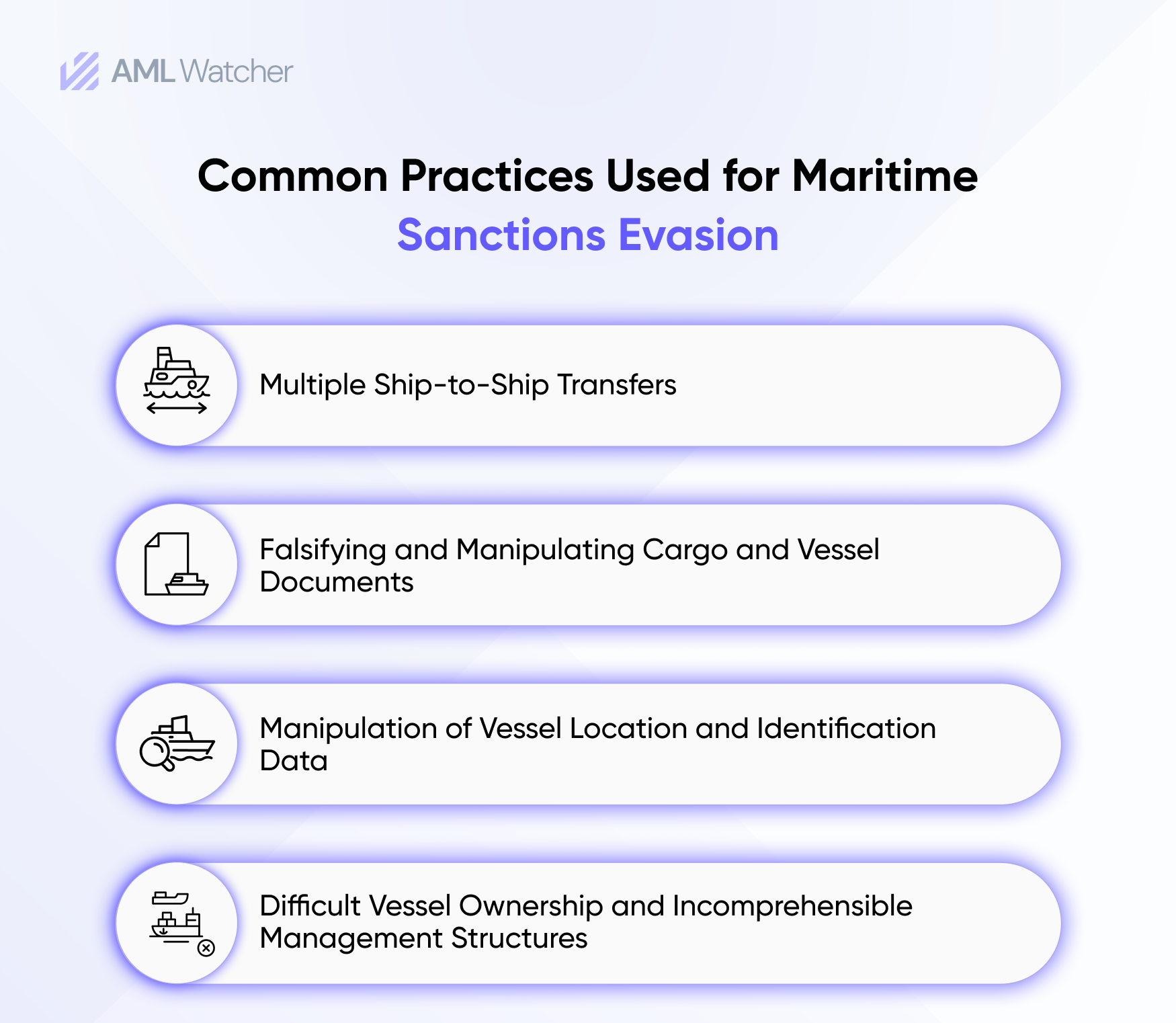
3. Manipulation of Vessel Location and Identification Data
Voluntarily disabling AIS transponders or performing any sort of modifications to the data in order to cover up their movements is a tactic often practiced by sanctioned vessels. This practice particularly conceals a cargo’s origin and causes uncertainty regarding location of vessels.
4. Difficult Vessel Ownership and Incomprehensible Management Structures
Sanctioned entities are linked with networks that use different shell companies and special purpose vehicles (SPVs) that can be most prevalent in high-risk, low transparency and low-regulation jurisdictions. These entities are most likely to be owned by individuals with no public profile, distorted source of wealth information, or individuals with false passports.
Why Detecting Maritime Sanctions Evasion Matters for Financial Institutions
Financial Institutions face exposure because maritime trade is linked to payments, trade finance, insurance activity and cross border settlements. The maritime industry involves complex supply chains, making it difficult for financial institutions to monitor and trace illicit activities. Without sufficient knowledge of evasive schemes and support of technological tools financial institutions are likely to inadvertently be part of illicit activities like financing or processing payment for sanctioned entities.
With OFAC’s added expectations for financial institutions to screen not only sanctioned vessels but also the ones which are “high-risk”, “spoofers” or those flagged by credible third-party intelligence providers. Financial institutions need to adopt right and effective solutions which can help them avoid risks linked to maritime sanction evasion.
Strengthen Your Defense Against Maritime Evasion with AML Watcher
Financial institutions that manage trade-finance and cross-border payments can face hidden exposure when vessels make the use of AIS manipulation, a layered ownership, along with consistent ship-to-ship transfers in order to cover up sanctioned trade.
AML Watcher supports vessel screening and sanctions risk checks that help compliance teams spot sanctioned vessels and ownership red flags earlier.
Request a demo to see how maritime screening fits into sanctions controls.
Move Beyond Articles. Activate AML Intelligence.
Switch to AML Watcher today and reduce your current AML cost by 50% - no questions asked.
- Find right product and pricing for your business
- Get your current solution provider audit & minimise your changeover risk
- Gain expert insights with quick response time to your queries