Alert!

Sanction Screening in SACCOs: The Risks, The Gaps, The Fix
Sanctions
March 13, 2026


Globally, Savings and Credit Cooperative Organisations (SACCOs) serve nearly 100 million members across more than 60 countries, making them one of the world’s most widely adopted cooperative financial systems.
That scale carries significant regulatory responsibility that many institutions are not yet fully equipped to meet. Non-compliance with sanction obligations does not produce a corrective notice. It produces something far more consequential: severed correspondent banking relationships, suspended operating licenses, and, in serious cases, full institutional closure. Sanction screening is not optional for SACCOs. It is an operational survival requirement.
What Makes SACCOs Uniquely Vulnerable
SACCOs were designed to serve communities that traditional banking has historically ignored. That founding purpose is not the problem. The structural conditions that come with it are.
Most SACCO member bases operate in cash-intensive environments where documentation standards are inconsistent, and identity verification is applied unevenly. High member volumes combined with weak KYC enforcement create screening blind spots that are difficult to detect and easy to exploit. Cross-border transaction flows through SACCO networks are increasing, particularly through diaspora remittance corridors and regional trade financing. Each of these transactions introduces jurisdictional exposure that demands active sanctions screening to manage responsibly.
The reality is straightforward. Sanctioned individuals do not target institutions with robust compliance programs. They target institutions where scrutiny is lowest, and documentation gaps are widest. Without dedicated compliance functions, most SACCOs cannot identify exploitation until regulatory pressure or a banking partner forces the issue. That delay highlights the importance of effective sanctions screening, which is impossible to overstate.
The Real Consequences of Non-Compliance
Regulatory fines are the most frequently cited consequence in compliance briefings. They are rarely the most damaging ones.
The more operationally severe outcome is de-risking. When a correspondent bank determines that a SACCO cannot demonstrate credible compliance, it exits the relationship without negotiation. That exit eliminates the capability to conduct cross-border transactions entirely. Remittance flows stop, trade settlements stall, and international funding pipelines close. For SACCOs that have built core member services around those capabilities, the disruption is structural.
Reputational damage within cooperative institutions spreads differently. Trust among members is grounded in personal relationships, which means it tends to erode quickly when compliance issues are exposed. The consequences are operational and immediate, not merely theoretical.
Development finance institutions and donor-backed programs are placing stricter rules on anti-money laundering (AML) and counter-financing of terrorism (CFT) for funding. In East African SACCO networks, mobile money providers have stopped working with institutions that cannot demonstrate compliance with these requirements. This trend is speeding up, not slowing down.
Key Sanctions Screening Challenges for SACCOs
Understanding the risk is one thing. Executing consistent screening against it is where most SACCOs encounter serious, compounding friction. These are not isolated technical issues. They are interconnected operational failures that reinforce each other. Some of the examples are as follows:
- Budget constraints: Most SACCO boards still see compliance as an extra cost rather than a way to manage risk. This viewpoint restricts funding for important needs, especially when operating margins are limited.
- Data quality issues: Member records are often incomplete, formatted inconsistently, or recorded in inconsistent local scripts. When data is unreliable, it can lead to misleading alerts, including both false positives and, more dangerously, false negatives.
- False-positive overload: Without a smart risk-scoring system, every alert requires manual review. Staff can feel overwhelmed, which leads to alert fatigue. As a result, flags often get cleared without proper verification. The screening program appears functional on paper but fails operationally.
- No escalation structure: A flag without a defined workflow is operationally worthless. Most SACCOs have no documented protocol for who reviews an alert, within what timeframe, or when a Suspicious Activity Report becomes necessary.
- Watchlist fragmentation: The UN, OFAC, EU, and local financial intelligence units maintain separate lists. Screening against one source while missing others creates a compliance gap that regulators and correspondent banks will not overlook.
- Jurisdiction complexity: SACCOs operating across borders face regulatory requirements that do not always align, and the gaps between those frameworks are where compliance failures typically originate.
How Technology Closes the Sanctions Screening Gap
The challenges outlined above are not permanent conditions. Each one has a direct technological remedy, provided the solution is selected and implemented with operational clarity.
Tools for Automated Sanction Screening
Name variation is a major challenge for maintaining accurate SACCO member databases. Automated screening tools address this using fuzzy matching and phonetic algorithms. These tools detect potential matches based on phonetic similarity rather than exact spelling. They are particularly concerning for names from African, Arabic, or South Asian languages, where spelling differences are common when written in English or the Roman alphabet.
In practice, both real-time and batch screening are necessary. Real-time screening occurs during onboarding and high-value transactions. However, batch screening checks the entire member database against updated watchlists at regular intervals. Together, these methods lower risks at entry points and reduce ongoing exposure. Risk-scoring engines reduce false positives by prioritizing alerts by risk severity so that staff can focus on the most important reviews first.
API-Based Watchlist Integration
No single sanctions list provides complete coverage. The UN Security Council list, OFAC’s Specially Designated Nationals list, the EU Consolidated List, and local financial intelligence unit databases each contain different entries. Therefore, API integration with combined watchlist providers enables sanction screening solutions to access all relevant sources simultaneously in real time. Automated updates reduce the risk of relying on outdated watchlist data, which is a recurring compliance issue that manual processes often cannot prevent.
Risk-Based Screening Logic
Another limitation is that SACCO members differ in risk levels, so they should not all be screened under the same risk tier. To address this, a risk-tiering framework is crucial that ranks members in 3 tiers (low, medium, or high risk) based on clear factors. Such as PEP status, how often they make cross-border transactions, the amount of cash deposits, and their geographic locations. Higher-risk members get more careful checks, while lower-risk members undergo proportionate screening. This logic concentrates compliance effort precisely where regulatory and financial crime exposure is highest.
Compliance Dashboard and Audit Trail
Real-time visibility into screening activities is essential for operations. A centralized compliance dashboard shows pending alert reviews, records actions taken, and keeps timestamps for every decision made during screening. This audit trail provides critical evidence during regulatory inspections and due diligence reviews by correspondent banks. It proves that the automated sanction screening program actually works. Without this trail, even a well-configured system cannot show compliance effectively.
How SACCOs Can Build a Strong Sanctions Screening Program
Choosing the right technology is just one part of the equation. The order in which you implement it plays a crucial role in whether that technology effectively supports sanction screening compliance or merely becomes another system that employees find ways to bypass.
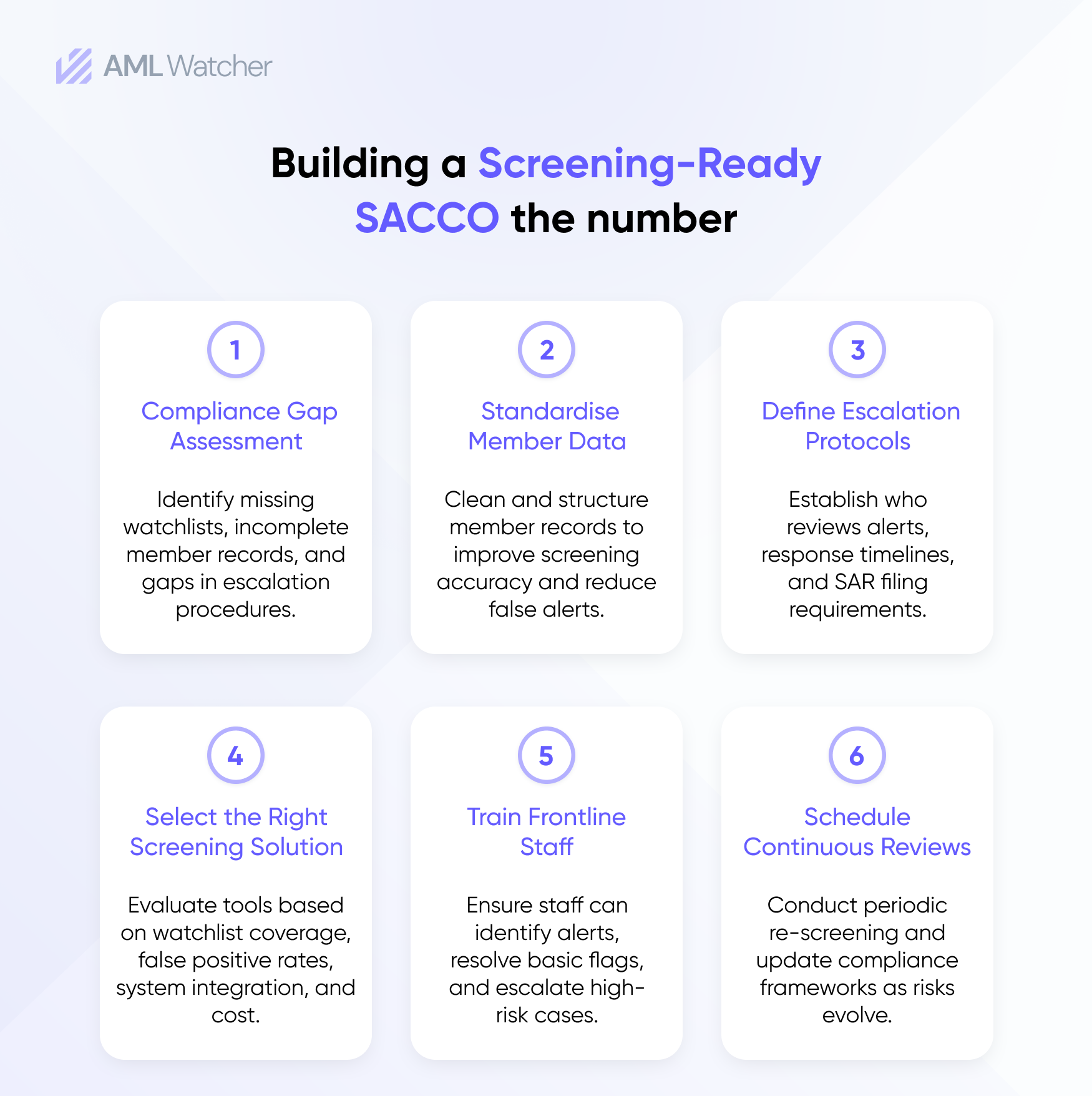
A reliable sanctions screening framework that protects SACCOs from regulatory risk and financial crime exposure.
The Stakes Are Clear, The Next Step Should Be Too
Sanctions screening is not a compliance checkbox for SACCOs. It is the mechanism that keeps institutions connected to correspondent banking networks, eligible for international funding, and trusted by the members they were built to serve.
That trust, once broken through a public compliance failure, is extraordinarily difficult to rebuild. SACCOs that build credible screening programs now will be positioned to expand their cross-border capabilities and attract institutional partnerships.
Move Beyond Articles. Activate AML Intelligence.
Switch to AML Watcher today and reduce your current AML cost by 50% - no questions asked.
- Find right product and pricing for your business
- Get your current solution provider audit & minimise your changeover risk
- Gain expert insights with quick response time to your queries