Alert!

Sectoral Sanctions: Why List Screening Alone Is Not Enough
Sanctions
October 16, 2026


- What Are Sectoral Sanctions? Defining the Basics
- Sectoral Sanctions vs Blocking Sanctions and Other Sanctions
- Why Jurisdiction Matters in Sectoral Sanctions
- Sectoral Sanctions in AML: Why the Nuance Matters for Screening
- Sectoral Sanctions Compliance: What Regulators Expect
- How AML Watcher Supports Sectoral Sanctions Screening
- Why Sectoral Sanctions Screening Requires More Than Name Matching

A sanctions screening system that checks only whether a name appears on a blocked list can miss restrictions that apply to specific activities. Sectoral sanctions may limit dealings such as certain debt, equity, financial or energy-related transactions without imposing a blanket asset freeze. The applicable directive, transaction and jurisdiction therefore determine whether a proposed activity is restricted.
This article explains how sectoral sanctions work, how they differ from blocking sanctions, and why name screening alone may not resolve the compliance decision.
What Are Sectoral Sanctions? Defining the Basics
Sectoral sanctions restrict specific activities, transactions or services involving defined sectors, entities or particular commercial activities rather than imposing a blanket prohibition on all dealings with a country. Depending on the sanctions regime, restrictions can cover areas such as certain debt or equity transactions, financial services, energy-related activities, trade or technology. The applicable legal authority defines the restriction, while the transaction determines whether that restriction applies.
In the United States, OFAC established a major sectoral sanctions framework for Russia under Executive Order 13662 in 2014. The framework uses directives to impose specific restrictions on defined activities involving designated persons and sectors. The EU applies its own sector-specific measures through Regulation (EU) No 833/2014, with additional Russia-related restrictions introduced and expanded since 2022.
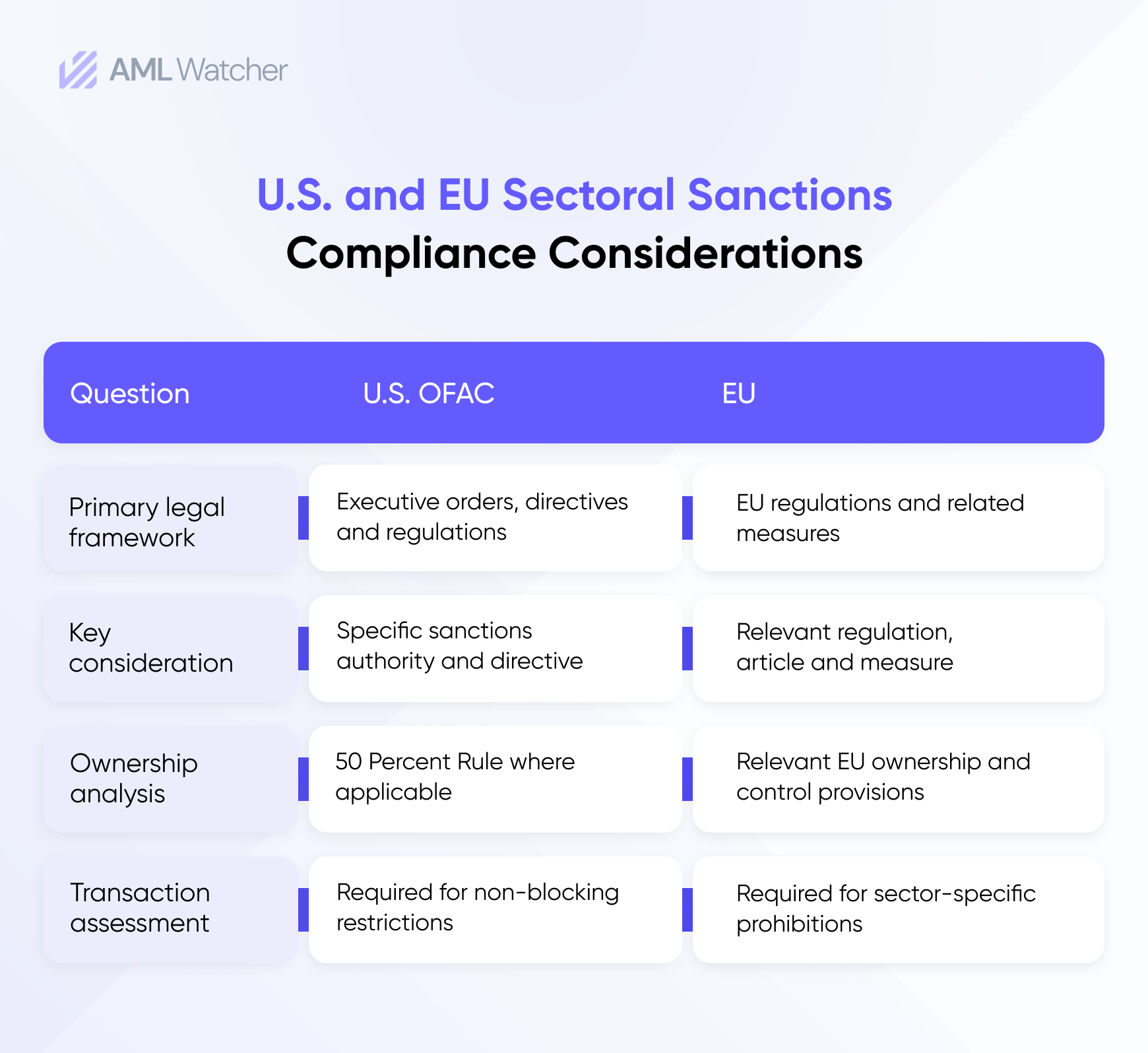
The U.S. SSI framework is a useful example, but assess sectoral sanctions under the legal framework applicable to the transaction. In the EU, for example, restrictions are established through EU regulations and related measures and supplemented by European Commission guidance. Compliance teams therefore need to identify the relevant jurisdiction and legal authority before applying screening rules.
Sectoral Sanctions vs Blocking Sanctions and Other Sanctions
One important distinction is that an entity identified on OFAC’s Sectoral Sanctions Identifications (SSI) List is not automatically subject to blocking sanctions. SSI restrictions generally prohibit the specific types of dealings identified in the applicable directive rather than imposing a blanket asset freeze. However, an entity can also be subject to other OFAC sanctions, including blocking sanctions, so screening results need to be assessed against all applicable sanctions authorities.
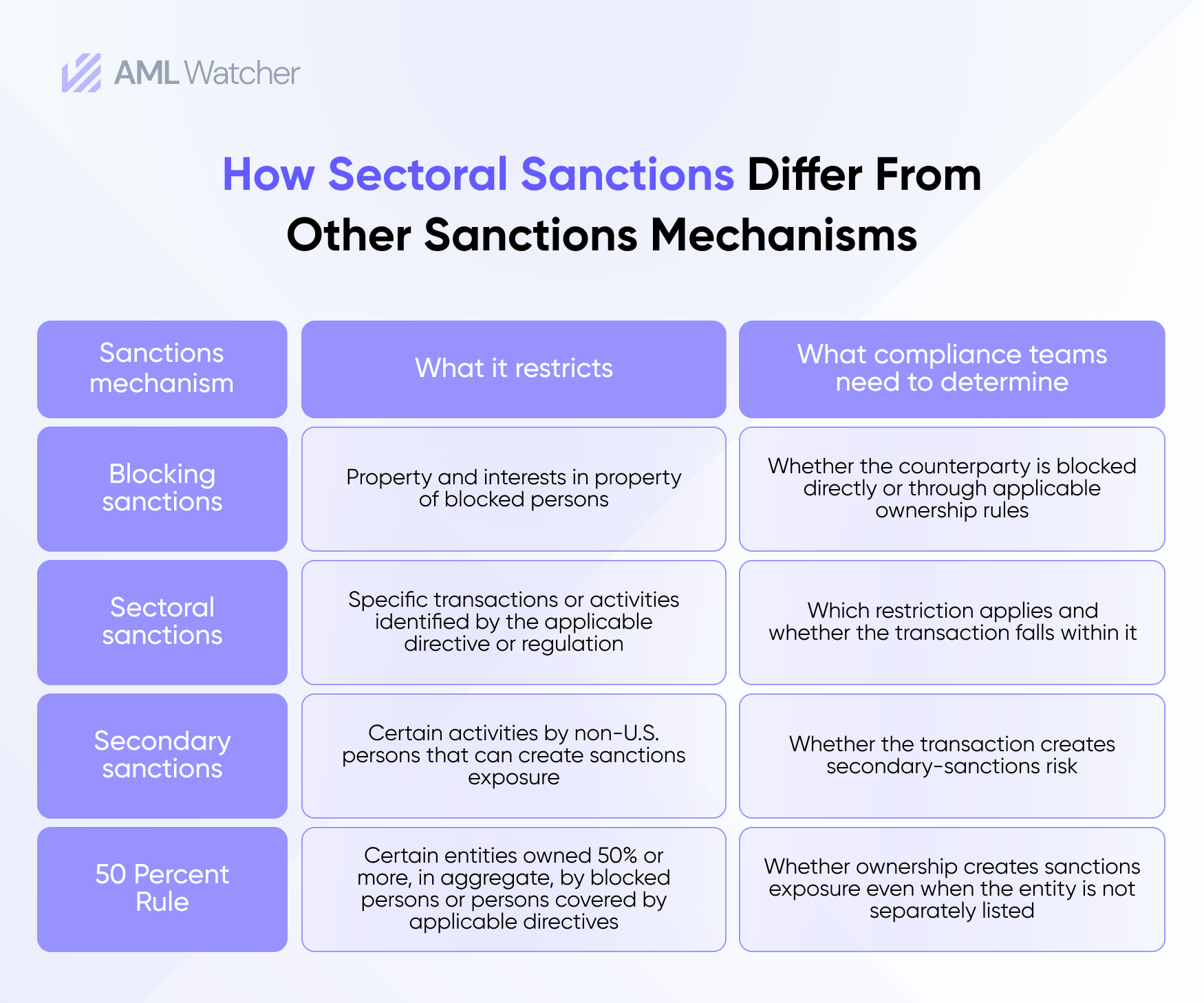
What this means for compliance teams:
A sanctions screening alert is not always the final compliance decision. For a potential sectoral sanctions alert, the analyst needs to determine which sanctions authority applies, what transaction is being proposed and whether the relevant restriction covers that activity. Sectoral sanctions screening therefore requires transaction-level context alongside name screening.
Example: Why an SSI Match Does Not End the Analysis
Consider a counterparty subject to a Russia-related directive restricting certain new debt and equity transactions. A name-screening system may correctly identify the counterparty as an SSI match, but that result alone does not establish that every proposed transaction is prohibited. The analyst must compare the proposed activity with the restrictions in the applicable directive and assess any other sanctions authorities that apply. OFAC states that individual directives operate independently, meaning a transaction involving a person subject to multiple directives must comply with each applicable restriction.
Why Jurisdiction Matters in Sectoral Sanctions
When assessing sectoral sanctions, it’s essential to evaluate the transaction’s jurisdictional connection. Therefore, it is important to determine not only if a counterparty is affected by a specific restriction, but also if the transaction involves a person, organization, activity or location that is subject to the relevant sanctions authority.
Moreover, the U.S. sanctions requirements can differ depending on whether the transaction involves a U.S. person or falls under U.S. jurisdiction. As a result, it’s important for sanctions controls to include details about the parties involved, payment processes, services, products, and other relevant factors that determine if a specific restriction applies.
Sectoral Sanctions in AML: Why the Nuance Matters for Screening
The operational challenge is turning a sanctions match into a documented decision about the transaction. The volume and scope of sanctions measures also continue to change. The EU’s 21st Russia sanctions package, adopted on 23 July 2026, added 218 listings, including 48 individuals and 170 entities, while introducing additional measures covering areas including energy, financial services, crypto and trade. Sanctions lists change, while the transaction categories covered by those measures can also evolve.
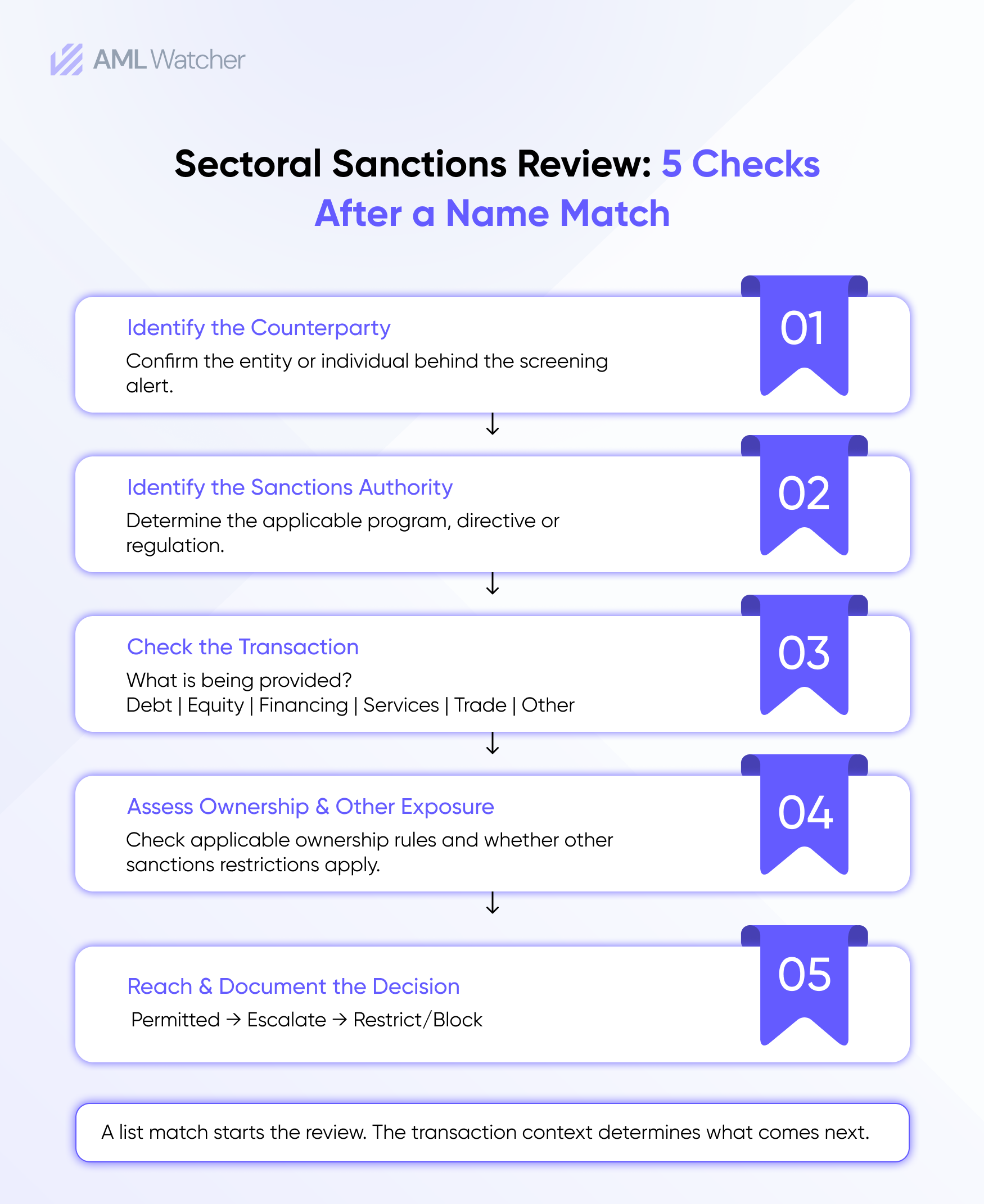
Ownership can create an additional screening factor under the 50 Percent Rule from OFAC. When this rule applies, OFAC prohibits entities that are owned 50% or more, either directly or indirectly, by individuals or entities subject to these restrictions. For instance, an entity may face restrictions even if it is not listed by name. Thus, it is important to check if this rule applies to the specific directive that is being reviewed.
Sectoral Sanctions Compliance: What Regulators Expect
A sectoral sanctions control needs to translate a potential match into a documented assessment of the restriction, transaction and applicable authorization.
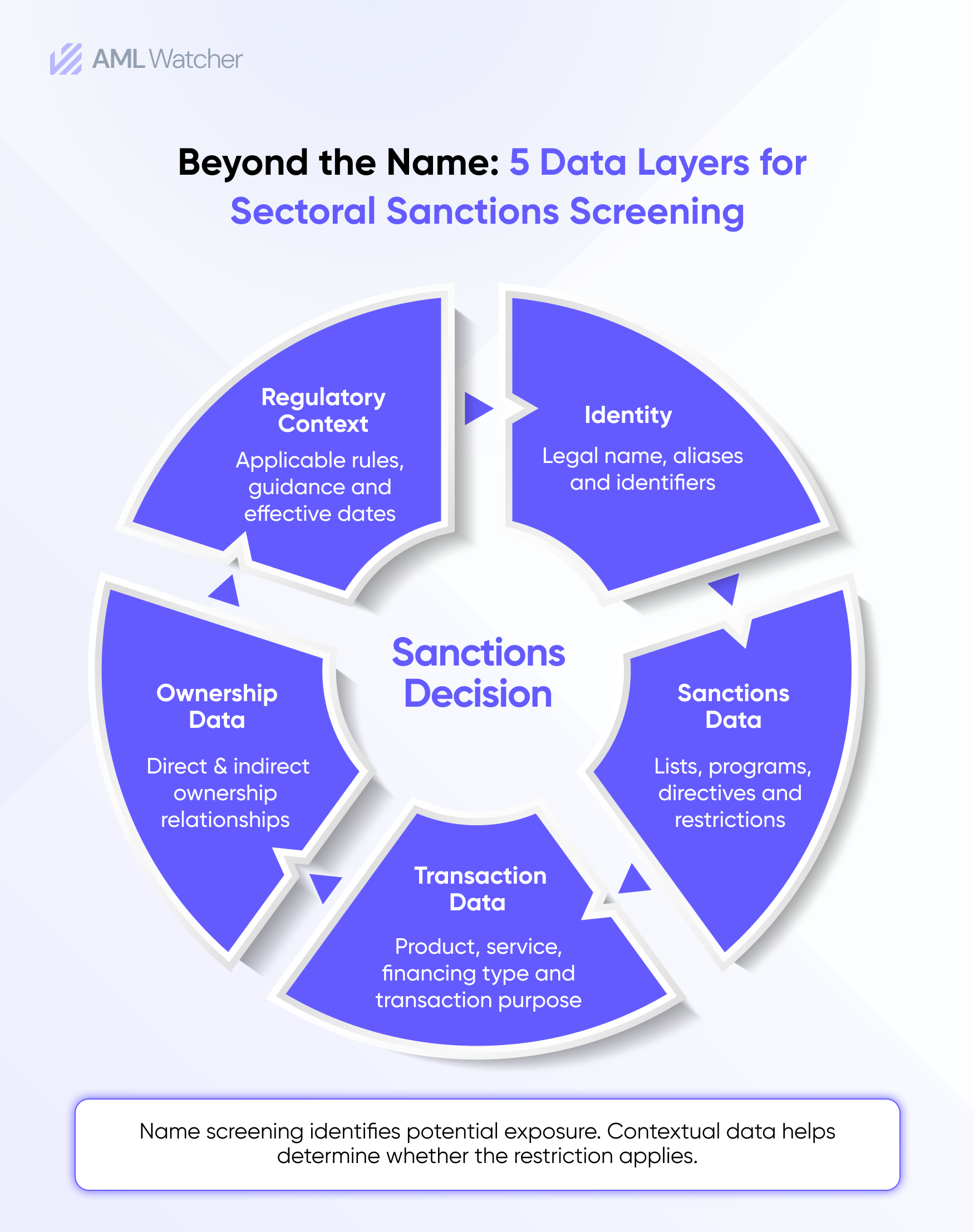
- Identify the applicable sanctions authority and restriction when a potential match is detected.
- Determine whether the transaction, service or financing activity falls within the relevant prohibition.
- Assess direct and indirect ownership relationships and other relevant control information where applicable sanctions rules extend restrictions beyond the named entity.
- Maintain current sanctions data and relevant regulatory guidance.
- Document the rationale for clearing, escalating or restricting a transaction.
- Check whether an applicable general license, specific license, exemption or other authorization affects the restriction.
Sectoral sanctions can also change an existing customer’s compliance position without changing the customer’s name or core identity data. Ongoing sanctions-data updates and rescreening therefore remain relevant even when customer information is unchanged. Screening controls should therefore separate match identification from assessing whether the proposed activity is restricted.
How AML Watcher Supports Sectoral Sanctions Screening
AML Watcher provides sanctions screening across 215+ regimes and 3,500+ watchlists, with sanctions data refreshed every 15 minutes. Its screening capabilities include multilingual, phonetic and transliteration-based matching, supporting identification of name variations across languages and data sources.
TruRisk adds an AI-driven review layer for screening alerts, helping identify potential true positives and reduce manual review effort. AML Watcher reports a 70–80% reduction in manual workload and describes reasoning behind true-positive decisions as part of the TruRisk workflow. This can support analysts in prioritizing alerts for further investigation, while the underlying sanctions assessment still depends on the applicable rules and transaction facts.
Why Sectoral Sanctions Screening Requires More Than Name Matching
Sectoral sanctions turn sanctions screening into a context-based assessment. A potential match is only the starting point. The final analysis may depend on the applicable directive, transaction, jurisdiction, ownership structure and any available authorization.
For compliance teams, the goal is therefore to connect reliable sanctions data with the information needed to assess the underlying activity. That approach becomes more important as sanctions regimes continue to expand across financial services, energy, technology and other sectors.
- No commitment needed
- Complete AML Database at your service
- Access our all-in-one dashboard


Tier-2 PSPs in ... must demonstrate automated monitoring, layered CDD, &...
See the Full Regulatory Expectation70–80% less manual work, 95% less fatigue, TruRisk Agent makes compliance effortless.
Experience Agentic AMLMove Beyond Articles. Activate AML Intelligence.
Switch to AML Watcher today and reduce your current AML cost by 50% - no questions asked.
- Find right product and pricing for your business
- Get your current solution provider audit & minimise your changeover risk
- Gain expert insights with quick response time to your queries