


 Alert!


Understanding Fiat Currency from Traditional Money to Crypto and AML
Crypto
September 30, 2026


- What Is Fiat Currency? Definition and Meaning
- What Is Fiat Money and How Does It Work?
- Forms of Money in a Fiat Monetary System
- How Fiat Currency Became the Modern Monetary Standard
- Fiat Currency vs Cryptocurrency: What Is the Difference?
- Why the Fiat-to-Crypto Connection Matters for AML Compliance
- Common AML Risks Associated With Fiat Transactions
- Example of a Fiat-to-Crypto AML Risk Pattern
- How Financial Institutions Can Monitor Fiat-Related Risk
- How AML Watcher Helps Identify Risk Across Financial Activity

Financial activity increasingly moves between bank accounts, payment systems, crypto platforms, and digital wallets. For financial institutions, fintechs, payment providers, and crypto businesses, understanding what fiat currency is helps establish how traditional money interacts with digital assets and where AML monitoring may need to connect activity across these channels.
The distinction between fiat currency and digital assets becomes particularly relevant when financial activity moves between traditional banking systems and blockchain-based platforms.
What Is Fiat Currency? Definition and Meaning
Fiat currency refers to money not redeemable for a fixed quantity of a physical commodity such as gold or silver. Its use and value are supported by the monetary, legal, and financial institutions of the issuing jurisdiction, as well as confidence in the wider economy.
The US dollar, euro, British pound, Japanese yen, and Chinese yuan are examples of modern fiat currencies. Their value does not come from the physical material used to produce notes or coins. Instead, their usefulness depends on the wider monetary system in which they operate.
Fiat currency can exist as physical cash or as balances recorded within the banking system. This distinction matters because modern financial activity largely involves electronic transfers rather than physical notes and coins.
What Is Fiat Money and How Does It Work?
Fiat money operates within a monetary system supported by central banks, commercial banks, payment infrastructure, and legal institutions. Central banks influence monetary conditions through tools such as policy interest rates, while commercial banks provide deposit accounts and payment services through which much everyday economic activity takes place.
Fiat money functions through the interaction of monetary authorities, commercial banks, payment infrastructure, and legal institutions. Central banks influence monetary conditions, while commercial banks provide deposit and payment services used for much of everyday economic activity.
Forms of Money in a Fiat Monetary System
Fiat money should not be equated with physical cash. Modern monetary systems include several forms of money, including cash, commercial bank deposits, and central bank reserves. The BIS distinguishes between central bank money and commercial bank money within this two-tier structure.
Fiat money can appear in different forms within the financial system. Such as:
- Physical cash consists of notes and coins issued under the authority of the relevant monetary system.
- Commercial bank deposits represent money held in customer accounts. They are digital records rather than physical notes, but they are denominated in the same national currency.
- Central bank money includes physical currency and reserves eligible financial institutions hold at the central bank.
This distinction matters for AML teams because most monitored financial activity is recorded electronically rather than involving physical cash directly. Most transactions now take place online, creating records teams can review to spot unusual trends, participants, geographic exposure, and changes in how customers normally transact.
How Fiat Currency Became the Modern Monetary Standard
Throughout history, money has existed in several forms. Initially, precious metals served as commodity money, valued because the material itself had value. Eventually, paper instruments emerged, representing claims on commodities held in reserves.
Following World War II. The Bretton Woods system was established, which pegged the United States dollar to gold while other currencies were linked to the dollar. However, this arrangement proved to be unsustainable, leading the United States to abandon the dollar’s convertibility into gold in 1971.
Fiat Currency vs Cryptocurrency: What Is the Difference?
Fiat currency vs cryptocurrency is fundamentally a comparison between different monetary and technological structures.
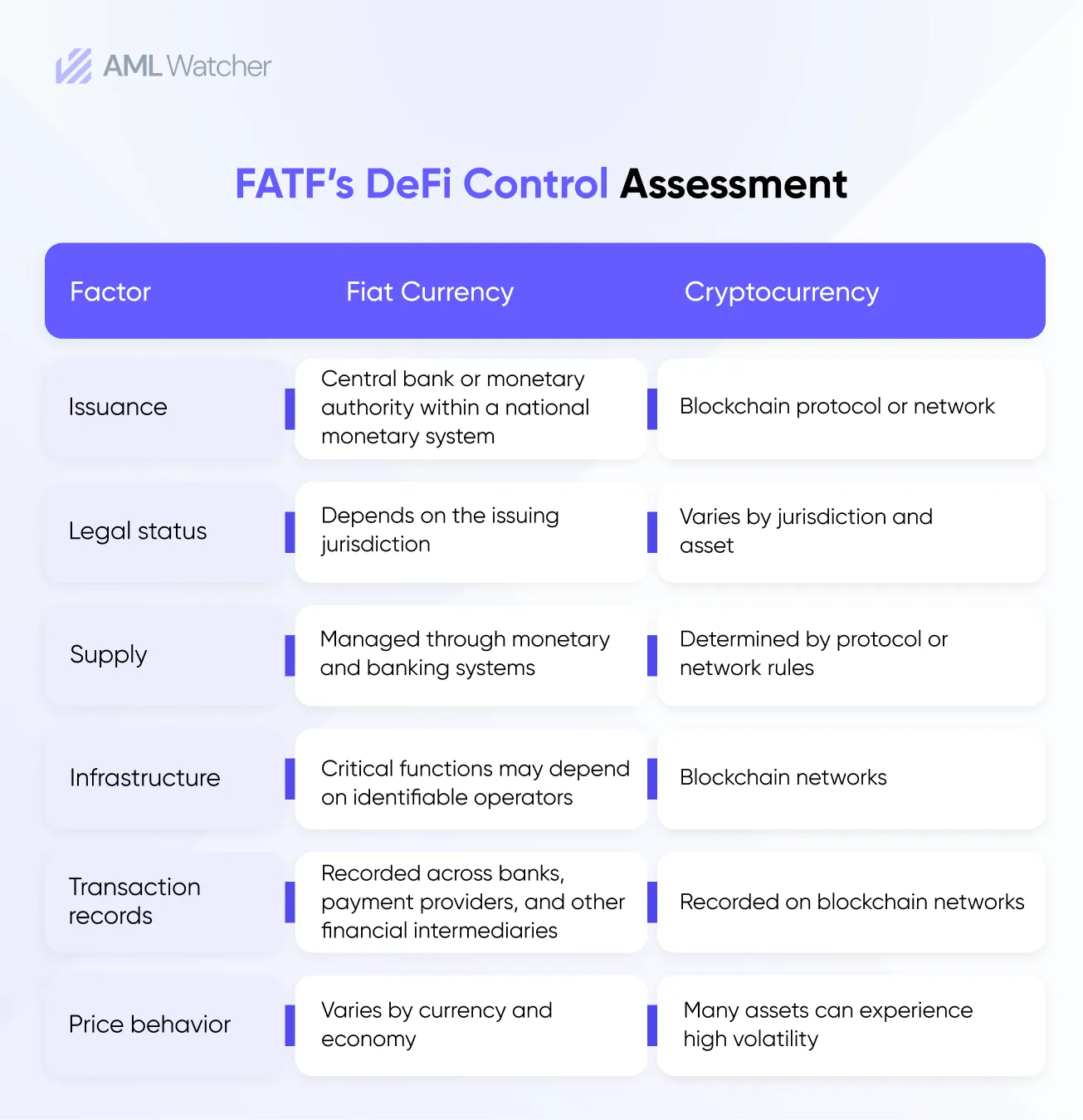
Cryptocurrency is not simply another form of fiat currency. Bitcoin is a decentralized currency, with no central institution controlling its issuance that issues it. It uses a protocol that sets out how it is issued and supplied, and the blockchain keeps a public record of those transactions.
Stablecoins deserve particular attention because they can be designed to maintain a value linked to a fiat currency while transactions occur using blockchain infrastructure. This link bridges conventional financial systems and digital asset platforms, which is significant for effective AML monitoring.
Why the Fiat-to-Crypto Connection Matters for AML Compliance
AML monitoring becomes more complex when funds move among payment platforms, bank accounts, crypto exchanges and blockchain addresses.
A customer may deposit fiat into a crypto platform, purchase a digital asset, transfer it to another wallet, and later convert proceeds back into fiat. Each stage can reveal different types of data relevant to the underlying activity.
FATF’s July 2026 targeted update on virtual assets as well as VASPs reports ongoing gaps in implementing Recommendation 15. It highlights risks involving stablecoins, peer-to-peer transactions through unhosted wallets, offshore VASPs, and other virtual-asset activities.
Regulatory treatment differs across the jurisdictions. In the United States, FinCEN’s guidance states that certain administrators and exchangers of convertible virtual currency may be treated as money transmitters under the Bank Secrecy Act framework, subject to applicable limitations or exemptions.
This means compliance programs may need to include customer due diligence, transaction monitoring, sanctions screening, and suspicious activity reporting, where applicable. The exact obligations depend on the institution, activity, and jurisdiction.

Common AML Risks Associated With Fiat Transactions
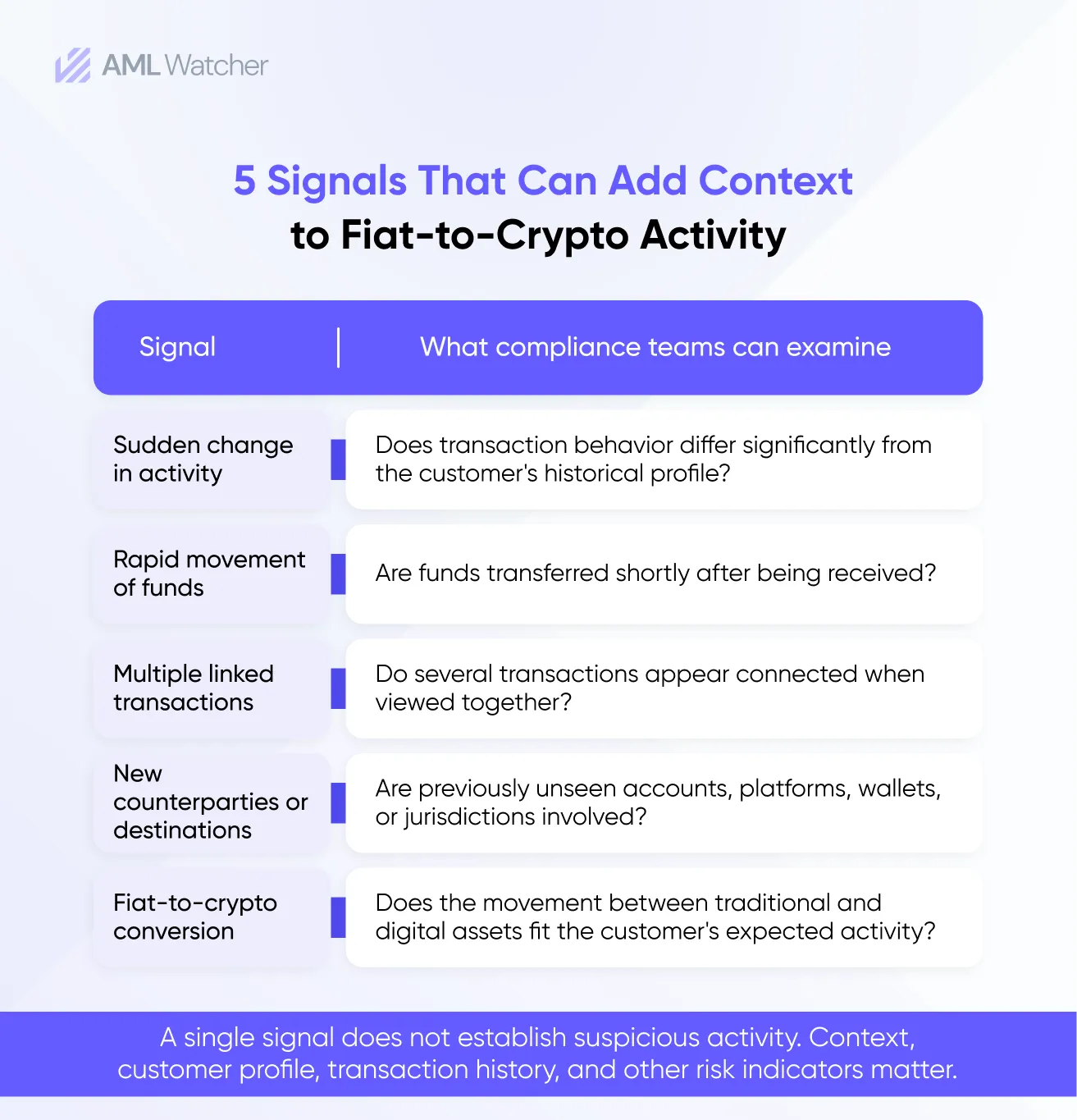
Fiat-related AML risk is rarely determined by a single transaction. Compliance teams may instead assess combinations of transaction velocity, unusual departures from a customer’s normal activity, unexplained cross-border transfers, structuring indicators, higher-risk geographic exposure, and unexpected movement between fiat and digital assets.
The context surrounding the transaction also matters. A large transaction is not automatically suspicious, while a smaller transaction can form part of a suspicious pattern when considered alongside the other activity, customer information, counterparties, geography, and transaction history.
Example of a Fiat-to-Crypto AML Risk Pattern
Consider a customer whose account historically shows regular salary payments and ordinary household spending. A sudden series of large fiat deposits is followed by rapid transfers to a crypto platform and subsequent movement of digital assets into external wallets.
None of these transactions alone necessarily establishes suspicious activity. Even so, the change from the customer’s historical behavior, the rapid movement of funds, and the connection between the bank account and digital-asset activity can help investigators understand the wider pattern for transaction monitoring and investigation.
A risk-based monitoring framework can therefore assess transaction behavior alongside customer information and historical activity instead of viewing every payment as an isolated event.
How Financial Institutions Can Monitor Fiat-Related Risk
Effective monitoring generally connects several stages of the AML process.
| Customer onboarding → risk assessment → transaction monitoring → alert generation → investigation → reporting or escalation |
Customer risk can change after onboarding as transaction behavior, counterparties, and geographic exposure evolve. Ongoing monitoring therefore needs to assess activity against the customer’s expected profile and relevant risk indicators.
AML Watcher’s Transaction Monitoring combines 150+ expert-curated AML typologies with 10,000+ customizable risk rules and real-time transaction alerts. The system assesses transactions in the context of both past and current customer data to help compliance teams identify unusual patterns as well as investigate relevant alerts.
How AML Watcher Helps Identify Risk Across Financial Activity
This method enables financial institutions to tailor their monitoring processes to specific customer segments and transaction behaviors, aligning them with the institution’s risk tolerance instead of relying solely on fixed preset thresholds.
- No commitment needed
- Complete AML Database at your service
- Access our all-in-one dashboard


Tier-2 PSPs in ... must demonstrate automated monitoring, layered CDD, &...
See the Full Regulatory Expectation70–80% less manual work, 95% less fatigue, TruRisk Agent makes compliance effortless.
Experience Agentic AMLMove Beyond Articles. Activate AML Intelligence.
Switch to AML Watcher today and reduce your current AML cost by 50% - no questions asked.
- Find right product and pricing for your business
- Get your current solution provider audit & minimise your changeover risk
- Gain expert insights with quick response time to your queries