

 Alert!

Decision-Led AML Screening: A Practical Model for Faster Reviews
AML Compliance
January 2, 2026


- Why AML Screening Slows Down After the Alert
- How Alert-Led Screening Creates Operational Roadblocks:
- What Difference Does Decision-Led Screening Make:
- Understanding AML Watcher’s AI Compliance Agent
- What are the use cases of an AI compliance agent?
- Why Use-Case Driven AI Matters in AML Compliance
- Why AML Watcher’s AI Compliance Agent Stands Out

AML screening has never been about generating alerts. It has always been about making the right decisions based on those alerts. Yet, for many compliance teams, the reality is far from ideal.
The real delay, however, comes after the alerts. Large volumes of search results, limited context, and manual reviews significantly slow down operational efficiency. This is where most screening programs slow down.
AML Watcher’s AI Compliance Agent was built with this reality in mind. Instead of focusing on an alert-led approach to AML screening, it provides decision support that helps compliance teams interpret data at a faster pace.
Why AML Screening Slows Down After the Alert
AML screening can generate hundreds of results in seconds, especially when a financial institution screens a common name or works across multiple jurisdictions.. The delay in this process is in individually categorizing each search result. With every search result requiring context and documentation to support whatever decision is made, this exercise can sometimes take days!
That is where most screening programs slow down in practice. Large result sets, limited identifiers, noisy adverse media, and manual evidence gathering create a repetitive cycle for compliance teams. Reviewers must compare names, dates, locations, and affiliations, then write a narrative that explains why a result was cleared or escalated, often while managing queues that keep growing throughout the day.
At AML Watcher, the Compliance AI Agent is designed for this “after the alert” workload by supporting reviewers with match reasoning that helps convert screening outputs into defensible outcomes across sanctions, PEPs, watchlists, and adverse media.
How Alert-Led Screening Creates Operational Roadblocks:
Traditional AML screening systems are designed around alerts, where the process begins with a list of candidates and ends only when a reviewer closes each one with a defensible outcome.
That model can work at small volumes, but it becomes difficult to sustain as institutions grow, expand into new regions, or increase product coverage, leading to increased screening activity.
In day-to-day operations, the highest operational cost does not come from generating hits, but from resolving compliance alerts while maintaining quality. Four issues usually combine to slow things down:
- High volumes of near matches appear for common names, transliterations, and partial identifiers, so reviewer effort increases even when the underlying risk is low.
- Context is often fragmented across systems and data points, leading reviewers to search for basic information rather than resolve alerts.
- Documentation becomes inconsistent across reviewers and teams, increasing rework during Quality Assurance and creating uneven audit trails.
- Customer onboarding slows when alerts become a queue, creating friction in customer journeys.
This is why the bottleneck occurs after the alert. Screening generates possibilities quickly, but reviewing and documenting each alert is what limits output.
What Difference Does Decision-Led Screening Make:
The essential difference between alert-led and decision-led screening is that the latter incorporates justification into the search process. When a name is searched against the database, decision-led screening produces a list of possible matches, using structured reasoning to show what aligns, what conflicts, and why a result is relevant or irrelevant based on the available data.
This shift matters because reviewers do not need to rebuild the same context repeatedly for every candidate. Review time drops when mismatches are clear early, and documentation becomes more standard when reasoning is visible at the point of review rather than written from memory at the end.
Understanding AML Watcher’s AI Compliance Agent
AML Watcher’s AI Compliance Agent works alongside the platform’s advanced screening engine and continuously refreshed data layer. When a search query is entered into the system, the screening engine returns multiple results, often numbering in the hundreds.
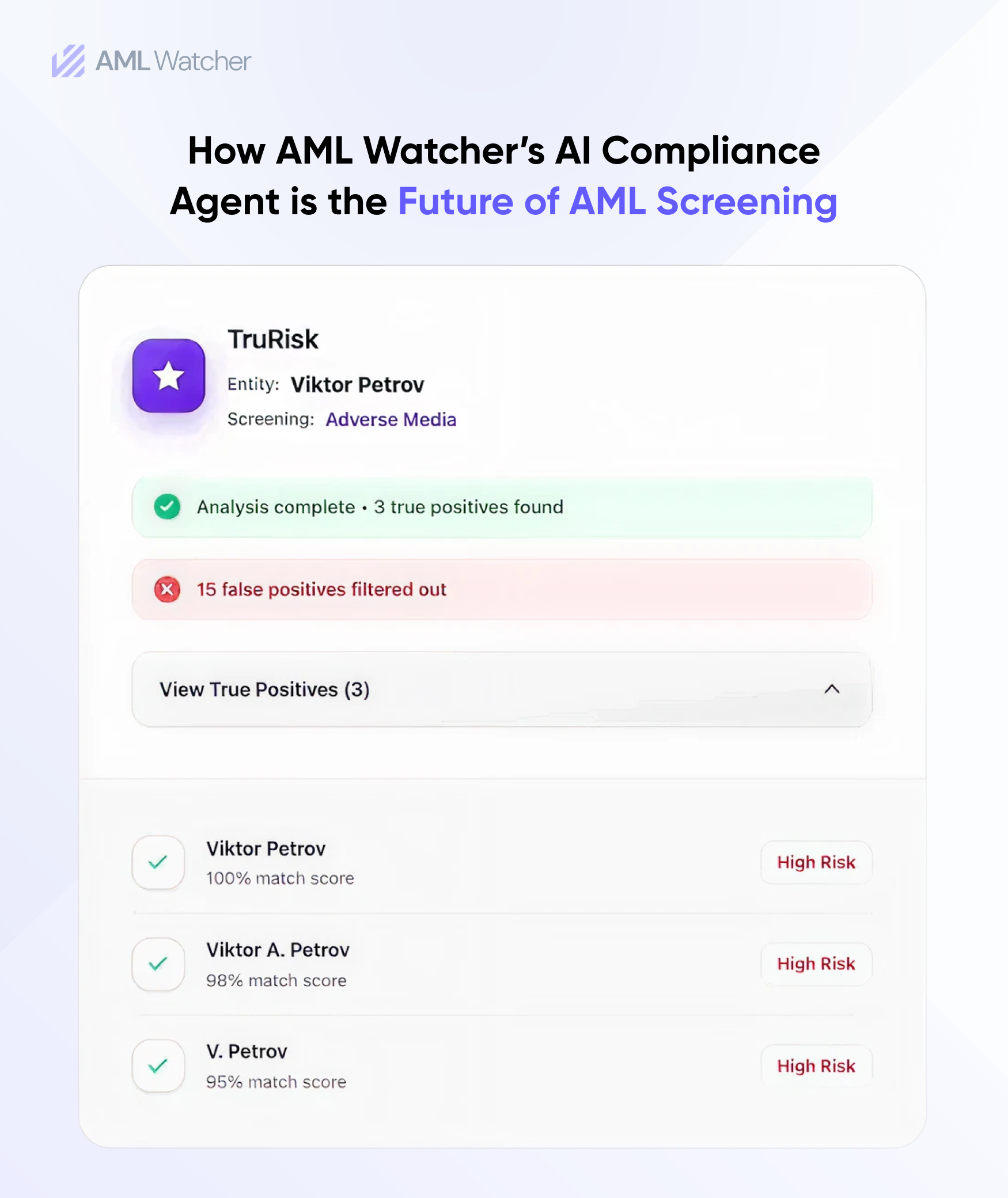
The AI Compliance Agent evaluates each result on search parameters (e.g., name, date of birth) and generates a concise AI evaluation for each match. These evaluations explain why a result is likely a true match or a false positive, using clear, human-readable justifications.
Compliance officers can categorize results as:
- False positives.
- Likely True Matches.
What are the use cases of an AI compliance agent?
- Managing High-Volume Name Screening Results:
Name screening often generates the highest alert volume, especially with common names, such as John. Reviewing hundreds of results manually is time-consuming and inefficient.
With AML Watcher’s AI Compliance Agent, each search result is complemented by an evaluation explaining the rationale for the match. A result may indicate that the searched name and date of birth align precisely with the result, indicating a high-confidence match. Others may be flagged as low relevance due to mismatched identifiers.
The ability to filter results to show specific categorizations only, such as false positives, allows compliance teams to immediately focus on the few matches that matter, rather than reviewing every possible hit.
- Reducing Manual Review of False Positives
Aside from screening issues, false positives also create a documentation burden. Every false-positive alert requires time to review, justify, and record.
AML Watcher’s AI Compliance Agent solves this issue by pre-classifying results based on data consistency. Compliance officers can quickly identify false positives and document their decisions, using the AI-provided explanation as supporting context.
In this way, the AI agent significantly reduces the manual review effort needed for every alert while maintaining transparency.
- Frictionless Customer Onboarding:
Delays in AML screening often lead to slower onboarding and customer loss. When compliance teams are overloaded with alerts, onboarding decisions stall, and a frustrating onboarding experience might also result in customers leaving the onboarding process entirely and choosing an alternative financial institution for their activities.
Through clear identification of true positives and eliminating low-risk matches early in the process, AML Watcher’s AI Compliance Agent enables faster screening outcomes, allowing customers to experience a lower friction onboarding process.
- Audit Readiness and Governance
Explainability is a critical requirement in AML compliance. Regulators expect institutions to provide clear justifications for their actions.
AML Watcher’s AI Compliance Agent supports strong governance by keeping the human reviewer in control. While compliance professionals make the final decision, the AI agent provides documented explanations for why a result was categorized as it was.
Consequently, AI-assisted reasoning strengthens audit trails and simplifies regulatory reviews.
- Scaling Compliance Without Expanding Headcount
Compliance operations often struggle with business expansion, and hiring/ training a larger compliance workforce is costly and time-intensive.
AML Watcher’s AI Compliance Agent enables higher screening volumes without linear growth in resources. Through automating evaluation, the agent allows existing teams to manage more alerts efficiently, supporting market expansion and business growth with no adverse effect on compliance standards.
Simply put, AML Watcher’s AI compliance Agent allows financial institutions to scale their business, enter new markets, and process a significantly larger amount of screening reviews.
Why Use-Case Driven AI Matters in AML Compliance
The use of AI in AML compliance is only effective when it fits real workflows. AML Watcher’s AI Compliance Agent was designed not as a replacement for compliance professionals but as a decision-support tool that removes roadblocks associated with alert-led screening.
With a decision-led approach on how screening results are reviewed, categorized, and documented, the AI Compliance Agent transforms screening from a volume-driven task into an organized, explainable process.
Why AML Watcher’s AI Compliance Agent Stands Out
AML Watcher’s AI Compliance Agent combines three critical elements:
- A continuously refreshed and enriched data layer.
- Intelligent evaluation of screening results.
- Clear justifications that explain every decision for compliance teams.
At AML Watcher, we understand the daily challenges compliance teams face.
That’s why we designed and launched AML Watcher’s AI Compliance Agent. To empower compliance teams to function efficiently, focus on real risks, and adhere to regulatory demands.

- No commitment needed
- Complete AML Database at your service
- Access our all-in-one dashboard


Tier-2 PSPs in ... must demonstrate automated monitoring, layered CDD, &...
See the Full Regulatory Expectation70–80% less manual work, 95% less fatigue, TruRisk Agent makes compliance effortless.
Experience Agentic AMLMove Beyond Articles. Activate AML Intelligence.
Switch to AML Watcher today and reduce your current AML cost by 50% - no questions asked.
- Find right product and pricing for your business
- Get your current solution provider audit & minimise your changeover risk
- Gain expert insights with quick response time to your queries