


 Alert!

Biggest AML Fines of 2025
AML/CFT
January 26, 2026


2025 marks a historic year in regard to the enforcement against money laundering. Regulators have intensified their scrutiny and are working more on penalizing institutions with weak financial crime controls. Most of the Bank, FinTech, cryptocurrency, and gambling firms received penalties due to failures in monitoring client transactions, screening them against the restricted lists, and performing KYC checks.
Such high-profile cases make it obvious that issues of compliance are no longer a casualty of oversights anymore they cause severe financial and reputation effects.
The lessons learned about what went wrong in 2025 may be valuable for firms that aim to enhance their AML programs and stay ahead of the changing regulatory requirements.
Did You Know?
According to the FCA, the total fines published in 2025 as of January 16, 2026, amount to £124, 221,367.45, excluding court fines.
Such figures depict the extent to which regulators have become serious regarding the enforcement of compliance and why all financial institutions should have strong proactive controls.
Let’s take a closer look at these fines and analyze how many were incurred across various sectors.
Key AML Fines in 2025 Across Different Sectors
Across different sectors, 2025 saw some significant AML fines. Here’s a breakdown of the companies involved and the reasons behind the penalties.
Crypto AML Fines in 2025
The digital assets, such as stablecoins, blockchain financial products, cryptocurrencies, and Non-fungible Tokens (NFTs), are under intense scrutiny by regulators. In 2025, the crypto sector faced massive penalties, marking a particularly challenging year.
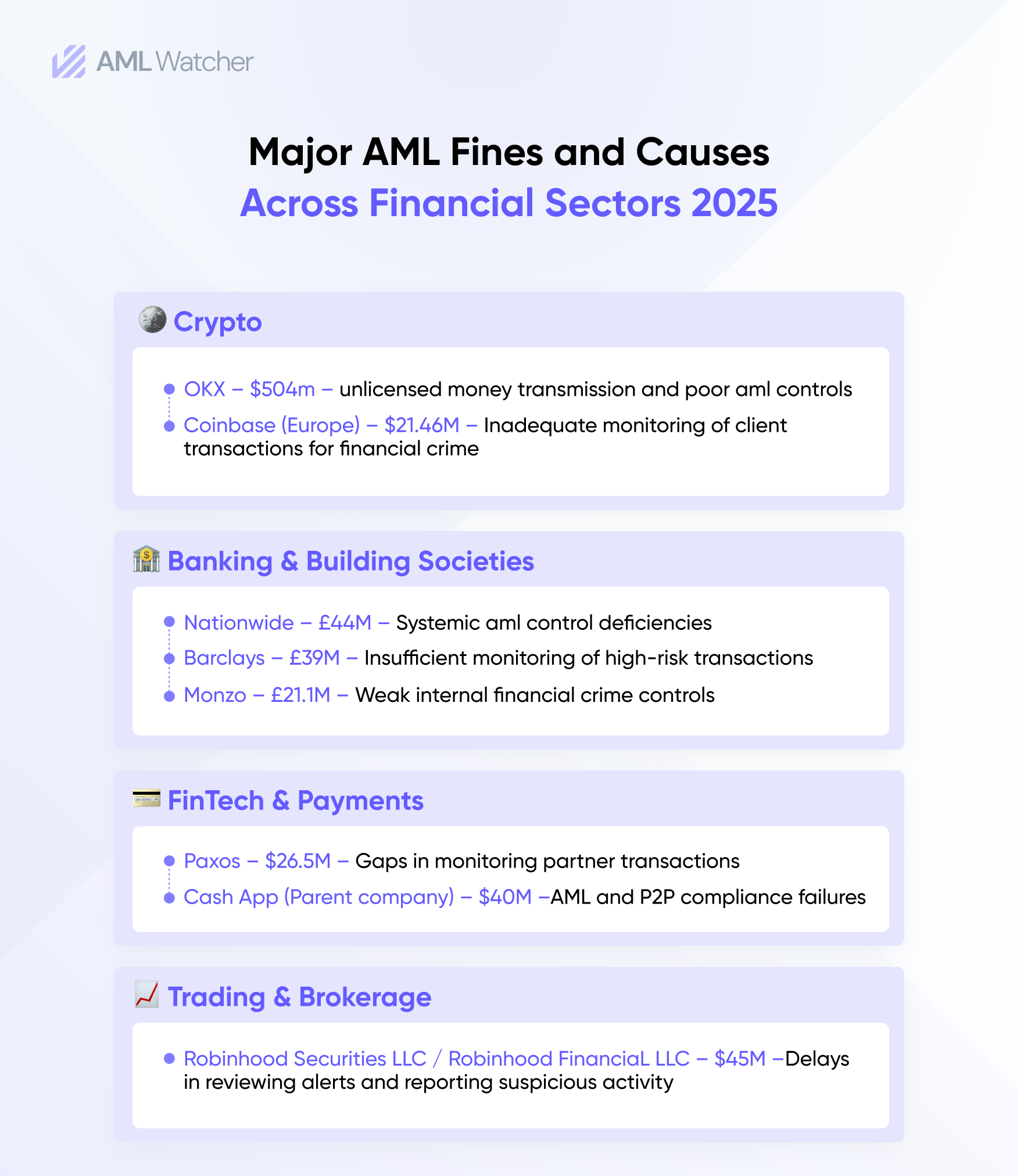
One significant case of crypto AML fines involved a major exchange named OKX, which agreed to pay more than $504 million after pleading guilty to unlicensed money transmission and poor AML controls. Authorities found a “growth at all costs” mentality on board millions of users with little KYC or sanctions checks.
Another famous penalty in the crypto sector in 2025 was when the Central Bank of Ireland penalized Coinbase’s European arm for failing to properly track client transactions for financial crime risks. Regulators claim that over several years, more than 30 million transactions worth about €176 billion weren’t checked properly, mainly because their systems weren’t set up correctly. For this negligence, Coinbase was fined €21.46M by the Central Bank of Ireland
These crypto AML fines highlight that aggressive growth without compliance will not protect firms.
Banking AML Fines in 2025
Traditional banks and building societies also felt the sting. Banks faced huge fines in 2025 because of weak AML controls. For example, the UK’s FCA fined Nationwide Building Society £44M in December 2025 for inadequate anti-financial crime systems.
Barclays Bank plc was fined £39,314,700 for failing to monitor high-risk clients, allowing criminal funds through the system. These penalties are part of the broader £42 million penalty the FCA imposed on Barclays in 2025.
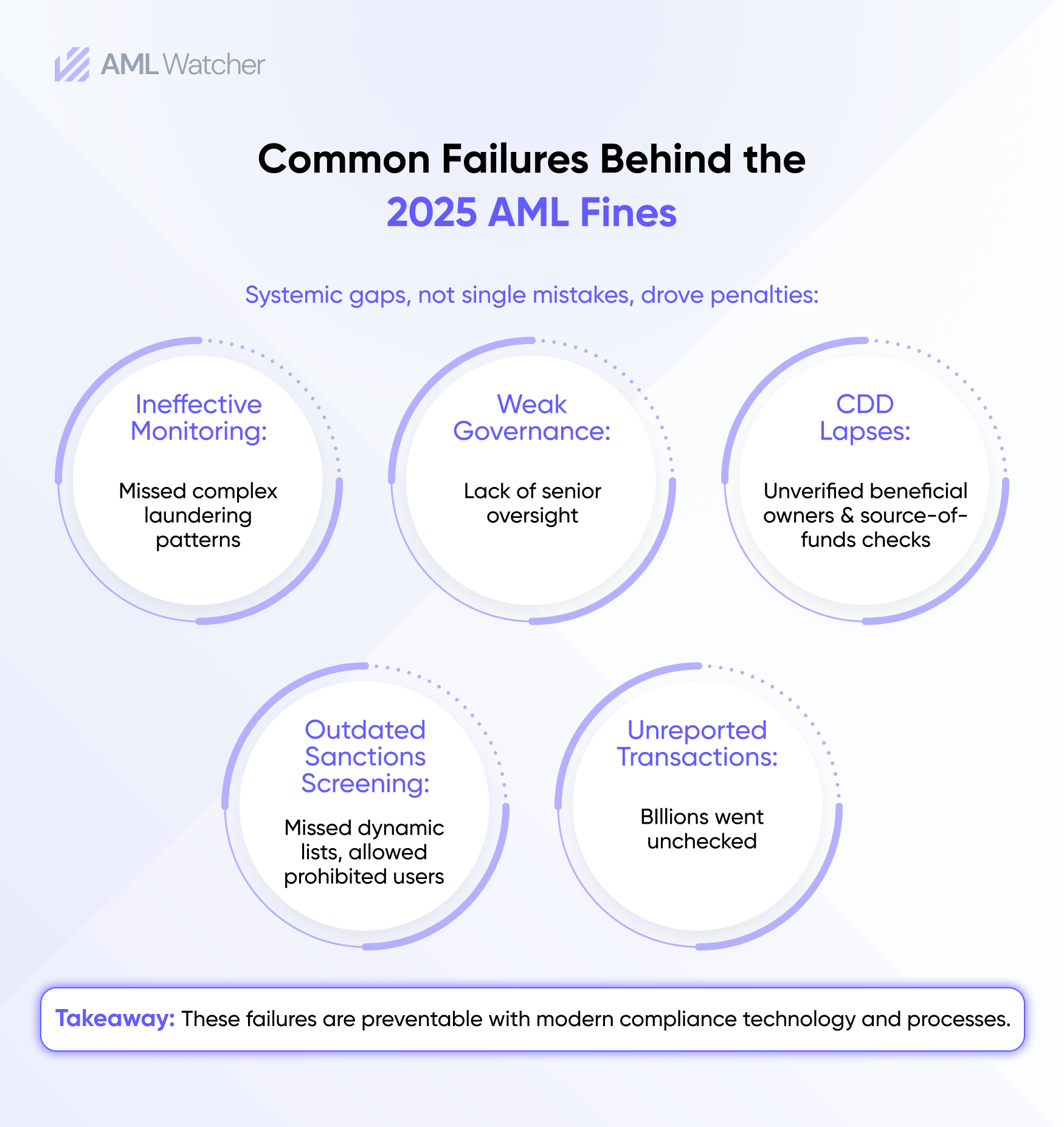
Common causes were outdated monitoring systems that missed clear suspicious patterns, siloed data that hid risks across products, and understaffed alert teams.
In one banking AML fines 2025, the FCA fined Monzo Bank about £21M for inadequate anti-financial crime systems and controls between October 2018 and August 2020.
These cases show that if the missing alerts allow criminals to slip through in an institute, regulators are ready to impose severe anti-money laundering penalties on them.
Fintech AML Penalties in 2025
Fintechs and payment processors saw some of 2025’s largest fines in their sector. In the US, New York regulators fined Paxos Trust Company $26.5M for failing to monitor illicit flows from partner Binance.
Similarly, Block.Inc., the Cash App’s parent, was hit with a $40M fine after New York State Department of Financial Services (NYDFS) found AML screening lapses that left its P2P platform vulnerable. The pattern is clear, rapid onboarding of users or services without parallel compliance growth leads to big penalties.
One takeaway from these FinTech AML penalties is that the most growth-oriented firms must invest heavily in human oversight of automated onboarding; otherwise, regulators will take enforcement actions.
AML Fines in the Trading and Brokerage Sector
Securities platforms and brokerages are not immune. 2025 has been a challenging year for the trading and brokerage sector in terms of penalties.
For example, Robinhood Securities LLC and Robinhood Financial LLC agreed to pay $45 million for failures in suspicious activity reporting and other compliance deficiencies as reported by a U.S. Securities and Exchange Commission press release.
Key issues included delays in reviewing alerts and filing suspicious activity reports, which were inadequate for the company’s scale. In short, the firm’s monitoring and reporting systems were not sufficient for its scale of operations.
This fine shows that even fintech brokers and trading platforms must adopt real-time monitoring and reporting systems to stay compliant with AML regulations.
AML Fines in Gambling
The gaming and gambling sector continues to face significant fines for AML lapses, highlighting ongoing regulatory scrutiny.
Common findings were inadequate risk-based checks on customers and products, poor due diligence on players, and failure to identify sources of funds for large transactions.
For example, in August 2025, ProgressPlay Limited received £1 million from the UK Gambling Commission for failing to properly verify player funds and monitor high-risk accounts, while Platinum Gaming Limited received a £10 million penalty from the UKGC in October 2025 for significant gaps in AML and safer gambling controls. Several high-profile cases are set to conclude in 2026, suggesting this sector’s total fines may climb further.
Hence, gambling operators must rigorously apply the same CDD standards as banks, or face “massively avoidable” penalties.
Regulators worldwide are on a “crackdown” footing. AML fines globally jumped 417% in H1 2025 compared to H1 2024, driven largely by crypto sector violations. As noted by Sarah Jane Boon from Norton Rose Fulbright in AML Enforcement on the Rise, the global AML fines hit $10.4 billion in 2024, and that trend shows no sign of slowing.
How Can You Prevent AML Failures with AML Watcher?
The experience of 2025 shows that gaps in monitoring customer risk can be catastrophic. Many financial institutions face penalties not only for onboarding errors but also when changes in customer behavior or emerging risks go unnoticed.
To prevent fines and reputational damage, institutions need proactive tools that detect risk before it escalates. AML Watcher addresses this challenge by continuously monitoring customers and triggering real-time alerts whenever risk signals, adverse media, or suspicious patterns appear. This allows compliance teams to act promptly and reduce exposure across the entire customer portfolio.
Stay compliant with regulatory requirements. AML Watcher flags risk changes in real time so your team can respond before issues become findings.

- No commitment needed
- Complete AML Database at your service
- Access our all-in-one dashboard


Tier-2 PSPs in ... must demonstrate automated monitoring, layered CDD, &...
See the Full Regulatory Expectation70–80% less manual work, 95% less fatigue, TruRisk Agent makes compliance effortless.
Experience Agentic AMLMove Beyond Articles. Activate AML Intelligence.
Switch to AML Watcher today and reduce your current AML cost by 50% - no questions asked.
- Find right product and pricing for your business
- Get your current solution provider audit & minimise your changeover risk
- Gain expert insights with quick response time to your queries