

 Alert!

Global Compliance Concerns in 2026
AML Compliance
February 16, 2026


For compliance teams technology remains a friend and an enemy at the same time. This is because it gives them an edge to protect their institutions from foreign harm. Scammers on the other hand, utilize the advances of technology like AI and cryptocurrencies for their own deceitful gains.
The most pressing issue as of today is that the situation has been rather difficult to address for compliance officers due to the increasing diversity in the range of crimes that happen. There are investment scams, ransomware, taking-over accounts and romance, a common and active tool used for deception.
According to the Federal Trade Commission of the United States the reported losses to fraud in 2024 remained at $12.5 billion, consumers complained losing the most to investment scams that was a total of $5.7 billion.
How Sophistication in Fraud Techniques Impacts Compliance and Risk Professionals in 2026
Fraud with the influence of technology is representative of challenging threats that remain on the rise. What is not representative of a fair fight is when criminals use advanced tools and latest technologies for financial crime and in contrast officers at mid-size banks and fintech firms lack such similar access to advanced detection technologies.
As a result, an update in compliance technologies, know-your-customer and AML programs for an effective defense against frauds that will affect organizations becomes essential.
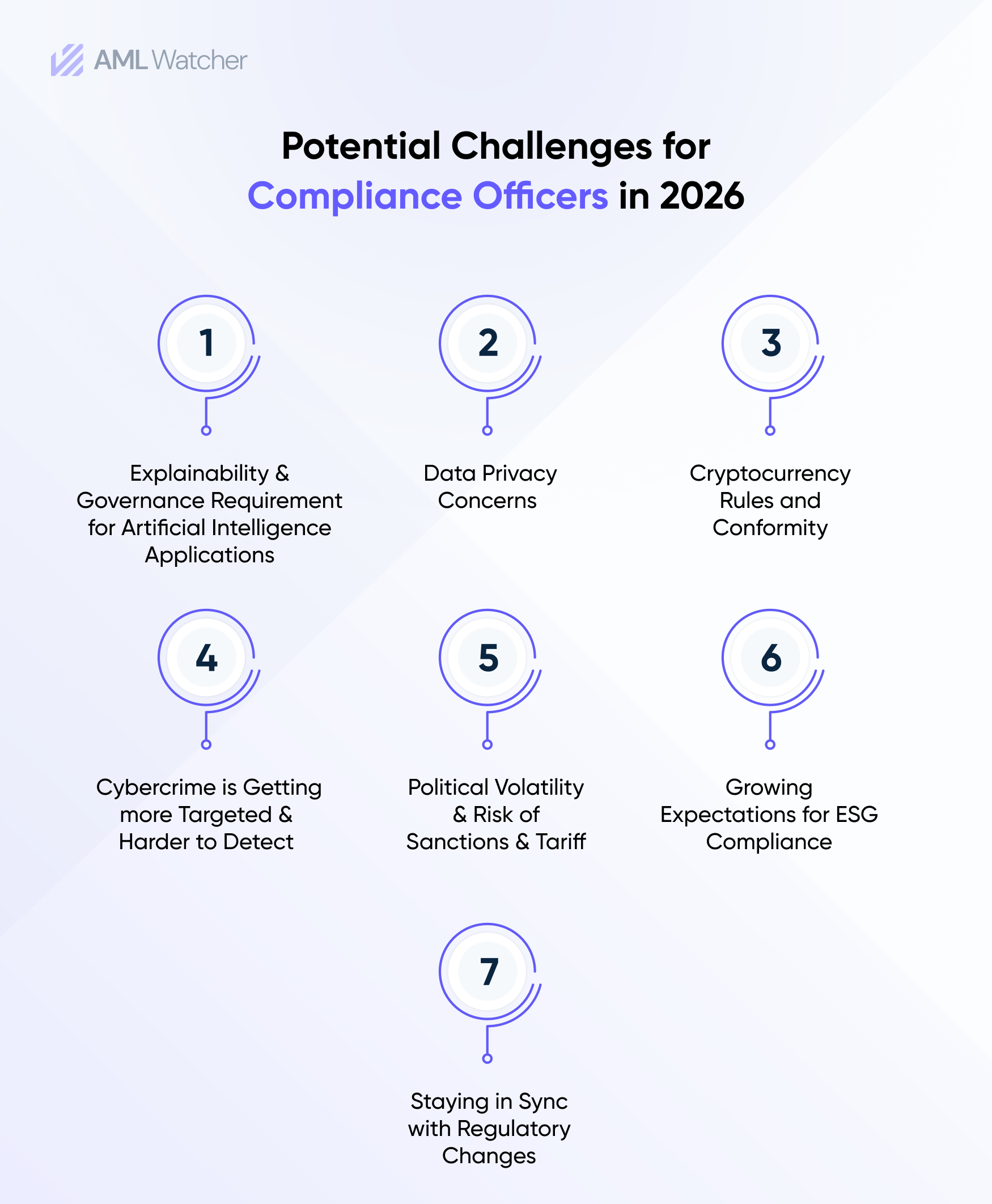
Potential Challenges for Compliance Officers in 2026
1. Explainability and Governance Requirement for Artificial Intelligence Applications
AI has witnessed a dramatic surge in its daily users and is now gradually becoming a global necessity. Compliance officers must use this advantage to their best potential while adhering to ethical standards and vigilance. AI and its advent remains a golden opportunity for compliance officers to counter vices like financial crime. Increased efficiency, reduction in costs, creation of stronger and more reliable KYC and AML programs are a priority for compliance teams but efforts to materialize this priority remain negligible.
Criminals use AI to create “fake” videos and images under the guise of them being original. They use these advanced technologies to create bots and persuade users to click on a suspicious URL and create multiple synthetic identities.
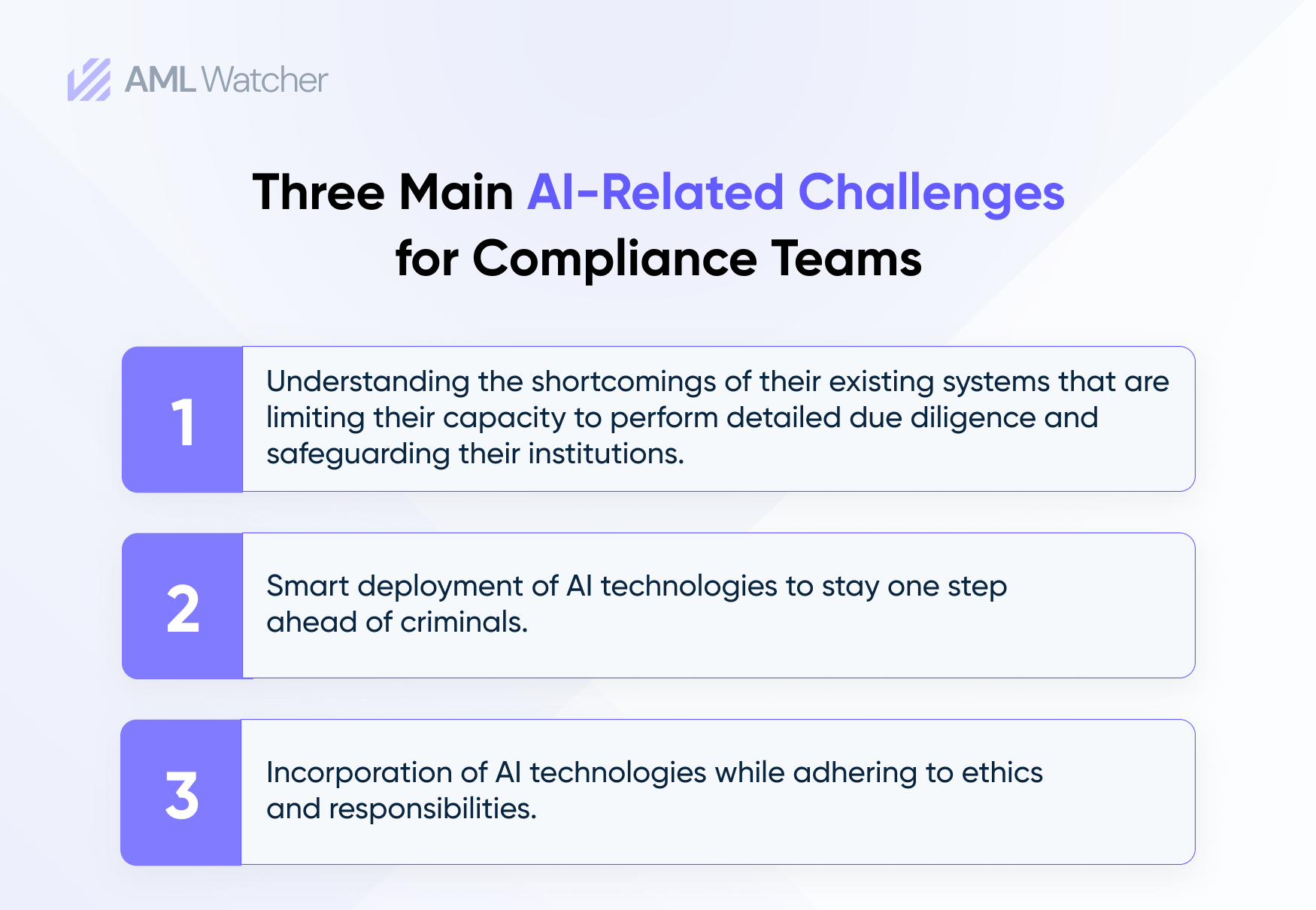
Teams must not operate AI systems without firm data-privacy procedures. While AI-assisted compliance seems to be a source of great ease it is important to note that nothing can top human oversight.
The level of reliance on AI must be checked. Leaders must be able to comprehend exactly how much they desire for their risk management programs to be dependent on AI. The supervision of well-trained professionals on high-value activities like investigation must still be under their domain.
2. Data Privacy Concerns
In the contemporary world the presence of a digital footprint of people in general has become very common. This has resulted in a chain of concerns over large-scale data breaches, multiple sorts of cyberattacks and abuse of personal information. People’s concerns about security have been making waves across the world. The trust of the masses in public institutions for the safeguarding of private data is also nearing its end. People remain uncertain as to how companies especially those resorted to AI development and tech make use of any personal information that is given to them.
3. Expanding Cryptocurrency Rules and Compliance
The integration of cryptocurrency and other digital resources has been so fast that governments and their efforts towards regulation have become slower in comparison.
The American government eased on the rulings that once limited banks to engage in any crypto-based services. In 2025, the Office of the Comptroller of the Currency (OCC) issued new guidance clarifying that national banks and federal savings associations may engage in certain crypto related services without needing to obtain prior regulatory approval. This reversed all the earlier cautionary policies that effectively limited banks’ crypto involvement.
Compliance challenges however, prevail. This is due to their volatile risk profile and a disintegrated regulatory landscape. Crypto is often used for money laundering and other criminal activities.
2026 will see a wider acknowledgement in cryptocurrency and it becoming a staple in the traditional banking systems.
The setting of a global standard for cryptocurrency will also remain underway in 2026. For example the United States in July, 2025 passed a federal law titled the GENIUS Act (Guiding and Establishing National Innovation for US Stablecoins Act) which remains a comprehensive regulatory framework for stablecoins, a type of cryptocurrency. The Act requires clear licensing rules and oversight to enhance transparency, consumer protection and financial stability in the digital asset market.
While a shift towards crypto involvement is emerging in traditional banking systems. It is important to note that for compliance officers the responsibility magnifies. A risk-based approach to crypto is not ideal if the officers are not well-equipped with it and struggle with understanding the legitimacy of any digital assets. Risk-based approaches can fail when teams lack blockchain tracing capability, clear typologies and asset-specific controls.
4. Cybercrime is Getting more Targeted and Harder to Detect
According to a recent report released by the FBI after combining complaints from 859,532 complainants of suspected internet crime, losses reported exceeded $16 billion, a dramatic 33% increase in losses from 2023 throughout the United States.
In the report the top three crimes remained the following:
- Phishing/spoofing
- Extortion and personal data breaches
- Investment fraud especially those involved with cryptocurrency remained highest totalling at $6.5 billion.
Crimes have been prevalent since years, what is most alarming in the contemporary world is the increased sophistication and finesse in the commitment of such crimes. This makes detection even harder and an increase in crime rate.
Efforts for stronger security remain high like the creation of antivirus software and firewalls against cyberattacks. The safe build-up of a security culture remains important in today’s world for companies and businesses.
5. Political Volatility and Risk of Sanctions and Tariff
Amidst shifting priorities, wars between nations and emerging trade wars as tactics for exerting pressure, what remains constant is uncertainty.
Uncertainty in identifying what to do with almost consistently changing regulatory landscape. These changes are not expected to come to a halt soon therefore, working around these changes remains the only solution for regulators and trade authorities.
The US Department of Justice has emphasized time and time again regarding the severe penalties and civil punishments that will be carried out for any sort of custom fraud or attempt at sanction evasion. In order to materialize these warnings the Department of Justice inaugurated the Market, Government and Consumer Fraud Unit.
This MGC unit is responsible for protecting financial markets and US investors. It further prosecutes any cases that involve large-scale trade and customs fraud including tariff circumvention. Another DOJ effort includes, Criminal Division Corporate Whistleblower Awards Pilot Program to prioritize prosecuting corporate crime.
A whistleblower who provides the Criminal division with organic and true information about corporate misconduct remains eligible for an award.
6. Growing Expectations for ESG Compliance
The number of sanctions across the world have increased be those diplomatic, military or environmental, the only difference remains that they differ from country to country.
Corporate companies are very carefully monitoring and gathering data on their organization’s ESG activities. ESG compliance has been mandated but it has its additional costs along with no universal standard for ESG reporting. They remain a necessity, however, failure to meet any of these standards can lead to penalties, tarnished identity and questionable repute in the market.
The EU continues to expand and maintain its ESG regulations. It has its own Corporate Sustainability Reporting Directive (CSRD) and Corporate Sustainability Due Diligence Directive that provide comprehensive sustainability disclosure requirements.
The CSRD mandates large and listed companies in the EU, including non-EU entities with significant EU revenue, to report on sustainability risks impacts and governance aligning with EU standards while the CSDDD requires large EU and non-EU companies to assess and address human rights and environmental impacts across their operations and supply chains. The CSRD and CSDDD typically aim for companies with over a 1,000 employees, these directives cover almost every aspect like governance, strategy and resource etc.
7. Staying in Sync with Regulatory Changes
For compliance officers and professionals it is almost a constant responsibility to stay on top of all regulatory changes that are made. It is a revolutionized, digital world where paying attention to every aspect from monitoring to data collection remains important.
Most public and private sector organizations are likely to encounter challenges like AI governance, data privacy risks, cryptocurrencies and climate change. These regulations will then hold companies to a higher standard of accountability, with relatively stricter punishments for failure to comply.
Regardless of all the regulatory changes that are made, the process of managing them is likely to involve some sort of dedicated software as well as the utilization of AI. manual systems are bound to exhaust since they can not keep up with the desired increase in pace of data collection, reporting which is only bound to increase overtime.

How to Prepare for what is coming in 2026?
In order to overcome any challenge, it remains necessary to completely embrace the changing landscape of organizations that are accustomed to the world of compliance. Therefore, for any organization or financial institution that actively seeks to solidify its risk management should definitely consider the following to make it past the daunting yet avoidable challenges of 2026.
1. Conduct Gap-Analysis for your Compliance Teams
Gap analysis enables teams to actively find any weaknesses that exist in their systems. Addressing those weaknesses and making relevant changes accordingly must remain a priority for compliance teams. Compliance leaders can run a gap analysis across policies, controls and alert handling capacity to identify where risk is outpacing coverage.
2. Strengthen Governance
Strong governance structures remain a cornerstone in order to comply with whatever rules mandated. A streamlined provision of modem AI systems, a one-rule for all standards for ESG reporting.
3. Conduct Training and Awareness Campaigns
In order for organizations to meet regulatory compliance it is important for all of its employees to be trained accordingly. For example they should know when and how to avoid falling for phishing traps that could potentially lead to problems with cybersecurity and any other compliance related problems.
4. Invest in Technology
Making a one-time big investment in compliance technologies will only yield multiple benefits. Acquiring data-governance systems, automation tools and compliance software can lead an organization to actively dodge the problems organizations could easily fall for.
5. Expect the Unexpected and Plan Accordingly
Anticipate potential scenarios that could go wrong, and work in accordance with them to minimize any uncertainties or ambiguities. Prediction of every risk remains highly unlikely, but it is best to stay cautious and vigilant than unready and disorganized.
How AML Watcher Addresses Global Compliance Concerns of 2026
With the evolution of fraud tactics through AI, traditional compliance workflows often struggle to keep pace with this level of change.
AML Watcher supports firms that require stronger control across onboarding and ongoing monitoring. Compliance teams are able to detect high-risk customers early by utilizing the platform’s context-aware risk assessment, AML screening, PEP and sanctions checks and adverse media monitoring capabilities and respond to regulatory expectations with clarity.
With compliance obligations continuing to expand, firms demand technology that strengthens oversight without creating any additional operational strain. AML Watcher provides the infrastructure to align risk detections with regulatory requirements and internal governance standards.
Book a demo to find out how AML Watcher can help compliance teams manage risk exposure with confidence and structure.
- No commitment needed
- Complete AML Database at your service
- Access our all-in-one dashboard


Tier-2 PSPs in ... must demonstrate automated monitoring, layered CDD, &...
See the Full Regulatory Expectation70–80% less manual work, 95% less fatigue, TruRisk Agent makes compliance effortless.
Experience Agentic AMLMove Beyond Articles. Activate AML Intelligence.
Switch to AML Watcher today and reduce your current AML cost by 50% - no questions asked.
- Find right product and pricing for your business
- Get your current solution provider audit & minimise your changeover risk
- Gain expert insights with quick response time to your queries