

 Alert!

What is Money Laundering With Example? A Closer Look
Money Laundering
May 21, 2026
September 6, 2024


Money rarely moves in a straight path when it is linked to criminal activity. It passes through layers designed to disguise its origin and make illicit funds appear legitimate.
Historical cases such as the Medellín Cartel’s investment in real estate and the Italian Mafia’s use of shell companies highlight how money laundering techniques have evolved over time.
However, for compliance teams, money laundering techniques are difficult to handle due to the sophisticated methodologies used in the process.
This analysis will explore the various techniques criminals use to launder money within financial institutions and examine how these institutions can effectively detect and address such illicit activities in a timely manner.
Understanding How Money Laundering Works
Money laundering refers to the process by which illegally obtained funds are disguised to appear as legitimate income through financial transactions or complex layering techniques.
The question arises, despite dozens of techniques launderers use, are these actually deceiving?
UNODC has its take on this, stating in one of its reports that $800 billion to $2 trillion is laundered each year globally, and that surprisingly only 1% of these illicit funds are ever seized and frozen by authorities.
A large proportion of laundering attempts succeed due to gaps in monitoring and cross-border financial visibility.
This also highlights the challenges law enforcement agencies face in tracing and prosecuting money laundering activities.
The Financial Action Task Force (FATF) highlights that layering techniques and the misuse of shell companies are designed to obscure the origin of funds and make tracing difficult for authorities.
Common Money Laundering Techniques With Examples
Do you think criminals would try to employ easily detectable techniques? They won’t.
What they will try instead are complex processes to hide the origin of funds, using a mix of old and new techniques.
Structuring, trade-based money laundering, purchasing NFTs and art, investing in casinos, and gambling are some of the prominent techniques used in money laundering.
Smurfing
Smurfing is a technique in which large amounts of illicit funds are split into smaller deposits and spread across multiple accounts to avoid detection thresholds.
That is why smurfing is the preferred choice of most launderers. Fraudsters try to break large sums into smaller amounts and deposit them into multiple accounts.
Smurfing schemes are particularly followed to disguise the reporting threshold of large amounts, which is, in most cases, 10,000 cash amounts.
Real Estate Laundering
For criminals, corrupted politicians, and human traffickers, purchasing property has always been an attractive way to launder their money and try to appear legitimate.
Real estate is attractive for laundering due to the high value of transactions and the ease with which illicit funds can be integrated into property purchases.
The additional factor of making the transaction through banking channels makes it easy to infuse the money into the financial system.
This is why, in the last decade, real estate money laundering has become a headache for organizations, largely because AML regulations are not effectively enforced within the organization’s compliance process.
Criminals find it all too easy to exploit the system, and they start setting up shell and offshore companies, often with the help of third-party facilitators.
Casino and Gambling Laundering
Several major casinos have faced regulatory penalties, including fines under anti-money laundering laws and the Bank Secrecy Act (BSA), for compliance failures.
This significant penalty amount highlights how even major casinos can struggle with preventing money laundering.
Research from the ATRAC public reports reveals the shocking amount of money laundered through casinos in Australia every year. According to the report, tens of millions of dollars are laundered.
How do criminals easily use casinos for laundering money?
One example of this is that they bet on low-risk games, intentionally lose money, and create the illusion of genuine gambling. They might then exchange their chips for clean cash, making the money appear legitimate
Trade-based money laundering
The international trading system is very complex, making it difficult for legitimate businesses to trade their goods. However, complexity creates loopholes for money laundering.
Detecting money laundering in trading is quite difficult, as evidenced by the Financial Action Task Force’s reports on Trade-based money laundering.
This comprehensive report examines the challenges of detecting and monitoring money laundering in the international trading system.
Over- and under-invoicing are the most common techniques used in trade-based money laundering. Over-invoicing occurs when goods are declared at a higher value than their actual worth, while under-invoicing involves declaring a lower value to move illicit funds across borders.
Offshore Companies
Setting up new shells and offshore companies isn’t illegal in most jurisdictions.
The legality of shell companies varies by jurisdiction; they are often misused to conceal ownership and move illicit funds across borders.
Shell companies are, in most cases, established for illegal purposes, and their extensive use for illegal money movement makes these organizations suspicious.
The International Consortium of Investigative Journalists reported on shell companies and highlighted that more than 1 million are used for money laundering.
And that is why establishing trusts and shell companies is a priority for money launderers.
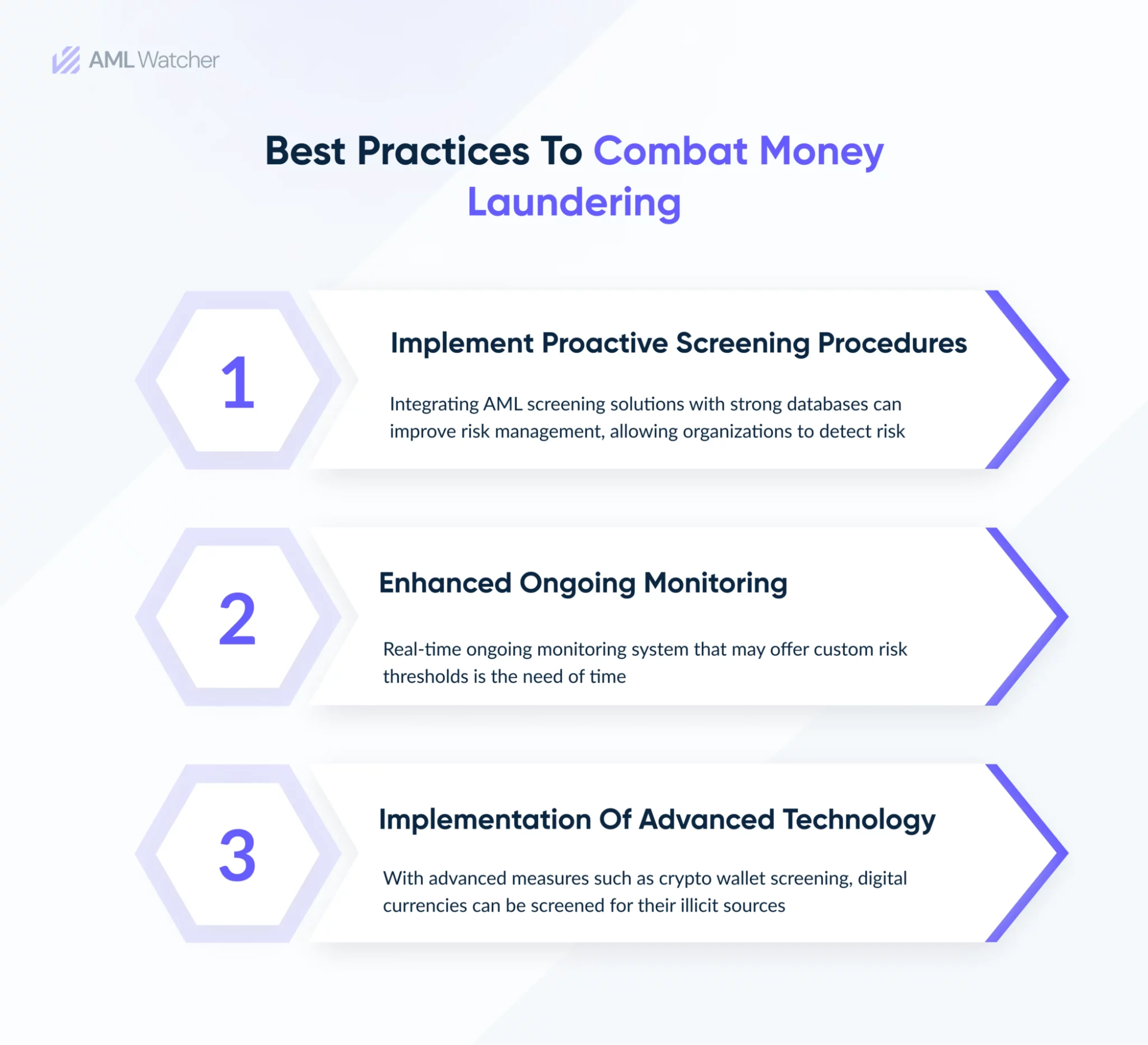
Top 3 Ways to Fight Against Money Laundering
While everyone is talking about channels of money laundering, here is a 4-step roadmap to counter the damage it might pose!
Implement Proactive Screening Procedures
To make AML processes more efficient and effective, businesses of all types need to collect essential information about their clients, employees, and business partners.
Financial institutions need robust screening measures in place. Now wait!
I know you might be tired of listening to this, which is why we are moving ahead to answer it precisely by focusing on “how”?
Integrating AML screening solutions with robust databases can improve risk management, enabling organizations to detect risk as soon as it enters the likelihood pipeline of posing reputational and monetary damage.
Enhanced Ongoing Monitoring
Like every other AML enthusiast, you must know that the bank’s failure that makes it possible for the Mexican Drug Cartels to launder billions of dollars lies in operational inefficiency.
This became possible because banks were not implementing adequate monitoring processes, which ultimately resulted in fines totaling 1.9 billion dollars.
A real-time, ongoing monitoring system that may offer custom risk thresholds needs time to effectively manage risks.
Implementation of Advanced Technology
The gaming and gambling industry and the crypto market have made laundering relatively easy for launderers, owing to vulnerabilities in their systems.
However, with advanced measures such as crypto wallet screening, digital currencies can be screened for their illicit origins, helping your business avoid damage.
How AML Watcher Helps Financial Institutions Detect Illicit Activity
Global estimates suggest that hundreds of billions to trillions of dollars are laundered annually, making detection and prevention a major challenge for financial institutions. Dealing with money laundering demands a strategic approach that is informed, critical, and continually changing.
Financial institutions continue to face growing pressure to detect and prevent money laundering activities across complex financial ecosystems. AML Watcher enables organizations to enhance risk detection through automated screening, adverse media monitoring, and real-time risk intelligence.
Request a Demo to explore how AML Watcher supports stronger AML compliance frameworks.
- No commitment needed
- Complete AML Database at your service
- Access our all-in-one dashboard


Tier-2 PSPs in ... must demonstrate automated monitoring, layered CDD, &...
See the Full Regulatory Expectation70–80% less manual work, 95% less fatigue, TruRisk Agent makes compliance effortless.
Experience Agentic AMLMove Beyond Articles. Activate AML Intelligence.
Switch to AML Watcher today and reduce your current AML cost by 50% - no questions asked.
- Find right product and pricing for your business
- Get your current solution provider audit & minimise your changeover risk
- Gain expert insights with quick response time to your queries