


 Alert!

How AML Watcher Solves Compliance Problems in the MENA Region
AML Compliance
March 25, 2026


- Why Compliance Teams that Work Across Three MENA Jurisdictions are Already Carrying Gaps
- GCC Regulators Are Now Inspecting System Performance, Not Policy Documents
- Arabic Name Screening: Where Most Tools Fail Before the First Match
- A Single Remittance Across Three MENA Jurisdictions Touches Multiple Sanction Regimes Simultaneously
- Five Criteria That Separate Purpose-Built MENA Screening From a Localized Global Tool
- How AML Watcher Is Built for the Specific Compliance Architecture of the MENA Market

In May 2025, the Central Bank of the UAE fined two foreign bank branches AED 18.1 million ($4.9 million) due to the failures of the AML/CFT frameworks. The regulator imposed a fine of AED 10.6 million on the first bank and AED 7.5 million on the other one. Two months later, a third foreign bank was levied with another AED 5.9 million penalty under the same federal law.
For compliance leaders who are working in this region, the regulatory communication is no longer an abstract one: AML/CFT gaps are a theoretical risk, and they are an auditable liability. Three specific gaps drive most of that exposure: Arabic name screening that fails on transliteration, cross-border watchlist coverage that breaks down at jurisdictional boundaries, and PEP network screening that stops at the individual rather than mapping the full exposure. This article examines each one and what a purpose-built screening system must provide to close them.
Why Compliance Teams that Work Across Three MENA Jurisdictions are Already Carrying Gaps
The regional Financial Action Task Force body (MENAFATF) facilitated the coordination of AML/CFT standards in 21 member states. The organization formalized plans to make mutual evaluations more rigorous and action plans more demanding at its 39th Plenary in November 2024.
All these 21 member states possess their respective regulatory authority, enforcement timeline, and risk profile. The only GCC-based country with individual membership of the FATF, Saudi Arabia, is operating under SAMA and its own Financial Intelligence Unit. The UAE operates a multi-body framework, led by the Central Bank, the Financial Intelligence Unit (FIU), and the National AML/CFT Committee General Secretariat, which was launched in December 2024. Each of the countries of Kuwait, Qatar, Bahrain, and Oman has its own supervisory structures.
In the case of an MLRO with operations in three or more of these jurisdictions, the compliance levels increase, definitions shift, and reporting thresholds differ. An onboarding procedure that satisfies one regulator may be insufficient for the next. MENA AML compliance challenges do not emerge from a single source; they emerge from the structure of the region itself.
GCC Regulators Are Now Inspecting System Performance, Not Policy Documents
The Gulf Cooperation Council (GCC) compliance framework is no longer static. Regulators have shifted from reviewing documented policies to inspecting actual system performance. In February 2025, Saudi Arabia’s Capital Market Authority imposed a fine and a five-year industry ban on a registered person for integrity violations under its Capital Market Institutions Regulations. In August 2025, Kuwait’s Central Bank penalized both a local bank and an e-payment company for failing to meet AML/CFT obligations.
Such actions are not exceptions. They are an indicator of a structural shift: regulators across the GCC are conducting active inspections, and compliance teams are supposed to implement their effectiveness in real-time and not at year end-review.
Institutions that built their programs around periodic audits rather than continuous operational performance are carrying exposure that legacy systems cannot address.
Arabic Name Screening: Where Most Tools Fail Before the First Match
The MENA region introduces a compliance challenge that the majority of screening tools are not architecturally equipped to handle: Arabic name variation at scale.
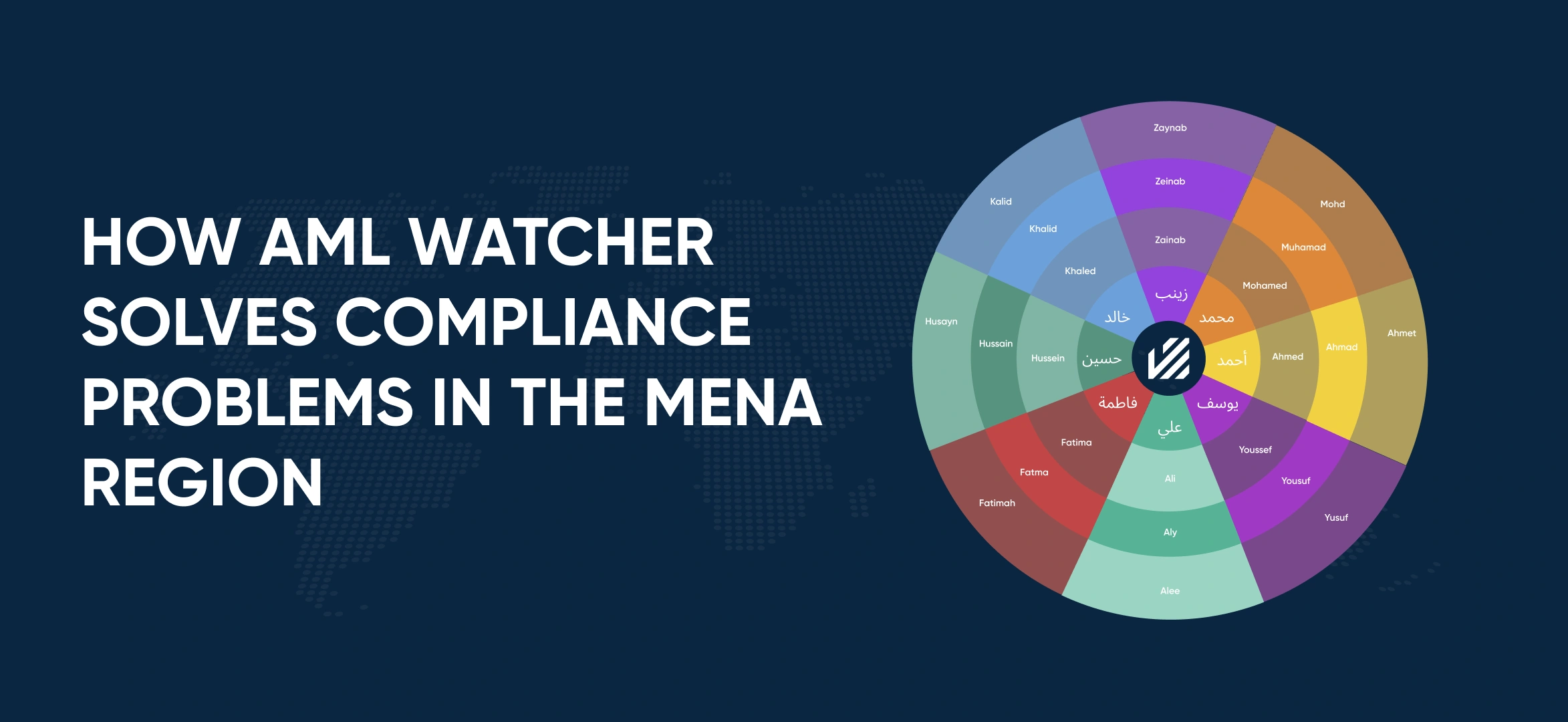
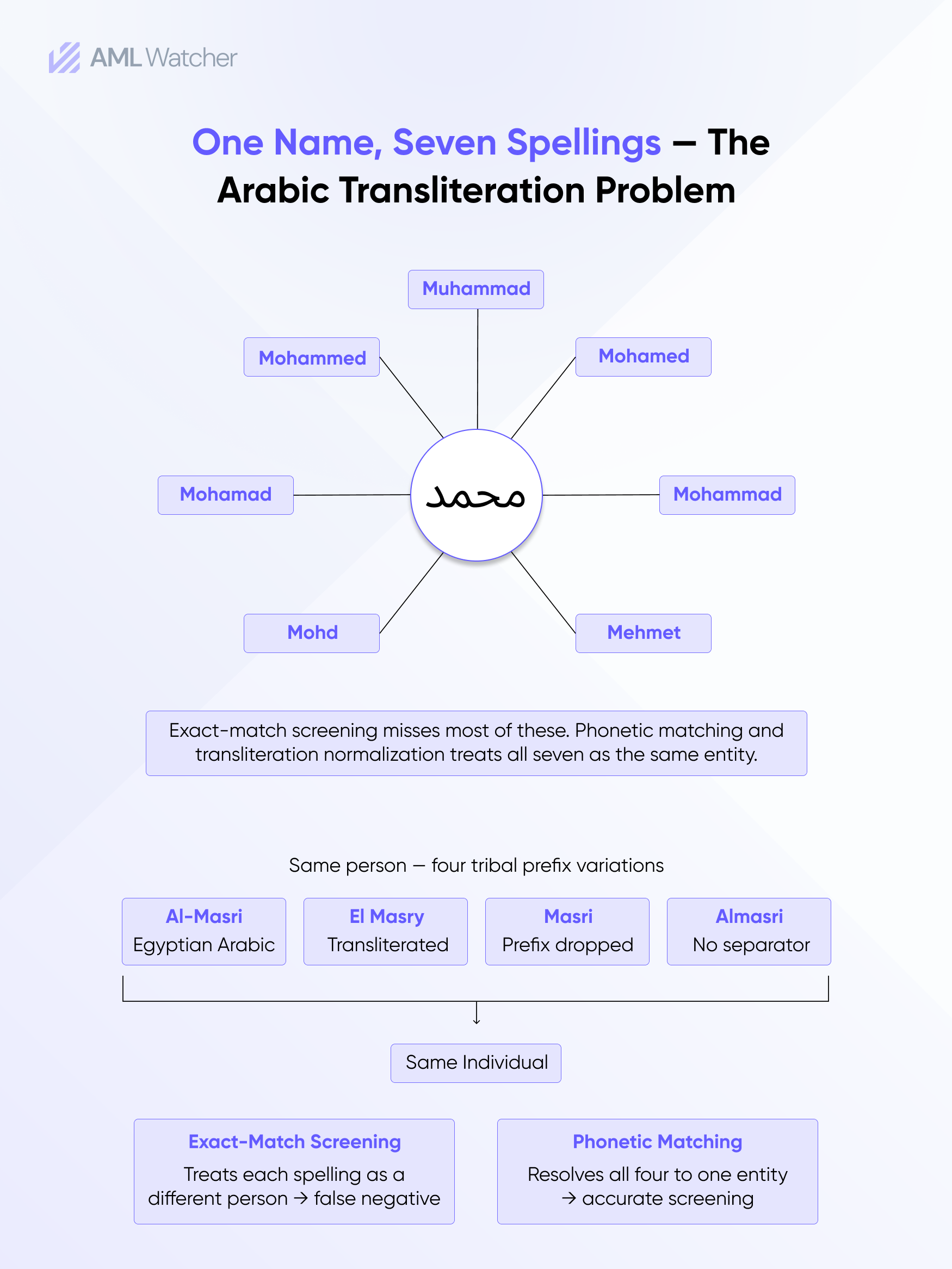
In sanction lists, watchlists, and government databases, the Arabic name “محمد” is listed under the names Mohamed, Mohammed, Muhamad, Mohd, and Mohammad with no standardization across source systems. Tribal names such as “Al-” or “Bin-” produce even further variation: the same individual can be called Al-Masri, El Masry, and Masri across different jurisdictions and document categories.
Exact-match screening logic produces two simultaneous failures in this environment.
False negatives occur when a real risk goes undetected because the transliteration in the database does not align with how the name appears in the system being screened. False positives happen when a legitimate customer is alerted due to the fact that his or her name has a superficial similarity to a listed entity.
Both are costly. False negative has direct regulatory exposure. False positives waste analyst time, as compliance teams spend hours reviewing alerts that should not have fired, and delay legitimate onboarding at the stage of the client relationship where speed matters the most.
Industry-wide, a massive amount of AML alerts are false positives. In the case of a mid-sized compliance team processing 200 alerts per day, that means roughly 180 of those alerts consume analyst time without ever surfacing a real risk. In a region where Arabic name variation multiplies the sources of false matches, that ratio gets worse, not better, without the right infrastructure.
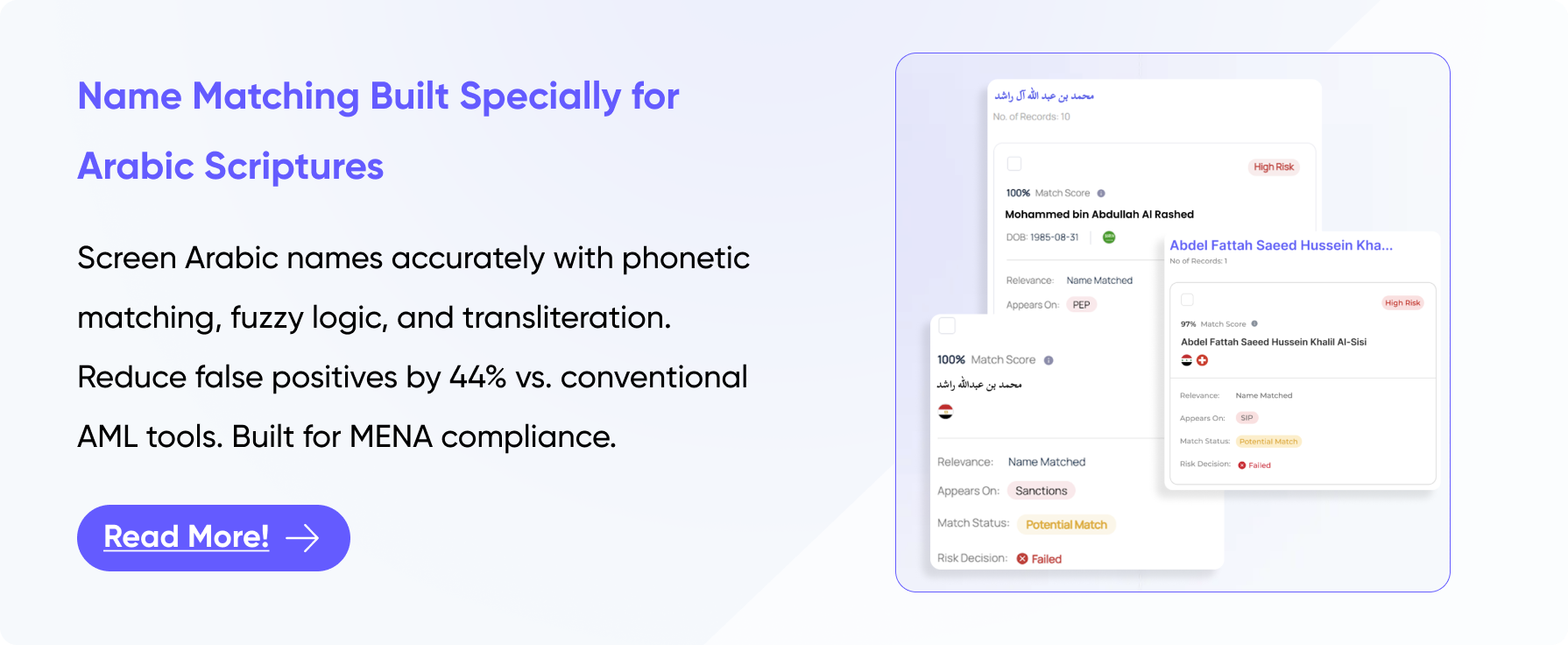
AML Watcher’s watchlist screening handles Arabic-Latin transliteration normalization as core architecture, not an optional configuration. Phonetic matching, fuzzy logic, and transliteration normalization across 80+ languages are built into the system by design, because in this environment, treating them as optional is not a product decision. It is a compliance risk.
A Single Remittance Across Three MENA Jurisdictions Touches Multiple Sanction Regimes Simultaneously
MENA compliance cannot be addressed jurisdiction by jurisdiction. The economy of the region depends on international trade.
The National AML/CFT Strategy of the UAE explicitly ranks trade-based money laundering (TBML) and digital payments (both being inherently cross-border in nature). According to FATF Recommendation 16, wire transfer transparency requirements apply across every step of a transaction
Single remittance sent from a Gulf city, and arriving in Cairo, Karachi, or Nairobi, crosses dozens of sanctions regimes, PEP lists, and watch lists on the local level before it reaches its destination. Reinforced by its 2020 guidance on trade-based money laundering, the FATF 2012 Recommendations observed TBML as one of the three main ways of transporting illicit funds across borders, and the MENA corridor remains one of the most actively followed pathways.
Institutions relying on siloed, jurisdiction-specific tools expose gaps at precisely the points where those tools fail to overlap. Cross-border AML compliance in MENA needs to have a single system that is in parallel with FATF, MENAFATF, and OFAC, one that implements regional data feeds, local terrorist designation lists, and minor or less significant jurisdictions and sources that are systematically ignored by global aggregators.
AML Watcher’s sanctions screening is built around this reality, not retrofitted to it. It maps FATF, MENAFATF, and OFAC obligations through a single system, updated every 15 minutes through Sanctions 2.0, because a sanctions designation issued today should not create a gap in screening until tomorrow.
Five Criteria That Separate Purpose-Built MENA Screening From a Localized Global Tool
Not every platform sold as an AML compliance platform addresses what the MENA compliance environment specifically demands. These are not feature requests. They are the gaps that generate audit findings, failed inspections, and enforcement penalties.
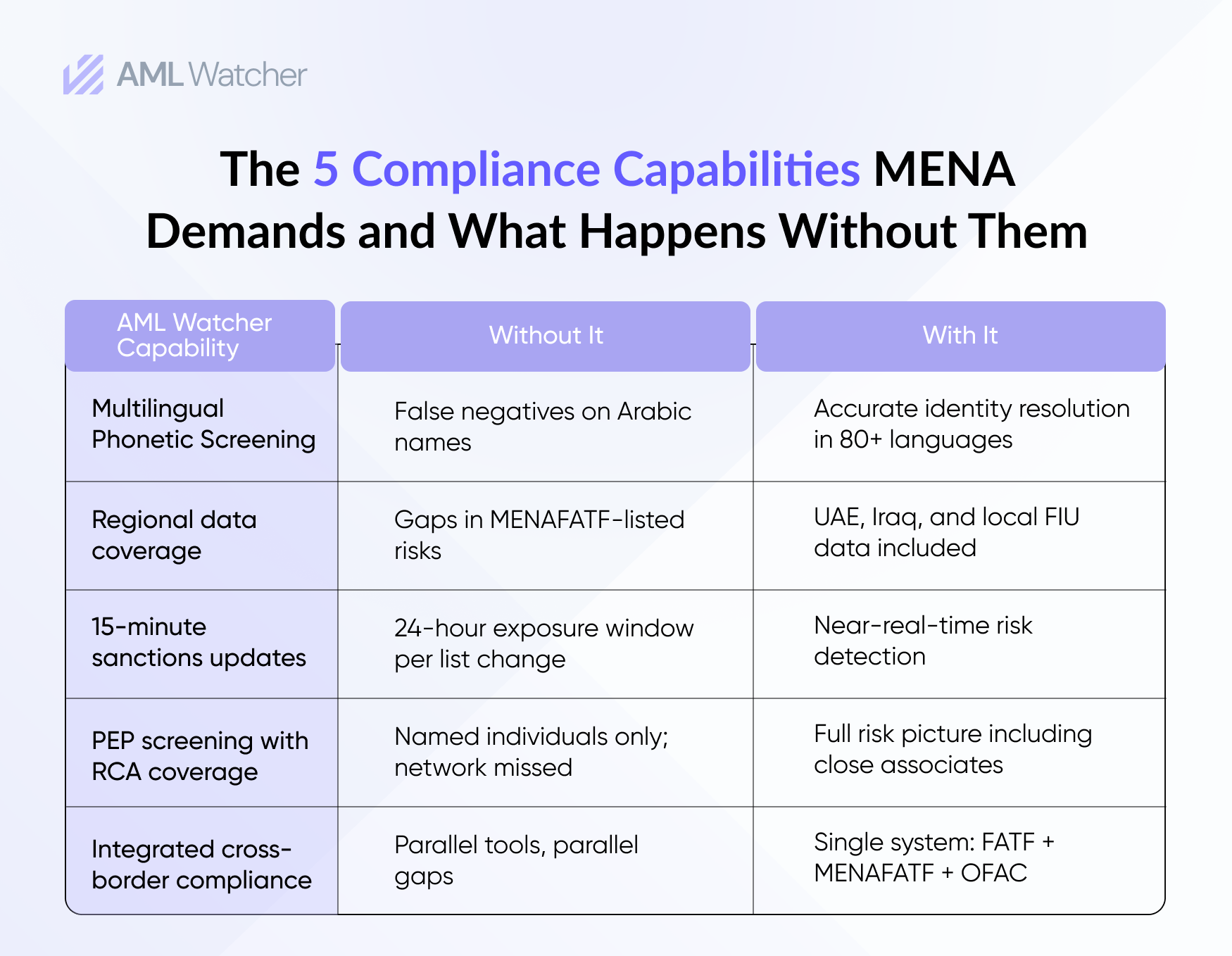
- Multilingual screening with native Arabic support. A compliance mechanism that will not consider Mohammad, Muhammed, and محمد as the same name is failing to screen the MENA market, but feigns to do so. The architecture should have phonetic matching and transliteration normalization, not as a configuration option.
- Regional watchlist coverage beyond global aggregators. UAE local terrorist designations, Iraqi AML/CFT Office records, and MENAFATF-aligned sources carry risk intelligence that major global platforms do not consistently index. An institution that relies only on global aggregators has already accepted the gaps those platforms carry.
- Sanctions data updated every 15 minutes. Regulators in this region move quickly. A 24-hour refresh cycle means every designation issued today is a gap in your screening until tomorrow.
- PEP screening that follows the network, not just the name. Under FATF Recommendation 12 , enhanced due diligence is required for politically exposed persons and their immediate associates. The MENA region has one of the highest concentrations of PEPs connected to state enterprises, sovereign wealth structures, and military hierarchies. Screening only named individuals misses the related close associate (RCA) exposure, including the family member, the business partner, and the nominee director, that regulators expect you to identify.
- A single system for FATF, OFAC, and MENAFATF obligations. Parallel workflows produce parallel gaps. If your screening operates in siloed tools by jurisdiction, the risk lives precisely where those tools do not overlap.
Institutions that identify a screening system meeting all five criteria are not just positioned to avoid penalties. They are positioned to onboard clients faster, scale operations confidently and demonstrate to regulators what real compliance performance looks like.
How AML Watcher Is Built for the Specific Compliance Architecture of the MENA Market
AML Watcher entered the MENA market with precision. In January 2025, AML Watcher opened its Dubai office at Business Central Tower B, Internet City, a deliberate commitment to serving the specific compliance challenges of this region, not managing them from a distance.
The platform spans 235+ countries, 215+ sanction regimes, and 3,500+ watchlists. Its PEP screening module holds 2.1 million+ profiles organized by seniority, risk tier, and RCA linkage, covering the network of exposure around a named PEP, not just the individual.
AML Watcher’s AI-powered risk engine, TruRisk, eliminates false positives by 44% and manual compliance by 70-80%. These are two independent, quantifiable results: reduced alerts that should never have fired, and excessively minimized time taken to review the ones that remain. For a compliance team processing 200 alerts a day, that is 88 fewer false matches to clear before the real work begins.
AML Watcher’s AML screening for MENA is not a localized version of a global tool. It is a compliance system built around the linguistic, regulatory, and operational realities that define this market.
Fewer false positives. Fewer compliance gaps. A defensible audit trail behind every decision. The next regulatory inspection will ask how your system handles Arabic name variation, cross-border exposure, and PEP network screening, not just whether you have a policy in place.

- No commitment needed
- Complete AML Database at your service
- Access our all-in-one dashboard


Tier-2 PSPs in ... must demonstrate automated monitoring, layered CDD, &...
See the Full Regulatory Expectation70–80% less manual work, 95% less fatigue, TruRisk Agent makes compliance effortless.
Experience Agentic AMLMove Beyond Articles. Activate AML Intelligence.
Switch to AML Watcher today and reduce your current AML cost by 50% - no questions asked.
- Find right product and pricing for your business
- Get your current solution provider audit & minimise your changeover risk
- Gain expert insights with quick response time to your queries