

 Alert!

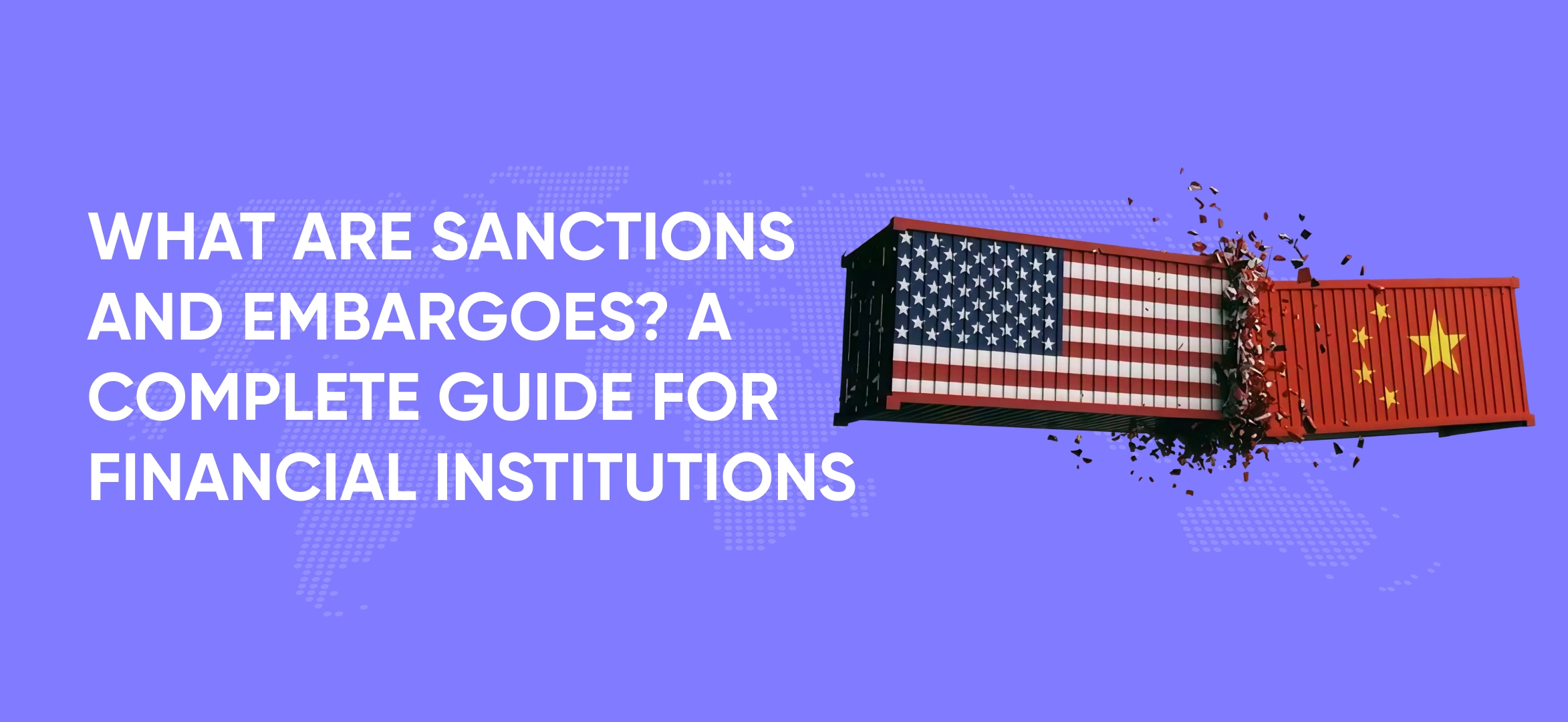
What Are Sanctions and Embargoes? A Complete Guide for Financial Institutions
Sanctions
July 30, 2026


- Understanding Sanctions and Common Types
- The Concept Of Embargoes and Its Types
- Why Sanctions and Embargoes Matter for AML Compliance
- Who Has The Authority To Impose Embargoes And Sanctions?
- Why Financial Institutions Need Sanctions Screening
- How To Reduce the Chances of International Sanctions and Embargoes

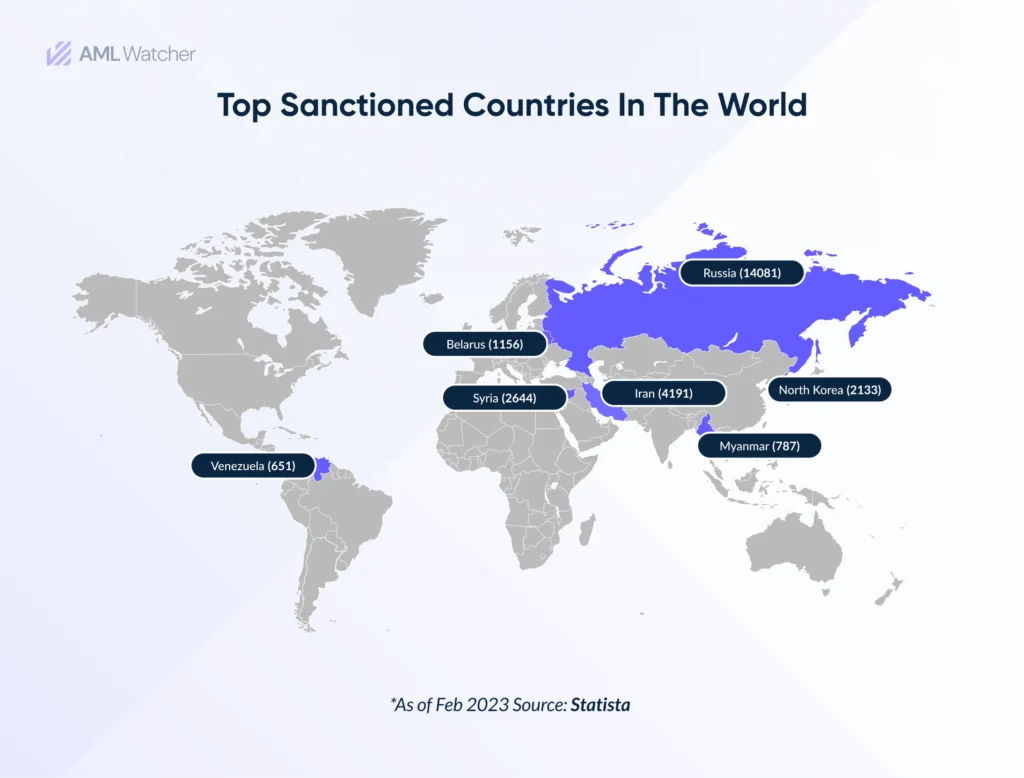
Since 2022 till today, the US, Canada, and the EU have tightened sanctions policies and embargoes against Russian financial institutions, state-owned entities, and designated individuals in following Russia’s invasion of Ukraine. Such measures involve financial restrictions on access to international financial systems and the freezing of assets, directly targeting individuals involved in laundering money through international networks.
In another instance, from 2006, the international community, including UN institutions, has undertaken several measures on the enforcement of an export embargo on North Korea, which prohibits the sales of arms, nuclear-related materials, and luxury items. Such restrictions are to impede the financing of its nuclear and long-range missile infrastructure.
These measures extend far beyond foreign policy and have direct implications for regulated businesses. Financial institutions and other regulated entities must screen customers, monitor transactions, and identify sanctioned individuals and entities to avoid facilitating prohibited activities and remain compliant with global sanctions and AML regulations.
Understanding Sanctions and Common Types
Sanctions are restrictive measures imposed by one or more countries or international organizations against another country, entity, or individual. They are designed to influence behavior by restricting access to financial systems, trade, or international markets. Sanctions may be imposed in response to human rights violations, terrorism financing, corruption, weapons proliferation, or breaches of international law.
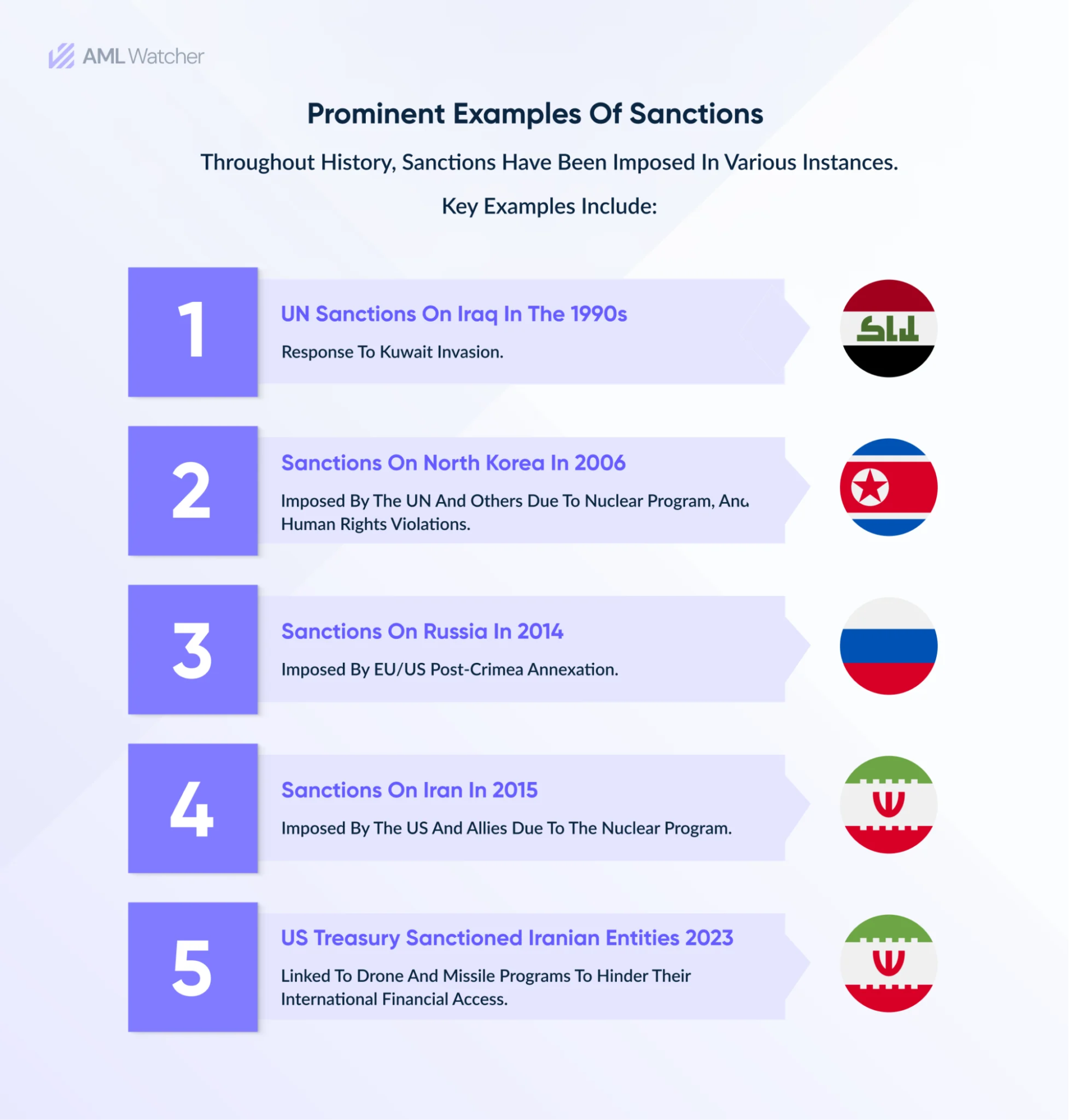
Sanctions can be imposed for specific purposes, often reflecting the interests of the state or group that enacts them. Among the most notable types of sanctions are:
Economic Sanctions
The basic types are restrictions on international trade in certain goods or services or restrictions on investment or other economic activity. Sanctions in this area include trade blockades, limitations on financial operations, and import and export restrictions.
Financial Sanctions
Financial sanctions are measures by governments or organizations to limit the financial activities of certain individuals, entities, or countries. These can include freezing assets and blocking transactions to disrupt illegal activities and combat terrorism financing while enhancing international security.
Military Sanctions
The purpose of military sanctions is to weaken the targeted nation’s military capabilities and discourage its aggressive acts by limiting the sale and supply of military technology, equipment, and assistance.
Targeted Sanctions
These sanctions target just individuals or entities by sanctioning their finances, such as freezing their assets or prohibiting them from traveling. Moreover, targeted sanctions comprise bans on the usage of technology and its resources.
Political Sanctions
These measures are diplomatic in nature and can, for instance, involve the decline of ties or the ban of diplomats. Political Sanctions are likely to be directed immediately at educational prospects and cultural exchanges, as well as any eventual membership of international organizations.
The Concept Of Embargoes and Its Types
An embargo is usually one of the political weapons, in the form of trade barriers, used to isolate a given country or a group of nations, cutting off trade between all concerned parties. Financial institutions operating internationally must comply with embargo restrictions because prohibited trade or financial transactions can expose them to sanctions violations.
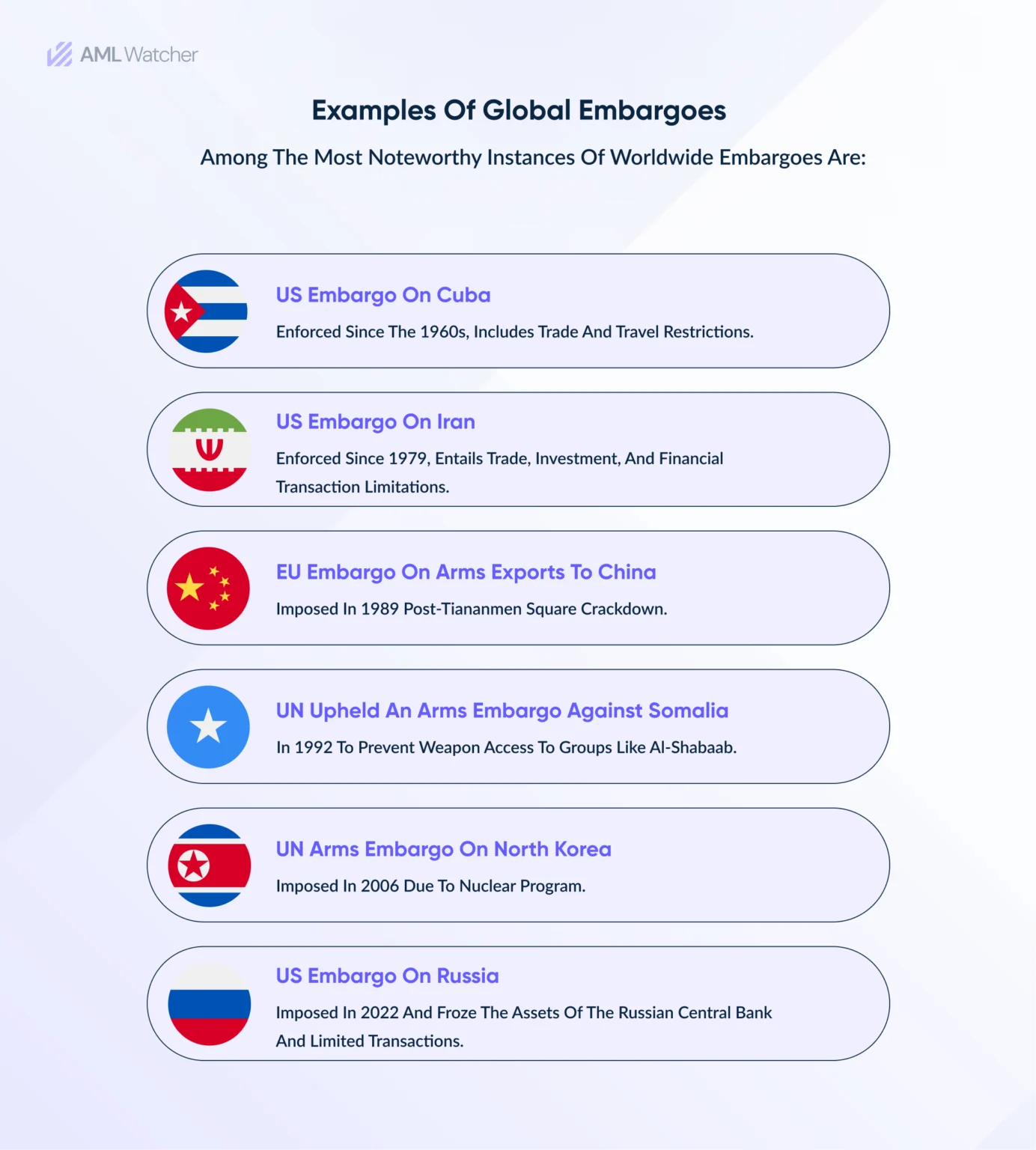
The types of embargoes that can be enforced vary based on the goals of the countries or groups imposing the sanctions. Some of the main international embargoes include:
Trade Embargoes
They can be imposed in several ways i.e., through trade bans or sanctions targeted on specific groups and countries. A trade embargo may be any form of restriction of trade between countries, for example, restriction of imports and exports or unilateral suspension of trade.
Military Embargoes
These limitations cultivate the prohibition or restrictions of military assistance or prohibiting arms sales to the mentioned country or group. A military embargo may include the restriction of technology transfer or training carried out for the armed forces.
Financial Embargoes
These sanctions include the blocking or limiting of financial transactions between the sanctioned state or organization. Financial restrictions can be implemented in different forms, such as the freezing of bank accounts or the act of cutting off individuals from international banking systems.
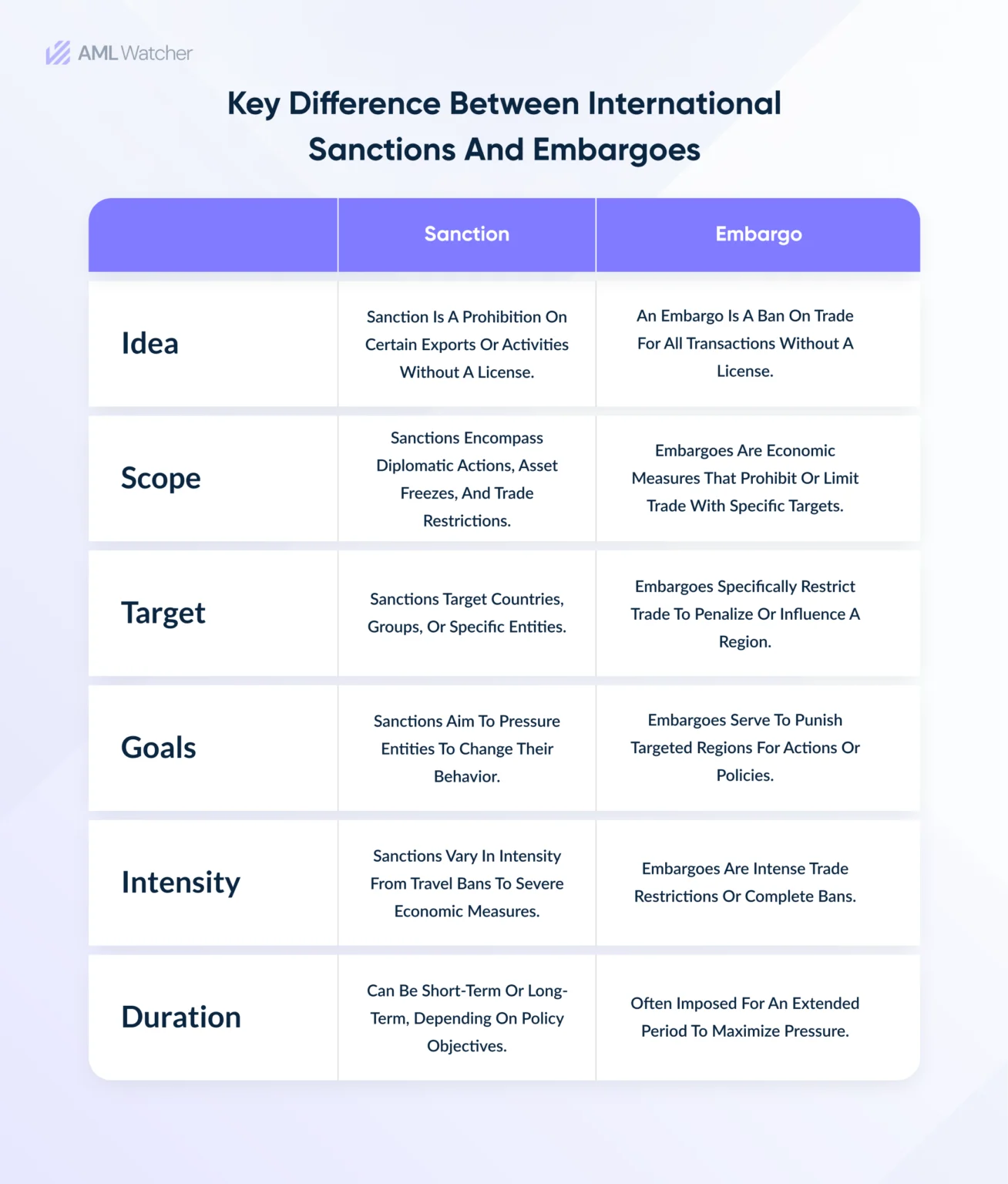
Why Sanctions and Embargoes Matter for AML Compliance
States impose sanctions and embargoes as their economic, diplomatic, and security management means, having several objectives, such as:
Behavioral Changing
Financial institutions must understand why sanctions are imposed because the reasons behind sanctions determine which individuals, entities, or jurisdictions become subject to screening requirements. These can be placed as a response to various kinds of unlawful activities that may include: human rights violations, money laundering, supporting terrorism, financial crimes, and nuclear weapons development.
Preserving National Security
Sanctions and embargoes can be used to defend vital national security concerns. The case of sanctioning the export of sensitive technologies and arms has ended up being used for the wrong purpose.
Reducing Conflicts
In extreme situations, sanctions and embargoes may be applied to halt or suspend conflicts. For instance, an embargo on the sale of sensitive arms may be a way to prevent a country from acquiring the weapons needed for war.
Financial Obligations
Sanctions and embargoes restrict access to financial systems to combat money laundering, terrorism financing, corruption, and other illicit financial activity.
Supporting Democracy And Human Rights
Sanctions and embargoes are implemented to help strengthen democracy and respect human rights. For instance, a ban would be introduced against a country that has a poor record on human rights to pressure it to improve its human rights measures.
Who Has The Authority To Impose Embargoes And Sanctions?
Sanctions and embargoes are used as tools by several international actors, ruled by diverse bodies and governed by distinct objectives. Here’s a breakdown of the key entities that typically impose these measures:
Governments
National Governments: Each nation awards sanctions independently through its authorized sanctioning entities. For example, in the United States, sanctions are applied by the Department of the Treasury’s Office of Foreign Assets Control (OFAC), while in the UK, they are imposed through the Office of Financial Sanctions Implementation (OFSI) within HM Treasury.
International Organizations
Several international institutions impose sanctions, such as the United Nations through the Security Council, limits actions by putting sanctions and embargoes that member states are required to respond to.
The European Union can impose sanctions and embargoes on its member states that are binding on all member countries. These funds constitute an important instrument of EU foreign security policy.
Multinational Coalitions
Associations of nations create coalitions to impose sanctions or international embargoes outside of the already institutionalized frameworks, such as the United Nations Security Council and the EU.
Why Financial Institutions Need Sanctions Screening
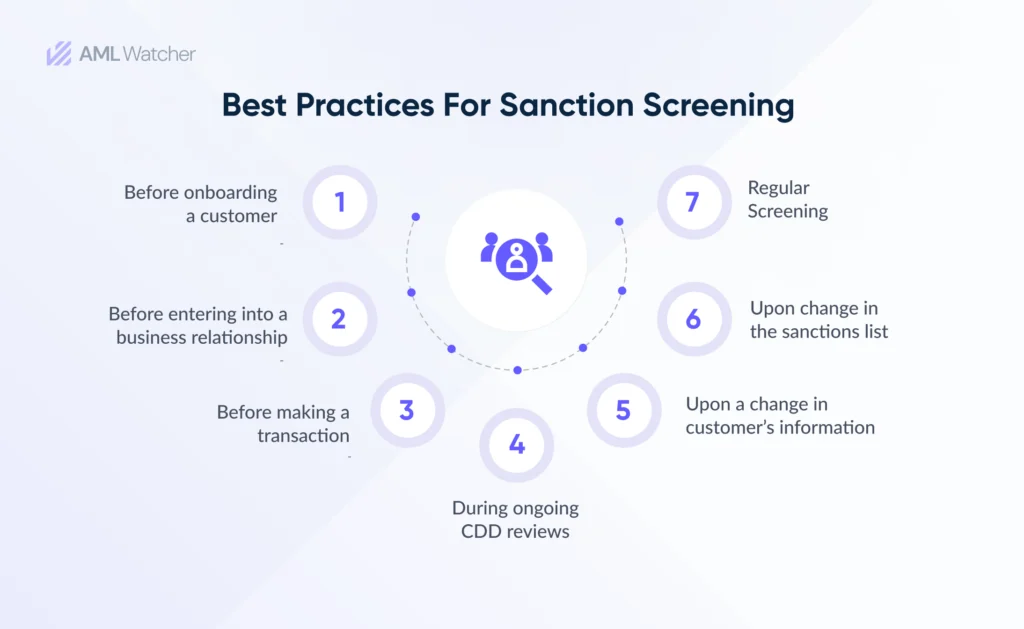
Financial institutions must screen customers and beneficial owners against global sanctions lists before establishing business relationships and throughout the customer lifecycle.
Sanctions lists issued by authorities such as the UN, OFAC, OFSI, and the EU are updated regularly, making continuous monitoring essential to identify newly designated individuals or entities. Effective sanctions screening also helps detect potential risks during transactions and customer reviews while reducing false positives through accurate matching and risk-based assessment.
A strong screening process supports regulatory expectations for AML and sanctions compliance, lowers the risk of dealing with sanctioned parties, and helps institutions avoid financial penalties, reputational damage, and operational disruption. As sanctions regimes continue to evolve, automated screening solutions have become an important part of maintaining an effective compliance framework.
How To Reduce the Chances of International Sanctions and Embargoes
Keeping pace with evolving sanctions lists and embargo restrictions can be challenging for financial institutions operating across multiple jurisdictions. AML Watcher’s sanctions screening solution helps organizations automate screening, monitor sanctions updates, and strengthen compliance with global regulations through features such as:
- Real-Time Monitoring: Continuously monitors sanctions updates and customer profiles, enabling faster identification of changes that require review.
- Regulatory Compliance: Supports compliance with evolving AML, CTF, and sanctions regulations through automated screening and ongoing monitoring.
- Enhanced Due Diligence: Strengthens customer due diligence by identifying and monitoring potential risks across clients and counterparties.
- Automated Screening: Screens customers against global sanctions lists, watchlists, and PEP databases before and throughout the business relationship.
- Risk-Based Insights: Provides additional context to help compliance teams assess potential sanctions exposure and make informed decisions.
Frequently Asked Questions
- No commitment needed
- Complete AML Database at your service
- Access our all-in-one dashboard


Tier-2 PSPs in ... must demonstrate automated monitoring, layered CDD, &...
See the Full Regulatory Expectation70–80% less manual work, 95% less fatigue, TruRisk Agent makes compliance effortless.
Experience Agentic AMLMove Beyond Articles. Activate AML Intelligence.
Switch to AML Watcher today and reduce your current AML cost by 50% - no questions asked.
- Find right product and pricing for your business
- Get your current solution provider audit & minimise your changeover risk
- Gain expert insights with quick response time to your queries