

 Alert!

What Is the EU AML Package? AMLR, AMLD7, and AMLA Explained
No category assigned
August 7, 2026


- What Is the EU AML Package?
- Why Did the EU Introduce the AML Package?
- What Is AMLR and How Does It Change EU AML Compliance?
- AMLD7 Explained: Is There Really a Seventh Anti-Money Laundering Directive?
- What Is AMLA and Why Does It Matter?
- EU AML Package Implementation Timeline and Key Deadlines
- Which Businesses Will Be Most Affected by the EU AML Package?
- Why the New EU AML Framework Creates Operational Challenges
- How Should Businesses Prepare for the EU AML Package?
- How AML Watcher Helps Organizations Prepare for the EU AML Package

Europe’s fight against money laundering has often been weakened by one persistent problem rather than a lack of regulation. Different interpretations of the same AML rules across Member States created compliance gaps that cross-border criminal networks exploited.
Financial institutions operating in multiple jurisdictions frequently manage separate compliance obligations despite serving a single European market. The sophistication of financial crime led to greater fragmentation of implementation, making it more difficult for compliance teams and supervisors.
The AML Package was an EU initiative to establish a more harmonized legal environment through directly applicable rules, enhanced supervision, and greater cooperation among national regulators.
What Is the EU AML Package?
The EU AML Package, formally known as the EU Anti-Money Laundering Package, is the European Union’s most comprehensive reform of EU AML legislation in decades. It was adopted in 2024 to enhance the bloc’s action against cross-border money laundering and terrorist financing and to minimize differences in its regulatory frameworks across Member States.
Although the common objectives were previously set out in AML Directives, there were variations in supervisory practices and compliance expectations in national implementations. This left businesses across multiple jurisdictions with an unnecessary burden of complexity, and criminals with the opportunity to exploit regulatory loopholes.
The reforms tackle those weaknesses with three mutually complementary legislative initiatives. The Anti-Money Laundering Regulation (AMLR) establishes a single rulebook with directly applicable obligations for regulated entities across the Member States.
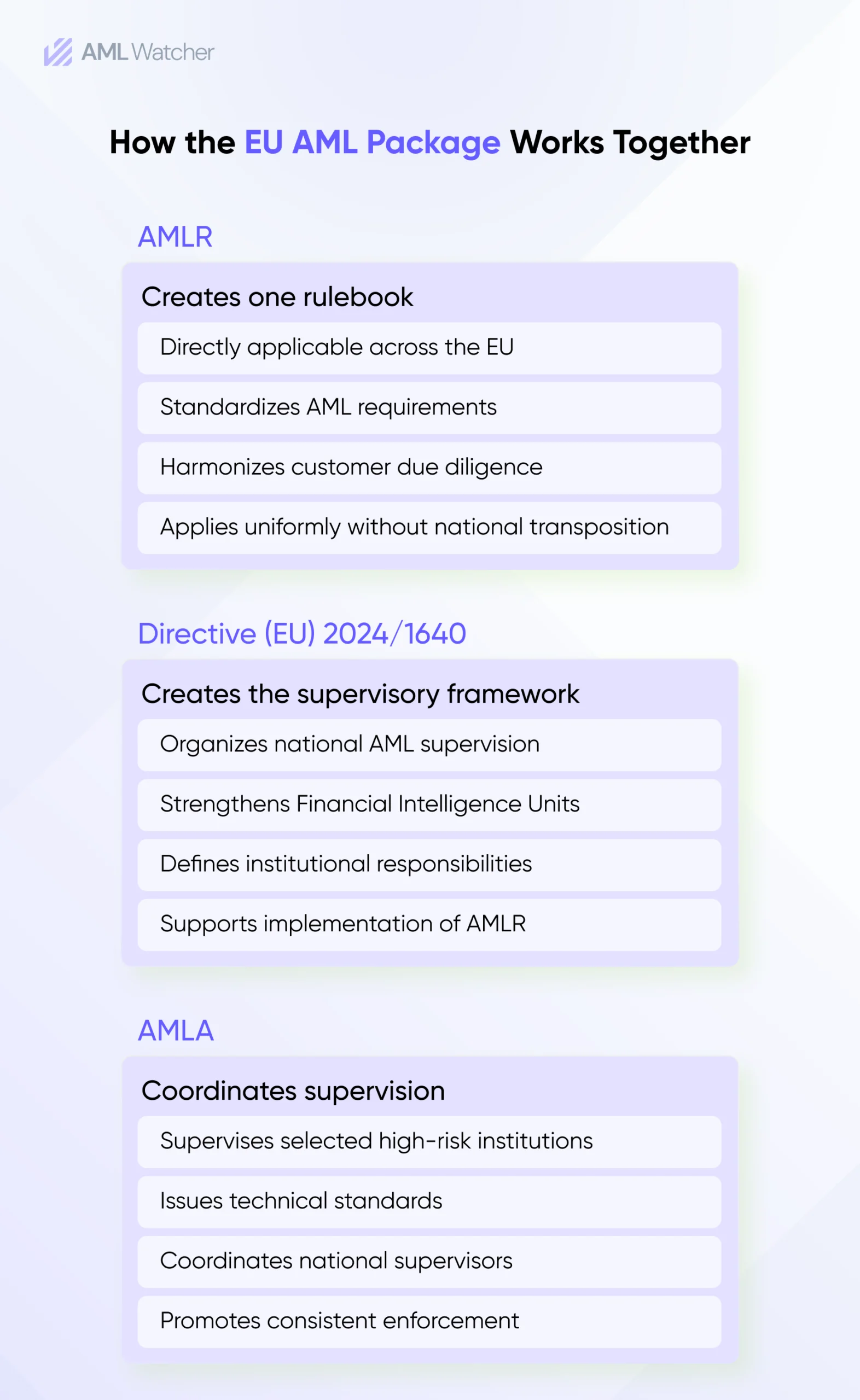
Directive (EU) 2024/1640 forms the institutional framework of the new AML Package and is widely referred to as the new AMLD6 because it replaces much of the previous AML directive framework. This should not be confused with Directive (EU) 2018/1673, commonly known as AMLD6, which concerns the criminalization of money laundering. The 2024 directive focuses instead on supervision, Financial Intelligence Units, and national implementation. Meanwhile, the Anti-Money Laundering Authority (AMLA) centrally coordinates and supervises selected high-risk institutions.
Some compliance professionals still look for AMLD7, as the industry had hoped the numbering of AML Directives would run on. However, the 2024 reform package failed to secure official status for the Seventh Anti-Money Laundering Directive. In contrast, the EU has adopted a method of substituting many of the obligations for the private sector with the directly applicable AMLR, and left the supporting institutional framework (AMLD6) intact.
Why Did the EU Introduce the AML Package?
The previous EU AML framework relied on directives that Member States implemented through their own national legislation. The policy goals were similar, but enforcement strategies and compliance expectations varied across jurisdictions. These differences enabled regulatory arbitrage, allowing illegal funds to be transferred through any weak links in the financial system. Multinational institutions also found that having multiple compliance processes across several EU markets was more difficult and riskier.
Several high-profile cases exposed these structural weaknesses. The Danske Bank scandal, Wirecard failures, the Panama Papers, and other trans-border AML failures pointed to the lack of effective supervision and the delay in coordinated action. The occurrences were a symptom of the current system’s weaknesses, not separate instances of non-compliance. The EU AML reforms were therefore aimed at creating greater uniformity, better supervision coordination, and fewer opportunities for financial crime within the EU.
What Is AMLR and How Does It Change EU AML Compliance?
The Anti-Money Laundering Regulation (AMLR) is the central pillar of the EU AML Regulation framework. Regulations are not directives that have to be implemented nationally; they are directly applicable in all Member States without the need for further legislation. This makes compliance easier for firms with operations across several jurisdictions, as there is a single rulebook to follow.
AMLR regulates fundamental compliance requirements, including Customer Due Diligence (CDD), Enhanced Due Diligence (EDD), beneficial ownership identification, record-keeping, and customer monitoring. It also establishes an EU-wide limit on cash payments of €10,000, with Member States able to set lower national limits.
The scope of obliged entities is extended to include banks, financial institutions, payment institutions, crypto-asset service providers, crowdfunding platforms, dealers of high-value goods and, from 2029, some professional football clubs and (some) football agents. AMLR harmonizes compliance requirements and provides businesses with clearer regulatory expectations.
AMLR reinforces the beneficial ownership standards by establishing more consistent criteria for identifying, verifying, and recording UBOs in the Member States.
It also enhances the quality and availability of beneficial ownership information, helping competent authorities and obliged entities uncover complex structures and minimize opportunities to conceal illicit assets through opaque corporate structures.
AMLD7 Explained: Is There Really a Seventh Anti-Money Laundering Directive?
Searches for AMLD7 and the Seventh Anti-Money Laundering Directive remain common because many compliance professionals expected the numbering of EU AML Directives to continue after AMLD6. The European Union did not officially adopt AMLD7. Instead, the 2024 reforms divided responsibilities between two complementary legal instruments.
AMLR introduces specific AML requirements which are directly applicable to regulated entities in all Member States. In contrast, Directive (EU) 2024/1640, known as AMLD6, introduces more stringent rules on the institutional and supervisory framework to be put in place by national authorities. Rather, AMLR, Directive (EU) 2024/1640, and AMLA were the vehicles used for implementing the reforms.
What Is AMLA and Why Does It Matter?
The Anti-Money Laundering Authority (AMLA) is the first-ever EU centralized Anti-Money Laundering supervisory body, aimed at enhancing AML supervision and improving supervisory coordination among the EU Member States.
AMLA is responsible for supervising high-risk cross-border financial institutions that pose the highest risk of money laundering and the financing of terrorism. In contrast, national regulators supervise the majority of obliged entities.
In addition to direct supervision, AMLA supports the cooperation between national supervisors and Financial Intelligence Units to enhance the effectiveness of their responses to cross-border financial crime. It also establishes regulatory technical standards and supervisory guidelines to encourage harmonization and minimize fragmentation between Member States.
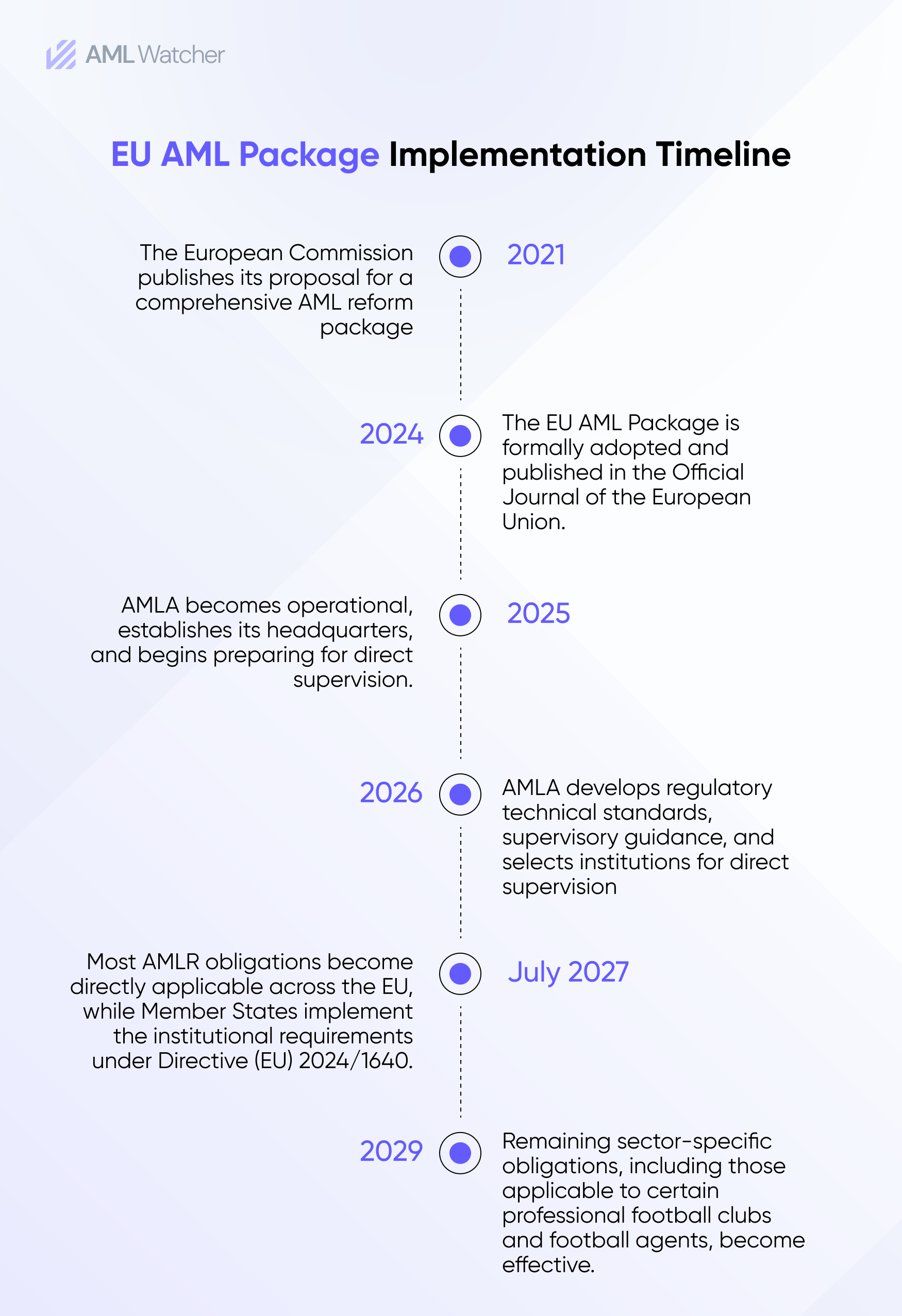
EU AML Package Implementation Timeline and Key Deadlines
What the Timeline Means for Businesses
The effective date of most AMLR obligations is July 2027, but compliance preparation should begin much earlier.
AMLA will further develop its supervisory framework in 2025 and 2026, and the European Commission and AMLA will release regulatory technical standards and implementing guidance.
Financial institutions should leverage this time to undertake a gap analysis, revise the due diligence process, bolster beneficial ownership controls, review sanctions and PEP screening procedures, and train staff.
Which Businesses Will Be Most Affected by the EU AML Package?
The EU AML Package broadens regulatory obligations across financial and designated non-financial sectors. The following sectors will face the greatest compliance impact under the new framework.
- Financial institutions, investment firms, insurance companies, payment providers, and money service businesses: Apply harmonized customer due diligence, ongoing monitoring, record keeping, and risk management requirements.
- Crypto Asset Service Providers (CASPs): Meet strengthened AML obligations alongside existing EU crypto regulations.
- Businesses dealing in high-value items and luxury goods: Use additional customer verification on more risky transactions and cash sales.
- Crowdfunding platforms: Enhance measures to detect and prevent financial crime.
- Real estate companies, law firms, and accounting firms: Be more vigilant regarding beneficial ownership, complex transactions, and client risk.
- Football clubs and football agents: Become obliged entities under phased implementation, introducing formal AML compliance responsibilities.
Why the New EU AML Framework Creates Operational Challenges
The new EU AML framework has harmonized regulations, but compliance operations remain intensive. Many organizations continue to maintain siloed customer information across different systems, making cross-border risk assessment and onboarding more complex. Manual screening, false positives, and inconsistent documentation are still using up compliance resources.
Concurrently, companies need to improve the process for beneficial ownership verification, PEP screening, adverse media monitoring, and ongoing customer monitoring to meet the harmonized expectations of regulators. There should also be clear evidence documented for each alert, risk decision, and customer review, which the supervisor can review.
Companies that embrace robust data management, automated monitoring, and effective compliance protocols will be better prepared for audits and better manage financial crime risk.
How Should Businesses Prepare for the EU AML Package?
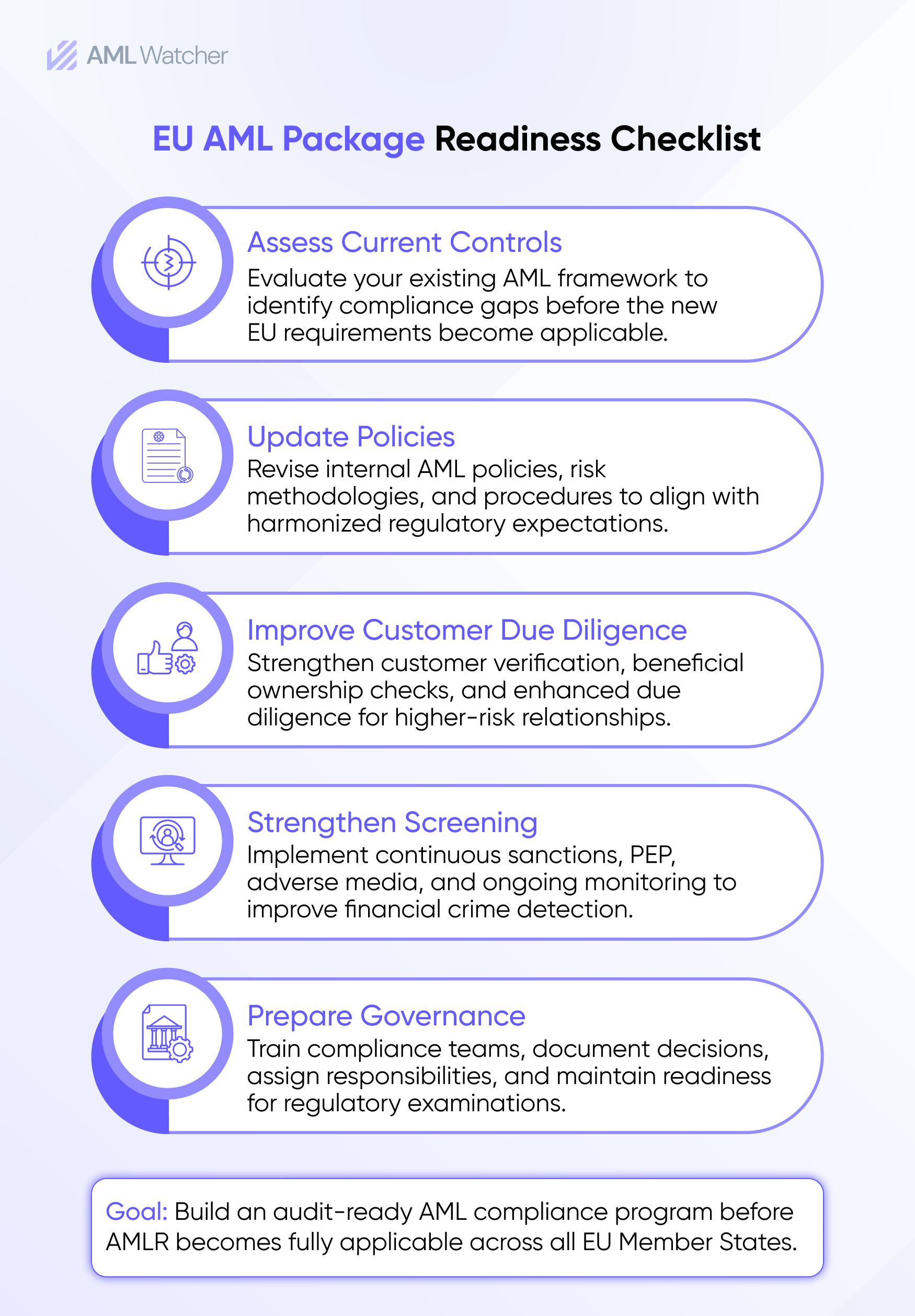
The first step is to perform an organization’s gap analysis, which involves identifying the controls currently in place and those needed to meet new regulations. The results should inform changes in AML policies, customer risk assessment processes, and beneficial ownership verification processes.
Compliance teams need to enhance sanctions screening, automate continuous monitoring if appropriate, document, educate employees, and audit third-party providers.
Governance frameworks should also support AMLA to ensure accountability. Early preparation can help organizations bridge operational gaps before implementing new requirements.
How AML Watcher Helps Organizations Prepare for the EU AML Package
Financial institutions also need reliable compliance data, beneficial ownership intelligence, continuous monitoring, and well-documented compliance decisions to apply the new requirements consistently.
AML Watcher supports these efforts through sanctions screening, PEP screening, adverse media screening, beneficial ownership intelligence, and ongoing monitoring within a single compliance workflow. This helps compliance teams reduce manual effort, improve risk visibility, and maintain audit-ready records as regulatory expectations evolve.

- No commitment needed
- Complete AML Database at your service
- Access our all-in-one dashboard


Tier-2 PSPs in ... must demonstrate automated monitoring, layered CDD, &...
See the Full Regulatory Expectation70–80% less manual work, 95% less fatigue, TruRisk Agent makes compliance effortless.
Experience Agentic AMLMove Beyond Articles. Activate AML Intelligence.
Switch to AML Watcher today and reduce your current AML cost by 50% - no questions asked.
- Find right product and pricing for your business
- Get your current solution provider audit & minimise your changeover risk
- Gain expert insights with quick response time to your queries