




 Alert!

Top Agentic AI Solutions for AML Compliance in 2026
No category assigned
September 8, 2026


An AML analyst can spend hours on a single case before reaching the point where judgment is actually required. Transaction histories, screening results, customer information, adverse media and investigative records often sit across different workflows and systems, leaving analysts to gather and reconcile evidence manually. Alert volumes add further pressure, leaving analysts with less capacity for higher-risk cases.
This is where best agentic AI vendors for AML compliance enter the conversation. The European Banking Authority has also highlighted the risk of poorly implemented compliance technology. Its 2025 opinion reported that more than half of serious compliance failures recorded in its EuReCA database involved the improper use of RegTech tools. The finding reinforces why agentic AI should be assessed on more than automation claims.
What Makes Agentic AI Different in AML Compliance?
Rule-based automation executes a fixed instruction: flag any wire above a threshold. AI-assisted analysis can score risk, summarize an alert or surface relevant information for an analyst. Agentic AI goes further by executing multiple steps within a defined workflow. An agent can gather evidence, analyze information, perform investigative tasks and produce an outcome for human review, depending on the controls configured by the financial institution.
In an AML workflow, this can span data gathering, contextual analysis, investigation, decision support and documentation. The FCA’s Supercharged Sandbox has explored machine learning and agentic systems for detecting, preventing and responding to financial crime, while its AI Live Testing programme examines governance, risk management and monitoring.
What Should Financial Institutions Look for in an Agentic AI AML Solution?
“Best” is doing a lot of work in vendor marketing this year, so it helps to anchor the comparison in criteria rather than claims.
- AML-specific intelligence: What AML data can the system access, including sanctions, PEP, adverse media, customer, transaction and investigative data?
- Investigation depth: Does the agent summarize an alert, or actually execute the steps an analyst would take?
- Explainability and auditability: Can a compliance team reconstruct exactly what evidence and logic produced a given decision?
- Human oversight: Where does the agent stop and hand a case to a person?
- Data quality and freshness: What sources feed the agent, how often are they refreshed, and can the source of evidence be traced?
- Integration: Does it slot into an existing compliance stack, or demand a rebuild?
- Regulatory adaptability: Can workflows flex as AML requirements change across jurisdictions?
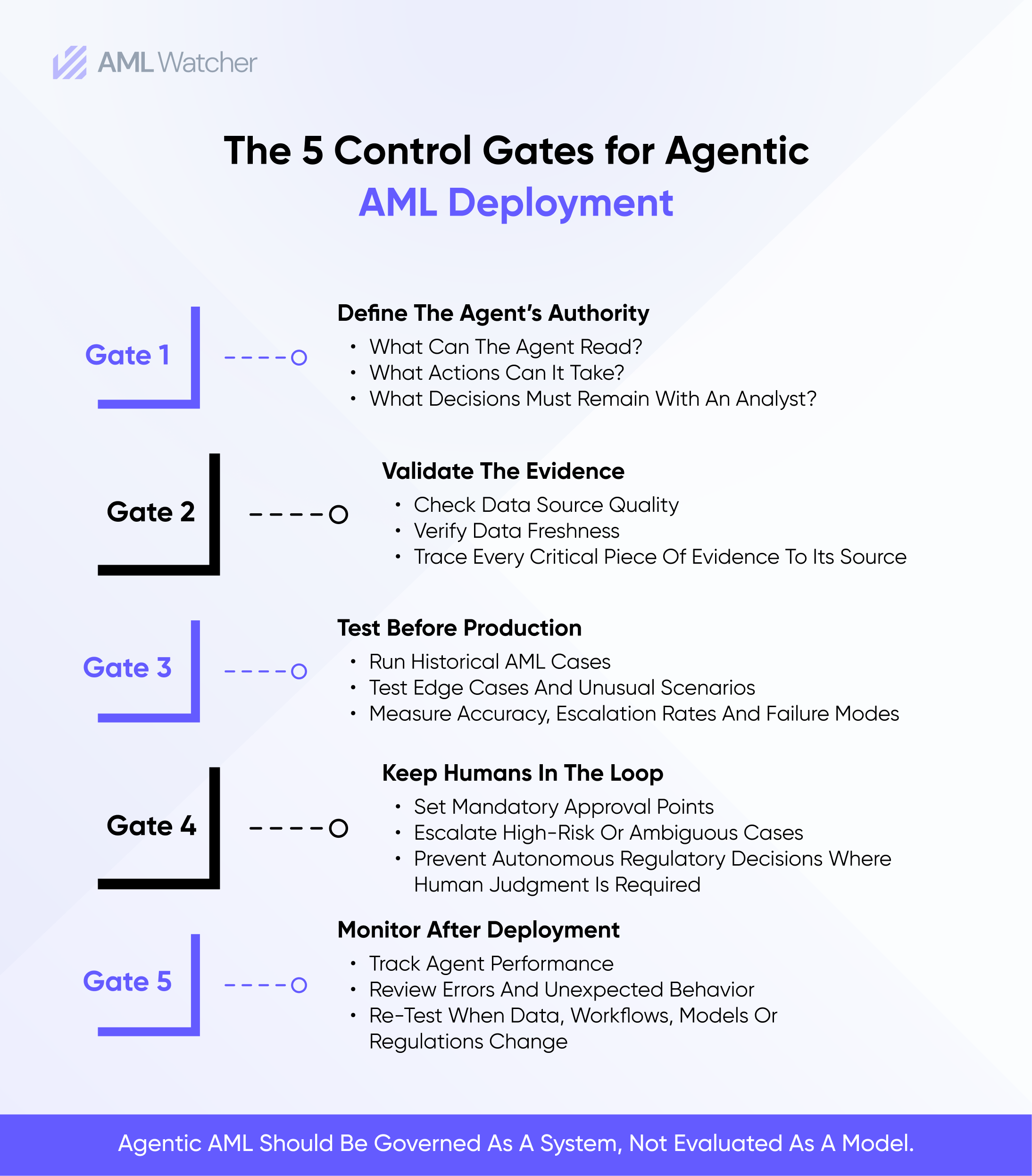
- Controls and testing: Can financial institutions define approval gates, test agent outputs before production and monitor performance after deployment?
The same criteria provide a practical lens for comparing the vendors below.
Top Agentic AI Vendors for AML in 2026
AML Watcher
AML Watcher’s Agentic AML Operations Platform combines an agent layer with a proprietary AML data and intelligence layer, giving agents access to screening, risk and investigative context rather than relying only on workflow automation. The platform screens against 3,500+ watchlists and 100,000+ data sources, with sanctions data refreshed every 15 minutes, alongside defined refresh cycles for PEP, watchlist and media data and applies an L1-screening, L2-investigation model where agentic workflows handle first-pass triage before escalating to structured investigation.
TruRisk adds contextual analysis to screening decisions and provides documented rationale and match information that can support analyst review and audit requirements.
AML Watcher’s agentic capabilities are designed to support the wider AML lifecycle, including screening, investigation, monitoring and filing. Its MCP server provides AI workflows with structured access to AML data and intelligence. Screening and investigation capabilities are currently positioned as live offerings, while other lifecycle capabilities are being rolled out across deployments.
The quality of an AML agent depends on the quality, coverage and freshness of the evidence available to it, making AML data infrastructure as important as the automation itself.
Unit21
Unit21 focuses on AI-driven risk and compliance workflows, with its platform supporting areas such as alert investigation, workflow automation and regulatory reporting. Its approach brings fraud and AML operations into a single environment, with AI agents intended to handle defined investigative and operational tasks while keeping human oversight in the process. For financial institutions evaluating agentic AML solutions, Unit21 represents an approach centered on combining risk infrastructure with workflow automation.
Hawk
Hawk applies AI to AML investigation workflows, with its AML Investigative Agent focused on tasks such as gathering relevant information, summarizing cases, identifying potential typologies and supporting SAR preparation. The approach is designed to work with existing compliance infrastructure, allowing financial institutions to introduce AI into investigative processes without replacing the wider technology stack. Its positioning is particularly relevant for teams looking to reduce the manual effort involved in alert investigation.
Sardine
Sardine approaches agentic AML as part of a broader financial crime platform that also covers fraud prevention and device intelligence. Its AI capabilities extend across areas such as sanctions screening, transaction monitoring, adverse media and investigation workflows, with human review remaining part of the process. This makes Sardine more relevant for financial institutions looking at AML alongside wider fraud and financial crime operations rather than as a standalone AML workflow.
WorkFusion
WorkFusion has focused on using AI agents and digital workers for financial crime operations, including alert review, investigations, sanctions and PEP screening, adverse media and transaction monitoring. Its approach has historically emphasized automating repetitive Level 1 and Level 2 compliance work, making it an established example of AI-driven financial crime automation before agentic AI became a broader industry focus. In 2026, WorkFusion became part of UiPath, bringing its financial crime capabilities into a wider enterprise automation ecosystem.
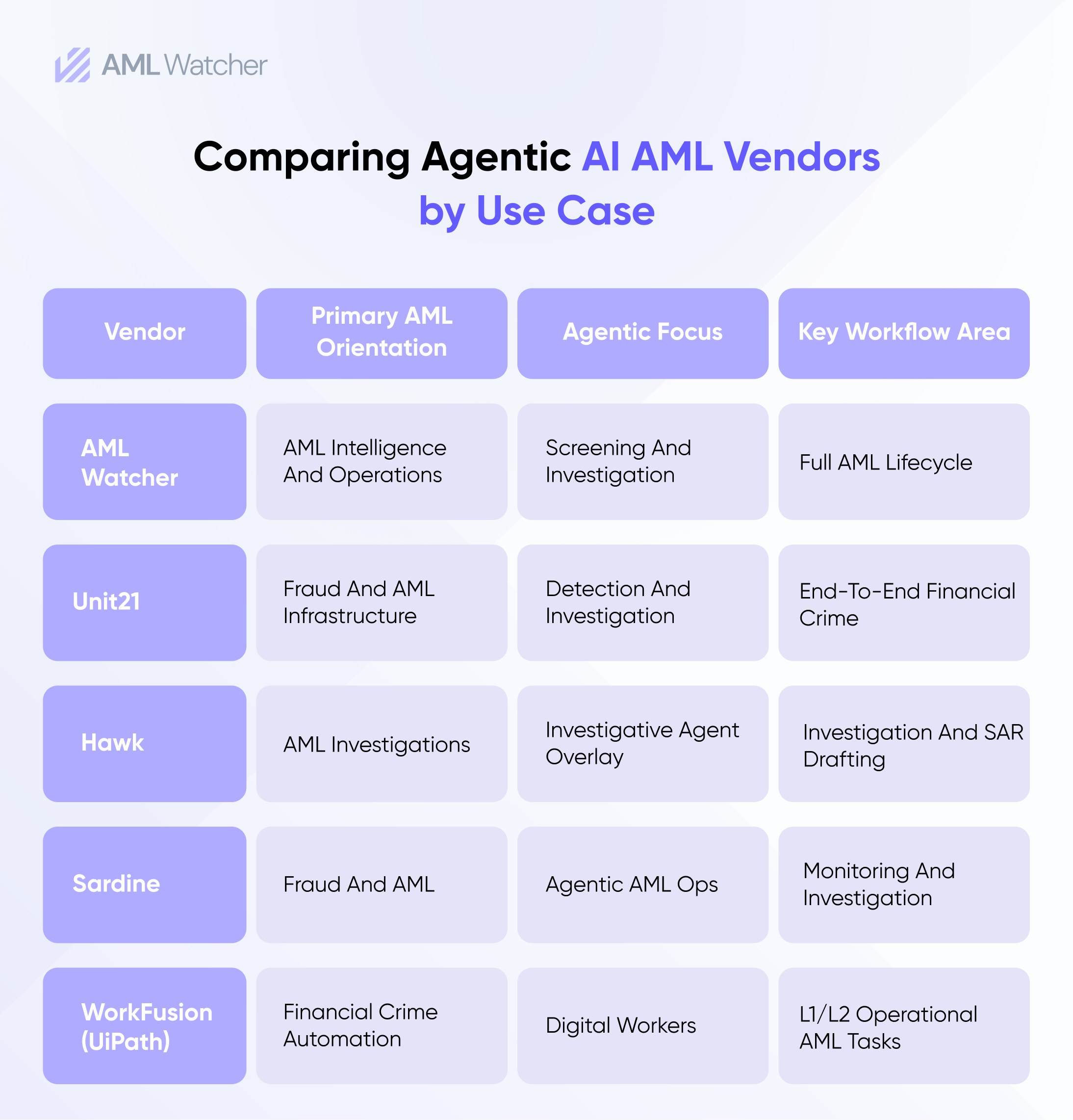
The comparison is based on publicly available information about each vendor’s agentic AI capabilities for AML or financial crime operations in 2026. It is not a formal market ranking and focuses on investigation automation, AML data, human oversight, integration and auditability.
The evaluation criteria above also reflect the broader FATF risk-based approach. Automation does not change an institution’s responsibility to understand its risks, apply appropriate controls and maintain oversight. Agentic AML solutions should therefore be assessed on the quality of their evidence, controls, documentation and governance, rather than on how autonomous their marketing language sounds.
The Future of Agentic AI in AML Compliance
One possible direction for the market is greater coordination between specialized agents, with monitoring, investigation and reporting workflows connected through shared data and controlled interfaces. MCP-style connectivity could also make it easier for AI agents to access approved compliance data and systems, although governance and access controls will remain necessary as these architectures develop.
As these architectures mature, regulatory expectations are likely to place greater emphasis on testing, monitoring and human oversight alongside AI deployment.
Choosing the Right Agentic AI Vendor for AML Compliance
There is no universal answer. The right fit depends on an institution’s AML operating model, data environment, investigation volume, regulatory footprint and the level of automation its governance framework can support. What separates stronger agentic AML solutions from the rest is not how autonomous they claim to be. It is whether their AML intelligence, investigation depth, governance and integration hold up under an examiner’s questions.
- No commitment needed
- Complete AML Database at your service
- Access our all-in-one dashboard


Tier-2 PSPs in ... must demonstrate automated monitoring, layered CDD, &...
See the Full Regulatory Expectation70–80% less manual work, 95% less fatigue, TruRisk Agent makes compliance effortless.
Experience Agentic AMLMove Beyond Articles. Activate AML Intelligence.
Switch to AML Watcher today and reduce your current AML cost by 50% - no questions asked.
- Find right product and pricing for your business
- Get your current solution provider audit & minimise your changeover risk
- Gain expert insights with quick response time to your queries


