

 Alert!

Best RegTech Companies 2026: 5 AML Platforms Compared
Others
September 23, 2026


- How to Choose an AML RegTech Platform
- AML Watcher: Focused on Screening Accuracy and Alert Reduction
- Fenergo: Enterprise Client Lifecycle Management
- Chainalysis: Crypto Transaction Monitoring and Blockchain Intelligence
- Jumio: Identity Verification and Biometric Fraud Prevention
- Ondato: Accessible, Transparent KYC and KYB
- Which AML RegTech Platform Fits Different Compliance Needs?

For many financial institutions, the hardest part of AML alert management is not generating alerts. It is determining which alerts represent genuine risk and which ones will ultimately require no further action. Research has found false-positive rates of around 90% in traditional transaction monitoring environments, creating a substantial workload for compliance teams. This is why financial institutions are looking beyond alert volumes and asking whether AML RegTech can improve the quality of screening decisions and investigation workflows.
Data coverage, matching accuracy, data freshness, investigation workflows and integration requirements therefore provide a more useful basis for comparison.
This guide compares five RegTech and financial-crime platforms in 2026, examining where each is strongest, what compliance problem each platform is designed to address, and where institutions may need additional capabilities.
How to Choose an AML RegTech Platform
Five criteria provide a practical basis for comparing AML RegTech platforms.
- Data coverage: Does the platform provide relevant sanctions, watchlists, PEP, adverse media and other financial-crime data required for screening?
- Matching accuracy: How effectively can the system distinguish a genuine risk from an irrelevant match?
- Data freshness: How quickly are new sanctions designations, watchlist entries and profile changes reflected in the screening environment?
- Investigation workflows: How much alert review, enrichment, investigation and case documentation can compliance teams manage within the platform?
- Integration: Can the solution fit the existing compliance architecture without creating unnecessary implementation complexity?
AML Watcher: Focused on Screening Accuracy and Alert Reduction
AML Watcher combines an in-house AML data layer with AI-assisted screening to address one of the most persistent problems in financial-crime compliance, the volume of irrelevant alerts generated during screening. Its database covers 3,500+ watchlists, 215+ sanctions regimes, 100,000+ data sources and more than 235 countries and states. AML Watcher also provides extensive PEP coverage, while sanctions data is refreshed every 15 minutes. Institutions should confirm current dataset counts and refresh cycles against the latest product documentation when evaluating coverage.
The combination of broad data coverage and contextual information gives screening decisions more information than name matching alone.
TruRisk is AML Watcher’s AI layer for screening and alert qualification. It evaluates identifiers such as date of birth, nationality and related-entity information alongside name matching to help distinguish potential true matches from irrelevant results across sanctions, PEP, watchlist and adverse media screening. Its decision reasoning also provides an auditable basis for human compliance review, helping analysts understand why an alert was classified in a particular way.
The underlying value is operational as well as technical. Fewer irrelevant alerts can allow compliance analysts to spend more time investigating cases that warrant closer attention.
Its PEP data uses a four-level classification designed to include lower-level public officials, while its international leaks database provides an additional source of ownership and financial-intelligence information beyond conventional sanctions and watchlist data. The platform also extends into transaction monitoring with 150+ pre-built AML typologies and 10,000+ customizable rules, alongside crypto wallet screening across 415+ risk categories.
AML Watcher also reports up to 50% lower AML compliance costs compared with existing solutions. Actual savings depend on screening volumes, deployment requirements and the institution’s existing technology stack.
Fenergo: Enterprise Client Lifecycle Management
Fenergo focuses on Client Lifecycle Management rather than standalone AML screening. Its FinCrime Operating System brings onboarding, identity verification, UBO analysis and ongoing monitoring into an entity-centric platform. Fenergo also offers its Fen-AI orchestration layer for automating parts of onboarding and periodic review while maintaining human oversight and audit trails.
Fenergo is particularly relevant to large, multi-jurisdictional institutions where client lifecycle orchestration is a primary requirement. Its proposition is broader than standalone AML screening, making it a different type of solution from platforms focused specifically on screening accuracy and alert reduction.
Chainalysis: Crypto Transaction Monitoring and Blockchain Intelligence
For crypto-facing institutions, Chainalysis focuses on on-chain investigation and cryptocurrency transaction monitoring. Its KYT (Know Your Transaction) solution helps financial institutions monitor transactions, trace fund flows and assess wallet risk. Its newer AI capabilities also support alert enrichment and investigation summaries, reducing some of the manual work involved in reviewing crypto transactions.
Its strongest fit is therefore for institutions where blockchain intelligence and crypto transaction monitoring are central compliance requirements.
Jumio: Identity Verification and Biometric Fraud Prevention
Jumio focuses on digital identity verification, combining document verification, biometrics and fraud detection for high-volume onboarding. Its Identity Graph covers more than 30 million profiles, while its document library supports thousands of identity document types. This makes the platform particularly relevant to institutions where identity verification and biometric fraud prevention are central to the onboarding process.
The platform is therefore particularly relevant to institutions where identity verification and biometric fraud prevention are central to onboarding.
Ondato: Accessible, Transparent KYC and KYB
Ondato combines KYC, KYB, identity verification and AML capabilities within a single platform. Its business verification functionality includes company registry checks and UBO identification, making the platform relevant to fintechs and other businesses that need both individual and business verification workflows. Its positioning is particularly suited to institutions looking for an integrated KYC and KYB offering rather than a platform focused primarily on AML screening optimization.
Which AML RegTech Platform Fits Different Compliance Needs?
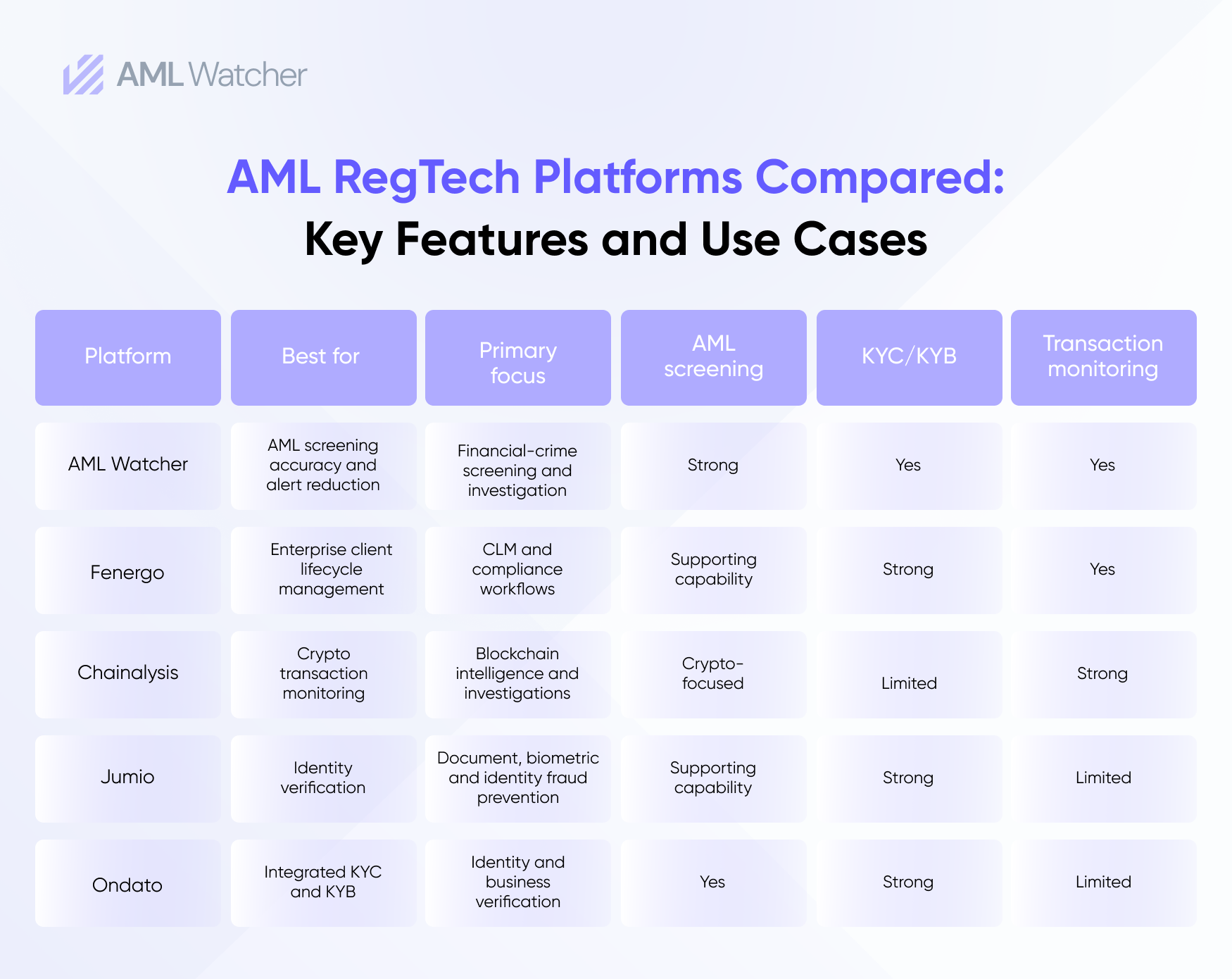
The five platforms address different compliance priorities, so the strongest fit depends on the risk and workflow gaps an institution is trying to address. Fenergo is suited to client lifecycle management, Chainalysis to blockchain intelligence and crypto transaction monitoring, Jumio to identity verification and biometric fraud prevention, and Ondato to integrated KYC and KYB workflows.
AML Watcher has a more focused proposition around AML screening, particularly for institutions assessing screening accuracy, financial-crime data coverage and alert qualification. Its combination of broad AML data, contextual screening and TruRisk-based alert qualification is designed to support more informed screening decisions while reducing unnecessary review.
For institutions evaluating AML RegTech platforms, the most useful comparison is therefore not which vendor has the longest feature list. The stronger question is which platform best matches the institution’s compliance priorities, data requirements and existing workflows.
- No commitment needed
- Complete AML Database at your service
- Access our all-in-one dashboard


Tier-2 PSPs in ... must demonstrate automated monitoring, layered CDD, &...
See the Full Regulatory Expectation70–80% less manual work, 95% less fatigue, TruRisk Agent makes compliance effortless.
Experience Agentic AMLMove Beyond Articles. Activate AML Intelligence.
Switch to AML Watcher today and reduce your current AML cost by 50% - no questions asked.
- Find right product and pricing for your business
- Get your current solution provider audit & minimise your changeover risk
- Gain expert insights with quick response time to your queries