

 Alert!

4 Ways RegTech Will Transform AML/KYC Controls
Anti Money Laundering
Sep, 24 2026
November 21, 2025


United Nations Office on Drugs and Crime estimates that scam-related losses across East Asia, Southeast Asia, Australia and New Zealand reached $88.3–$114.1 billion in 2025, up from $18–$37 billion in 2023. This increase is due to advancements in AI, deepfakes, and crypto-enabled fraud. Countries and regions are now taking adaptive measures. On January 1, 2026, the European Banking Authority established a new Anti-Money Laundering Authority (AMLA) and declared it the sole regulatory authority in the whole of Europe instead of 27 national regulators. Similarly, the USA’s FinCEN has announced a shift towards encouraging technological innovation and adoption of new technology. The recommendations were officially published in the Federal Register on April 10, 2026 and ordered banks and financial institutions to adopt new technologies to improve AML/CFT effectiveness.
This shift shows that RegTech AML regulators are seriously and proactively incorporating the measures to curb money laundering and terror financing. The 4 ways RegTech is transforming AML/KYC controls in accordance with today’s rapid evolution of fraud methodologies and as per the recommendations of regulatory authorities:
- Risk-based supervision is replacing rigid checklists
- Cross-border data reporting is being standardised for the first time
- Regulators are co-developing AI tools with the firms they oversee
- Even how regulators communicate expectations is being restructured
What RegTech Actually Means for AML/KYC Today
RegTech is the use of AI, machine learning, and automated data infrastructure to handle compliance work that once required human monitoring. That is the textbook definition, and it is evolving in 2026. AML RegTech today is improving and evolving by adding new features and technologies in it as per the guidance of regulatory authorities such as the Financial Action Task Force (FATF).
The FATF has examined and encouraged the role of new technologies to support AML/CFT implementation. It sets regulations regarding new technologies and noted that they can increase the ability to collect, process, and share data in real time. FATF also acknowledged the role of AI and noted that AI-based tools can analyse information in real time and help identify emerging risks.
This does not mean that regulators are telling firms to replace human competence with AI. They recommend a stronger focus on risk identification, more scrutiny of data, targeted supervision, and the application of effective controls under human supervision.
What are the 4 Major Ways of RegTech Transformation?
RegTech is transforming in the following 4 major ways, and regulators are incorporating the following methodologies to improve the AML and KYC controls:
1. How Risk-Based Supervision Is Replacing Checklist Compliance
AML compliance for years has worked like a checklist, including documenting everything and flagging everything above a threshold. AML compliance in the US has likewise worked on this documentation methodology, predefined controls and extensive examinations for years. In April, 2026, the U.S. Department of the Treasury’s Financial Crimes Enforcement Network (FinCEN) took the initiative to change it and described it as a fundamental reform of Bank Secrecy Act Compliance Programs. FinCEN took this initiative to transform and promote risk-based, reasonably designed programmes and greater consistency in evaluating effectiveness.
This shows that countries and RegTech authorities are now adapting new technologies faster than ever before. FinCEN has categorically stated that the firms that are experimenting with new technologies, including AI, federated learning and other advanced technologies, won’t be penalised for trying something new. This is a major breakthrough, as previously the authorities that were using any methodologies against the proposed checklist techniques were penalised. This is indeed a sigh of relief for compliance teams who were hesitant to use AI-driven monitoring because it was harder to defend against an audit. The shift of the regulators towards a risk-based approach has indeed removed a major obstacle for compliance teams.
2. Centralised, Standardised Data Reporting Across Borders
Another major shift that recently happened is the centralisation of a single AML body throughout Europe. AML/KYC technology for regulatory bodies is also changing in Europe, and the EU is perhaps the perfect example of how mutual harmony can create a major RegTech success. EU has spent decades fighting money laundering through directives that each of its 27 member states implemented in its own way. It benefitted the launderers, as there were 27 slightly different rulebooks with 27 different levels of enforcement actions. Every country has to deal with its own AML/CFT on its own, and there are plenty of gaps for money to slip through. The authorities in the European Union recognised this gap and came up with the formation of a new authority. On 1 January 2026, AMLA and the EBA completed the full handover of AML/CFT mandates from the EBA to the Anti-Money Laundering Authority (AMLA), to end that fragmentation. A Single Rulebook will apply uniformly across every member state starting July 10, 2027. The agency is already collecting standardised eligibility data to select the first 40 high-risk institutions it will directly supervise beginning in 2028.
For RegTech, this is a major shift as the difference between building a compliance tool for one jurisdiction and building one that speaks a common data language across an entire economic bloc. Institutions operating in multiple EU countries have historically needed separate reporting logic for each regulator. Previously, financial institutions and banks had to go through a lot of documentation that was messy and required a lot of manpower and time for completion. Now the new rulebook has simplified it, and all the banks will follow the same guidelines to label, organise, and submit their data. Humans won’t need to fill the documents themselves and just need to link their databases into automated software systems that can instantly read and share the information.
3. Regulators Are Co-Building AI Tools, Not Just Approving Them
The relationship between the regulators and technology developers is also changing. Regulators are adopting AI methodologies, shifting toward automated RegTech AML solutions, and creating controlled environments to test AI experiments. The UK’s Financial Conduct Authority’s Supercharged Sandbox is a prime example of it. The programme offers participating firms access to a secure environment with GPU-enabled computing, enterprise AI tooling, synthetic datasets, mentoring and expert support. Its stated purpose is to help firms experiment, test and develop AI use cases in financial services. The numbers showed staggering demand. The first batch ran from September 2025 to January 2026, received 132 applications, with 22 firms selected. The second batch received 199 applications, a 51% increase and the FCA selected 21 organisations.
The FCA is not presenting this as a technology competition, but as a way for financial organisations to see how AI advancements could reshape financial services and regulation.
The implication for AML/KYC teams is important.
Instead of waiting years for a finished regulatory platform, firms are being encouraged to join the evolutionary phase and experiment, learn, test, and regulate on their own.
4. Compliance Communication Itself Is Being Restructured
The fourth change is not as dramatic as AI but potentially as important as AI for compliance operations.
Regulators are changing how they communicate with firms.
The FCA introduced nine annual Regulatory Priorities reports to replace more than 40 portfolio letters in Feb 2026. The FCA said these new reports were designed to communicate sector-specific priorities more clearly and consistently.
The reports cover the following sectors:
- Insurance
- Consumer Investments
- Pensions
- Consumer Finance
- Retail Banking
- Mortgages
- Wholesale Buy-Side
- Wholesale Markets
- Payments
The FCA announced the new approach to create a more streamlined and one-stop source of regulatory priorities. It also promised to share annual updates and add direct links for more detailed information.
Why does this matter to RegTech?
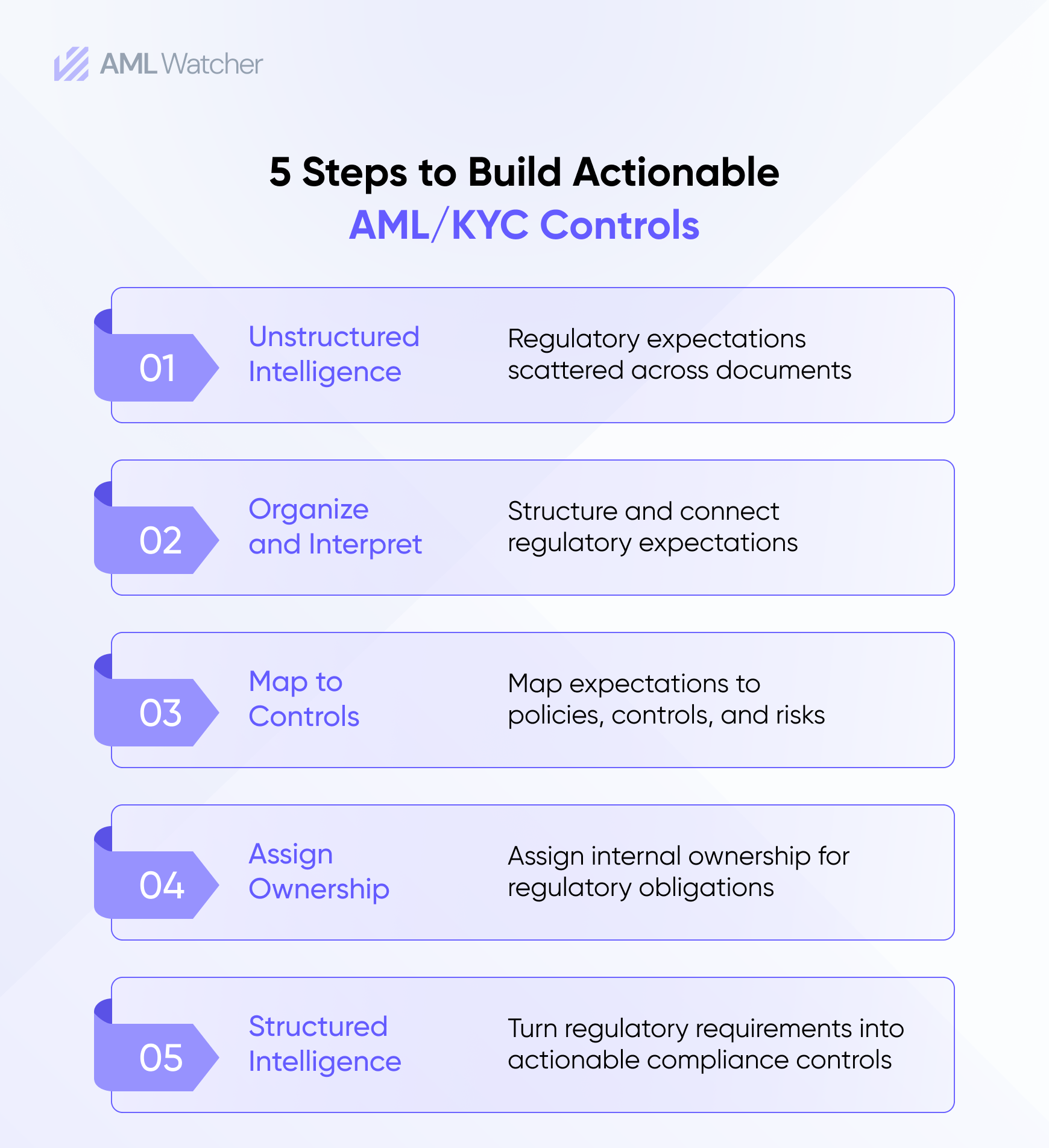
Compliance technology increasingly depends on structured regulatory intelligence. With so much paperwork and regulatory complexity, compliance teams often have to process everything manually, which can help money launderers move funds quickly.
Structuring, automating, and adding AML/CTF regulatory technology solutions to the process would help compliance teams act proactively against criminals and assess risk faster.
The FCA has also said its new supervisory approach will help collect targeted data and take a more risk-based approach with its largest firms.
This shows that RegTech is moving towards a broader transformation, and compliance teams are not only automating but also increasingly structuring how regulatory compliance is translated into more actionable AML/KYC controls.
What This Means for Compliance Teams Right Now
The 4 ways discussed above show that RegTech is transforming AML/KYC controls now and will continue to do so in the coming years.
The US is redefining its AML/CFT programmes to reflect AI advancements and to be risk-based and effective in controlling hazards. The EU is building data infrastructure for the first time to enable uniform cross-border supervision and regulation. The UK is equipping firms with infrastructure, databases, computing resources, and expert support to experiment with AI and curb financial irregularities. The important conclusion is not that every compliance process will immediately become AI-driven. It is just to ensure that it becomes more efficient, data-centric, and technology-enabled. Notably, none of these regulators coordinated with each other on this matter, and they reached the same conclusion at the same time. This shows that RegTech adoption in 2026 is no longer just a competitive advantage. It is actually the baseline regulators are forming their regulations around.
AML Watcher has been working for years now, encouraging businesses and regulatory authorities to foster a compliant culture and attain easy yet efficient solutions, and believes in boosting collaboration, innovation, and outcomes. Connect with us to strategise your compliance with innovation and commitment.
Frequently Asked Questions
- No commitment needed
- Complete AML Database at your service
- Access our all-in-one dashboard


Tier-2 PSPs in ... must demonstrate automated monitoring, layered CDD, &...
See the Full Regulatory Expectation70–80% less manual work, 95% less fatigue, TruRisk Agent makes compliance effortless.
Experience Agentic AMLMove Beyond Articles. Activate AML Intelligence.
Switch to AML Watcher today and reduce your current AML cost by 50% - no questions asked.
- Find right product and pricing for your business
- Get your current solution provider audit & minimise your changeover risk
- Gain expert insights with quick response time to your queries