Alert!

A 2026 Guide on AML Compliance
AML Compliance
December 26, 2025


Fraud schemes are evolving with advances in technology, and criminals adopt new methods daily. Fraud schemes are increasingly intertwined with money laundering, requiring financial institutions to go beyond compliance audits to effectively tackle emerging threats. Regulators have been very specific in their expectations that businesses must demonstrate involvement in preventing financial crime throughout the entire customer lifecycle.
This blog will outline the major modifications to AML compliance by 2026 and give financial institutions the tools and strategies necessary to comply with regulations and combat the increasing risks of money laundering and terrorist financing.
What is AML Compliance?
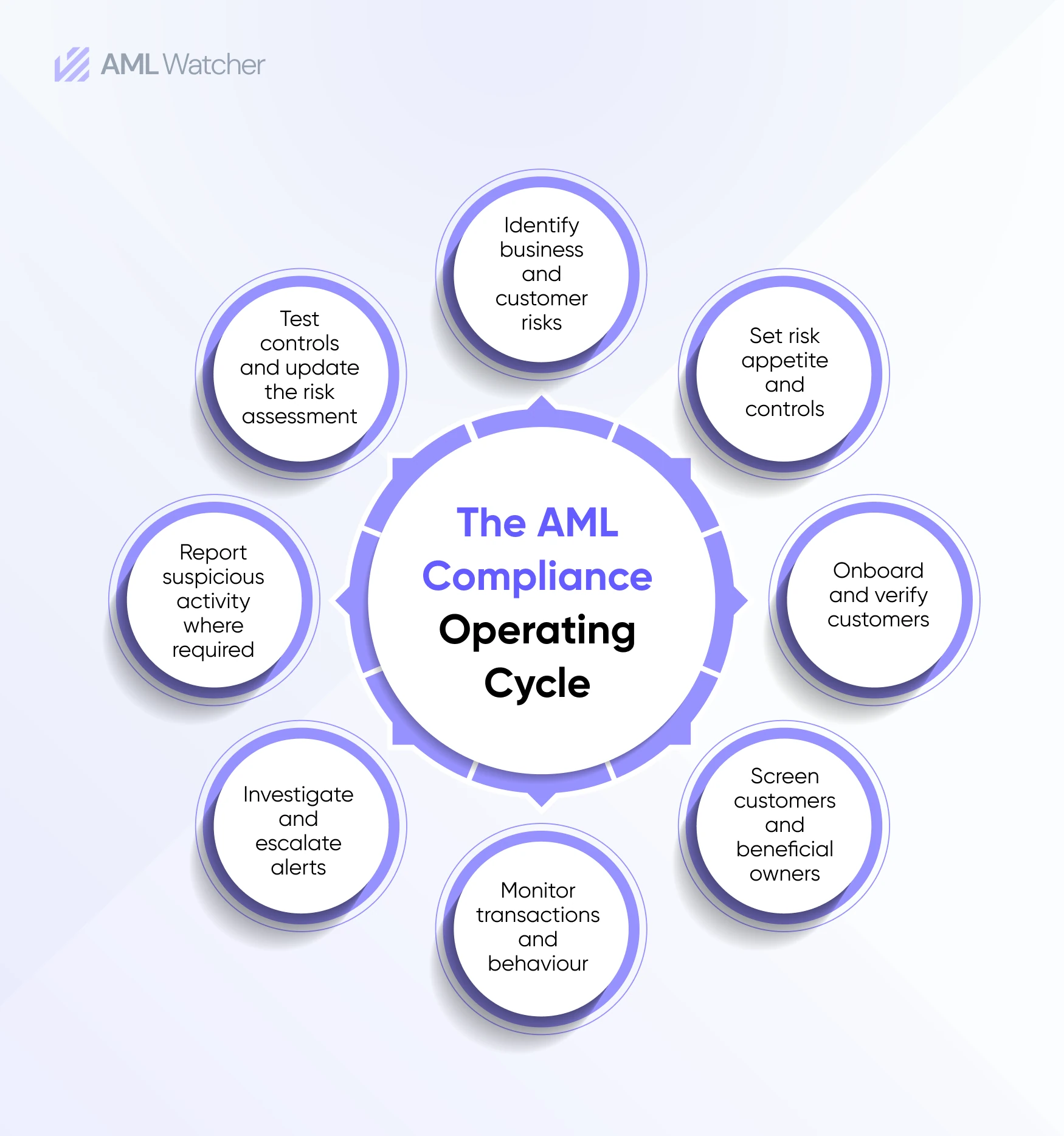
Anti-money laundering (AML) compliance is a regulatory system that an institution adopts to identify, prevent, and report any suspicious financial activity. It includes practices such as customer identity checks (KYC), continuous monitoring of transactions for illegal activity, and countering the financing of terrorism (CFT) to prevent terrorist group financing. Effective AML compliance is not a one-time onboarding formality. It is a continuous process that combines customer due diligence, sanctions and PEP screening, transaction monitoring, suspicious activity reporting, staff training, record-keeping, and independent testing.
The Financial Action Task Force (FATF) is the main authority that sets the AML/CFT standards internationally. Its risk-based approach wants countries and regulated entities to identify, assess, and understand money-laundering and terrorist-financing threats and then apply control measures accordingly.
Current compliance with AML requires constant supervision of customer activities and timely reporting of suspicious behaviour to regulators, which is a sign of the sophistication of financial offenders and the technological progress that promotes the work of criminals.
What Has Changed in 2026?
AML compliance teams are managing a more complex operating environment. Cross-border payments move faster, and criminal networks are using the latest digital channels. Regulators increasingly expect firms to show their controls work in practice, not just that policies exist.
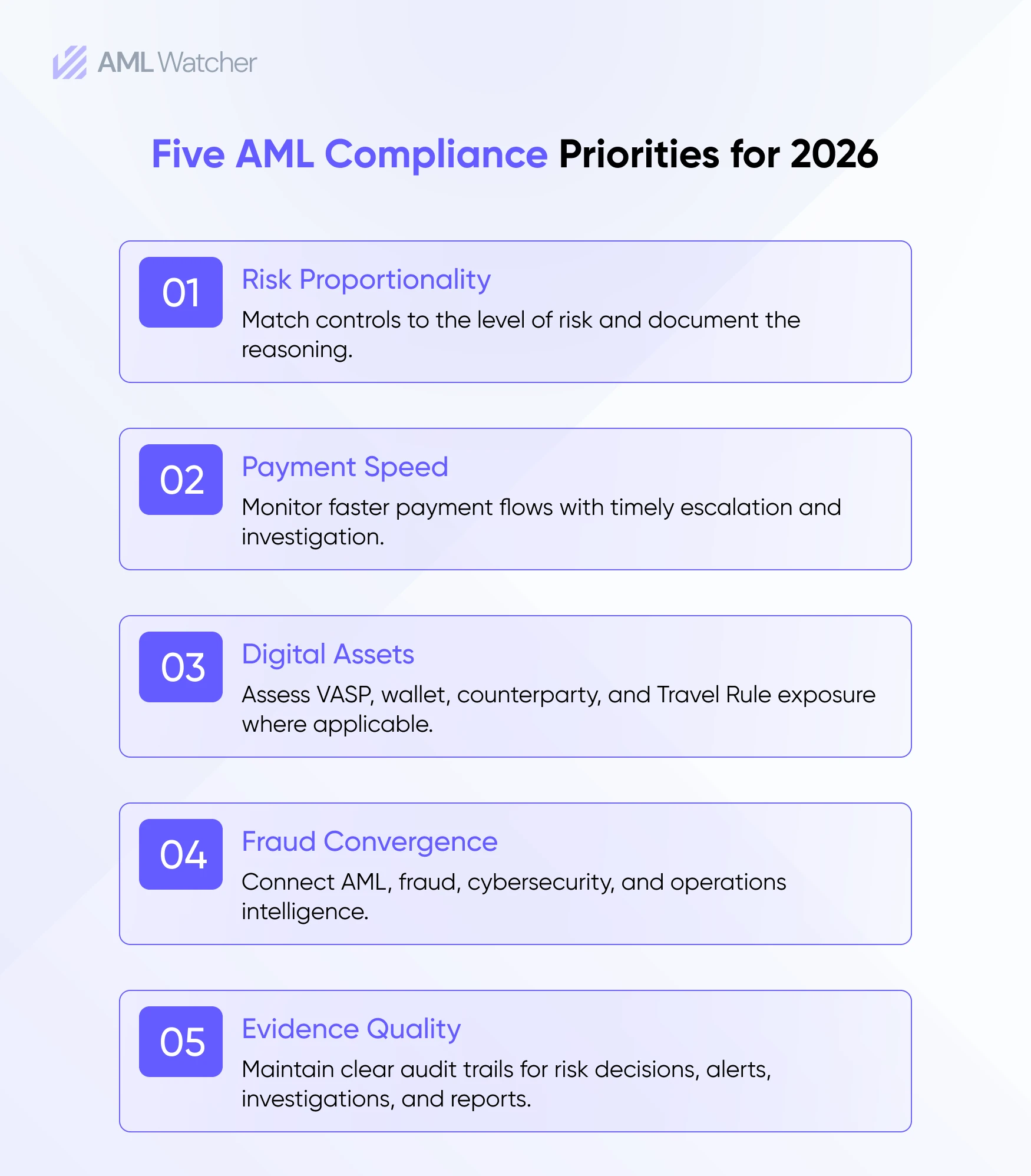
Proportionality Is Now More Clearly Defined
In February 2025, FATF revised its standards to reinforce proportionality within the risk-based approach. This means controls should address higher-risk relationships more intensively while allowing simplified measures in lower-risk situations when appropriate.
This makes customer verification and onboarding, documented risk scoring, and periodic risk-assessment updates for compliance teams more important. A firm should be able to explain why and how it applied standard due diligence, enhanced due diligence, or simplified measures in a particular case.
Virtual-Asset Rules Are Expanding
Virtual assets remain a major area of regulatory attention. FATF’s 2026 targeted update found that 83% of surveyed jurisdictions had made the Travel Rule law, up from 73% in 2025. But the implementation and enforcement remain uneven across jurisdictions. The Travel Rule generally requires crypto companies to attach sender and receiver details to transfers, much like traditional bank wires. To do this safely, these companies must know their local laws, vet the platforms they send money to, and make sure their tech partners are secure.
Cyber-Enabled Fraud Is Becoming an AML Issue
Online scams are not only fraud anymore, as they often depend on mule accounts, payment networks, shell companies, virtual assets, and cross-border laundering channels. UNODC has linked scam-centre activity to money laundering, corruption, trafficking, and misuse of virtual assets. This means AML teams need closer coordination with fraud, cybersecurity, operations, and customer-support functions. A transaction monitoring team may see unusual movement of funds, while a fraud team may hold the customer-behaviour signals needed to understand the full risk.
2026 AML Risk Landscape
To implement an effective AML control framework, it is essential to have a clear understanding of risk assessment, including hazards, existing control measures, and additional controls needed. In 2026, organisations should review their risk assessments against the new threats as follows:
| Risks | What Could be the Consequences | Control Measures Needed |
| Faster Payments | Funds can move through multiple accounts before a review is completed. | Real-time monitoring, clear escalation rules, and investigation queues. |
| Cross-Border Activities | Different Jurisdictions create data, sanctions and reporting challenges. | Assess country exposures, payment routes, and local requirements. |
| Virtual Assets | Transfers may involve unregulated providers or high-risk wallets. | Apply VASP due diligence, wallet risk assessment, and Travel Rule control where needed. |
| Mule Account Networks | Accounts may receive amounts that may leave immediately. | Detect account inflows and outflows, linked accounts, unusual device data and behavioural monitoring. |
| Sanctions Unpredictability | A newly listed person on a sanctions list can create an immediate threat. | Regular screening of customers and transactions against the latest available lists. |
| Beneficial Ownership Nontransparency | Companies can be used to hide the real ownership or beneficiary. | Identify and verify the real owners of the companies using a risk-based approach. |
| AI and Data Governance | Usage of unauthorised AI tools can impact the quality of investigation and results. | Maintain data secrecy, strictly prohibit the use of unauthorised tools, and implement human review and supervision. |
Higher risk does not automatically mean a customer must be rejected. It means the organisation should understand the risk, apply stronger controls where appropriate, document its reasoning, and follow applicable law.
Key Building Blocks of a Successful AML Program in 2026
In order to remain in line with changing regulations, companies need to come up with AML programs that align with their risk appetite while ensuring they meet regulatory requirements. The main pillars of an effective AML compliance program in 2026 are as follows:
Enterprise-Wide Risk Assessment (EWRA)
An enterprise-level risk assessment is the foundation of modern AML compliance. It identifies the areas where the organisation is exposed to money laundering, terror financing, sanctions risk and other fraud-linked risks.
An efficient EWRA must cover the following areas:
- Customer types and customer behaviour
- Products and services
- Delivery channels, including non-face-to-face onboarding
- Countries and geographic exposure
- Payment methods and transaction patterns
- Third parties, agents, vendors, and correspondent relationships
- Digital assets and emerging technology, where relevant
The assessment should be reviewed whenever there is a change in the organisation, for example, after launching a new product, entering a new market, a change in higher management, or identifying a severe control failure.
Customer Due Diligence (CDD) and Enhanced Due Diligence (EDD)
Customer Due Diligence (CDD) is the core of AML compliance, as it is a process aimed at collecting the necessary information about clients to determine their risk level. In their case, higher-risk clients, including PEPs or citizens of high-risk jurisdictions, require Enhanced Due Diligence (EDD) measures. This can entail the collection of more data about the monetary history, wealth, and origin of money of the client.
CDD and EDD are important in determining the risks that may happen in advance, and this gives businesses the knowledge to reduce risks of exposure to illegal activities.
Transaction Monitoring and Investigation
Transaction monitoring should be continuous against the transaction history of the customer and should detect any unusual behaviour against his known profile and risk level. An effective monitoring process should include:
- Rapid fund flow without any clear commercial rationale
- Activity inconsistent with the customer’s stated business or income
- Frequent transfers just below relevant reporting threshold levels
- Sudden changes in transaction size, frequency, or destination
- Transfers involving higher-risk locations
- Unusual use of virtual assets, payment intermediaries, or linked accounts
- Patterns consistent with mule-account activity or scam proceeds
An impactful monitoring program requires more than alerts and proactive actions. Teams need clear case-management processes, investigator guidance, escalation thresholds, quality assurance, and periodic tuning to reduce both missed risk and unnecessary false positives.
Sanctions, PEP and Adverse Media Screening
Sanctions screening, PEP screening, and adverse media screening serve different purposes and each of them has its own impact:
- Sanctions screening helps identify individuals, organisations, vessels, or other parties subject to restrictions under applicable sanctions regimes.
- PEP screening helps identify people holding prominent public positions, their relevant family members and close associates where applicable.
- Adverse-media screening helps identify credible negative information that may indicate financial crime, corruption, fraud, or reputational risk.
It does not mean that a potential match is automatically a confirmed match. Compliance teams have to work hard and need documented processes to investigate alerts, resolve false positives, escalate confirmed matches, and retain the rationale for their decisions.
Suspicious Activity Reporting (SAR), Internal Governance and Trainings
When suspicious activity occurs, the relevant authorities should be notified. This requires organisations to have explicit, well-articulated procedures for identifying, reporting, and investigating suspicious transactions.
Moreover, companies are expected to have robust internal controls, such as audit trails, senior management oversight, and periodic review of the compliance systems. This makes the organisation responsible and prepared for regulatory scrutiny.
Management should ensure role-specific refresher training. Frontline teams may need to identify onboarding red flags, investigators may need case-writing and escalation guidance, and senior management may need training on oversight duties and risk decisions.
What AML Technology Should Demonstrate
As technology is evolving, criminals are using the latest methods and loopholes for money laundering. The role of technology in AML has also become extremely important as it can make AML work faster and more consistent. FATF, in its report OPPORTUNITIES AND CHALLENGES OF NEW TECHNOLOGIES FOR AML/CFT, encouraged the adoption of Artificial Intelligence (AI) and advanced technologies in Anti-Money Laundering (AML) and Countering the Financing of Terrorism (CFT) frameworks to move away from rigid, rule-based traditional systems toward dynamic, risk-based supervision. Technology is helping compliance systems, but it does not replace accountability. A system should support informed human decisions and help the organisation demonstrate how those decisions were reached.
When evaluating AML technology, ask whether it can provide:
- Current, traceable screening data
- Clear match-resolution workflows
- Configurable risk scoring aligned to the organization’s risk capacity
- Audit logs that show who reviewed, changed, approved, or closed a case
- Data-quality checks and exception handling
- Transaction-monitoring systems that can be tested and tuned
- Case management, escalation, and reporting support
- Role-based access controls and secure record retention
- Explainable outputs when automation or AI supports prioritisation
- Integration with onboarding, payments, customer, and fraud data where appropriate
How AML Watcher Supports 2026 AML Compliance
Many institutions expose themselves to enforcement action if ongoing monitoring has gaps or screening workflows are outdated and can’t capture risk changes during the customer lifecycle after onboarding.
AML Watcher supports continuous screening across 215+ global sanctions lists with precise name matching that updates every 15 minutes, PEP screening with 6m+ enriched PEP profiles, 3500+ official watchlists, and adverse media against 50k+ local and global news sources, helping teams keep risk decisions current as new signals emerge.
Frequently Asked Questions
AML/CFT regulations refer to laws that aim at deterring and
identifying money laundering and terrorist financing activities.
They demand that financial institutions implement preventive
measures, including transaction monitoring and customer identity
verification.
Risk-based approach enables businesses to channel resources to
higher-risk customers and transactions to enhance the effectiveness
and efficiency of their AML programs while reducing the cost of
business operations.
Continuous monitoring is the act of tracking and analyzing
customer transactions to detect suspicious activity. This helps
immediately identify the changing patterns of financial crime.
- No commitment needed
- Complete AML Database at your service
- Access our all-in-one dashboard


Tier-2 PSPs in ... must demonstrate automated monitoring, layered CDD, &...
See the Full Regulatory Expectation70–80% less manual work, 95% less fatigue, TruRisk Agent makes compliance effortless.
Experience Agentic AMLMove Beyond Articles. Activate AML Intelligence.
Switch to AML Watcher today and reduce your current AML cost by 50% - no questions asked.
- Find right product and pricing for your business
- Get your current solution provider audit & minimise your changeover risk
- Gain expert insights with quick response time to your queries