

 Alert!

Customer Due Diligence (CDD) in AML: Real-World Challenges and How to Fix Them
Due Diligence
Sep 13, 2026
July 26, 2024


Global financial institutions lost approximately $3.8 billion in total financial penalties in the 2025 calendar year for noncompliance with anti-money laundering (AML), know-your-customer (KYC), and customer due diligence (CDD) regulations. Often, the issue isn’t the absence of CDD, but slow, manual, and inconsistent CDD processes. This lag in Customer Due Diligence in AML allows launderers to bypass the system.
Customer Due Diligence is a must, whether businesses deny it or accept it, because if compliance costs are scary, then one hasn’t considered the cost of non-compliance. It would be unfair to call out businesses with minimal to no compliance for money laundering (ML) and financing of terrorism, given the unending regulatory web and the complex AML CDD solutions available in the market.
We highlighted the scale of AML penalties for failing to comply with AML/CFT laws, even as the AML solutions market is predicted to exceed $6.8 billion by 2028. Challenges persist because compliance requires more than simple due diligence. What does it take to meet real-time compliance challenges efficiently?
In this article, we will explore the clear need for CDD AML compliance, the hard-core business challenges of implementing CDD measures, and how to articulate them.
What Is Customer Due Diligence (CDD) in AML?
Customer Due Diligence (CDD) in AML is the process of collecting and verifying customers’ or business partners’ information. It includes information such as the nature of the business, source of wealth, and transaction patterns. CDD assesses potential AML risks for new and existing clients.
CDD screening is the financial system’s immune system. It involves running structured checks on clients and business partners. Applying this method, CDD helps institutions identify and stop potential money-laundering and terrorist-financing risks before they cause harm.
FATF has issued 40 recommendations to regulatory authorities that cover CDD/AML compliance in every possible way. Recommendation 10 covers Customer Due Diligence. It requires CDD at four key moments: when establishing a business relationship, for occasional transactions above set limits, when there’s suspicion of ML/TF,
when earlier customer data seems unreliable.
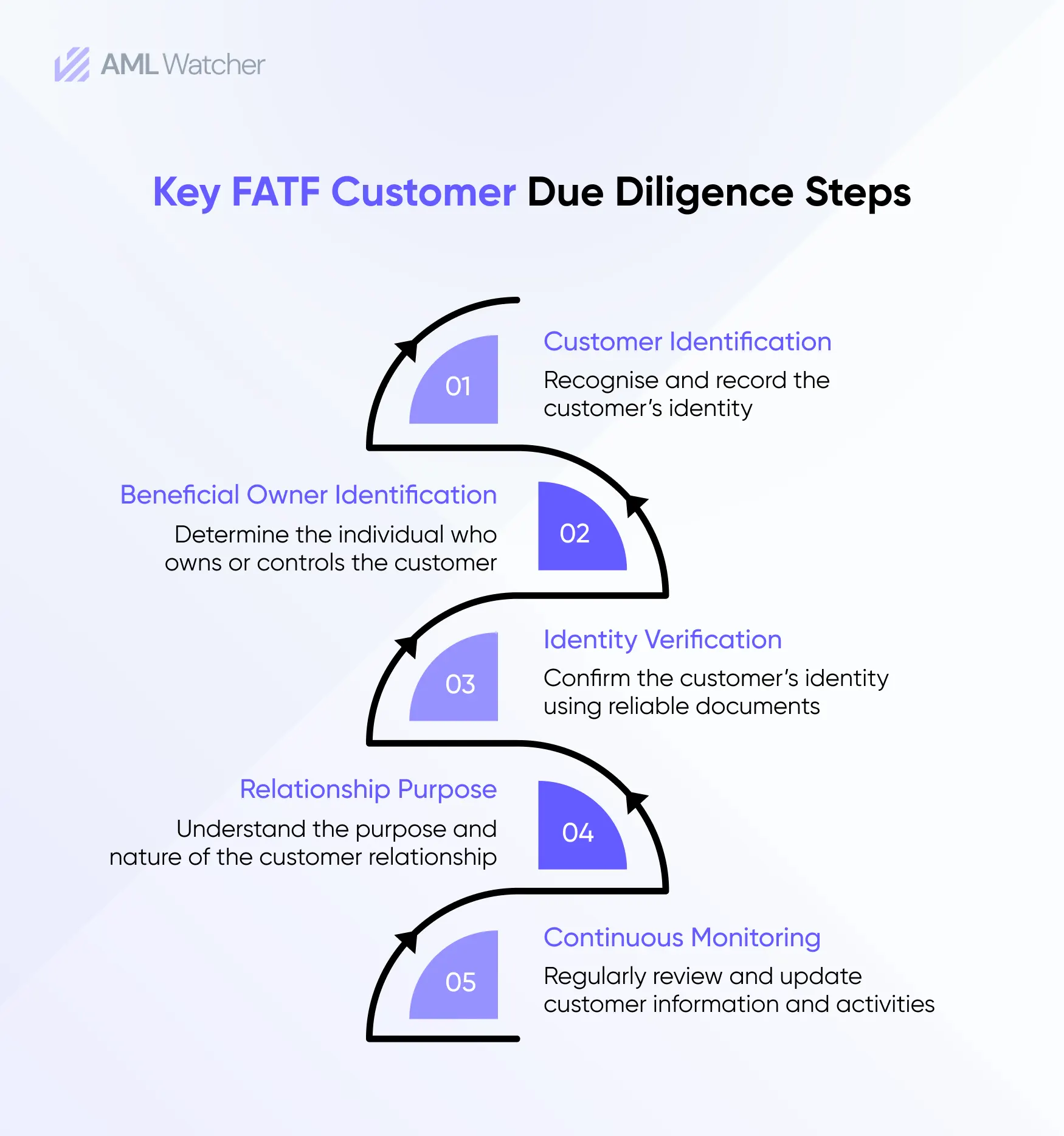
5 Key Checks for Efficient CDD in AML Compliance
Client Identification and Verification
Customer due diligence allows businesses to collect basic customer information. It includes information like name, date of birth, and a certificate of residence, which also supports KYC (Know Your Customer).
Identifying and verifying customer data helps businesses prevent corrupt actors from penetrating the system for illicit activities.
Almost 1.4 billion adults worldwide do not use banking or mobile banking services, according to the World Bank’s latest Global Findex Database 2025 report. The FATF updated its recommendations in Feb 2025 to help more people access financial services and use banking channels. The update has encouraged financial institutions to adopt a risk-based approach and apply profile-based checks. FATF recommends simpler checks for low-risk profiles and stronger checks for high-risk profiles.
This helps both customers and RegTech regulators address AML challenges. It reduces hurdles to opening a bank account. For RegTech companies, it highlights the importance of using technology for efficient risk assessment, customer verification, and AML compliance without burdening legitimate customers.
Check on Source of Wealth & Funds
Illicit financial activities such as money laundering and associated crimes are motivated by the influx of dirty money. Understanding a client’s source of funds helps compliance teams assess whether large deposits or unusual transactions perfectly match the customer’s profile or signal potential red flags for money laundering.
AML red flags are easy to understand because they include signs that a transaction may need closer review. These include money movements that fail to match a customer’s income or business. They can include unexplained cash deposits, complex international transfers, or money moving quickly between accounts. Other warning signs include unusual account activity, payments involving unknown people, and customers who avoid providing information about their funds.
These signs don’t automatically mean someone is criminal, but they may indicate illegal activity and may require further review by regulatory authorities.
Identification of Beneficial Ownership
Criminals exploit loopholes in beneficial ownership methodologies for money laundering. Strict AML regulatory guidelines require businesses of all sizes to identify the beneficial ownership of any account or business to curb this misuse. The increasing financial crime linked to shell companies requires businesses to know the real owner and controller behind opened accounts.
Regulators have strongly condemned the misuse of shell companies to hide ownership and have emphasised efforts to counter it. Basel AML Index 2025 report highlights a troubling trend. It showed that while the global risk average has drifted to 5.28 out of 10, Financial Transparency and Standards have been the report’s biggest disappointment. The EU and Western European nations have seen a 40% rise in risk profiles, largely due to failures in beneficial ownership tracking.
The FATF recommends a simple 3-step checklist to find out who is really in charge of a company in its FATF Recommendation 25 Portal. It tells you to look first for a person who owns at least 25% of the business. If no one owns that much, look for the person making the big decisions behind the scenes; if you still can’t find them, look at the boss running the day-to-day work (like the CEO).
If you deal with high-risk entities and politically exposed persons (PEPs), identifying beneficial ownership can protect you from unforgiving non-compliance consequences.
The dynamic regulatory environment is not flexible to PEP non-compliance. Learn about PEP Screening and why it is essential to uplift your AML compliance game.
Risk Assessment & Ongoing Monitoring
Continuously monitoring a customer’s transactional activity and watching for profile changes is essential for compliance checks. Developing a customer risk profile is only one part of an AML customer due diligence checklist. FATF, in its Recommendation 1, expects ongoing due diligence. It recommends regularly reviewing transactions, updating risk profiles, and re-verifying information when something changes or looks suspicious.
Efficient CDD requires regularly evaluating AML risks to spot potential illicit activity by tracking transactions and updating high-risk clients’ risk profiles.
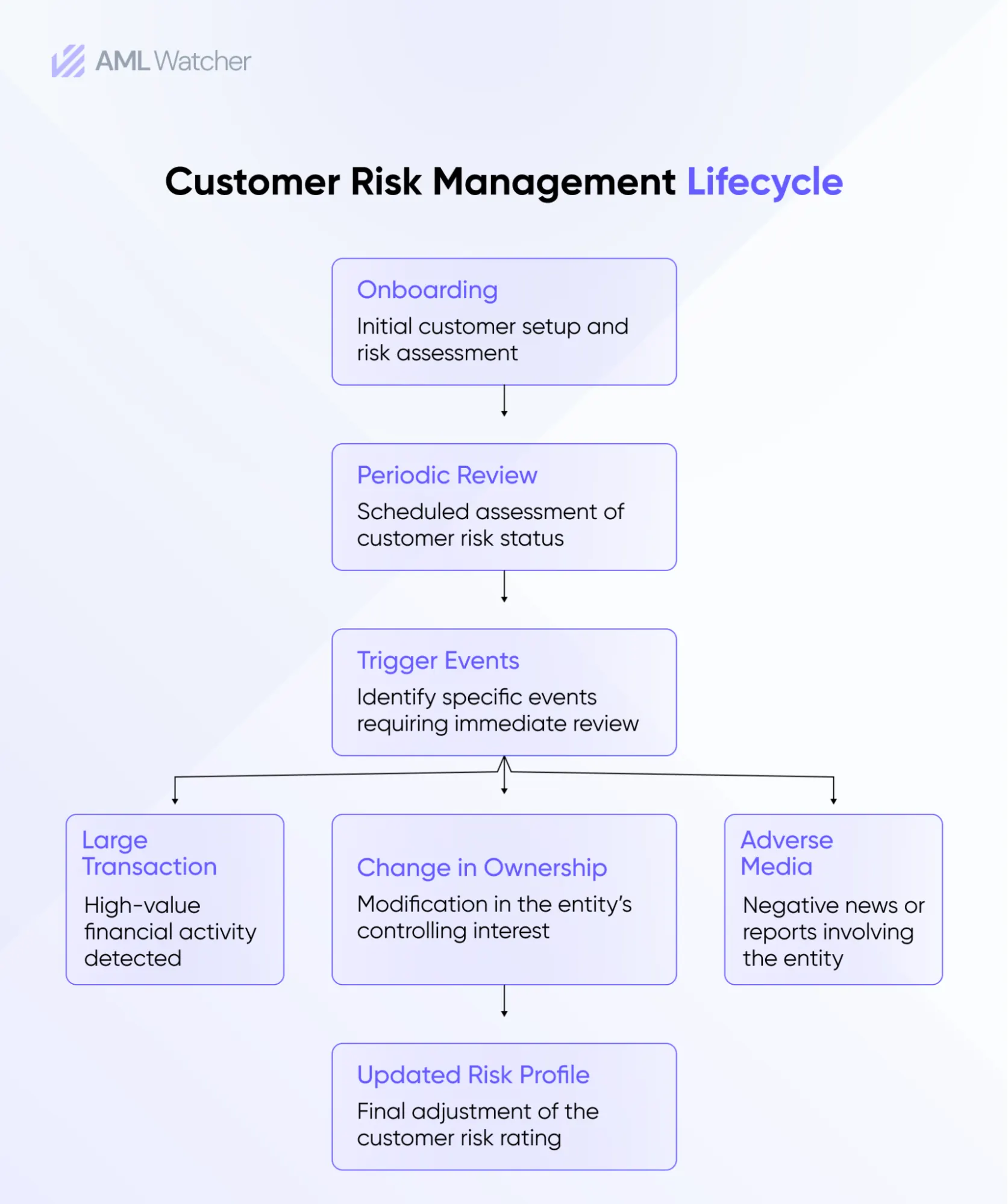
Recordkeeping and Reporting
AML customer due diligence requirements do not stop at managing risk levels or knowing your customers. They also require maintaining detailed records of information collected for CDD purposes.
Regulatory bodies expect businesses to have trails of compliance documentation, including risk assessments, AML/KYC documents, and SARs (Suspicious Activity Reports) filed against potential illicit activity.
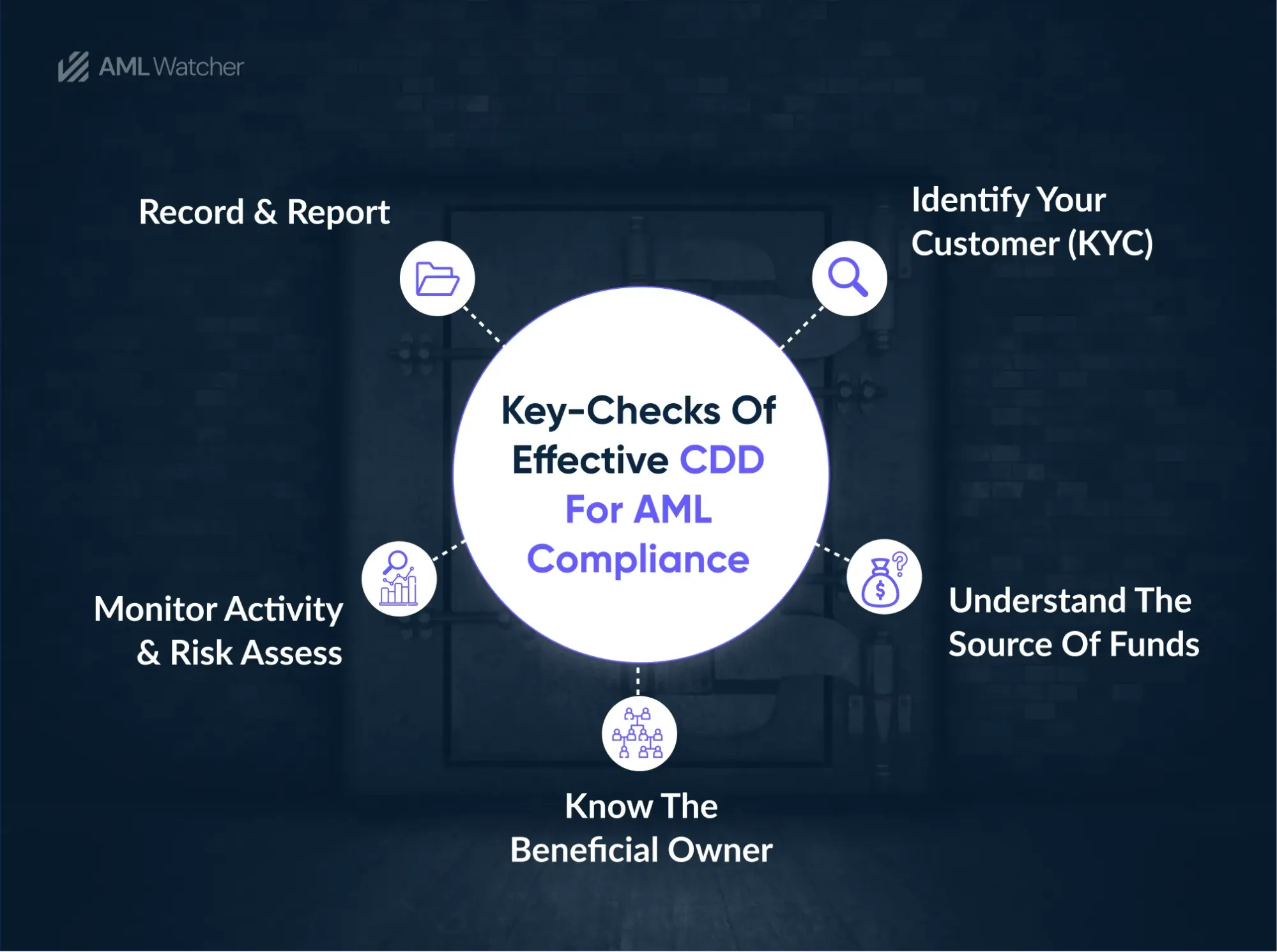
Once you understand the key CDD Requirements in AML, the secret ingredient to meeting regulatory compliance demands is including a risk-based approach in your AML framework.
FATF Recommendation 11 focuses entirely on record-keeping. All information gathered through Customer Due Diligence (CDD) must be stored for at least five years after the business relationship has ended.
Let’s look at the challenges that need immediate attention.
Why Does CDD Fail in Practice?
Customer Due Diligence fails in practice because a huge gap exists between written compliance policies and their operational execution. The increasing AML penalties show that, despite stricter regulatory expectations, real-world challenges in deploying CDD measures and lowering CDD risk ratings remain unresolved.
Time constraints meant I could only cover a few of those as below:
Financial Crimes have Evolved
Money Launderers have also updated their methods of laundering and fraud with the advancements in technology. Compliance is no longer limited to catching criminals with traditional money-laundering methods. It’s far more complicated now because of technological advancements. Technology doesn’t ask to be used in the meanest way possible, but if we don’t use it against corrupt actors, they will.
Financial crimes have evolved in some of the following ways:
Cyber-Enabled Fraud: Online scammers steal your money, pass it through ordinary bank accounts, and then convert it into cryptocurrency so authorities can’t trace it back. According to the APG Cyber Scam Hubs & Human Trafficking Report 2026, domestic mule networks activate to move victim funds across multiple intra-bank layers in under an hour, then convert them into crypto assets to obscure the audit trail.
Trade-Based Money Laundering: This involves washing dirty money by faking commercial shipping paperwork (like imports/exports) using a maze of fake, invisible companies so nobody knows who really owns them. The APG Typologies Report explicitly indicates that criminal networks rely heavily on professional gatekeepers (like lawyers and corporate formation agents) to build complex corporate structures and shell companies. This is how they deliberately hide the identity of the true beneficial owners and allow illicit trade flows to pass under the radar of customs and tax authorities.
Scam Hubs: These are industrial-scale, heavily fortified compounds (often in remote borders or Special Economic Zones) where transnational gangs hold human trafficking victims hostage, forcing them to run internet scams that drain billions from worldwide victims. The UNODC Transnational Organised Crime Threat Analysis estimated that total annual losses from these digital scam offences across the Asia-Pacific region reached between USD $88.3 billion and USD $114.1 billion. They also noted that criminals are actively integrating AI-powered deepfakes and automated chatbots to scale their fraudulent outreach.
Advanced, opaque tactics make it hard for businesses with limited AML compliance solutions to monitor these entities, allowing fraudsters to exploit the system.
Substandard CDD measures and failed AML in Banks lead to consequences businesses are not ready to embrace. Learn how four big banks turned their compliance game around the corner.
Alarming False Positives & Resource Bleeding
False positives force anti-money laundering (AML) teams to constantly engage with digital noise, and institutions suffer severe resource bleed, expending vast intellectual and capital assets on low-risk profiles rather than focusing on deep-tier network intelligence. For instance, a business might get flagged because its past owner was involved in corrupt financial activities, while the new owner has nothing to do with it, all the set factors that keep a compliance officer wasting their time on unnecessary investigations. This operational breakdown is reflected globally in peer assessments, as detailed in the FATF Malaysia Mutual Evaluation Report 2025. Even highly proactive systems like Malaysia, with the latest and upgraded legal frameworks, struggle to convert high-profile money laundering investigations into actual convictions. When regulatory systems resultantly prioritise paper compliance over focused operational efficiency, the resulting resource drain leaves law enforcement permanently on the back foot in terms of the capacity required to counter the launderers.
Below are some more concerning factors that lead to delayed or failed CDD in AML compliance.
Long story short, the practical efficiency of the CDD framework depends on automating the AML and CDD risk assessment tool, so compliance officers can investigate what matters most rather than digging into false AML alarms.
Automating CDD/AML tools is just the tip of the iceberg. Let’s see what else can help your business achieve functional compliance results you have been losing sleep over.
3 Practical Ways to Make CDD Work in the Real World
Since it is always easier said than done, are you ready to talk about solutions that not only help businesses keep pace with ever-evolving AML regulations but are also easy to implement with limited compliance resources? Let’s dig into them and answer a few questions.
Is Your CDD/AML Tool Automated?
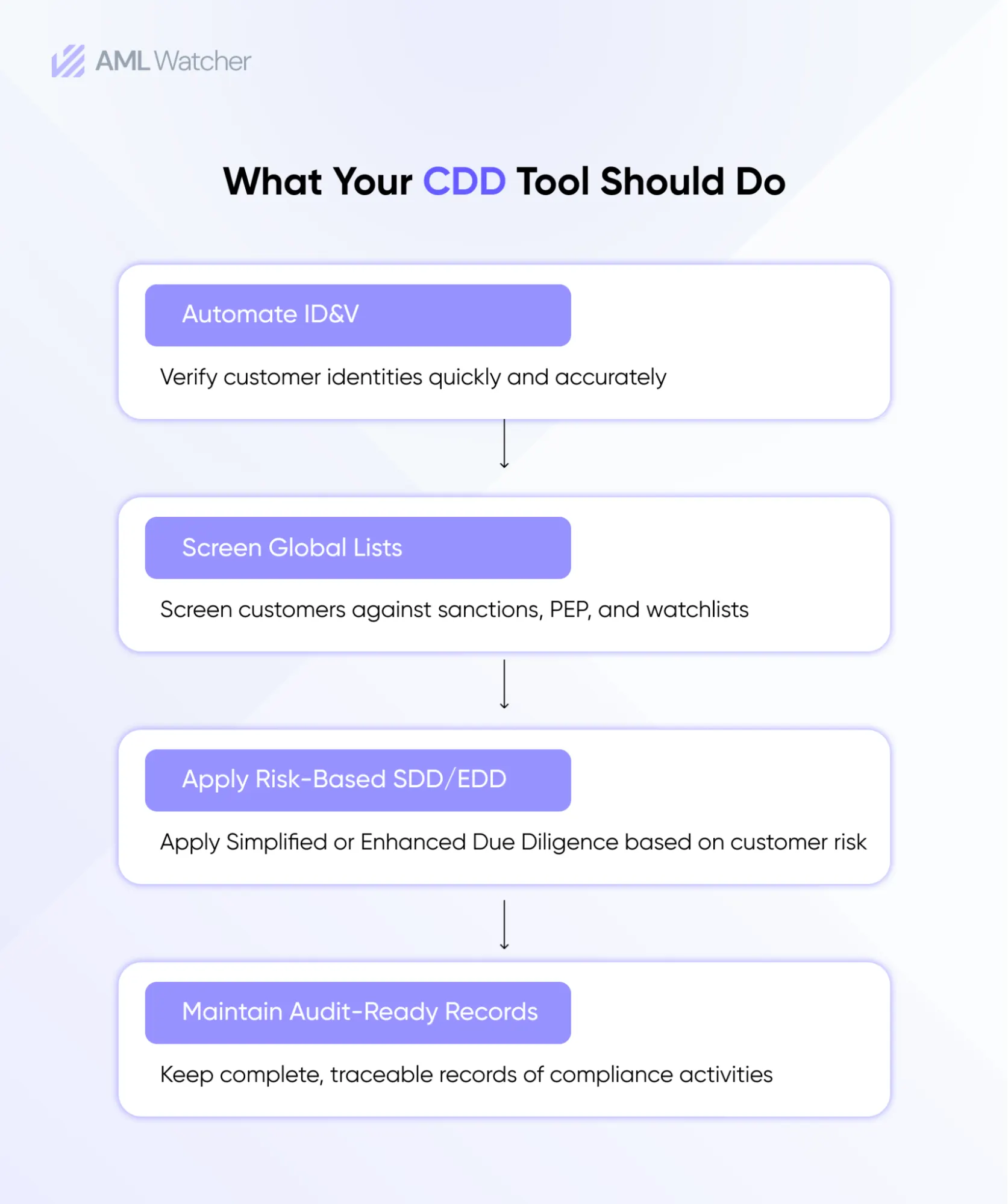
Automating the CDD/AML tool with your business development and onboarding tools means smartly assessing and managing AML risks. The regulatory authorities have also shifted toward burden reduction. Under FinCEN’s 2026 Account Opening Exceptive Relief Order, the legacy ‘set-and-repeat’ mandate of the 2016 CDD Rule has been dismantled. Financial institutions are no longer required to re-verify corporate ownership at every transactional account opening. FinCEN has normalised a data-driven and risk-based threshold. Re-verification is now limited to initial customer onboarding, risk profile variations or concrete flags about the reliability of existing file information.
A client or business partner initiates the deal with basic but important background information; the automated AML tool picks it up and scans it against globally recognised AML data, including sanctions lists, PEP networks, corruption lists, and regional barred lists.
The perks of automation aren’t limited to faster risk assessments; they also let businesses thoroughly screen and investigate higher-risk clients. It also provides well-maintained CDD/AML records in the form of authentically curated documentation for regulatory audits.
Can You Uncover Fraudsters with Adverse Media Screening?
Adverse media isn’t about punishing reputation; it’s about spotting patterns that suggest higher ML/TF risk before regulators do. A new client or business partner highlighted in negative news may be as risky as one on a corruption or barred list, as both can indicate a potential to exploit financial systems. Adverse media checks can help you spot corrupt actors.
Detecting potential fraudsters through negative news screening helps businesses understand who they are dealing with. A reputationally damaged individual may be more likely to commit financial fraud, even if they are not an alleged criminal, enabling an efficient, risk-based customer due diligence process for AML compliance.
Are You Aware Of Your Customer’s Story?
You can’t rely on technology alone to meet efficient CDD goals because no intelligence can replace human intellect and judgment. Tech-embedded AML tools are ideal, but knowing your customer’s story is the cherry on the cake.
FATF in its Recommendation 10, beautifully summarises what is CDD in AML and why it is important. It recommends that financial institutions understand the ‘purpose and intended nature’ of the relationship. Institutions should also have a close relationship with the client and understand its position. For example, a fintech noticed a merchant’s transaction volumes suddenly spiked 10x. Automated rules flagged it, but the relationship manager’s conversation with the client about a new product launch confirmed the activity was legitimate.
Understanding your customer’s history, along with strong risk scoring, helps you secure new business and operate with accountability. Like a long-term investment, paying attention to your business partner’s unique story not only strengthens AML CDD checks but also builds a strong business relationship and trust.
How Does AML Watcher Ease Your CDD Compliance Struggles?
Highlighting problems is everyone’s task, but creating practical, functional solutions takes real effort. AML Watcher, designed to make compliance simple and accurate, delivers real-time solutions for harmonised CDD in AML compliance.
Whether it’s staying ahead of regulatory updates or customising risk scoring, AML Watcher has your back in handling a flood of false alarms caused by inappropriate risk parameters.
Overcome compliance indecision and choose wisely, because corrupt actors don’t sit idle when they decide to pollute your compliance framework. Get in touch with the compliance geeks at AML Watcher and stay ahead of the unknown.
- No commitment needed
- Complete AML Database at your service
- Access our all-in-one dashboard


Tier-2 PSPs in ... must demonstrate automated monitoring, layered CDD, &...
See the Full Regulatory Expectation70–80% less manual work, 95% less fatigue, TruRisk Agent makes compliance effortless.
Experience Agentic AMLMove Beyond Articles. Activate AML Intelligence.
Switch to AML Watcher today and reduce your current AML cost by 50% - no questions asked.
- Find right product and pricing for your business
- Get your current solution provider audit & minimise your changeover risk
- Gain expert insights with quick response time to your queries