

 Alert!

Managing AML Risks Across Tokenized Assets and Digital Transactions
Risk Assessment & Management
October 6, 2026


- What Is Tokenization and How Does It Work?
- What Are Tokenized Assets? Examples and Use Cases
- Tokenization in AML: Where Do the Risks Come From?
- Asset Tokenization AML: What Should Financial Institutions Monitor?
- AML Compliance in Tokenization: A Risk-Based Approach
- How Regulations Are Evolving Around Tokenized Assets
- How AML Technology Can Support Safer Tokenized Asset Markets
- Get Ahead of Tokenized Asset Risk

A tokenized bond can move across digital infrastructure in seconds, but the transaction record alone may not reveal who ultimately controls the relevant wallet. That distinction creates an important AML challenge for financial institutions adopting tokenization.
Tokenized bonds, funds, deposits and other assets are becoming part of financial institutions’ digital finance strategies as firms explore programmable transactions, new settlement models and digital representations of financial claims. BIS describes tokenization as the process of representing assets or rights in digital form, including through distributed ledger technology. Tokenization can change how assets are issued, transferred and settled, creating new relationships between issuers, investors, intermediaries, custodians and digital wallets.
What Is Tokenization and How Does It Work?
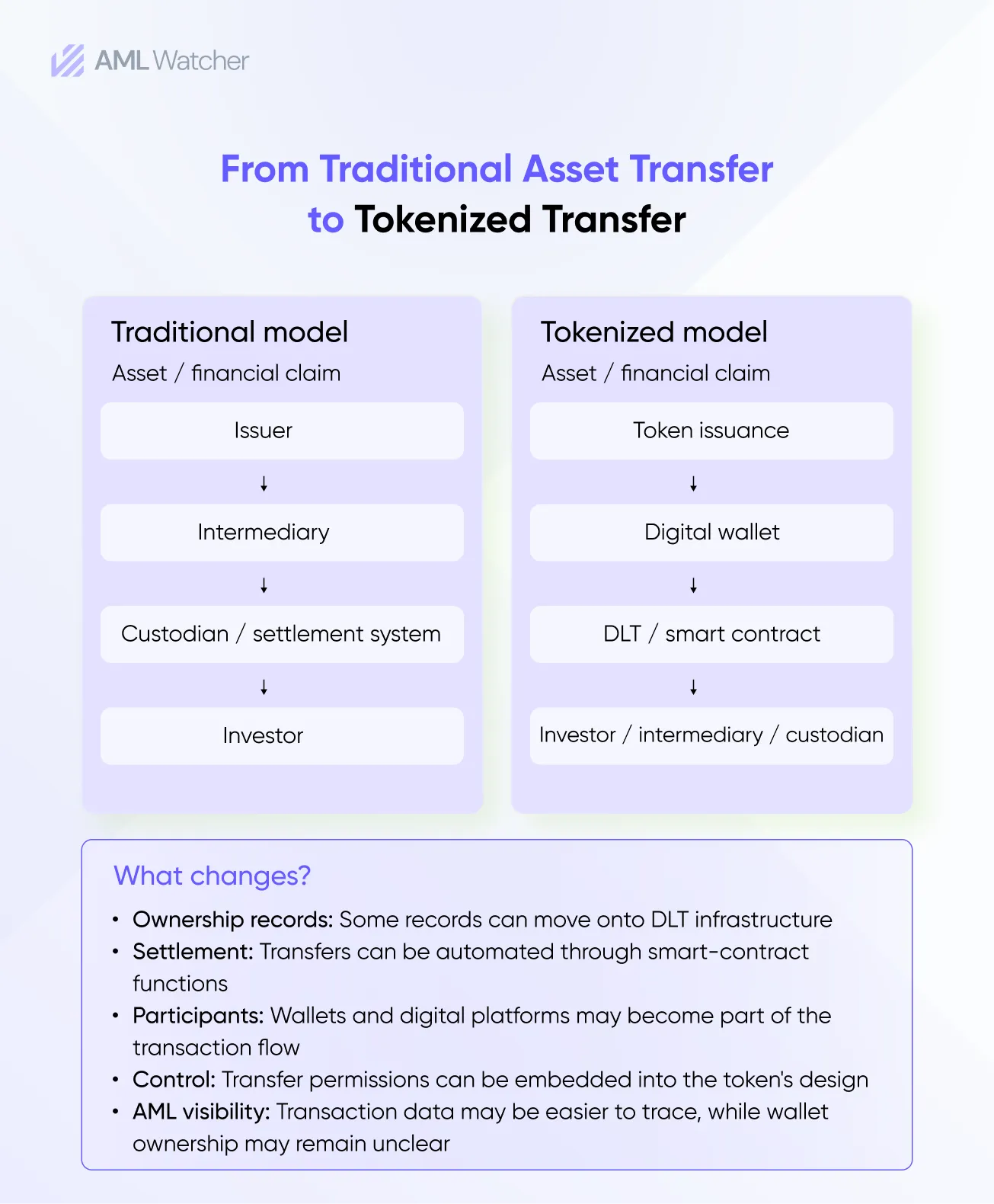
Tokenization is the process of representing an asset, financial claim or right in digital form through a token. Depending on the structure, the token can represent ownership of, or a claim on, an underlying asset or financial instrument. Distributed ledger technology can be used to record ownership and transfers, while the underlying asset may continue to exist within traditional financial or physical infrastructure.
A token can represent interests in assets or financial instruments such as bonds, fund units, deposits, commodities and other forms of financial or real-world value.
The compliance implications arise not only from what the token represents, but also from how it is issued, transferred, held and settled. Traditional transactions often involve multiple records, intermediaries and reconciliation processes across different systems. A tokenized transaction can bring some transaction and ownership records onto DLT infrastructure, while smart contracts can automate predefined functions such as transfer restrictions or settlement conditions. The exact architecture varies by tokenized asset and platform, so the AML implications depend on the participants, permissions and transaction flows involved.
That can reduce friction and shorten settlement. It can also introduce new relationships between wallets, platforms, custodians and counterparties. Therefore, AML controls need to account for the new transaction environment rather than simply replicate traditional processes.
What Are Tokenized Assets? Examples and Use Cases
Tokenized assets are digital representations of existing financial or real-world value. They can include tokenized bonds and securities, investment funds, real estate interests, commodities and bank deposits.
The tokenized real-world asset market surpassed $30 billion in 2026, reflecting growing institutional adoption across areas such as asset-backed credit and other tokenized financial products.
However, tokenization does not create one universal regulatory category. A tokenized security may remain subject to securities legislation, while another digital token can fall under a crypto-asset framework. The relevant treatment depends on the asset, issuance model, activities and jurisdiction.
That distinction matters for AML teams because applicable customer due diligence, monitoring, and reporting obligations can differ by structure.
Tokenization in AML: Where Do the Risks Come From?
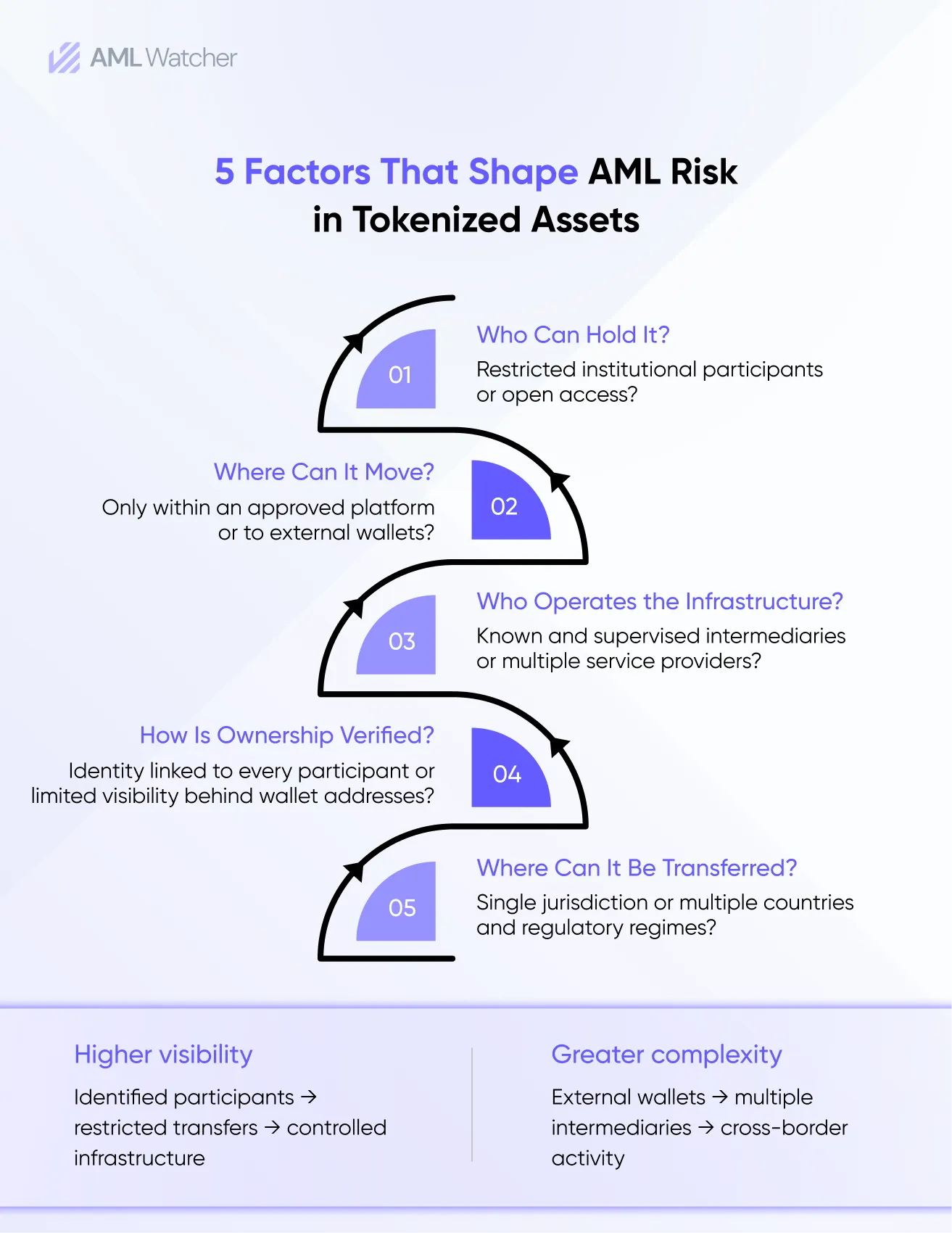
Tokenization does not automatically create an AML risk simply because an asset is represented on DLT. The risk depends on how the token is issued, who can hold or transfer it, which intermediaries are involved and how identity information is connected to transactions.
Several areas require particular attention.
- Wallet ownership and identity: A blockchain address can record transactions without establishing the identity or beneficial ownership of the person controlling that address. Compliance teams therefore need to connect blockchain activity with reliable customer and counterparty information.
- Transfers to external wallets: Where tokenized assets can move to self-hosted or otherwise external wallets, institutions may have less direct visibility into the parties involved and the purpose of the transaction. FATF has identified risks associated with peer-to-peer activity through unhosted wallets as part of its recent work on virtual assets.
- Cross-border exposure: Tokenized assets can involve issuers, investors, custodians, wallet providers and other intermediaries across different jurisdictions. This can raise questions about applicable AML requirements, sanctions exposure, and regulatory responsibilities.
- Changes in risk after onboarding: A wallet or counterparty that presents limited risk during onboarding can later become associated with sanctions, fraud, illicit services or other adverse information. Ongoing screening and monitoring are therefore relevant where the business relationship and regulatory framework require them.
- Complex transaction flows: Multiple wallets, intermediaries, networks or transfer mechanisms can make it harder to reconstruct the economic relationship behind a transaction. This can increase the importance of transaction monitoring and blockchain analytics.
These concerns remain relevant to regulators. FATF’s July 2026 update identified continuing implementation gaps around Recommendation 15 and highlighted risks involving unhosted wallets, offshore VASPs, stablecoins and virtual-asset-enabled fraud.
Asset Tokenization AML: What Should Financial Institutions Monitor?
An AML framework for tokenized assets needs to consider more than the blockchain transaction itself. The relevant controls should reflect the asset structure, customer relationship, transfer mechanism and jurisdictions involved.
At onboarding and issuance, financial institutions should establish the identity and, where applicable, beneficial ownership of customers and counterparties. Depending on the risk profile and regulatory obligations, controls can include customer due diligence, sanctions screening, PEP screening, source of funds or source of wealth assessment and jurisdictional risk assessment.
At the point of transfer, transaction monitoring can assess factors such as transaction value, frequency, velocity, unusual behavioural patterns, wallet exposure and connections to known high-risk addresses or services. Where Travel Rule obligations apply, institutions should also consider the information requirements associated with transfers involving relevant virtual asset service providers. FATF identifies customer due diligence, record keeping, suspicious transaction reporting and Travel Rule implementation among the measures applicable under its virtual asset framework.
After onboarding, ongoing monitoring can identify changes in customer, counterparty or wallet risk that require investigation or escalation.
The exact control framework should therefore reflect the legal classification and operating model of the tokenized asset rather than treating every tokenized transaction as a virtual asset transaction.
AML Compliance in Tokenization: A Risk-Based Approach
AML compliance in tokenization works best when the control framework reflects the design of the tokenized product from the outset.
Define the token’s legal and operational structure
The first step is understanding what the token represents, who issues it, who can hold it, where it can be transferred and which entities operate the supporting infrastructure. These factors help determine which regulatory and AML obligations may apply.
Connect identity with transaction activity
A wallet address provides transaction information but limited identity context. Linking wallet activity with customer, beneficial ownership, and counterparty information gives compliance teams a stronger basis for assessing risk.
Design controls around transferability
A token restricted to identified institutional participants presents a different monitoring environment from a token that can move freely between external wallets. The control framework should reflect those differences.
Monitor risk after onboarding
Ongoing screening and transaction monitoring can identify changes that require investigation or escalation.
How Regulations Are Evolving Around Tokenized Assets
The regulatory treatment of tokenized assets depends heavily on what the token represents and which activities take place around it. There is no single AML or crypto-asset framework that applies to every tokenized asset.
In the EU, the Markets in Crypto-Assets Regulation establishes a harmonized framework for certain crypto-assets and crypto-asset service providers. MiCA does not cover tokenized deposits or financial instruments that already fall within existing EU financial-services legislation. The EU’s DLT Pilot Regime provides a framework for testing DLT-based market infrastructures for certain financial instruments, including shares, bonds and units in collective investment undertakings.
At the international level, FATF Recommendation 15 remains an important reference for AML/CFT requirements relating to virtual assets and VASPs. Its July 2026 update reported progress in Travel Rule implementation but also continuing weaknesses in licensing, supervision and risk mitigation.
Therefore, a tokenized bond, tokenized fund, tokenized deposit and stablecoin should not automatically be treated as the same compliance category. The asset’s legal nature, issuance model, transferability, participants and jurisdiction all influence the applicable framework.
How AML Technology Can Support Safer Tokenized Asset Markets
As tokenized markets connect customers, counterparties, wallets and transaction activity across digital infrastructure, compliance teams need a way to bring these risk signals into the same investigation process.
AML Watcher’s Crypto Wallet Screening can identify and flag high-risk cryptocurrency wallets, screen wallet addresses against sanctions data and support real-time monitoring of changes in wallet risk.
AML Watcher’s Transaction Monitoring provides 150+ prebuilt AML typologies and more than 10,000 customizable rules, allowing financial institutions to configure monitoring logic around their risk appetite and transaction patterns.
AML technology can connect customer screening, transaction monitoring and crypto wallet risk information, bringing wallet and transaction signals into the wider AML control environment.
The objective is not to replace analyst judgment. It provides relevant risk signals and investigation context so compliance teams can focus on activity that warrants further review.
Get Ahead of Tokenized Asset Risk
Tokenized asset markets can create new relationships between customers, wallets, counterparties and transaction networks, making it harder for traditional AML processes to provide sufficient context around digital value flows.
AML Watcher helps financial institutions connect customer screening, transaction monitoring and crypto wallet risk intelligence within their AML workflows. AML Watcher helps financial institutions bring customer, transaction and wallet risk signals into a broader AML workflow, giving compliance teams greater context when reviewing tokenized asset activity.
- No commitment needed
- Complete AML Database at your service
- Access our all-in-one dashboard


Tier-2 PSPs in ... must demonstrate automated monitoring, layered CDD, &...
See the Full Regulatory Expectation70–80% less manual work, 95% less fatigue, TruRisk Agent makes compliance effortless.
Experience Agentic AMLMove Beyond Articles. Activate AML Intelligence.
Switch to AML Watcher today and reduce your current AML cost by 50% - no questions asked.
- Find right product and pricing for your business
- Get your current solution provider audit & minimise your changeover risk
- Gain expert insights with quick response time to your queries