

 Alert!

What Is IaaS? How it Supports AML Compliance
No category assigned
October 7, 2026


IaaS (Infrastructure as a Service) is a type of cloud computing that provides businesses with customised IT solutions to meet their needs. The resources it provides include servers, storage and networking infrastructure over the internet. Companies dont need to buy physical servers or hardware to run their applications; they can run them virtually. Businesses just pay the subscription fee and can use it as needed. They can add or remove features as needed.
According to the US National Institute of Standards and Technology (NIST), IaaS is the model where companies rent basic computing, storage, and networking facilities and choose the software that runs on it, while the service provider takes care of the infrastructure. IaaS is the foundation of modern AML compliance technology and AML screening platforms, including AML Watcher’s API, which operates on cloud infrastructure that determines how client data is processed, how quickly results appear, and what security measures are applied. This guide explains how IaaS works and what compliance teams should keep in mind while evaluating cloud-based AML vendors.
What are the Three Cloud Computing Service Models?
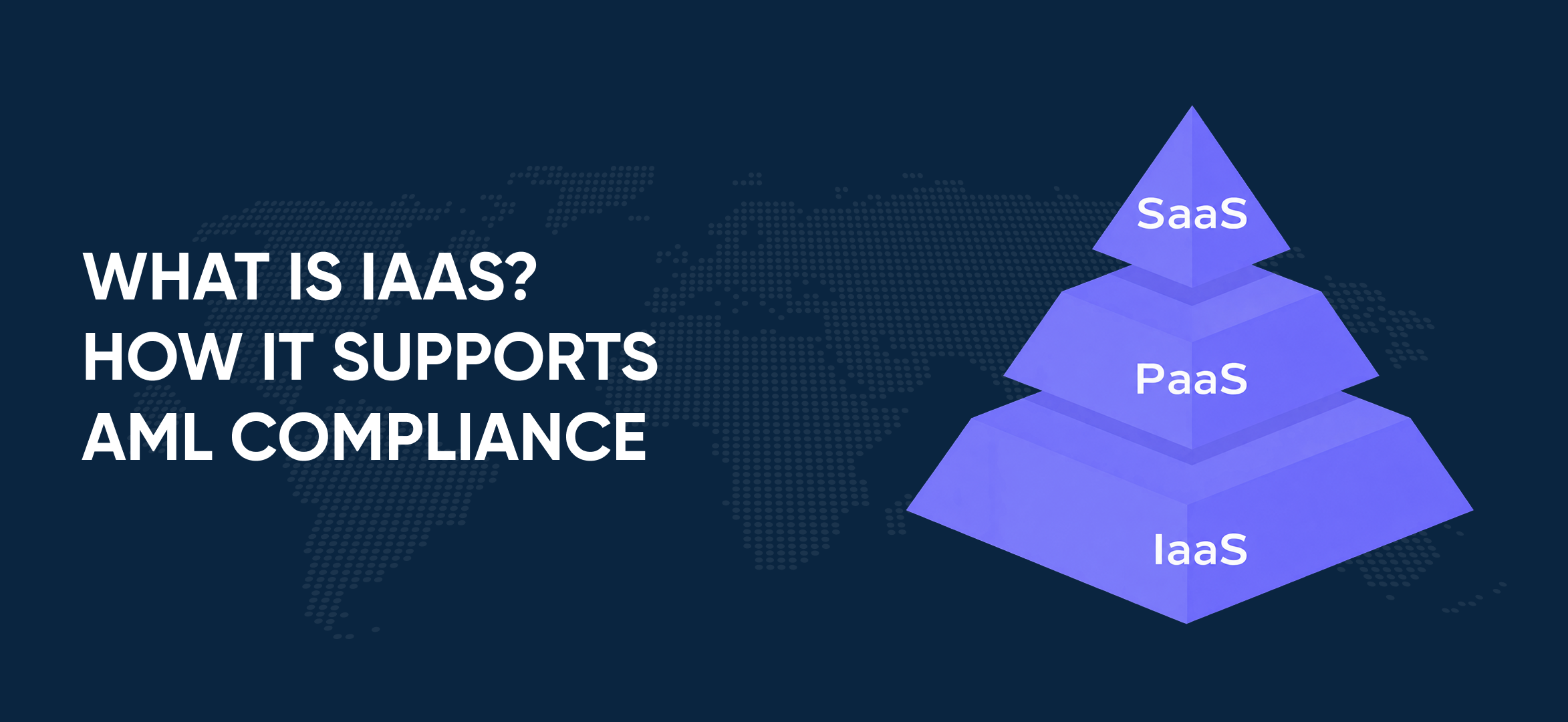
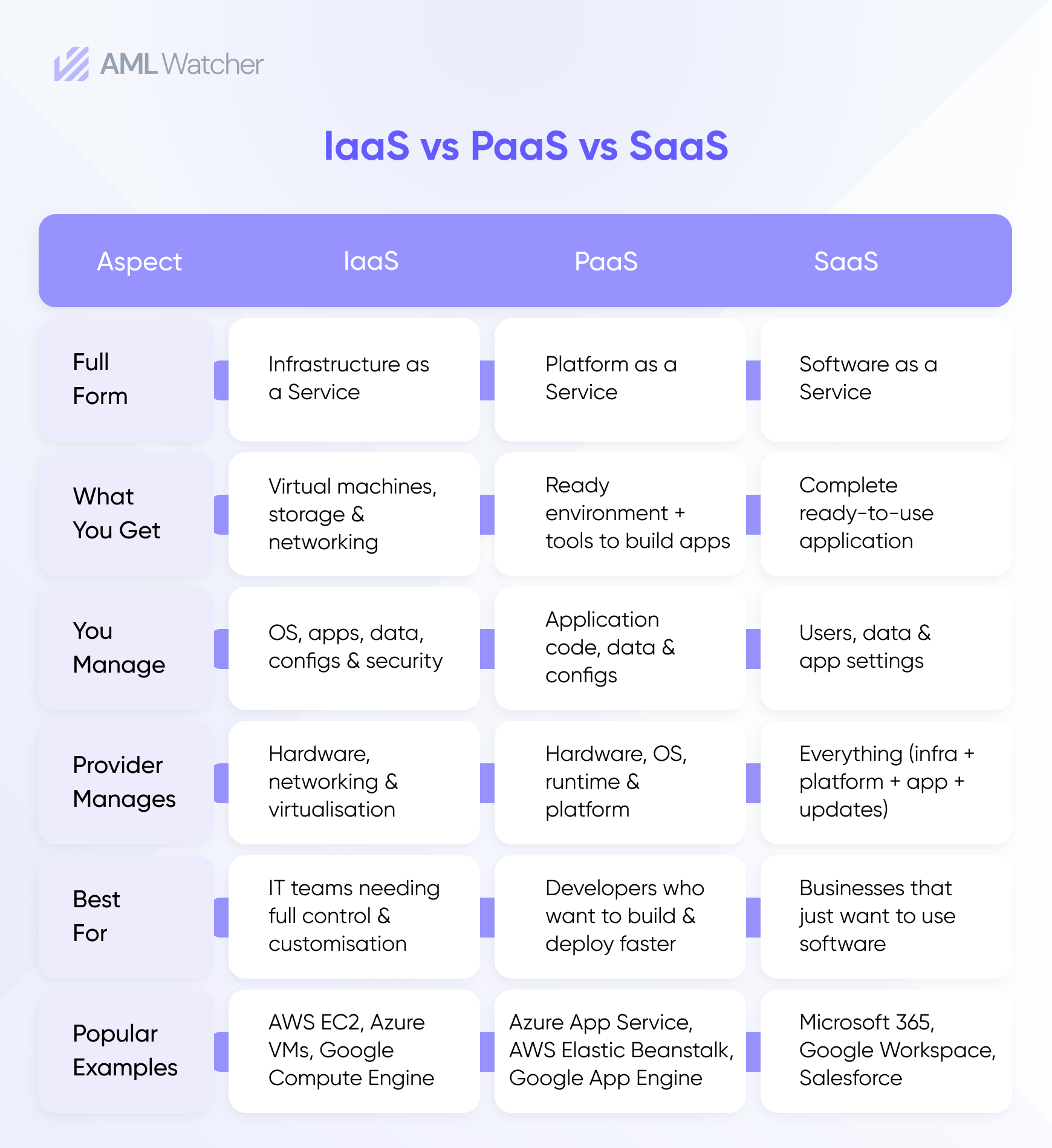
IaaS, PaaS, and SaaS are the three service models or types of cloud computing that deliver IT solutions over the internet.
Let’s dig down deep and get an idea of each of the components:
Infrastructure as a Service (IaaS)
IaaS provides the basic building blocks of virtualised computing.
- Major services it offers are servers, storage, and networking services.
- How it operates: The service provider handles the physical hardware and the client is responsible for managing the operating system, data, and applications.
- Examples: Amazon Web Services (AWS) EC2, Google Compute Engine.
Platform as a Service (PaaS)
PaaS offers a cloud-based environment for developers.
- Major services it offers are tools and frameworks to build, test, and run applications without worrying about the hardware.
- How it operates: The service provider handles servers, storage, and operating systems, and the client is responsible only for their code and data.
- Examples: Google App Engine, Heroku.
Software as a Service (SaaS)
SaaS provides ready-to-use software applications over the internet.
- Major services it offers include a complete, functional software product that is accessed through a web browser.
- How it works: The provider is solely responsible for handling everything, including maintenance, updates, and security.
- Examples: Gmail, Microsoft 365, Salesforce.
IaaS provides infrastructure with greater control, PaaS provides a managed environment for building and deploying applications, and SaaS provides ready-to-use software with most of the technical management handled by the provider. AML Watcher’s screening API is delivered as SaaS; clients call it via an API and never manage the server. Behind that API is the IaaS, which this article covers in detail.
How IaaS Works (Step-by-Step Guide)
- Requesting: You request and submit the resources via a web console; for example, I need 5 virtual CPUs, 32 GB RAM, and 500 GB Storage.
- Delivery of Services: The relevant team members from the service providers provide you with virtual servers from the large pools of their physical servers in data centres.
- Installation and Working: You install and configure your applications, operating systems, data, and middleware on those virtual servers.
- Payment Methodology: You choose your payment method. You can choose an hourly, weekly, or monthly subscription, depending on your needs. You can add or remove features as needed afterwards.
- After Sales Support: The service provider handles troubleshooting and after-sales support, including maintenance, power, cooling, physical security, and uptime.
This model shines because it doesn’t require long waits or lengthy procurement cycles. Also, you dont need to worry about buying physical machines you might not fully use. Compliance vendors requesting resources also means choosing the cloud region where the servers operate, which in turn decides where the client’s data is stored and processed.
Key Advantages of IaaS
- Lower Upfront Costs: You dont need to buy physical servers and space to store them. This initial cost is eliminated, and you only pay a minimal subscription fee to start using the systems.
- Fast Installation Process: Installation is quick and doesn’t require any procurement procedures. New servers and installations are done in minutes, not in months.
- Global Reach: Deploy services globally to reduce lag for users worldwide.
- Focus on Productivity: You don’t need to handle hardware maintenance; instead, you and your team can focus on productivity.
- Structural Robustness: Cloud platforms distribute workloads across different machines and locations to maintain performance and avoid lag.
Common Issues Related to IaaS and How to Counter Them
- Shared Security: The IaaS provider owns the hardware and network infrastructure, and your security is not secure if you dont apply protective measures. You must secure your data, apps, OS, and user access. Use strong passwords, multi-factor authentication, encryption, and regular patching.
- Cost Factor: The subscription runs on your customised needs. If you have subscribed and resources are left running, you will be charged accordingly. The best approach is to set budgets, auto-shutdowns, and install alerts.
- Vendor Lock-In: Sometimes a service provider’s cost or service quality can force you to switch vendors. Design for portability, including using standard OS images, containers, and infrastructure‑as‑code templates, so that you can shift easily whenever there is such a situation.
- Compliance Protocols: For regulated data, such as in the health or finance sectors, you must check the service provider’s credentials, such as certifications like ISO 27001, SOC 2, HIPAA, PCI DSS and data location options. Always double-check and demand these credentials, and dont assume that the vendor is covering everything on his own.
When a Business Should Shift to IaaS?
IaaS is a strong fit for your organisation if:
- You want full control: You know exactly which operating system to use, how the network is set up, and how security is configured. You don’t want the cloud provider making those choices for you.
- Your organisation has ever-changing workflows: If the nature of your work is unpredictable and your demand goes up and down unpredictably, or grows very quickly, IaaS is the best choice for you, as you can add or remove servers in minutes instead of waiting weeks to buy new hardware.
- If you don’t want to spend money on equipment: You need huge financing to buy servers, storage, and networking equipment. IaaS lets you pay only for what you use, at a much lower cost than buying a full set of equipment. So you avoid high upfront costs.
- You immediately want to start projects or experiment safely: IaaS gives you the benefit that you can test a new idea really fast and shut it down if it doesn’t work with almost no financial risk.
- If you want to run custom software: If your business model requires custom software, it is your best choice when your applications need specialised software that standard cloud platforms don’t support easily.
Why IaaS Matters for AML Compliance Technology
IaaS offers speed, helps address security concerns, and lets compliance teams locate where sensitive data is stored. When a bank, fintech or payment company integrates an AML screening API, it connects to software running on cloud infrastructure. That infrastructure offers four things compliance teams care about:
- Screening speed. Compute capacity and server proximity offer quick screening of a customer or transaction against sanctions, PEP and adverse-media data. If a server is located halfway around the world, the screening process can take time, ultimately bothering the compliance officers and the customers.
- Data location. The cloud region determines where screening data is stored and processed, supporting data protection and GDPR transfer rules. Under GDPR, European citizens’ data cannot be shared with countries having weak protection systems. By selecting the server location, compliance teams can ensure customers’ data remains within protective borders.
- Availability. Tech providers spread software workloads across multiple data centres (availability zones) within a region. If one data centre is attacked by a cyberattack, fire or any other emergency, the other data centre immediately takes the workload. This is how the service provider offers uninterrupted services.
- Independent assurance. Certifications and audit reports show whether security controls were actually tested. Regulators will not accept a bank or a financial institution saying, “The vendor told us they were safe.” Compliance teams rely on official paperwork like SOC 2 reports or ISO 27001 certifications, as verified legal proof that the vendor’s security controls actually work in the real world.
These questions are becoming more formal in Europe. The Anti-Money Laundering Regulation (AMLR), Regulation (EU) 2024/1624, applies directly in every member state from 10 July 2027, and DORA’s third-party chapter requires financial institutions to assess providers before signing and to include specific clauses in contracts. For compliance officers and IT security teams, understanding the infrastructure behind a vendor is part of due diligence.
Security and Compliance in IaaS
In IaaS, security is a shared job between the vendor and client. The cloud provider handles some parts, and you handle the rest. This is called the shared responsibility model. AWS describes the split as security of the cloud (the provider’s responsibility) versus security in the cloud (the customer’s).
Who is responsible for what in IaaS?
Think of renting an apartment, in which a landlord is responsible for the building structure, electricity, and main locks.
The cloud provider similarly handles the foundation, including:
- Physical data centres and buildings.
- Hardware including servers, storage, and networking equipment and other such things.
- The host network and virtualisation layer.
- Core platform security is the full responsibility of the vendor.
The client, on the other hand, is like a tenant responsible for securing the inside of an apartment, including doors, windows, valuables, and keys.
The customer handles everything inside, including:
- The customer has to secure the operating system on their virtual machines.
- Protect and take care of their applications.
- Must apply encryption methods to the data for maximum protection.
- Manage who can access what by implementing identity and access control methods.
The same logic applies to AML compliance
A bank can use a vendor’s screening API, but it cannot hand over responsibility for its AML obligations to the vendor. When selecting a service provider, an AML compliance team should verify the provider’s documentation and credentials.
Which certifications should you look for?
- ISO/IEC 27001 tells about an organisation’s information security management system.
- SOC 2 Type 2 is an independent attestation report. It assesses whether controls were suitably designed and operating effectively over a period of time. Generally 6 to 12 months, against the AICPA Trust Services Criteria.
- ISO/IEC 27017 is another important certification and adds cloud-specific implementation guidance on top of ISO/IEC 27002 controls.
- PCI DSS is relevant only if the vendor handles payment card data.
Always ask for the audit report or certificate itself, including its scope and date, not just a logo.
How AML Watcher Uses IaaS
AML Watcher is an ISO 27001 Certified and GDPR compliant entity. AML Watcher built its software like a three-story building, with each floor having a separate responsibility:
| Layer 1: The Foundation (IaaS) | This is the physical setup, which includes the actual computers, hard drives, and network cables. It handles the heavy work, like searching massive global sanctions lists and scanning millions of news articles for bad press. AML Watcher has their servers operating across the world, as it is operational in 235+ countries. |
| Layer 2: The Brains (How it Works) | AML Watcher plugs into your LLM through the MCP server. This layer does the actual work, like screening whether the specific query “John Smith” trying to open an account resembles the one that is on the sanctions list or not. After screening hundreds of documents, it quickly summarised the results for human compliance officers. |
| Layer 3: The Delivery (Application) | This is AML Watcher’s customised software. It checks whether the client bank is authorised to log in, reviews the query request, calculates the risk score using its advanced TruRisk feature, and provides the final answer to the bank. |
Why this setup matters:
AML Watcher can handle millions of new transactions instantly because the layers are separate, keep their security intact, and upgrade their AI brain behind the scenes without halting the bank’s connection.
The Shared Responsibility Model (Who Guards What?)
When using rented cloud tech, security is a mutual responsibility split between the Cloud Provider and AML Watcher.
The Cloud Provider guards the physical world:
- Locking the physical data centre doors and running security cameras.
- Replacing broken computer parts and hard drives.
- Making sure the master virtualisation software is highly secured.
- Supplying uninterrupted power services so the system stays online.
AML Watcher guards the digital world:
- Keeping the virtual computer systems updated
- Coding the app safely and controlling who gets access keys
- Encrypting data (scrambling it) so it cannot be read if intercepted
- Getting specific financial compliance badges for their software.
- No commitment needed
- Complete AML Database at your service
- Access our all-in-one dashboard


Tier-2 PSPs in ... must demonstrate automated monitoring, layered CDD, &...
See the Full Regulatory Expectation70–80% less manual work, 95% less fatigue, TruRisk Agent makes compliance effortless.
Experience Agentic AMLMove Beyond Articles. Activate AML Intelligence.
Switch to AML Watcher today and reduce your current AML cost by 50% - no questions asked.
- Find right product and pricing for your business
- Get your current solution provider audit & minimise your changeover risk
- Gain expert insights with quick response time to your queries