Alert!

Straw Buyer Fraud: How to Spot a Straw Purchase Before It Defaults
No category assigned
November 4, 2026


A KYC operations manager approves a car loan after confirming the borrower’s identity, verifying their credit history, and documenting their income. However, eight weeks later, the payments stop, and the borrower claims they have no idea where the vehicle is. All checks came back clear because the applicant was legitimate; yet, the individual who sought the car never appeared in any documents.
Recent industry data reveals an increasing worry in the realm of auto lending. A proprietary straw-borrower risk index surged by 37.6% between August 2023 and July 2026, hitting an all-time high of 142.0 in December 2025. This index focuses on various indicators linked to straw-borrower activity, rather than confirmed cases of fraud. This rising trend emphasizes the need for lenders to go beyond traditional identity verification methods and closely examine who truly controls the financed asset. This article delves into the mechanics of straw buyer fraud, the intersection of lending fraud with money laundering, the warning signs that should trigger further scrutiny, and how AML (Anti-Money Laundering) screening can bolster risk assessments.
What Is a Straw Buyer?
A straw buyer is a person whose name or credit is used to acquire an asset or obtain financing primarily for another party’s benefit. The straw buyer may submit the application, sign the agreement or appear on the title, while another person directs the transaction or ultimately controls the asset.
In a fraudulent arrangement, the lender or seller may be misled about who is purchasing the asset, who will use it or who is responsible for the transaction’s underlying purpose. The named buyer may be fully aware of the arrangement, pressured into participating or unaware of how their identity is being used. The legal consequences depend on the facts and applicable law.
A hidden beneficiary may be unable to qualify for financing or may seek to conceal their involvement and bypass a lender’s underwriting controls. Investigators therefore need to establish the parties’ roles and the purpose of the transaction rather than infer intent from the arrangement alone.
A straw buyer and a money mule perform different roles. A straw buyer’s name or credit is used in an acquisition, while a money mule moves or handles funds on behalf of another party. A single person may perform both roles in a wider financial crime scheme, depending on the circumstances.
A lender or seller may suffer a loss if the transaction is fraudulent. Brokers, intermediaries or other facilitators may also become involved, although their presence does not by itself establish wrongdoing.
What Is a Straw Purchase Under the Law?
The legal meaning of a straw purchase depends on the transaction and jurisdiction. US firearms law provides one example. Federal law addresses purchases made on behalf of another person in specified circumstances and false statements about the actual buyer. These provisions are specific to firearms transactions and should not be treated as a universal legal definition of straw buyer fraud.
In auto lending and real estate, knowingly misrepresenting material information to obtain financing or acquire an asset may constitute fraud, depending on the facts and applicable law. A person who signs a loan agreement may also remain contractually responsible for the debt even when another party uses the financed asset.
How Does Straw Buyer Fraud Work?
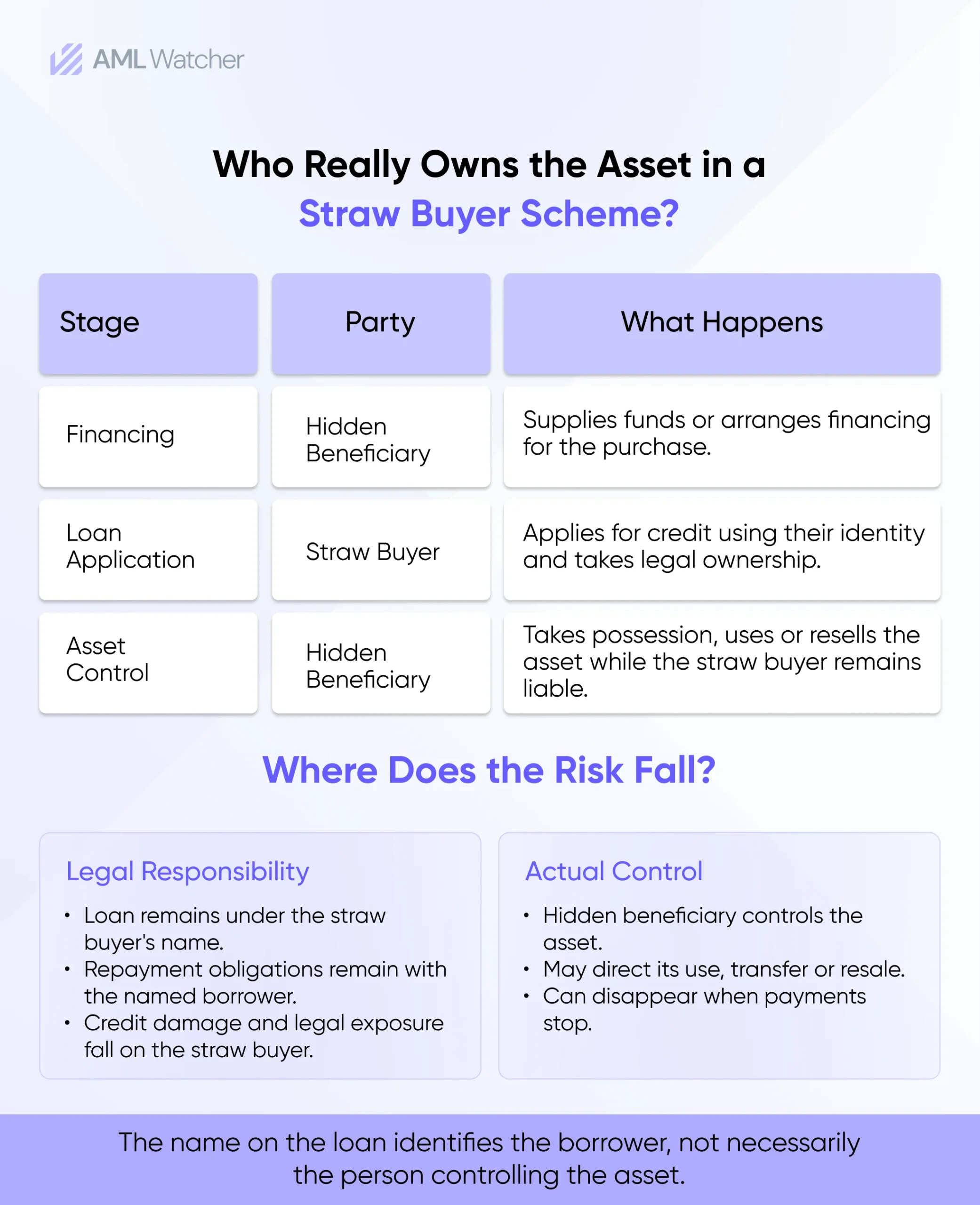
Straw-buyer schemes often begin when an individual is recruited to apply for financing on behalf of another person. The applicant may have a genuine identity and an acceptable credit profile, while the intended use of the loan or the party controlling the asset is misrepresented. The straw buyer submits the application, provides the required documents and signs the financing agreement. Once the transaction is approved, the hidden beneficiary may take possession of the vehicle or exercise control over the asset. The lender may not immediately recognize the arrangement because the named borrower and the person using the asset are different.
In some cases, the named borrower defaults shortly after approval, while the hidden beneficiary may have already taken possession of or transferred the asset. When a lender contacts the named borrower after a missed payment, the borrower may have limited knowledge of the asset’s location or use. Early payment default can therefore be a warning sign, but it does not establish fraud on its own.
How Is a Straw Buyer Used in a Real Estate Scam?
In real estate fraud, a straw buyer may appear as the purchaser or mortgage applicant while another individual provides the funds, directs the transaction or ultimately controls the property. The lender may be misled about the actual borrower, source of funds or intended use of the property. In some cases, nominee ownership may also obscure the identity of the person benefiting from the transaction, creating potential money laundering risks.
Regulatory requirements surrounding residential real estate reporting have also changed. FinCEN’s Residential Real Estate Rule was scheduled to take effect on March 1, 2026. However, a federal court in the Eastern District of Texas vacated the rule on March 19, 2026, and FinCEN subsequently appealed the decision. While the court order remains in force, reporting persons are not required to file Real Estate Reports under the rule.
The rule was designed to increase transparency in certain non-financed residential property transfers involving legal entities and trusts, where ownership structures can make it harder to identify the individuals benefiting from a transaction. Its reporting scope should not be confused with the wider risks posed by straw buyers in mortgage lending. Financial institutions still need appropriate controls for the transactions and customers within their remit, in accordance with applicable legal and regulatory requirements.
Which Red Flags Expose a Straw Buyer?
Identity verification and beneficial ownership checks serve different purposes. Under FinCEN’s Customer Due Diligence Rule, covered financial institutions must identify and verify the beneficial owners of legal entity customers, subject to the applicable requirements and exclusions. Those obligations do not create a universal requirement to identify a hidden beneficiary behind every individual borrower. Therefore, a verified identity should not be treated as proof that the applicant will control the asset or that the transaction reflects its actual purpose.
Customer identification establishes who is applying. Beneficial ownership checks help establish who owns or controls a legal entity customer. Transaction and relationship analysis can help identify inconsistencies between the named applicant, the source of funds, the intended use of the asset and the parties directing the transaction.
Together, these checks help financial institutions assess whether the named applicant, ownership structure and transaction activity are consistent with the stated purpose of the financing.
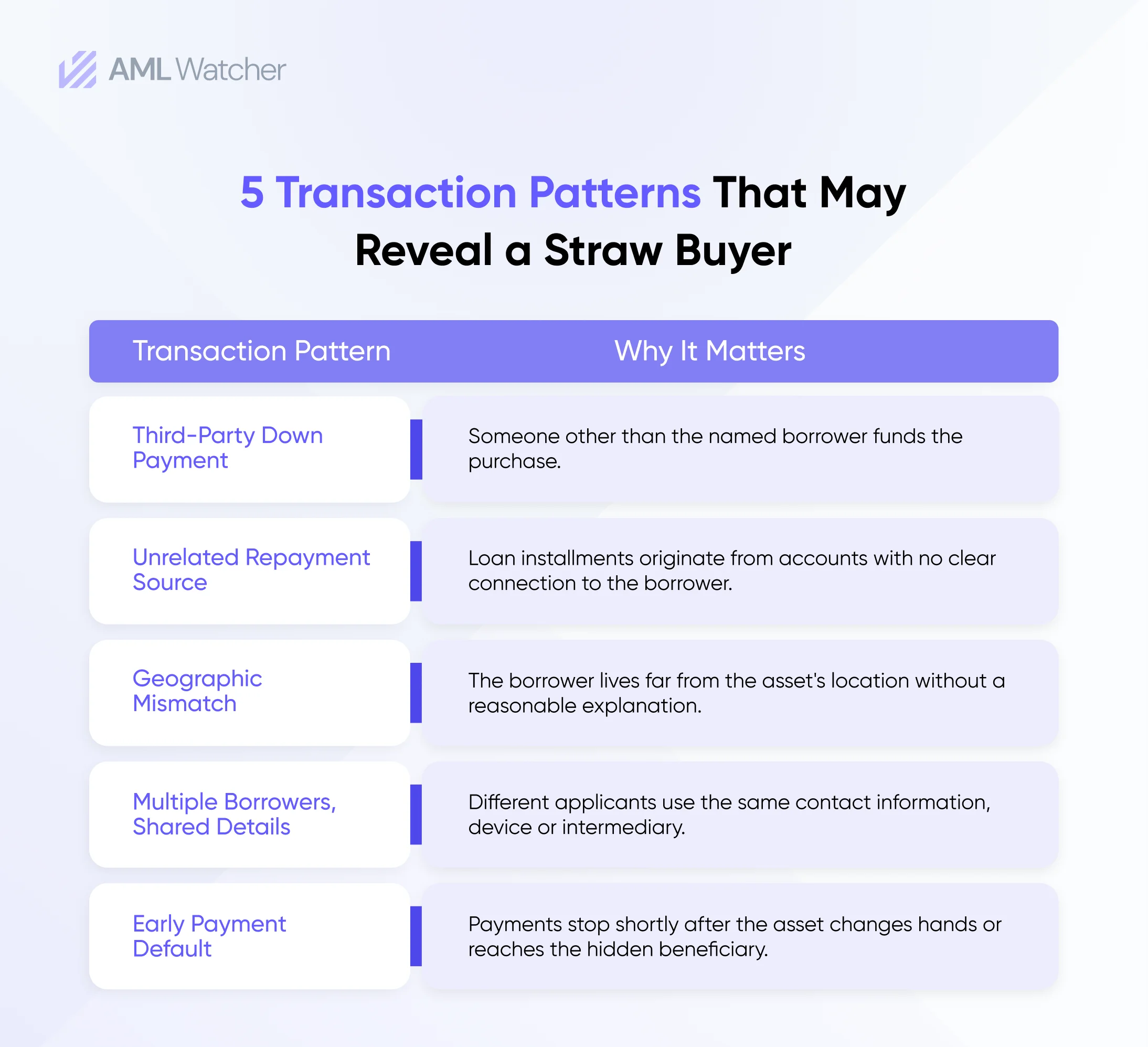
- Several first-time borrowers sharing an address, phone number, device or broker
- A borrower who lives far from the dealership or property with no stated reason
- A vehicle or home that does not fit the borrower’s age, income or stated need
- Down payments or repayments sent from accounts the borrower does not own
- A third party who directs the transaction, communicates on the borrower’s behalf or exercises control over the asset without a clear explanation
- Payments that stop within weeks, followed by a borrower who cannot describe the asset
Each signal is weak alone. Together they form a pattern.
How AML Screening Helps Assess Straw Buyer Risk
When the relevant data and monitoring scenarios are configured appropriately, transaction monitoring can complement customer screening by identifying patterns that may indicate unusual funding activity, third-party involvement or transactions inconsistent with expected customer behaviour.
AML Watcher’s sanctions, PEP, watchlist and adverse media screening can help identify applicants and other relevant parties with documented risk indicators. Its Special Interest Persons data can provide additional context for individuals associated with suspected or confirmed criminal activity.
AML Watcher’s International Leaks Database can help investigators identify relevant information about offshore structures and individuals appearing in international leaks, providing additional context for due diligence. Investigators can use relevant findings to guide ownership checks and determine whether additional review is warranted.
Straw-buyer fraud can remain difficult to identify when financial institutions focus only on the identity and creditworthiness of the named applicant. A clearer understanding of the parties involved, ownership relationships and transaction activity can help investigators identify arrangements that warrant further scrutiny.
- No commitment needed
- Complete AML Database at your service
- Access our all-in-one dashboard


Tier-2 PSPs in ... must demonstrate automated monitoring, layered CDD, &...
See the Full Regulatory Expectation70–80% less manual work, 95% less fatigue, TruRisk Agent makes compliance effortless.
Experience Agentic AMLMove Beyond Articles. Activate AML Intelligence.
Switch to AML Watcher today and reduce your current AML cost by 50% - no questions asked.
- Find right product and pricing for your business
- Get your current solution provider audit & minimise your changeover risk
- Gain expert insights with quick response time to your queries