


 Alert!

Perpetual AML Explained Guide to Continuous Financial Crime Risk
AML Compliance
October 23, 2026


- What Is Perpetual AML?
- Why Perpetual AML Matters for Advanced AML Compliance
- Perpetual AML vs Perpetual KYC: What Is the Difference?
- How Perpetual AML Monitoring Works
- From Periodic AML Reviews to Event-Driven Risk Management
- What Role Does Perpetual AML Software Play?
- Challenges of Implementing Perpetual AML
- How Financial Institutions Can Build a Perpetual AML Framework
- How AML Watcher Enables Continuous Financial Crime Risk Management

A customer can present a low-risk profile during onboarding and develop materially different risk characteristics months later. Beneficial ownership may change, new sanctions exposure may emerge, or transaction activity may shift beyond expected patterns. Adverse media can also surface after the latest customer review has already closed.
A scheduled review may eventually identify these changes, but material developments can occur between review points. Financial crime risk does not follow an institution’s review calendar. This is where perpetual AML monitoring becomes relevant for financial institutions managing customer relationships over time.
Perpetual AML describes AML compliance as a continuous risk-management process that combines ongoing monitoring with periodic and event-driven customer reviews. It brings ongoing customer due diligence, screening, transaction monitoring and risk reassessment into one operating model.
Importantly, perpetual AML is an industry term, not a standalone regulatory obligation. Regulatory frameworks instead establish requirements for ongoing customer due diligence, transaction monitoring, risk-based updates and, where appropriate, event-driven reviews. Existing frameworks already require forms of ongoing monitoring and risk-based customer management across major jurisdictions.
What Is Perpetual AML?
Perpetual AML refers to managing financial crime risk continuously throughout the customer relationship, with material changes informing the institution’s response.
In practice, the approach can bring four dimensions together within a connected risk-management framework.
- Customer information includes identity details, beneficial ownership, corporate structures, business activities and other information supporting the customer profile.
- Risk indicators include sanctions exposure, PEP status, adverse media, jurisdictional concerns and other factors affecting the customer’s financial crime risk.
- Transactions and behaviour provide additional context. Changes in transaction volumes, counterparties, payment routes or geographic exposure can indicate activity that differs from the established customer profile.
- Risk response determines what happens after a relevant signal appears. Depending on the circumstances, the response can involve information updates, risk reassessment, enhanced due diligence, investigation or escalation.
The term “perpetual” does not mean analysts manually examine every customer continuously. Instead, the AML programme is structured to detect material changes when relevant signals emerge.
FinCEN’s CDD framework requires covered financial institutions to understand the nature and purpose of customer relationships, conduct ongoing monitoring to detect and report potentially suspicious transactions, and maintain and update customer information on a risk basis. However, perpetual AML is not generally defined as a standalone regulatory obligation. Regulatory frameworks generally address the underlying controls through requirements for ongoing customer due diligence, monitoring, risk-based updates and event-driven reviews.
Why Perpetual AML Matters for Advanced AML Compliance
Customer risk profiles should not be treated as static records because business relationships and associated risk factors can change over time. A company can enter new markets, introduce new products, change ownership or alter transaction behaviour after onboarding.
The challenge becomes sharper when criminal networks deliberately change counterparties, payment routes or jurisdictions. A customer profile prepared twelve months earlier may therefore provide incomplete context for current activity.
The FCA requires firms to conduct ongoing monitoring on a risk-sensitive basis, including scrutinising transactions against what the firm knows about the customer and keeping relevant CDD information up to date.
Therefore, perpetual AML is best understood as an operating model that connects existing AML controls around changing customer risk.
Perpetual AML vs Perpetual KYC: What Is the Difference?
Perpetual KYC generally focuses on maintaining an accurate and current customer profile throughout the relationship. Perpetual AML takes that further by assessing broader financial crime risk.
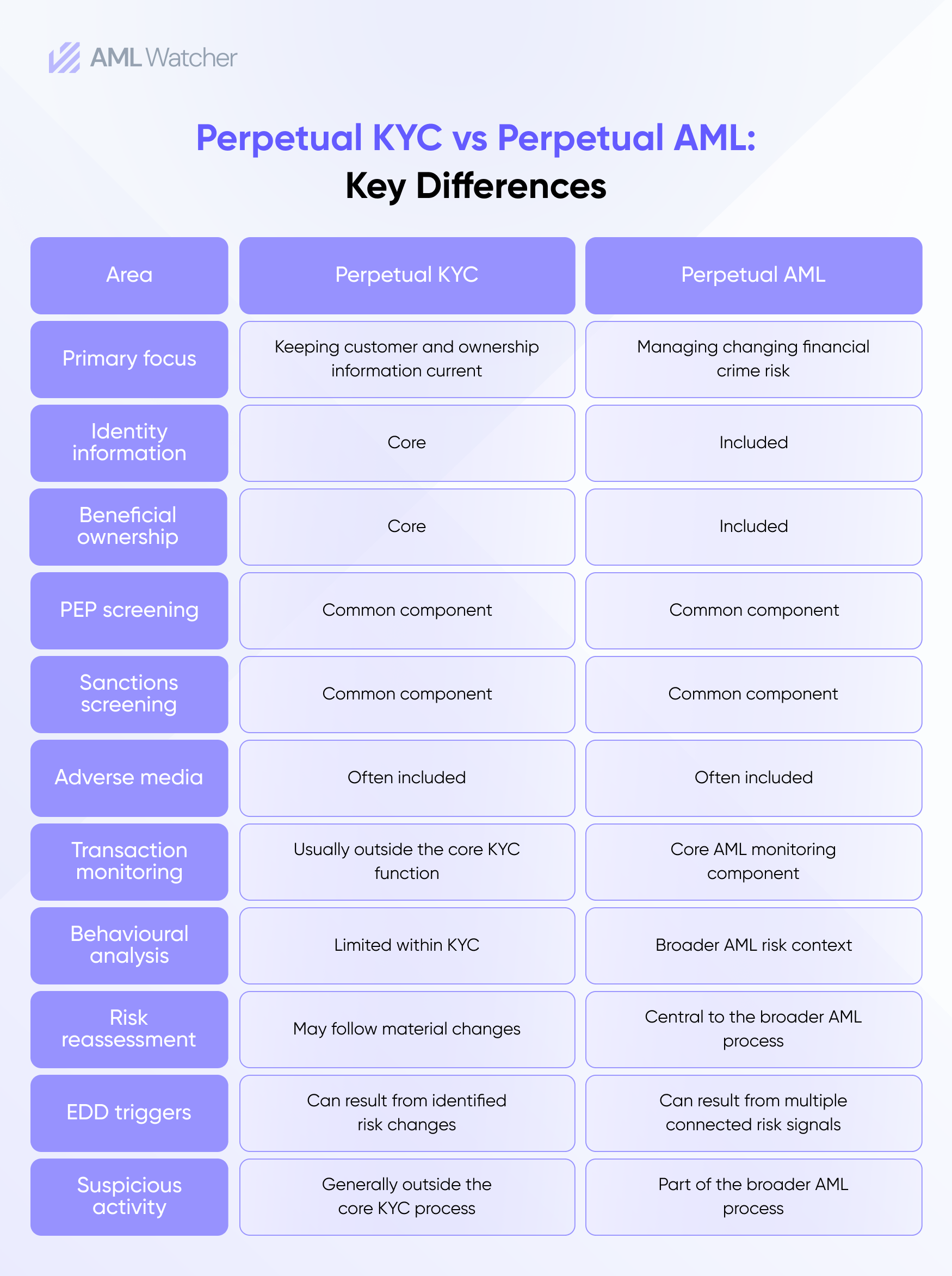
Consider a corporate customer whose director changes during the relationship. A perpetual KYC process would update the director information and reassess the ownership or control structure.
A perpetual AML process would consider the same change alongside sanctions exposure, PEP status, adverse media and subsequent transaction activity. In simple terms, perpetual KYC focuses on whether customer information stays current, whereas perpetual AML considers whether those changes alter the customer’s broader financial crime risk and require a different response.
Boundaries can vary between firms, and vendors may use these terms differently, so don’t treat them as universally standardised definitions.
How Perpetual AML Monitoring Works
Perpetual AML monitoring turns relevant changes into signals for risk assessment and action.
A typical process follows this sequence:
Customer relationship → Continuous monitoring → Risk signal → Signal validation → Risk reassessment → Appropriate action → Updated profile
This process does not eliminate periodic reviews. Instead, event-driven monitoring adds a mechanism to identify when a customer relationship may need attention before the next scheduled review. The underlying signals can originate from several sources.
Customer data can reveal changes involving identity, ownership, corporate structures or business activities. External intelligence can identify sanctions changes, PEP developments or adverse media involving customers and connected parties.
Transaction monitoring adds behavioural context that static customer records cannot provide. Unusual volumes, new counterparties, unexpected jurisdictions or transaction patterns outside expected activity can create additional risk signals.
The response should remain proportionate to the circumstances. A single information change may require a profile update, while several connected signals could warrant EDD or investigation.
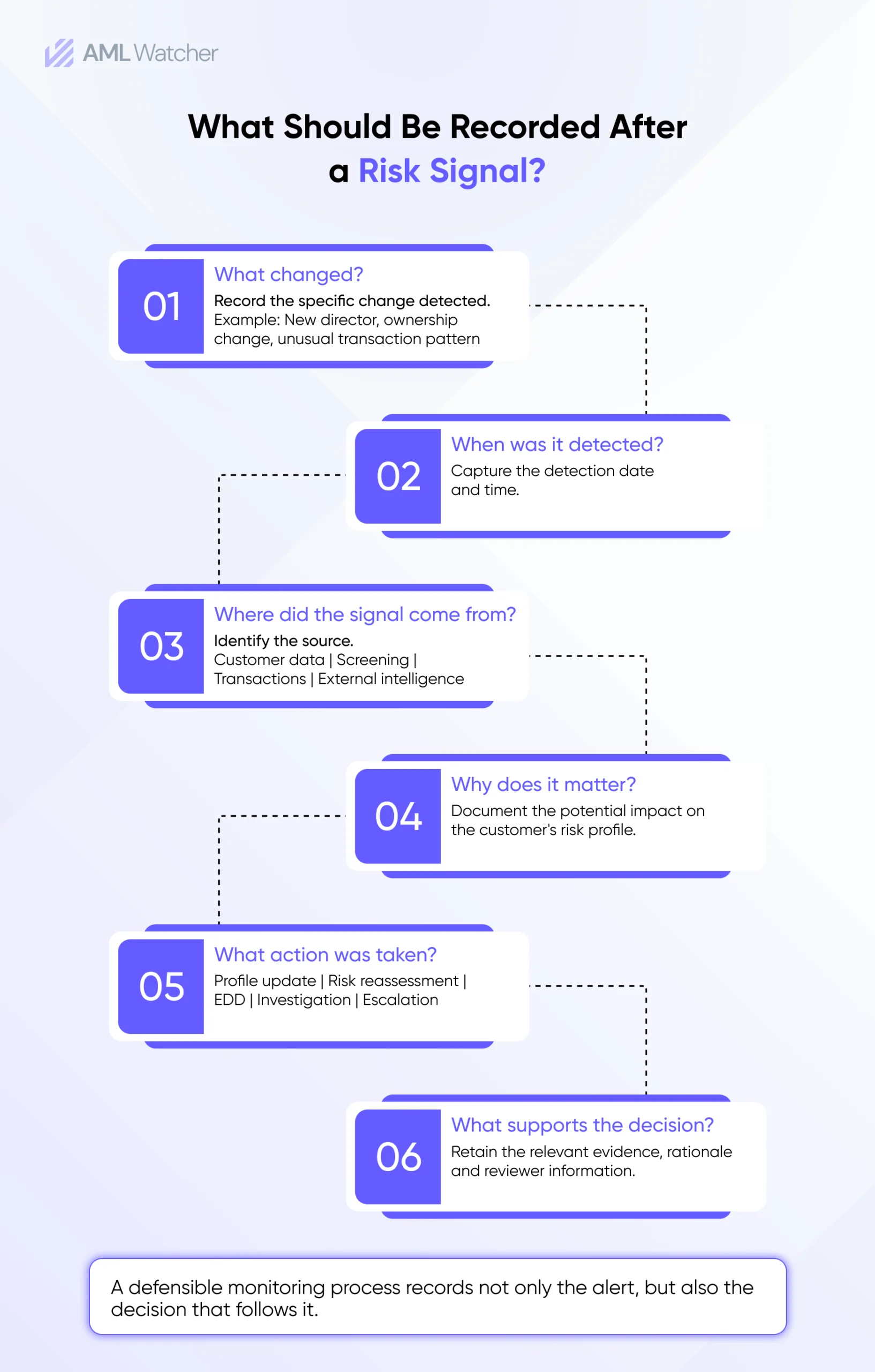
This risk-based approach matters because perpetual monitoring should identify meaningful changes rather than create an indiscriminate flow of alerts.
From Periodic AML Reviews to Event-Driven Risk Management
A periodic review model uses scheduled customer reviews alongside ongoing monitoring and other risk-based controls.
Consider three scenarios. A beneficial owner changes before the next scheduled review. A connected entity becomes subject to sanctions after the customer was screened. Transaction volume suddenly rises beyond the originally expected activity.
Periodic reviews therefore still have a role within a perpetual AML programme. Continuous monitoring complements those reviews by allowing relevant changes to trigger action earlier.
FinCEN states that, when ongoing monitoring identifies information relevant to assessing or reassessing customer risk, institutions should update customer information as appropriate. FinCEN also makes clear that customer information does not have to be updated on a fixed continuous or periodic schedule in every case.
What Role Does Perpetual AML Software Play?
Manual monitoring becomes difficult when institutions manage large customer populations, multiple jurisdictions and numerous risk data sources.
Perpetual AML technology can connect screening, transaction monitoring, customer information and case workflows within a common risk-management process.
Transaction monitoring can flag activity outside expected patterns using rules, typologies, and behavioural indicators. Entity resolution can link customers to beneficial owners, directors, related entities, and counterparties.
Risk scoring can then combine different signals to support customer risk reassessment. Case management provides investigators with a structured environment to review alerts, document decisions, and escalate cases.
Technology, however, does not replace compliance judgement. Poor customer monitoring and poor-quality data can weaken results, where weakly configured rules may generate unnecessary alerts.
The quality of the underlying data, monitoring logic, governance and investigation process therefore remains central to effective perpetual AML compliance.
Challenges of Implementing Perpetual AML
Continuous monitoring can create a practical problem when every detected change generates an alert. Higher monitoring coverage can increase false positives, create analyst fatigue and divert resources from genuinely relevant investigations.
Data quality presents another constraint. An automated monitoring system cannot reliably interpret customer risk when underlying ownership, identity or business information remains incomplete.
Fragmented systems can create another weakness. KYC information may sit separately from sanctions screening, transaction monitoring, adverse media and ownership records.
Compliance teams also need clear criteria for material changes. Not every customer update should trigger EDD or a full investigation, while certain signal combinations may require immediate escalation.
Human oversight therefore remains necessary. Automated monitoring tools can flag and prioritise signals, but investigators must interpret those signals within the customer’s broader context.
Effective perpetual AML is not about generating more alerts. It is about identifying meaningful changes and responding proportionately.
How Financial Institutions Can Build a Perpetual AML Framework
A practical framework starts with an accurate customer baseline. Without reliable onboarding information, later monitoring has a weak reference point.
The next step is to define risk-change triggers that warrant review, reassessment, or escalation. These can include ownership changes, sanctions developments, PEP changes, adverse media, transaction anomalies, geographic expansion and changes in business activity.
Monitoring systems should then connect the relevant information sources. KYC, sanctions, PEP, adverse media, transaction and ownership data should contribute to a coherent customer risk picture.
Response procedures should also be defined before alerts occur. Each trigger can have an established pathway covering information refresh, risk-rating review, EDD, investigation, escalation or reporting.
Monitoring intensity should reflect customer risk. Higher-risk relationships may require closer scrutiny, while lower-risk relationships can receive proportionate treatment.
Governance should also define who owns each response, what evidence must be retained and how decisions are reviewed for consistency. Useful indicators include investigation times, false-positive rates, overdue reviews, risk-rating changes, investigation volumes and escalation rates.
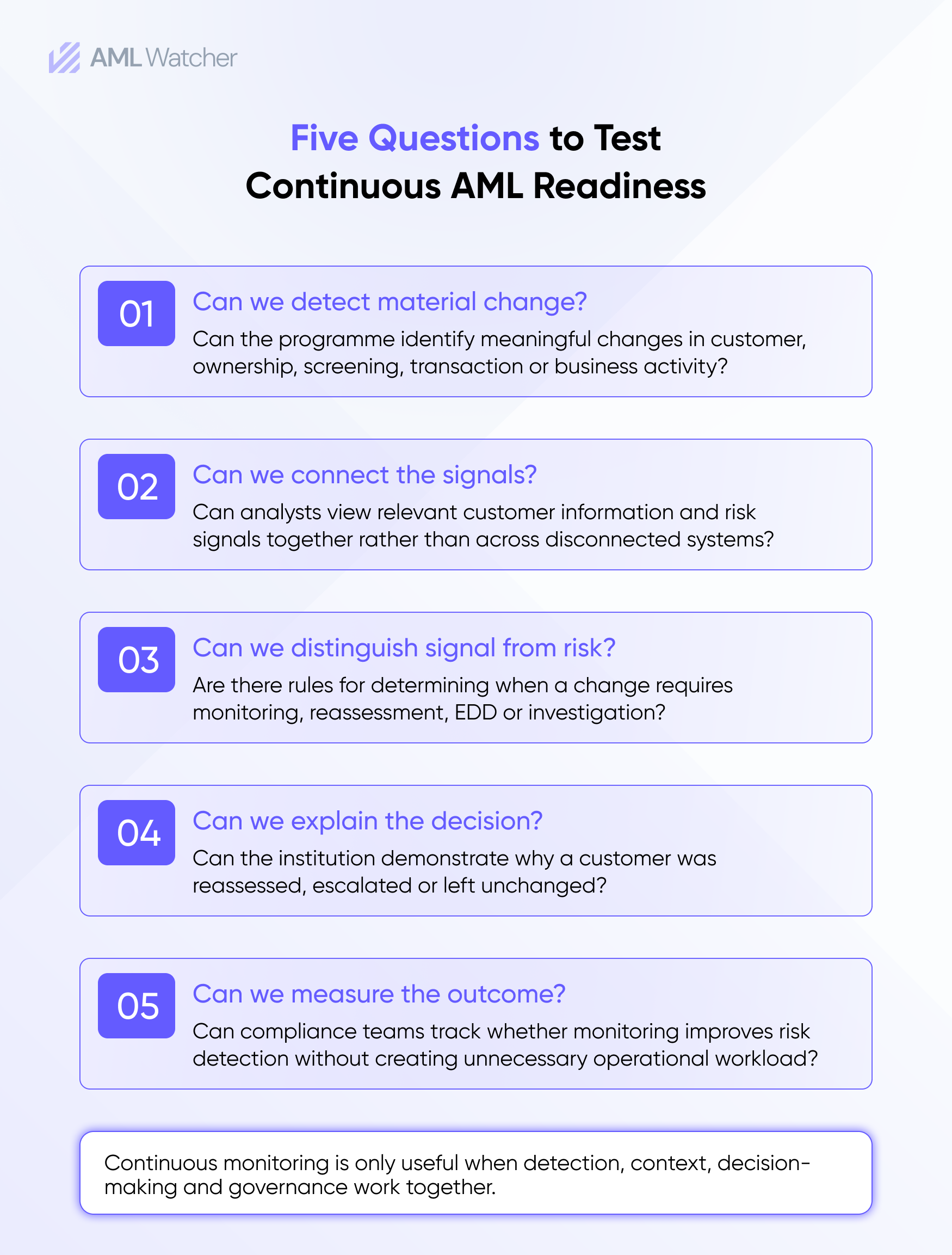
These measures help compliance leaders determine whether continuous monitoring improves risk detection or simply increases operational workload.
How AML Watcher Enables Continuous Financial Crime Risk Management
A perpetual AML framework depends on timely risk data, connected screening, and transaction intelligence because relevant changes must move from detection to risk assessment and investigation. AML Watcher provides sanctions data covering 215+ sanction regimes, alongside PEP, watchlist and adverse media screening capabilities. AML Watcher states that its sanctions data can refresh at 15-minute intervals.
Its transaction monitoring solution supports 150+ AML typologies and 10,000+ customizable rules for identifying transaction patterns and anomalies.
For compliance teams managing high screening volumes, AML Watcher’s TruRisk uses multiple identifiers and contextual data to help distinguish potential true positives from false-positive screening matches. AML Watcher reports a 44% reduction in false positives compared with its referenced current or legacy screening solutions.
- No commitment needed
- Complete AML Database at your service
- Access our all-in-one dashboard


Tier-2 PSPs in ... must demonstrate automated monitoring, layered CDD, &...
See the Full Regulatory Expectation70–80% less manual work, 95% less fatigue, TruRisk Agent makes compliance effortless.
Experience Agentic AMLMove Beyond Articles. Activate AML Intelligence.
Switch to AML Watcher today and reduce your current AML cost by 50% - no questions asked.
- Find right product and pricing for your business
- Get your current solution provider audit & minimise your changeover risk
- Gain expert insights with quick response time to your queries


