


 Alert!

Trust Infrastructure for Financial Services and AML Compliance
Anti Money Laundering
November 20, 2026


- What Is Trust Infrastructure?
- Why AML/KYC Compliance Cannot Stop at Identity Verification
- How Verifying Ultimate Ownership Strengthens Digital Trust Infrastructure
- Why Continuous Customer Due Diligence Keeps Trust Current
- How Transaction Monitoring Identifies Financial Crime Risk
- Why Customer Risk Assessment Must Evolve After Onboarding
- How Agentic AI Changes Online Trust and Safety in Payments
- Building an Investigation-Ready Trust Infrastructure Framework
- How AML Watcher Supports Digital Trust Solutions for Financial Institutions

Financial Institutions face evolving financial crimes risks that require more than isolated KYC checks or screening tools. Trust infrastructure connects identity verification, beneficial ownership, sanction screening and transaction monitoring to establish a clearer picture of customer risk. This interconnected approach helps compliance teams maintain visibility, respond to emerging threats and make informed decisions.
What Is Trust Infrastructure?
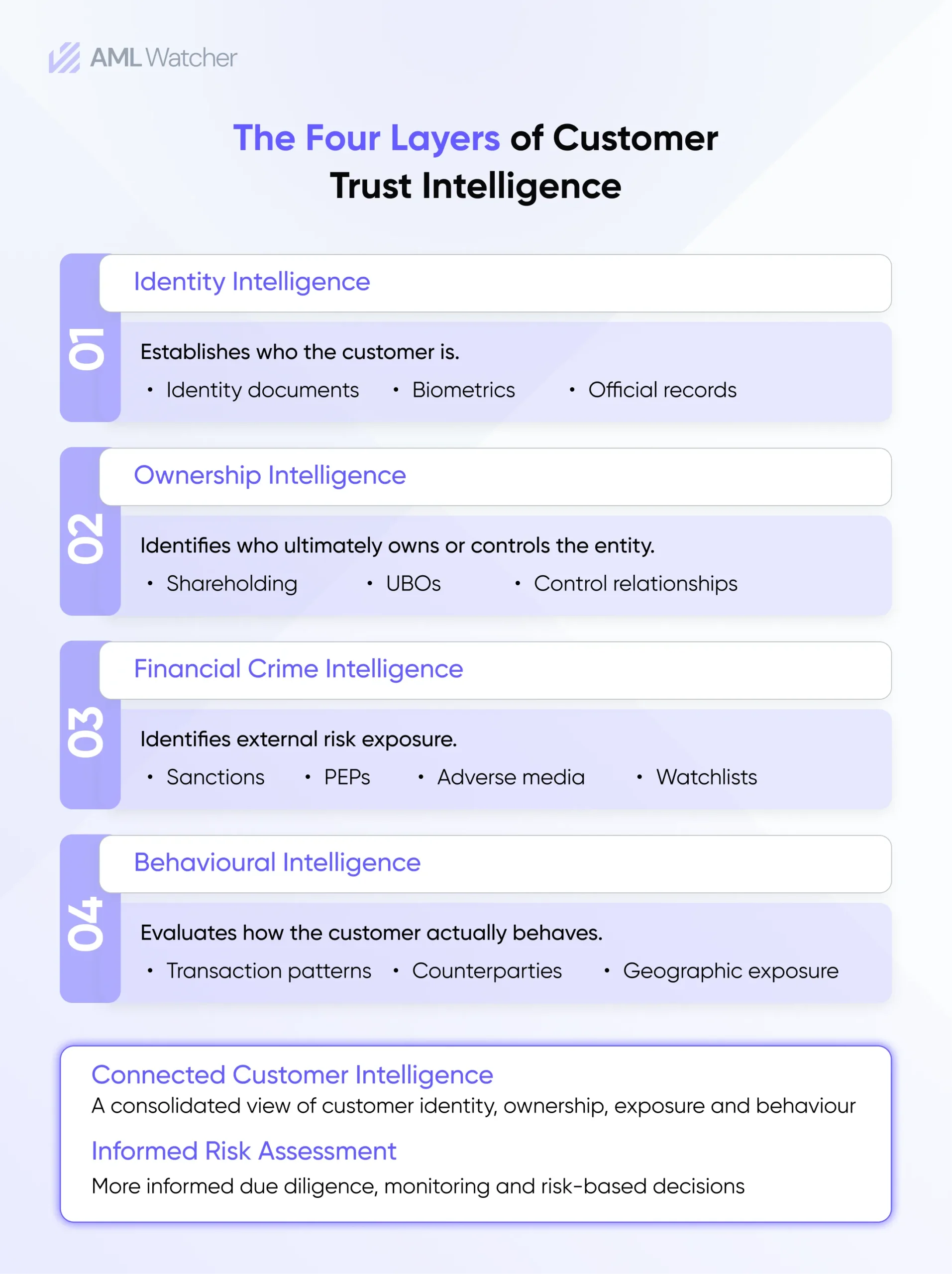
Trust infrastructure in AML compliance involves the connected processes, data and controls financial institutions use to establish customer credibility, assess financial crime exposure and reassess risk throughout a business relationship. It brings together identity verification, beneficial ownership checks, sanctions and PEP screening, adverse media analysis, ongoing due diligence and transaction monitoring.
Three information elements form part of a defensible customer assessment. Identity information establishes who the customer is. Ownership and control information establishes which individuals behind a legal entity. Financial crime intelligence adds context through sanctions exposure, PEP relationships, adverse media and transaction behaviour.
Why AML/KYC Compliance Cannot Stop at Identity Verification
Limitations of traditional KYC
FATF Recommendation 10 requires customer due diligence to go beyond confirming a customer’s identity. Financial institutions are expected to establish why the customer has entered into the relationship and intended nature of a business relationship, identify beneficial owners and conduct ongoing due diligence.
Source of funds and source of wealth information also provide a basis for determining whether a customer’s financial circumstances and activities are consistent with the institution’s understanding of the relationship. The depth of these checks should reflect the customer’s risk profile and applicable regulatory requirements.
What financial crime intelligence adds
Sanctions screening should also consider applicable ownership and control rules, since a sanctioned individual or entity may exercise control through another legal entity rather than appearing directly in the customer’s name.
Adverse media screening tools can flag reporting associated with fraud, corruption and related financial crimes. However, analysts must assess the source’s credibility, the nature of the allegation, how relevant the information is and whether the subject’s identity before treating a result as a risk indicator. Positive reviews and ad hoc web searches are no substitute for structured screening using credible and recognised information sources.
How information quality shapes every screening decision
Incomplete customer records, inconsistent identifiers, transliteration differences and spelling differences may influence screening accuracy. A name may appear differently across national registries, sanctions records and international databases.
If a screening system relies too solely on exact name matching, relevant records may go undetected. Reliable screening therefore requires accurate source data, appropriate matching The process also involves reviewing reviews so analysts can separate genuine matches from unrelated individuals.
How Verifying Ultimate Ownership Strengthens Digital Trust Infrastructure
Verifying a company’s legal existence does not establish who ultimately owns or controls it. Corporate structures may involve multiple subsidiaries, nominee shareholders, trusts and entities registered in multiple countries and regulatory environments.. These arrangements can obscure the individuals who ultimately benefit from or exercise control over a business.
FATF’s March 2022 revision of Recommendation 24 strengthened the international standards for greater visibility into ultimate ownership. It requires countries to ensure that adequate, accurate and up-to-date information on the beneficial ownership and control of legal persons is available to competent authorities.
This creates an obligation for regulated firms to means that customer due diligence should examine the ownership and control structure beyond the immediate shareholder. Changes in shareholding, beneficial ownership or effective control should prompt reassessment where they affect the customer’s risk profile. The resulting information should feed into PEP screening, sanctions checks alongside the institution’s wider customer risk assessment.
Why Continuous Customer Due Diligence Keeps Trust Current
Customer due diligence does not end once onboarding checks are complete. FATF Recommendation 10 requires financial institutions to conduct ongoing customer checks across the business relationship. The process also involves reviewing transactions to determine whether the activity aligns with the institution’s knowledge of the customer, its business activities and risk profile.
Continuous customer checks enable firms to detect developments that could affect the original assessment. A previously acceptable customer relationship could warrant additional scrutiny when new ownership information, political exposure, adverse media or transaction patterns emerge.
Periodic reviews versus event-triggered reviews
Periodic reviews review and refresh customer records at schedules based on the institution’s risk assessment. Higher-risk customers generally require more frequent reviews than lower-risk relationships.
Event-triggered reviews take place when new information indicates a potential change in risk, allowing compliance teams to review customers between scheduled review dates.
Each method addresses a separate review requirement.. Periodic reviews provide scheduled reassessment, while event-triggered reviews allow compliance teams to act on to relevant developments between review dates.
When does enhanced due diligence become necessary
When new information indicates elevated financial crime exposure, financial institutions may need to apply Enhanced Due Diligence procedures. Depending on the circumstances, this can involve obtaining additional information about the source of funds, source of wealth, business activities, ownership arrangements or the purpose of specific financial activity.
Consider a situation where a previously low-risk corporate customer acquires a beneficial owner identified as a PEP or becomes associated with credible adverse media, the institution should review whether the business relationship remains appropriate. The findings should determine whether additional due diligence, more frequent monitoring or other risk mitigation measures are appropriate.
How Transaction Monitoring Identifies Financial Crime Risk
Defining expected behavior
Transaction monitoring evaluates customer transactions against expected patterns of financial activity. These expectations are informed by the customer’s occupation or business activity, geographic exposure, source of funds, products used and previous transaction behaviour.
A transaction that appears unusual in isolation may be consistent with the customer’s established business activity. However, repeated deviations from the expected profile may indicate activity that warrants further investigation.
Spotting unusual patterns
Warning signs may include:
- Sudden shifts in transaction frequency or volume
- Funds transferred between accounts within a short period between accounts
- Structuring just below reporting thresholds
- Activity inconsistent with the declared business
- Cash deposits followed quickly by large withdrawals
- Transfers involving high-risk jurisdictions or unknown counterparties
Connecting alerts to customer risk
A domestic business that suddenly receives high-value transfers from unrelated overseas accounts, then withdraws the funds within days, may pass every transaction-level review. The wider activity pattern is what matters. Alerts like this should feed the customer’s risk rating and trigger due diligence.
AML Watcher’s Transaction Monitoring provides more than 150 predefined AML typologies and supports the creation of over 10,000 custom monitoring rules. Such functionality enables financial institutions to configure detection scenarios around the characteristics of their customer base, customer activity and transaction behaviour, along with risk exposure.
Why Customer Risk Assessment Must Evolve After Onboarding
Customer risk assessment brings together the information collected through due diligence, ownership verification, screening alongside ongoing monitoring of financial activity. Its purpose is to determine the level of financial crime exposure associated with a customer and establish appropriate monitoring controls. Banks and other regulated firms should therefore review risk ratings whenever new information develops and modify their controls accordingly.
Risk assessments should be supported by identifiable risk factors, transparent scoring criteria and documented decisions. Where an analyst overrides an automated risk rating, the reason should be recorded alongside the supporting evidence. Automated scoring can help standardise assessments and prioritise higher-risk relationships, but the final compliance decision must remain subject to appropriate human oversight.
AML Watcher’s Configurable Risk Scoring allows institutions to define risk parameters and tailor customer assessments to their own risk appetite. Its TruRisk AI solution adds identity matching, risk narratives and documented reasoning to support the analyst’s assessment of potential matches.
How Agentic AI Changes Online Trust and Safety in Payments
As financial institutions explore AI-driven compliance workflows, access to reliable screening intelligence becomes an important consideration. AML Watcher’s MCP Server connects its AML data, including sanctions, PEP, watchlists and adverse media, with compatible AI agents and internal systems through the Model Context Protocol. This allows AI-driven workflows to retrieve structured AML intelligence while maintaining records of automated screening actions.
Building an Investigation-Ready Trust Infrastructure Framework
Connecting customer intelligence and monitoring
An effective AML framework connects information gathered during onboarding with subsequent screening results, beneficial ownership changes, transaction activity and customer risk assessments. When these processes operate in isolation, analysts may have to retrieve information from multiple systems, investigate duplicate alerts or reassess customers without access to their complete risk history.
A connected approach allows customer intelligence and transaction monitoring findings to inform one another. Counterparty information adds another layer of context by helping institutions understand the individuals and businesses involved in customer transactions.
From alerts to accountable decisions
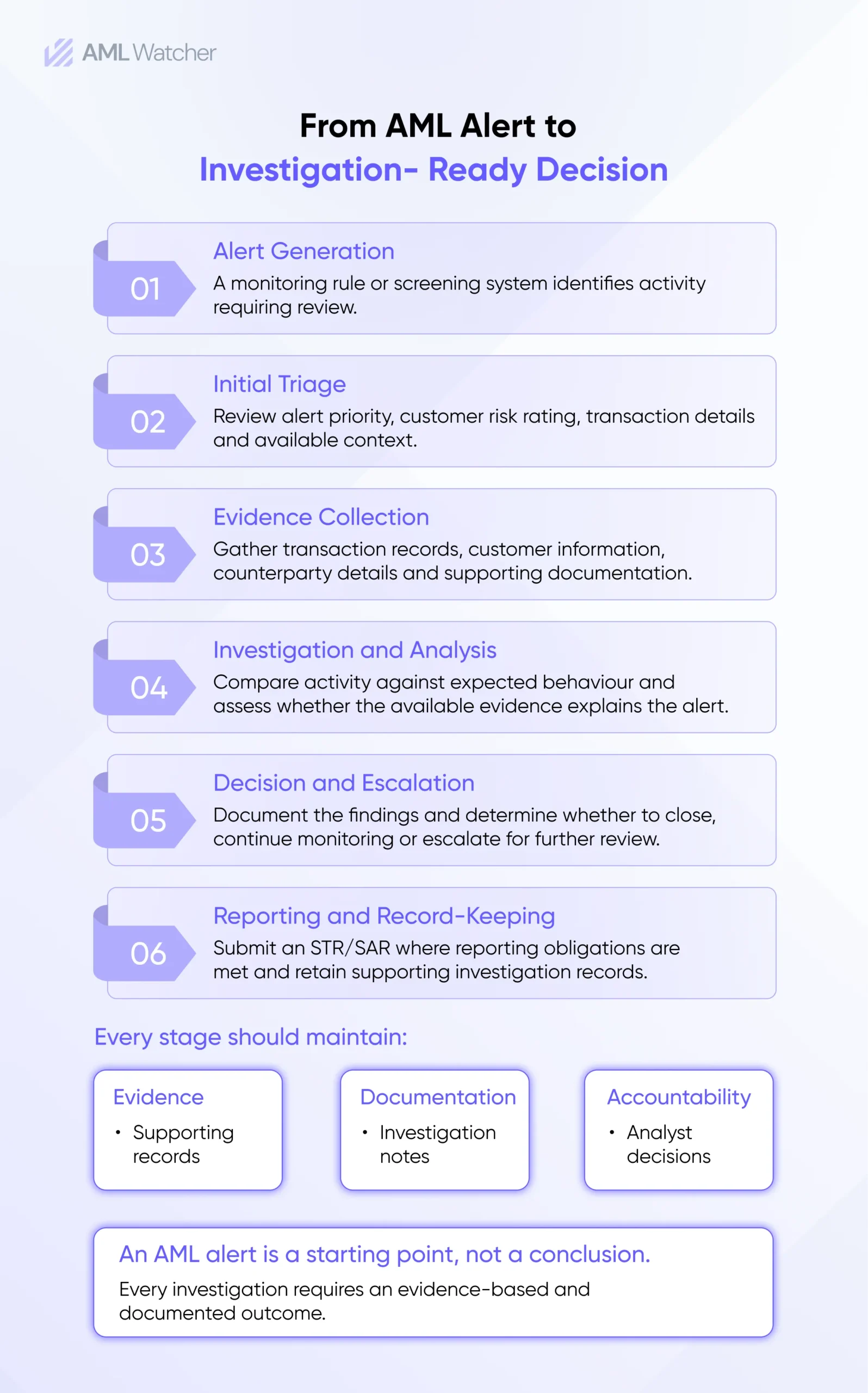
Alert generation, investigation, escalation and suspicious transaction reporting are distinct stages of AML operations. FATF Recommendation 20 requires financial institutions to report suspicious transactions to the relevant Financial Intelligence Unit, including attempted transactions where applicable. Therefore, an alert should lead to an evidence-based assessment rather than an automatic conclusion that suspicious activity has occurred.
High volumes of false-positive alerts can also consume investigation resources and delay the review of potentially suspicious activity. Every investigation should therefore document the alert, supporting evidence, analyst findings and final disposition. FATF Recommendation 11 establishes record-keeping requirements, including a general minimum retention period of five years, subject to applicable national requirements.
Protecting AML data and evidence quality
The reliability of an AML investigation depends on the quality and traceability of the information supporting it. Financial institutions should maintain accurate customer records, use credible screening sources and restrict access to sensitive information according to employee responsibilities.
How AML Watcher Supports Digital Trust Solutions for Financial Institutions
AML Watcher supports financial institutions in connecting customer screening, risk assessment and transaction monitoring within their AML compliance operations. Its solutions bring together sanctions, PEP, watchlist and adverse media screening with ongoing monitoring and AI-supported risk assessment.
This connected approach helps compliance teams assess customer and counterparty exposure, investigate potential matches and respond to changing financial crime risks. Financial institutions can explore how AML Watcher’s solutions support their compliance requirements through a personalized demonstration.
- No commitment needed
- Complete AML Database at your service
- Access our all-in-one dashboard


Tier-2 PSPs in ... must demonstrate automated monitoring, layered CDD, &...
See the Full Regulatory Expectation70–80% less manual work, 95% less fatigue, TruRisk Agent makes compliance effortless.
Experience Agentic AMLMove Beyond Articles. Activate AML Intelligence.
Switch to AML Watcher today and reduce your current AML cost by 50% - no questions asked.
- Find right product and pricing for your business
- Get your current solution provider audit & minimise your changeover risk
- Gain expert insights with quick response time to your queries


