Alert!

Proof of Funds: What It Proves, What It Misses, and How AML Teams Verify It
Anti Money Laundering, Fraud Prevention
November 18, 2026


When verifying high-value transactions, the first and most critical step is confirming a customer’s financial capacity. However, simply seeing money in an account is only half part of the story. While proof of funds verification confirms that funds are available, it does not reveal anything about how that money was earned or whether it carries hidden financial crime risks. For Anti-Money Laundering (AML) teams, relying only on a balance check leaves dangerous compliance risks. This is why compliance teams combine it with source of funds (SoF) and source of wealth (SoW) checks.
What is proof of funds?
Proof of funds is a document, or set of documents, showing that a person or company has the liquid money or financial holdings needed to complete a purchase, investment or onboarding. Usually, it includes a bank statement or a proof of funds letter issued by a bank. It can also be a statement from a deposit or brokerage account. It is most common in real estate, private banking, corporate finance, and auctions, and immigration authorities often also demand it.
A strong POF record covers these important details:
- Ownership of the account: It is held by a valid customer with an authorised signatory, or a properly documented funding entity.
- Availability of funds: The funds are ready to use, debt-free, and can be accessed at any time.
- Amount and currency: There is enough money to cover the purchase price, fees, taxes, and any currency exchange charges.
- Date and validity: The document is recent enough to prove that the amount is in the account and has been present for a certain period of time.
- Authenticity: The document comes from a real and verifiable source and hasn’t been edited or tampered with.
Proof of funds vs source of funds vs source of wealth
These terms are often considered the same but practically answer different questions. Confusing them is the most common weakness during reviewing PoF documents.
| Check | Questions it answers | Typical evidence required |
| Proof of funds | Does money exist and is it accessible? | Most recent bank statement or a maintenance certificate |
| Source of funds | Where did the money actually come from? | Sale contract, pay slips, loan agreement, or gift letter |
| Source of wealth | How the customer built their overall wealth | Business accounts, tax returns, inheritance or sale records |
A clean balance can be established through layering of dirty money. HMRC, in its Estate Agent Risk Assessment guidance (AMLG3200), warns that a clean balance can be masked through dirty money laundering techniques, as criminals frequently buy properties after laundering funds through other channels to make the money legal and bypass enhanced due diligence.
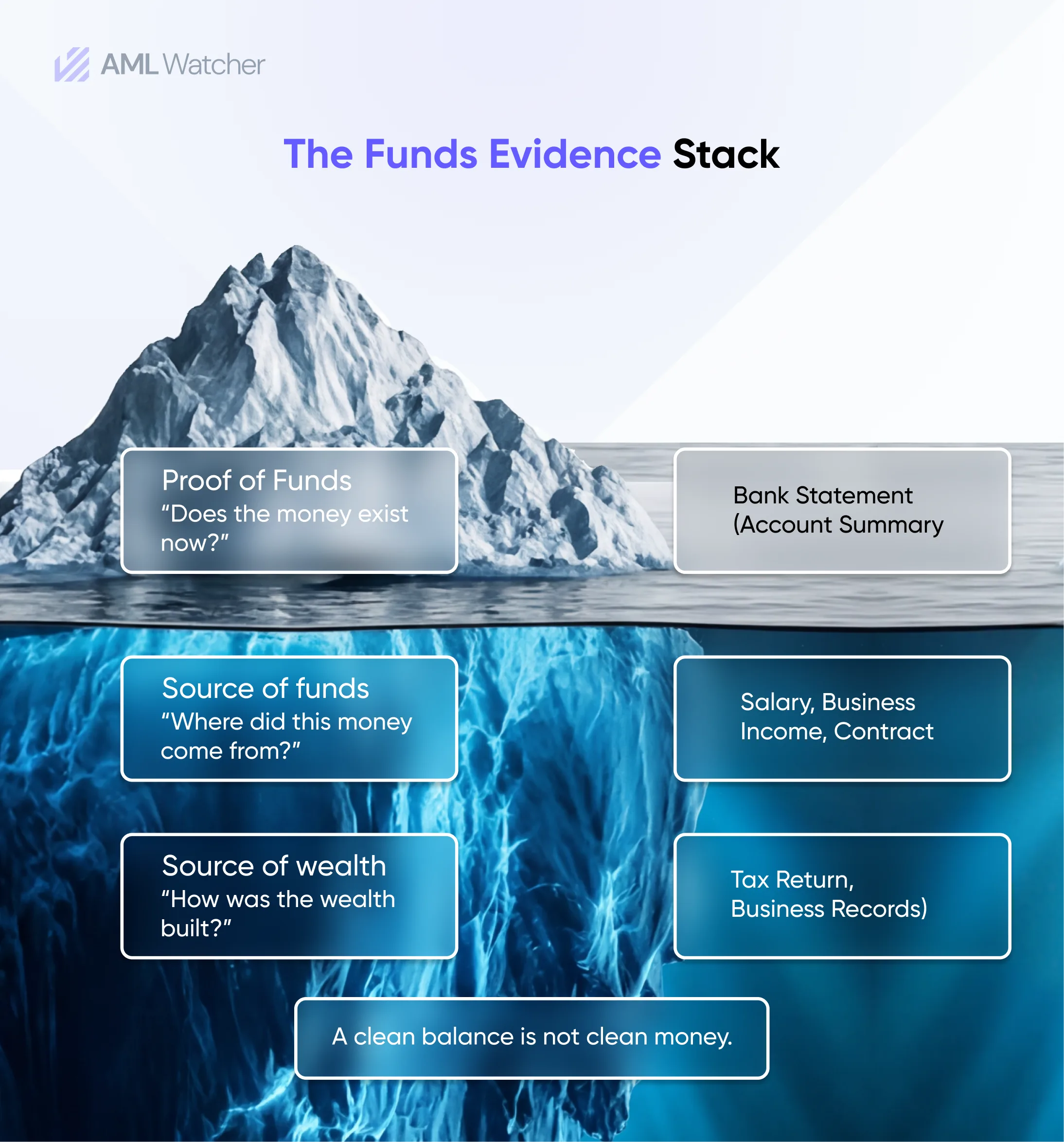
A balance is the visible tip. Compliance checks what lies underneath.
What regulators actually expect
Regulators require risk-based due diligence, and no regulatory source mandates a stand-alone “proof of funds letter” as a universally accepted document. Evidence of funds is only a part of due diligence.
- FATF in its Recommendation 10 requires continuous due diligence and guides financial institutions to conduct scrutiny of transactions against the information of the customer’s business and risk profile, including, where necessary, the source of funds. FATF in its 2022 Risk-based Approach Guidance for the Real Estate Sector found that the real estate sector often understands its risks poorly and regularly fails to mitigate them.
- The United Kingdom’s HMRC Risk Assessment of Estate Agent Businesses (AMLG3200) says the source of funds must always be examined in property transactions, and that SoF and SoW checks are a key part of enhanced due diligence when high-risk indicators are present. It also cites the National Crime Agency’s findings that up to £10 billion could be laundered through UK property each year.
- European Union’s Regulation (EU) 2024/1624, also known as AMLR, will be applied across Europe from 10 July 2027. Its Article 34 lists additional information on the source of funds and source of wealth of the customer and beneficial owners among enhanced due diligence measures.
- United States’ FinCEN CDD Rule (31 CFR § 1010.230) requires covered entities to check and verify beneficial owners of legal entity customers.
Proof of funds is therefore the paperwork and documented evidence collected, and due diligence is the risk assessment that is applied to it. A bank balance alone never satisfies compliance, as it only shows financial capacity, while regulators want to know whether the funds are clean for the deal.
How to review a proof of funds letter from a bank
Reviewing a bank letter to check its authenticity and legitimacy is important, and can be verified by following six things in it:
- Name: The account holder’s title must match the verified customer or beneficial owner exactly.
- Issuer and signatory: The letter must be on letterhead of the bank and include an authorised signature. Its authenticity can be verified through a contact number or an email that is printed on it for verification.
- Balance and currency: The available amount should cover the transaction and fees, and the currency should be stated.
- Date: The letter should include the most recent date, and the amount should be held for 30 to 90 days. This is common practice and is strictly enforced for higher-risk cases.
- Official document: Only accept the PDF version of the document that is issued by the bank and do not accept any screenshots. If there is any editing or inconsistent fonts on the document, escalate for further scrutiny.
- Account activity: Do not ignore sudden large deposits or third-party transfers that require further investigation.
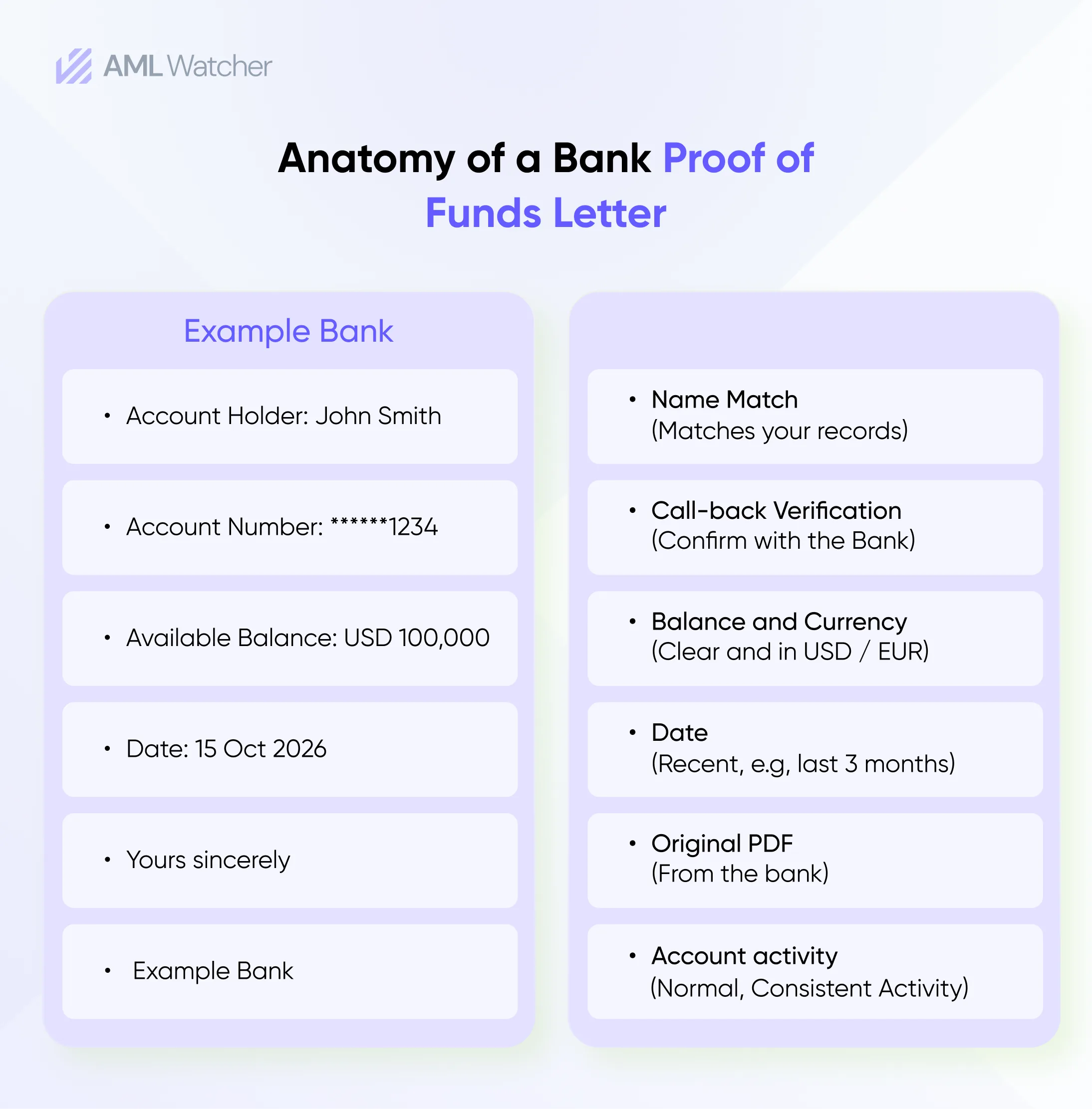
Six checks before you accept a bank letter.
Proof of funds requirements by scenario
Proof of funds requirements depend on the risk level and who is asking for it. The table below discusses when proof is needed and when further source of funds or source of wealth verification is required.
| Scenario | Typical proof of funds required | When SoF/SoW verification is needed |
| Cash property purchase | Recent bank statement or bank letter | Price exceeds declared means, or funds arrive from a third party or overseas |
| Corporate or SPV buyer | Company account statements plus beneficial owner verification | Ownership structure is complicated, offshore or cannot be traced |
| Private banking or investment | Deposit and brokerage statements | PEP involvement, high-risk country links or rapid inflows |
| Property auction | Bank letter or statement before bidding | When CDD cannot be completed, the deposit is frozen until the NCA gives consent to return the funds. |
Risks associated with the real estate sector
HMRC’s AMLG3200 states that the following proof of funds in real estate indicators are considered of higher risk:
- The customer changes bank accounts during the transaction.
- Funds come from a foreign account or a high-risk jurisdiction.
- If a payment is made in cash, foreign currency or cryptocurrency.
- Payment comes from an unknown account that is not associated with the customer.
- If the purchase exceeds or does not match the customer’s declared financial sources.
- The customer fails to or is reluctant to explain how the purchase is funded.
If a corporate buyer’s beneficial owner cannot be identified, HMRC’s position is that the process should not proceed and further investigation is required.
A five-step verification workflow
- Collect evidence of funds, perform identity verification, and identify beneficial owners.
- Authenticate the document by verifying the information from the issuer.
- Compare the balance against the customer’s profile and the transaction value.
- In case of any unusual behaviour, report immediately and run SoF and SoW checks under enhanced due diligence.
- Decide and record the proceedings. If due diligence cannot be completed, do not proceed, and consider a suspicious activity report. Record your reasoning, and refresh the file when the funding route or transaction value changes.
Technology is helpful and speeds up this process, but HMRC is clear that using a third-party provider does not remove the firm’s compliance responsibility.
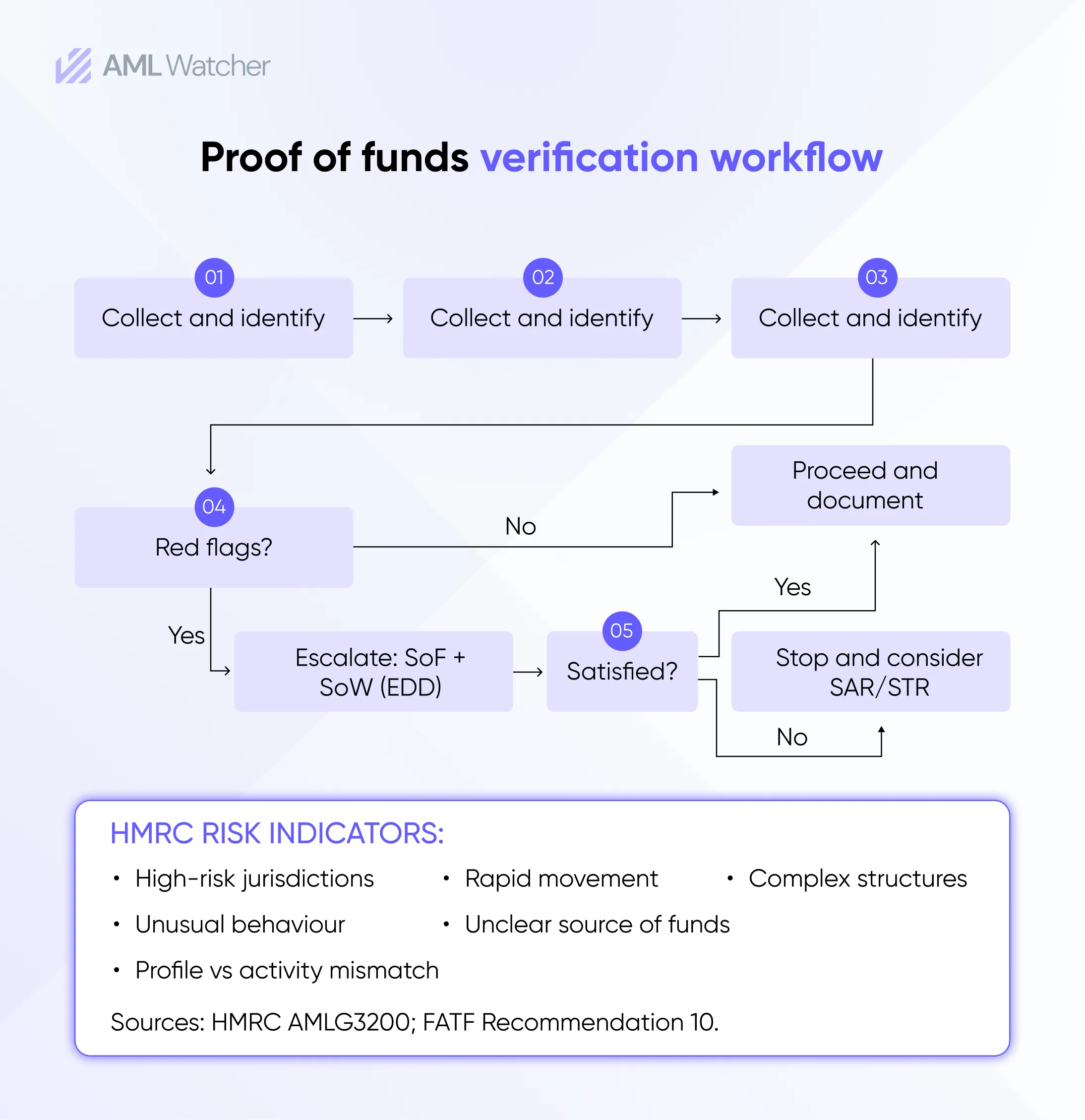
From collection to decision: when a balance is enough and when it is not.
Conclusion
Proof of funds is important, but it is a part of the customer verification process. A mature compliance program treats POF as one input into a broader source-of-funds and risk assessment process. Verifying ownership, availability of funds, authenticity, and the customer’s transaction history in the account before the transaction proceeds are all necessary parts of due diligence. That is the difference between collecting a document and making a defensible compliance decision.
Frequently Asked Questions
No, these are different terms. Proof of funds shows the money is there. Source of funds explains where it came from.
No universal period appears in the regulatory sources. Set it in your risk-based policy; usually, 30 to 90 days are commonly considered.
No, screenshots are not acceptable because they are easy to edit; request the original bank-issued verifiable document.
- No commitment needed
- Complete AML Database at your service
- Access our all-in-one dashboard


Tier-2 PSPs in ... must demonstrate automated monitoring, layered CDD, &...
See the Full Regulatory Expectation70–80% less manual work, 95% less fatigue, TruRisk Agent makes compliance effortless.
Experience Agentic AMLMove Beyond Articles. Activate AML Intelligence.
Switch to AML Watcher today and reduce your current AML cost by 50% - no questions asked.
- Find right product and pricing for your business
- Get your current solution provider audit & minimise your changeover risk
- Gain expert insights with quick response time to your queries