Alert!

State-Owned Enterprises and PEP Screening: Understanding Overlooked AML Risks
PEP
November 13, 2026


- Are SOE Executives Considered Politically Exposed Persons (PEPs)?
- What Are State-Owned Enterprises and Who Qualifies as a PEP?
- Why SOE Ownership Creates Screening Difficulties for Banks
- Sanctions Compliance and SOE PEP Screening: Understanding the Connection
- How Can Financial Institutions Strengthen SOE Compliance Through Effective PEP Screening?
- How AML Watcher Supports SOE-Related PEP Screening

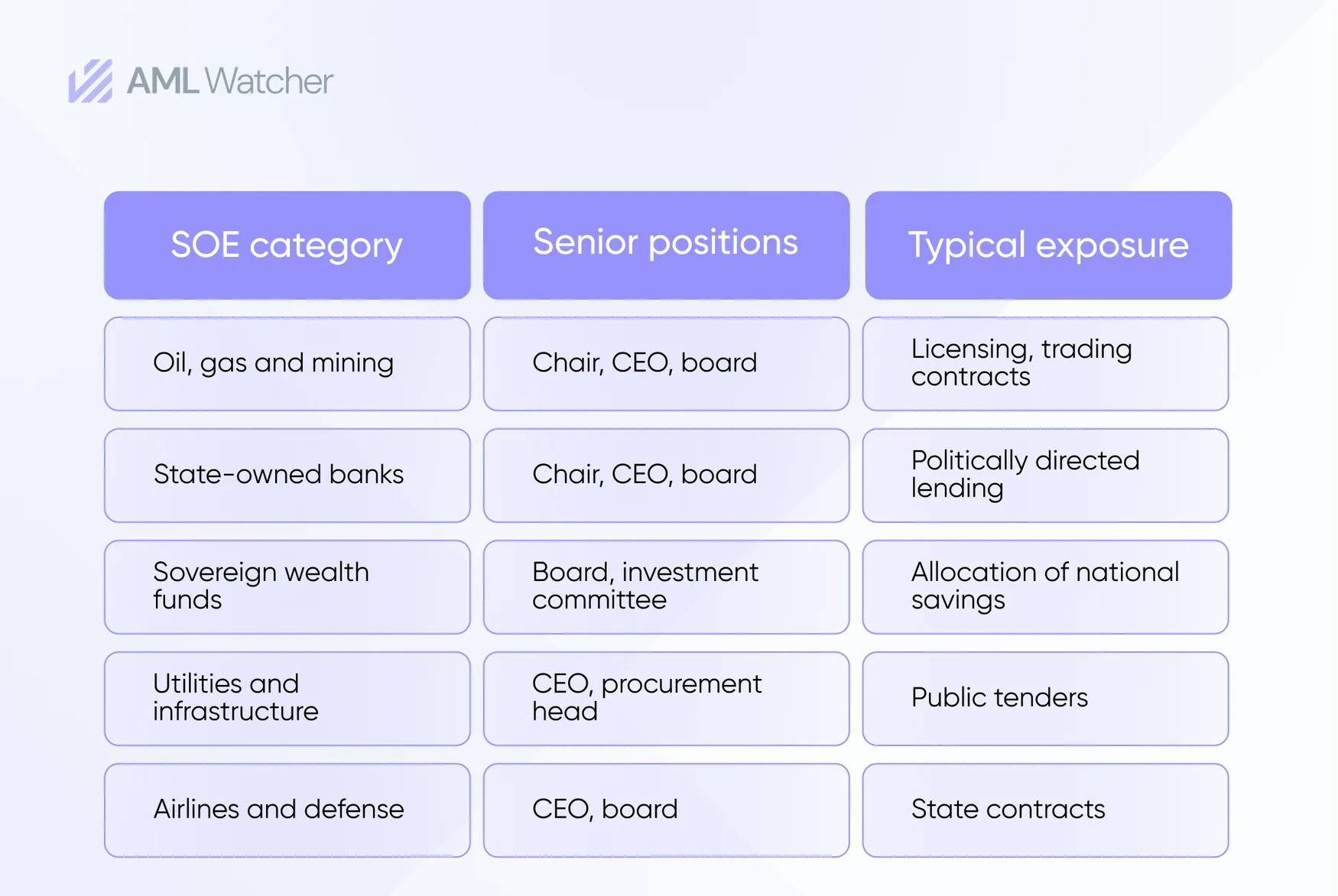
Most Politically Exposed Person (PEP) screening programs are designed to identify ministers, legislators and senior government officials. However, senior executives of state-owned enterprises (SOEs), such as national oil companies and state-owned banks, can receive less attention despite their influence over public assets, government contracts and national revenue.
The scale of state ownership makes this an important compliance consideration. According to OECD research, 126 of the world’s 500 largest companies by revenue were state-owned in 2023, compared with 34 in 2000. This highlights how state-linked businesses participate in major commercial activities, including sectors connected to public infrastructure, energy, and finance.
Are SOE Executives Considered Politically Exposed Persons (PEPs)?
Yes. Senior executives of state-owned corporations can qualify as politically exposed persons under the FATF framework because their positions involve prominent public functions. FATF includes senior executives of state-owned corporations in its examples of foreign and domestic PEPs. However, the definition does not extend automatically to every employee of a state-owned business.
FATF’s guidance on Recommendations 12 and 22 distinguishes between the individual holding a prominent public function and the organisation in which that individual works. An SOE is not itself a PEP. The definition generally excludes middle-ranking and more junior employees.
For foreign PEPs, financial institutions must apply the additional measures in Recommendation 12, including senior management approval, establishing the source of wealth and source of funds, and enhanced ongoing monitoring. For domestic PEPs and individuals entrusted with prominent functions by international organisations, these measures apply where the relationship presents a higher risk. Family members and close associates are also subject to the relevant PEP requirements.
The EU framework explicitly includes members of the administrative, management and supervisory bodies of state-owned enterprises within its PEP definition. Article 3(9) of Directive (EU) 2015/849 establishes this category. Regulation (EU) 2024/1624, which will generally apply from 10 July 2027, retains the SOE-related PEP concept while specifying the relevant conditions concerning state control and enterprise size. Financial institutions operating in the EU should therefore review their PEP classification procedures ahead of the transition.
What Are State-Owned Enterprises and Who Qualifies as a PEP?
State-owned enterprises are commercial entities in which the state holds an ownership interest or exercises control. The precise criteria vary between jurisdictions.
The UK case of Hajiyeva v National Crime Agency [2020] EWCA Civ 108 illustrates how state ownership can establish PEP exposure. The Court of Appeal upheld the finding that the former chairman of the International Bank of Azerbaijan qualified as a PEP because the Azerbaijani state held a controlling shareholding in the bank. His wife was also treated as a PEP through their family relationship.
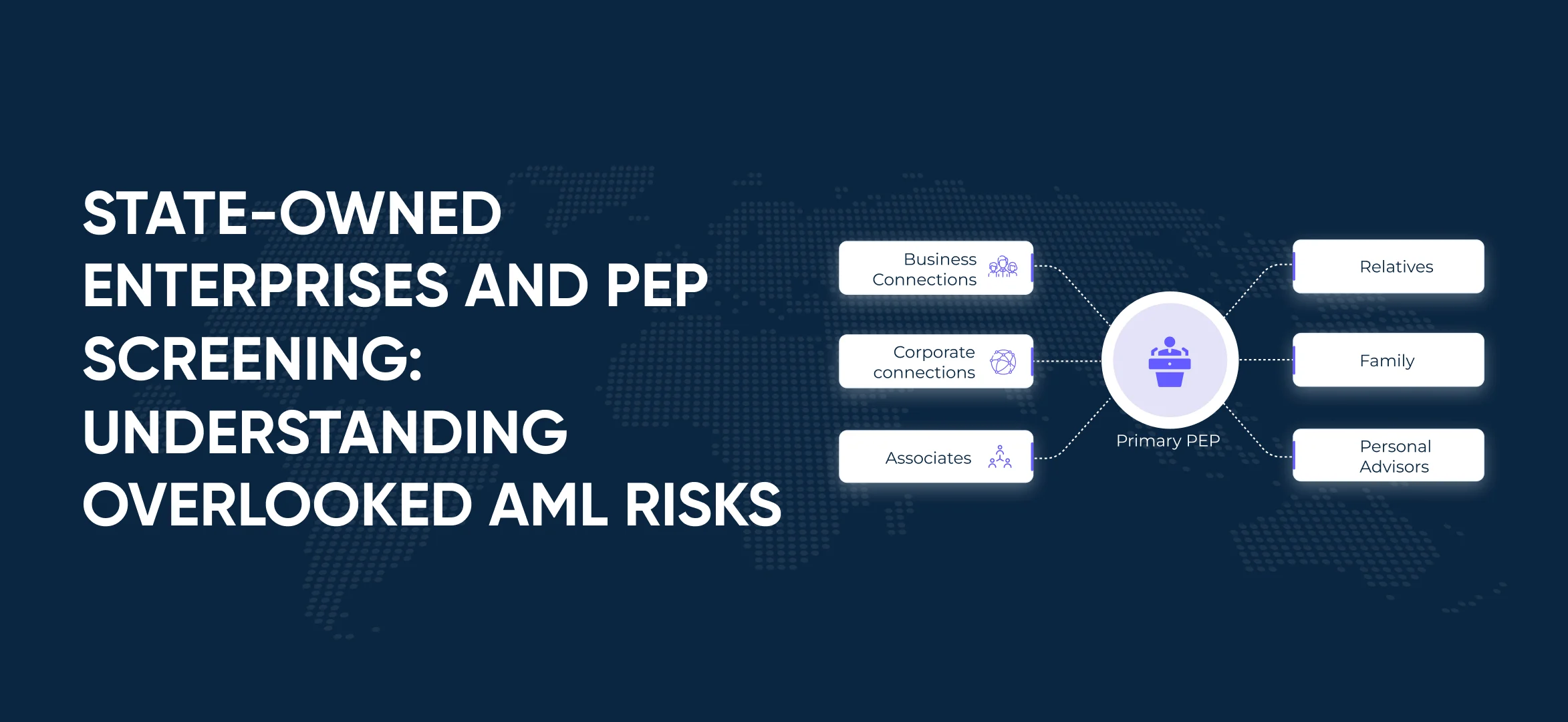
Relatives and close associates (RCAs) can create additional PEP exposure. For example, a company owned or controlled by a PEP’s close associate may receive contracts from an SOE in which the PEP holds a senior position.
Why SOE Ownership Creates Screening Difficulties for Banks
Government ownership can be difficult to identify because SOEs often operate through subsidiaries, joint ventures and holding companies. These structures can conceal indirect relationships between private businesses and state-controlled entities, making standard customer screening less effective.
SOE executives may also hold corporate titles rather than conventional political positions. Consequently, PEP databases with limited SOE coverage may overlook individuals whose appointments receive little public attention.
Regulatory differences create further challenges. UK HMRC guidance considers state ownership exceeding 50% or other forms of state control when identifying qualifying SOE management bodies. The EU AMLR applies specific criteria to SOEs and enterprises controlled by regional or local authorities, making jurisdiction-specific classification necessary.
PEP exposure can change through board appointments, privatisation or shifts in government ownership. Meanwhile, incomplete identifiers and inconsistent name spellings can generate false positives, increasing investigation workloads for compliance teams. Ongoing monitoring and accurate screening data help institutions address these risks.
Sanctions Compliance and SOE PEP Screening: Understanding the Connection
PEP exposure and sanctions exposure are separate compliance risks that can overlap in SOE-related relationships. State ownership does not automatically mean an enterprise is sanctioned. Financial institutions must therefore assess both risks independently.
Under OFAC’s 50 Percent Rule, an entity is blocked when one or more blocked persons own 50% or more of it, directly or indirectly, in aggregate. For example, a company owned 30% by one blocked person and 25% by another meets the threshold, even if it is not named on the SDN List.
However, state ownership or control alone does not automatically trigger blocking under this rule. An entity controlled by blocked persons but below the 50% ownership threshold may still face other sanctions restrictions. EU and UK frameworks apply their own ownership and control tests.
Financial institutions should trace ownership structures and assess relevant control relationships. PEP and sanctions screening should operate as complementary controls, supported by separate risk assessments and escalation procedures.
How Can Financial Institutions Strengthen SOE Compliance Through Effective PEP Screening?
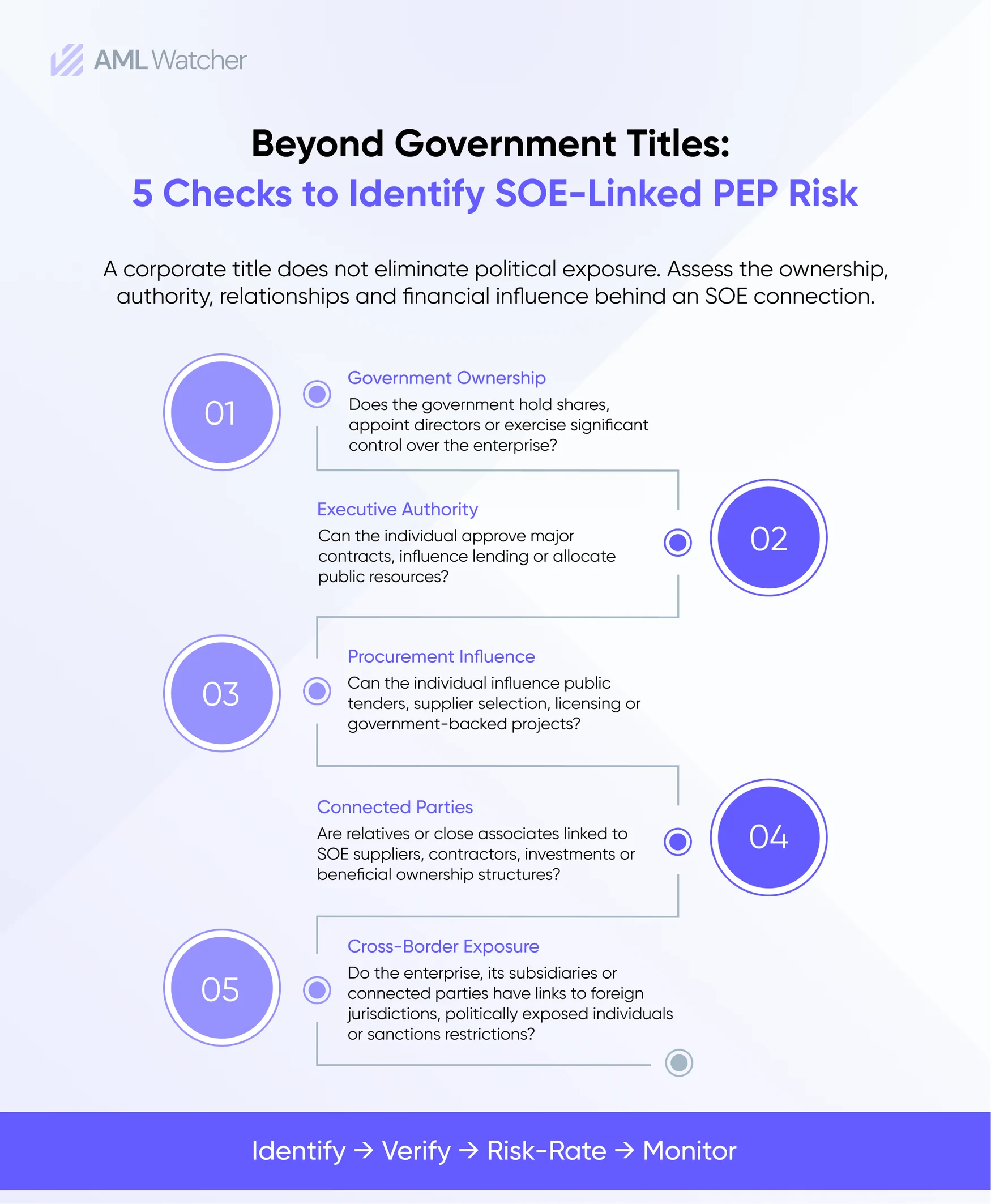
Effective SOE compliance requires a structured PEP screening framework that addresses ownership risks, identifies relevant public functions and supports risk-based due diligence. Six key controls can help financial institutions strengthen this approach.
- Define the scope of SOE exposure. Establish the applicable ownership and control criteria, and identify the senior positions that qualify under relevant PEP definitions.
- Use comprehensive PEP screening data. Select screening sources that cover senior executives of state-owned corporations, relevant management and supervisory bodies, domestic and foreign PEPs, and their family members and close associates.
- Apply appropriate enhanced due diligence. Assess source of wealth, source of funds, business purpose, expected transaction activity and the nature of the individual’s public function. The extent of EDD should reflect the applicable PEP requirements and the overall risk presented by the relationship.
- Assess sanctions and beneficial ownership exposure. Screen relevant individuals and entities against applicable sanctions lists, examine ownership and control structures, and identify ultimate beneficial owners (UBOs) behind corporate customers. This helps institutions identify indirect SOE relationships and entities that may be subject to sanctions restrictions.
- Maintain ongoing monitoring. Monitor changes in PEP status, senior appointments, government ownership, corporate control structures and sanctions designations. Reassess customer risk profiles when new information affects the original screening decision.
- Maintain an auditable decision trail. Record screening matches, verification steps, ownership research, risk assessments, EDD findings, escalation decisions and senior management approvals. These records help demonstrate how the institution identified and managed the relevant PEP and sanctions exposure.
SOE-related PEP screening should extend beyond customer onboarding. Changes in government ownership, board appointments, joint ventures and corporate control can alter a customer’s risk profile. Financial institutions should periodically test their screening procedures against these scenarios.
How AML Watcher Supports SOE-Related PEP Screening
AML Watcher’s PEP screening solution provides access to over 6 million PEP profiles, sourced from 100,000+ sources across 235+ countries and states. Its coverage includes senior SOE executives, local public officials, aliases, family members and close associates, helping compliance teams investigate broader PEP relationships.
AML Watcher also offers sanctions screening across 215+ global regimes, with data updates every 15 minutes, alongside adverse media screening. Its TruRisk AI agent supports alert investigations through explainable AI and automated L2 decision processes. A customer case study reports a 44% reduction in false positives, helping compliance teams reduce unnecessary manual reviews.
- No commitment needed
- Complete AML Database at your service
- Access our all-in-one dashboard


Tier-2 PSPs in ... must demonstrate automated monitoring, layered CDD, &...
See the Full Regulatory Expectation70–80% less manual work, 95% less fatigue, TruRisk Agent makes compliance effortless.
Experience Agentic AMLMove Beyond Articles. Activate AML Intelligence.
Switch to AML Watcher today and reduce your current AML cost by 50% - no questions asked.
- Find right product and pricing for your business
- Get your current solution provider audit & minimise your changeover risk
- Gain expert insights with quick response time to your queries