

 Alert!

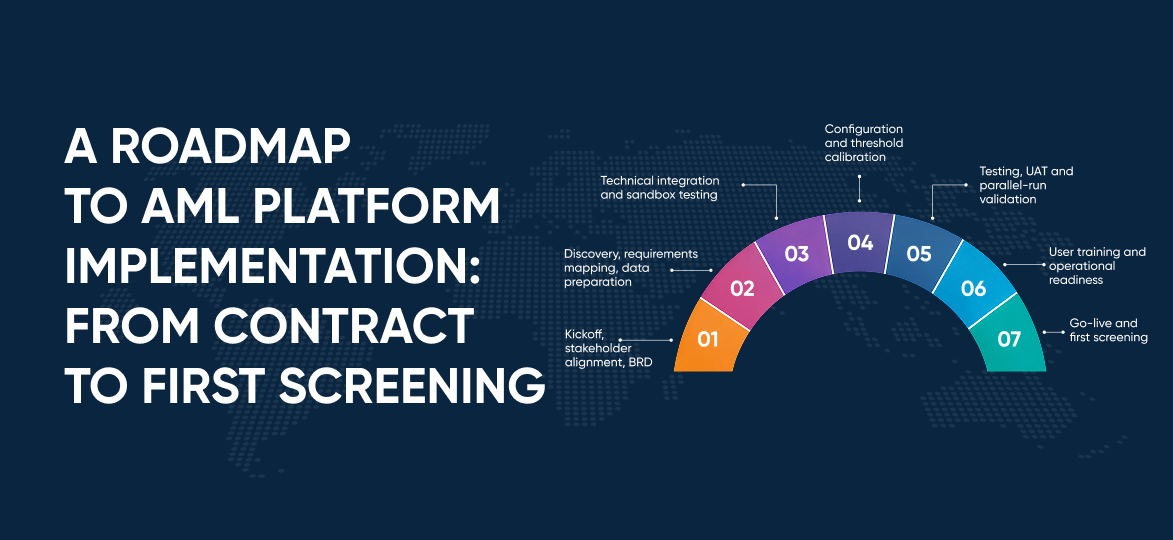
A Roadmap to AML Platform Implementation: From Contract to First Screening
Others
June 12, 2026


- Why AML Platform Implementation Projects Stall Before They Start
- Phase 2: Discovery, Requirements Mapping, and Data Preparation
- Phase 3: AML Software Integration
- Phase 4: Configuration With Threshold Tuning
- Phase 5: Testing, UAT, and Parallel-Run Validation
- Phase 6: User Training and Operational Readiness
- Phase 7: AML Platform Deployment and the First 30 Days
- Common Mistakes That Delay AML Platform Implementations
- How AML Watcher Accelerates Implementation Without Shortcutting Compliance

A Chief Compliance Officer signs an AML platform contract, expecting screening operations to be live within weeks. Three months later, onboarding teams are still dependent on manual reviews, sanctions alerts are processed outside the target workflow, and regulators are asking for evidence that new controls are operational. The vendor was selected, the budget was approved, yet the compliance objective remains unmet.
This is where many AML platform implementations encounter problems. Contract signing marks the beginning of operational execution, not the completion of the project. Delays usually stem from unclear ownership structures, poor data quality, connectivity issues across critical systems, and testing processes that uncover issues too late. Each missed milestone extends the period during which compliance teams operate without the controls they intended to deploy.
This AML implementation roadmap outlines every implementation phase, from contract signature to first live screening, helping compliance leaders move from procurement to a fully operational screening program with greater confidence and control.
Why AML Platform Implementation Projects Stall Before They Start
Most AML project implementation delays begin long before the first technical workshop takes place. The root cause is rarely the platform itself. More often, institutions enter implementation without clearly defined ownership, requirements, and success criteria.
A missing BRD, also known as Business Requirements Document, is one of the most common warning signs. Without clearly documented screening requirements, ownership responsibilities, escalation procedures, and reporting expectations, implementation teams spend valuable weeks resolving questions that should have been answered earlier.
Data preparedness remains another common obstacle. Incomplete customer records, varying formats, and undocumented data repositories frequently surface only after implementation begins, extending integration and testing timelines.
Regulatory obligations do not pause during implementation. Screening gaps, manual workarounds, and delayed control deployment leave institutions operating with temporary control weaknesses while projects remain unfinished.
The financial consequences are also important. Extended projects consume additional operational resources, delay efficiency gains, and create avoidable compliance costs.
Organizations that establish ownership, requirements, and data readiness before implementation begins typically reach go-live sooner, with fewer delays.
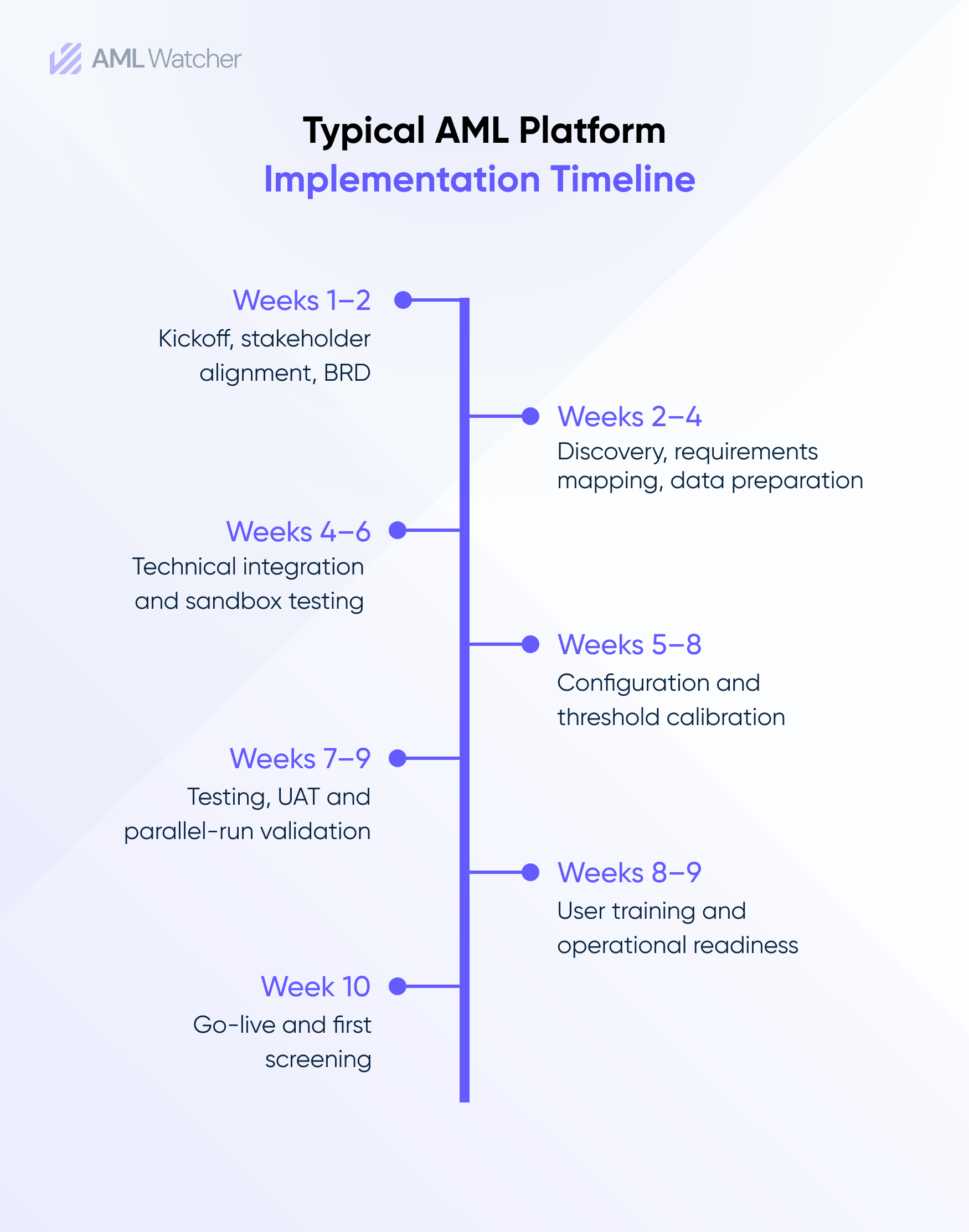
Weeks 1–2
The first action after signing is appointing a single internal implementation owner with authority across compliance, IT, and operations. Projects without a named owner drift; the vendor inherits a coordination problem that belongs inside the firm.
The kickoff call defines scope through the BRD: which customer types are screened, which regulatory lists go live on day one (OFAC SDN, UN Consolidated List, EU asset freeze lists, HMT financial sanctions), and which phase in later. Success teams should agree on clear success measures before configuration begins, what “working correctly” means, and who has sign-off authority at each milestone. Key participants: MLRO, compliance, risk, operations, IT, and a named vendor implementation specialist.
Deliverable: Signed BRD with named ownership, phased timeline, and defined go-live criteria.
Phase 2: Discovery, Requirements Mapping, and Data Preparation
Weeks 2–4
In this phase, the focus shifts to the two parallel workstreams that most AML vendor onboarding guides treat separately. Running them together saves two weeks.
Requirements mapping documents existing compliance processes: how customers enter the system, where sanctions screening fits within the AML onboarding process, what escalation procedures govern PEP hits, and what case management requirements apply. Regulatory obligations map to configuration inputs, FATF Recommendation 12 for PEP screening, FATF Recommendation 10 for Customer Due Diligence requirements, and jurisdiction-specific requirements for high-risk markets.
Data preparation determines screening accuracy before AML software implementation and integration activities begin. Individual records require full legal name, along with the date of birth, the nationality, and the country of residence. Business records require entity name, registration number, incorporation jurisdiction, and beneficial ownership structure. UBO identification is frequently where corporate screening most commonly fails. Resolve missing records, inconsistent name formats, and incomplete KYC data from legacy onboarding before integrating any system. The legacy system’s alert baseline must also be documented here for use in Phase 4 threshold calibration.
Deliverable: Documented implementation requirements and screening-ready customer datasets.
Phase 3: AML Software Integration
Weeks 4–6
Three integration models apply during AML software integration: API connectivity supporting real-time screening with automated triggers; batch screening for periodic rescreening within older technology environments (not suitable as the sole onboarding method); and hybrid approaches that allow multiple systems with different architectures to feed a single screening layer.
The most common technical delay is a field-level mismatch between source system schemas and the AML platform’s data model, not API configuration itself. Sandbox testing must use actual customer records volumes to surface these mismatches before production. Name matching configuration also begins here: fuzzy logic parameters, transliteration rules, and alias coverage determine false positive volume from day one. The security configuration operates concurrently, focusing on user role provisioning, implementing multi-factor authentication (MFA), logging audit trails, and ensuring compliance with local data storage regulations for regulated markets, such as the PDPL in Saudi Arabia and NESA in the UAE.
Deliverable: Documented information movement, security controls sign-off, and sandbox verification using actual data volumes.
Phase 4: Configuration With Threshold Tuning
Weeks 5–8
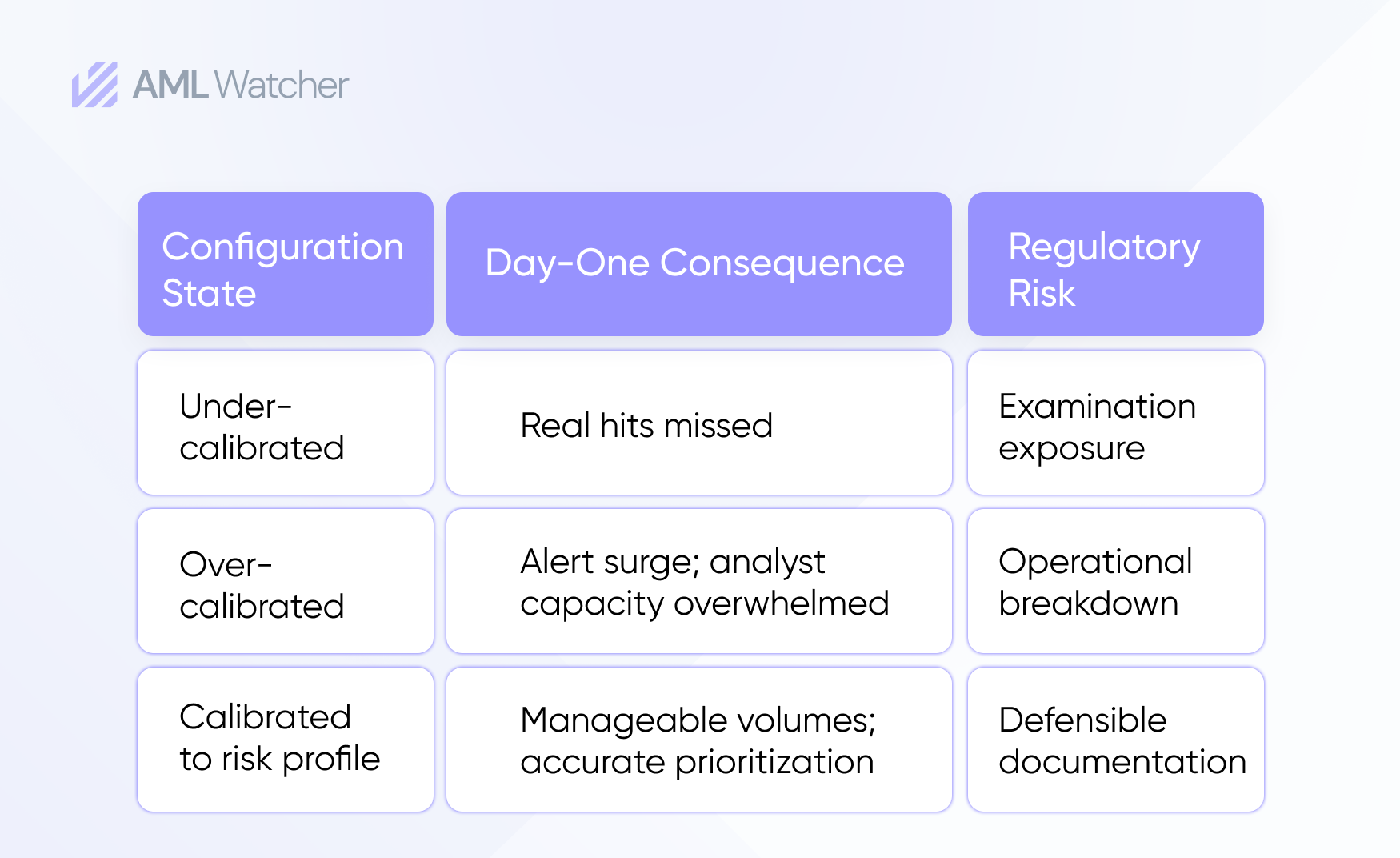
Threshold calibration is the most consequential configuration decision during AML platform implementation and AML platform deployment. Set too sensitive, and analysts face an alert surge on day one. Set too loose, and real matches are missed while regulatory exposure accumulates without visibility.
“A platform that goes live without calibrated thresholds does not reduce analyst workload; it replaces a manual screening problem with an automated false positive problem.”
Thresholds must be calibrated against the firm’s actual customer risk profile; high-volume retail onboarding requires different sensitivity settings than a private banking book or a correspondent financial relationship. High-risk country flags, industry-specific rules, and customer risk categories must be configured as distinct rule sets.
List coverage is finalized in this phase: watchlist screening covering sanctions lists, regulatory watchlists, law enforcement notices, and fugitive databases, adverse media screening with NLP-driven source coverage and sentiment thresholds; PEP databases covering all four FATF levels, including Relatives and Close Associates (RCAs). Escalation workflows, SLA timers, and investigation queues must be configured before User Acceptance Testing begins.
Phase 5: Testing, UAT, and Parallel-Run Validation
Weeks 7–9
Testing is a compliance obligation, not an IT formality. Sign-off from compliance and operations is required before go-live; IT sign-off alone does not establish that the screening program meets regulatory expectations.
There are three layers of testing involved. The technical testing confirms connectivity and evaluates system performance during times of peak volume. Screening accuracy testing uses real previously collected customer records, not sanitized batches, to assess actual match rates, false-positive volume, and false-negative detection rates. Parallel-run validation runs the new platform alongside the legacy system simultaneously, catching match logic failures that sandbox testing misses.
User Acceptance Testing (UAT) validates compliance workflows, escalation routing, investigation documentation, and reporting outputs. Every UAT finding must be logged; that record is what an examiner will request if a post-go-live match failure surfaces. UAT runs 2–4 weeks for API-first SaaS tools; 4–8 weeks when organizations deploy platforms that include case management modules.
Deliverable: Formal sign-off from compliance, operations, and IT, retained as audit evidence.
Phase 6: User Training and Operational Readiness
Weeks 8–9
A correctly configured platform run by undertrained analysts produces the same examination exposure as a misconfigured one. Training must be complete before go-live, not during the first 30 days when alert volumes peak.
Compliance analysts, operations teams, and administrators require role-specific training covering alert handling, the AML screening workflow, user management, and audit procedures.
Three documents must exist before go-live: screening SOPs with step-by-step alert handling instructions; escalation guidelines defining MLRO referral thresholds; and a governance framework documenting program ownership and configuration change approval. Senior management reporting on alert volumes and false positive rates must have a defined upward path before launch.
Deliverable: Signed-off SOPs, escalation operating procedures, and oversight documentation.
Phase 7: AML Platform Deployment and the First 30 Days
Week 10 onward
On launch day, it’s essential to follow a checklist to ensure everything runs smoothly. Start by confirming the connectivity across all connected systems. Next, verify that role provisioning is set up correctly for each analyst and administrator. After that, conduct a final review of data quality, and make sure the alert queue dashboards and SLA timers are up and running.
The first live screening sequence during AML screening implementation follows a defined path: customer data submitted, screened against configured watchlists, matches detected via fuzzy logic and transliteration, alerts generated with risk scores, routed to the correct investigation queue, and analyst disposition documented with rationale.
Alert volumes are highest in the first 30 days. Analyst capacity must be pre-allocated before launch. Alert disposition data from this window feeds back into threshold tuning. This is the calibration feedback process that turns the program from functional to defensible. Ongoing monitoring, alongside the testing and documentation requirements, applies from the first day the screening program becomes operational.
AML Screening API-first SaaS platforms significantly compress technical integration. Enterprise platforms with case management modules typically require 6–12 months for the same scope. Timeline variance is driven primarily by internal data readiness and organizational complexity.
Common Mistakes That Delay AML Platform Implementations
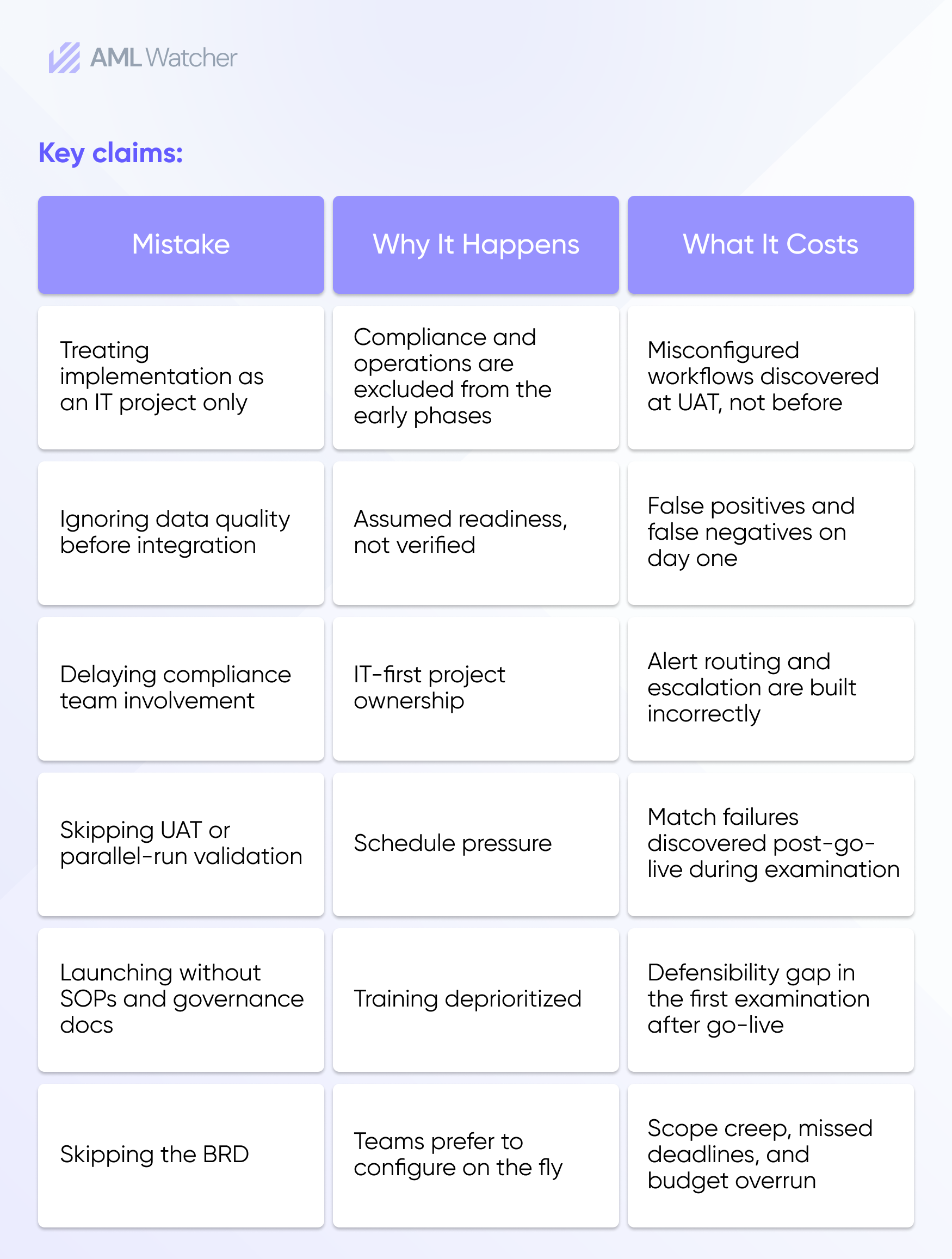
Most implementation delays originate from governance, planning, and ownership gaps that surface late in the delivery cycle.
How AML Watcher Accelerates Implementation Without Shortcutting Compliance
Many institutions reach the implementation stage with the right technology selection but struggle to turn that investment into a fully operational screening program. Delays in integration, poor threshold tuning, and fragmented screening coverage can extend implementation project schedules while increasing compliance risk.
AML Watcher’s API-first architecture connects to onboarding, core banking platforms, and payment infrastructure without extensive development, helping organizations accelerate deployment. Furthermore, the platform combines real-time screening, ongoing monitoring, sanctions screening, PEP screening, and adverse media monitoring within a unified compliance environment.
- No commitment needed
- Complete AML Database at your service
- Access our all-in-one dashboard


Tier-2 PSPs in ... must demonstrate automated monitoring, layered CDD, &...
See the Full Regulatory Expectation70–80% less manual work, 95% less fatigue, TruRisk Agent makes compliance effortless.
Experience Agentic AMLMove Beyond Articles. Activate AML Intelligence.
Switch to AML Watcher today and reduce your current AML cost by 50% - no questions asked.
- Find right product and pricing for your business
- Get your current solution provider audit & minimise your changeover risk
- Gain expert insights with quick response time to your queries