

 Alert!

Best AML Software Vendors for Banks, FinTechs, Crypto & MSBs in 2026
Anti Money Laundering
27, Aug 2026
July 14, 2026


- How We Compared the Best AML Software: Our Evaluation Criteria
- Top AML Software Solutions in 2026: Reviewed
- AML Watcher
- Which AML Software Is Best for Your Institution?
- How AML Software Is Priced (and How to Compare True Cost)
- What Makes a Good AML Provider Great in 2026
- AML Software Provider Evaluation Checklist
- Common Mistakes Buyers Make When Selecting AML Software
- Choosing Your AML Software Vendor

An AML screening platform that misses a designation can expose an institution to regulatory action. A platform that generates thousands of unnecessary alerts creates a different problem: investigators spend more time clearing false positives than reviewing genuine risks.
Selecting AML software, therefore, affects compliance quality, operational costs, and regulatory resilience simultaneously. Two platforms may screen the same sanctions lists yet deliver different outcomes because of differences in data quality, matching technology, update frequency, and alert handling.
With regulators expecting faster, more consistent financial crime controls, choosing the right AML software has become a long-term compliance decision rather than simply another software purchase.
This article compares the top AML software providers using six evaluation criteria. Actual pricing is listed where available, and reasonable ranges are provided where not. Vendors are grouped by the buyer type they genuinely serve.
How We Compared the Best AML Software: Our Evaluation Criteria
Our comparison framework was developed around the operational factors that compliance teams evaluate during AML software procurement. Instead of comparing marketing claims, we assessed each platform based on publicly documented capabilities, pricing transparency, deployment requirements, published AI functionality, screening coverage, and, where available, evidence supporting false-positive reduction.
- Data Coverage Depth: Sanctions regimes, watchlists, PEP levels, adverse media sources, jurisdictions, and languages.
- Accuracy and Handling of False-Positives: Matching technology, true-positive isolation, and, if reduction figures are published. This is the sole criterion for assessing operational viability at a 90% industry false-positive rate.
- Time to Deployment (Contract Signing to Live Screening): Near-instantaneous on API platforms to 18 months with enterprise suites.
- Pricing Transparency and Model: Published or quote-only pricing, per-check, tiered subscription, or enterprise licensing, together with what is included in the quoted price.
- AI Capability: Machine learning matching, explainable AI, agentic alert prioritization, and AI compliance workflow connectivity.
- Integration and Fit: API quality, batch screening, on-premises deployment option, and scale from startup to enterprise throughput.
Vendor reputation, funding, or customer logo counts were intentionally excluded from the evaluation. These factors do not necessarily indicate whether a platform fits a particular institution’s risk profile, operational requirements, or budget.
This comparison is based on publicly available pricing, vendor documentation, and third-party review platforms including G2, Capterra, and Gartner Peer Insights.
Top AML Software Solutions in 2026: Reviewed
The vendors are sorted by the buyer type that they serve. Best is always in terms of an institution’s size, risk mandate, and budget.
AML Watcher
Best Value for FinTechs and Growing Compliance Teams
Ideal for: SME fintechs, banks, crypto companies, MSBs, and regulated organizations seeking transparent pricing, fast deployment, and lower false-positive rates than many legacy AML platforms.
Overview:
AML Watcher is an API-first AML screening platform designed for fast-growing fintechs, banks, crypto businesses, MSBs, and other regulated organizations. It develops and maintains its own screening database covering sanctions, politically exposed persons (PEPs), adverse media, international leaks, special interest persons and entities, and crypto wallets. Maintaining data in-house provides greater control over update frequency, coverage quality, and the addition of new risk categories, without relying on external data providers. TruRisk applies explainable AI to support alert prioritization for each potential match, allowing analysts to review decisions more efficiently.
Strengths:
- The proprietary screening database covers more than 3,500 watchlists, 215 sanctions regimes, all four FATF PEP levels, more than 50,000 adverse media sources, international leaks, crypto wallet intelligence, RCAs, SIPs/SIEs, and selected disputed territories where compliance obligations may still apply. Because the data is maintained internally, updates are published approximately every 15 minutes.
- According to AML Watcher’s internal performance testing, TruRisk has demonstrated reductions in false positives and manual review effort while providing explainable reasoning for every match. Institutions evaluating these claims should request the underlying methodology during product demonstrations.
- Bundled screening: watchlist, PEP, and adverse media under one price. No per-type charges. Crypto wallet screening covers more than 415 risk categories. An MCP server links the database directly to the AI agents and compliance systems.
- Transparent tiered price structure, including a Free Trial (25 searches). Per-entity cost decreases as volume scales.
Limitations:
- Identity verification is not bundled; IDV is handled separately.
- Unused monthly credits will not carry over to the following month, and volume planning is key to cost efficiency.
- Minimum plan starts at 100 monitored entities.
Pricing:
- Transparent tiered pricing with bundled sanctions, PEP, and adverse media screening. Per-entity costs decrease with volume.
Deployment:
- API supports near-immediate live screening. On-premises deployment available for data residency requirements.
NICE Actimize
Designed primarily for Tier-1 banks and multinational financial institutions requiring enterprise-scale AML and fraud management. Deployments typically involve extensive implementation, dedicated IT resources, and custom pricing suited to large compliance programs.
LSEG World-Check
A long-established screening database used by many global financial institutions for sanctions, PEP, and adverse media screening. Pricing is available upon request, and deployment depends on implementation requirements and the integration approach.
Dow Jones Risk & Compliance
Provides sanctions, adverse media, and risk intelligence datasets used across regulated industries. Organizations generally obtain pricing through direct engagement, with implementation varying according to deployment and workflow requirements.
LexisNexis Risk Solutions (AML Insight / RiskNarrative)
Offers screening data alongside workflow orchestration for customer onboarding and compliance. The platform is commonly used by mid-to-large regulated organizations, with pricing and deployment determined through enterprise quotation processes.
ComplyAdvantage
Designed for fintechs and regulated businesses seeking API-based AML screening and monitoring. Publicly reported entry-level pricing is available, while larger deployments typically transition to usage-based or enterprise commercial models.
iDenfy
iDenfy combines identity verification with sanctions, PEP, watchlist, and adverse media screening for fintechs and regulated businesses. Its API/SDK supports fast deployment, with public pricing available alongside AML screening services.
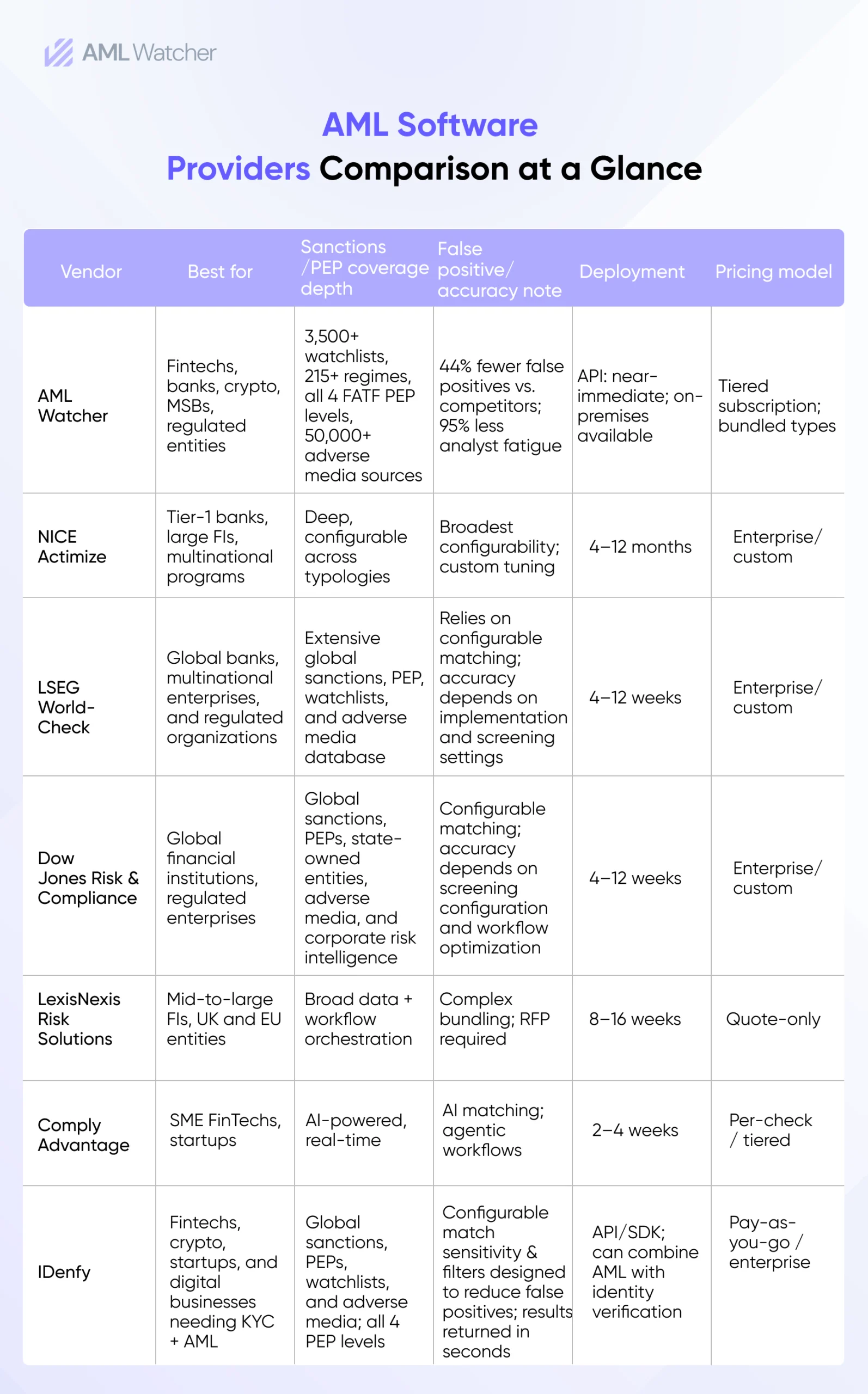
The comparison table is intended as a starting point rather than a definitive ranking. Institutions should compare vendors based on size, risk profile, deployment requirements, and budget, as no single platform is the best fit for every organization.
Which AML Software Is Best for Your Institution?
Instead of comparing every platform against the same benchmark, institutions should shortlist vendors based on their regulatory obligations, transaction volume, deployment requirements, and available compliance resources.
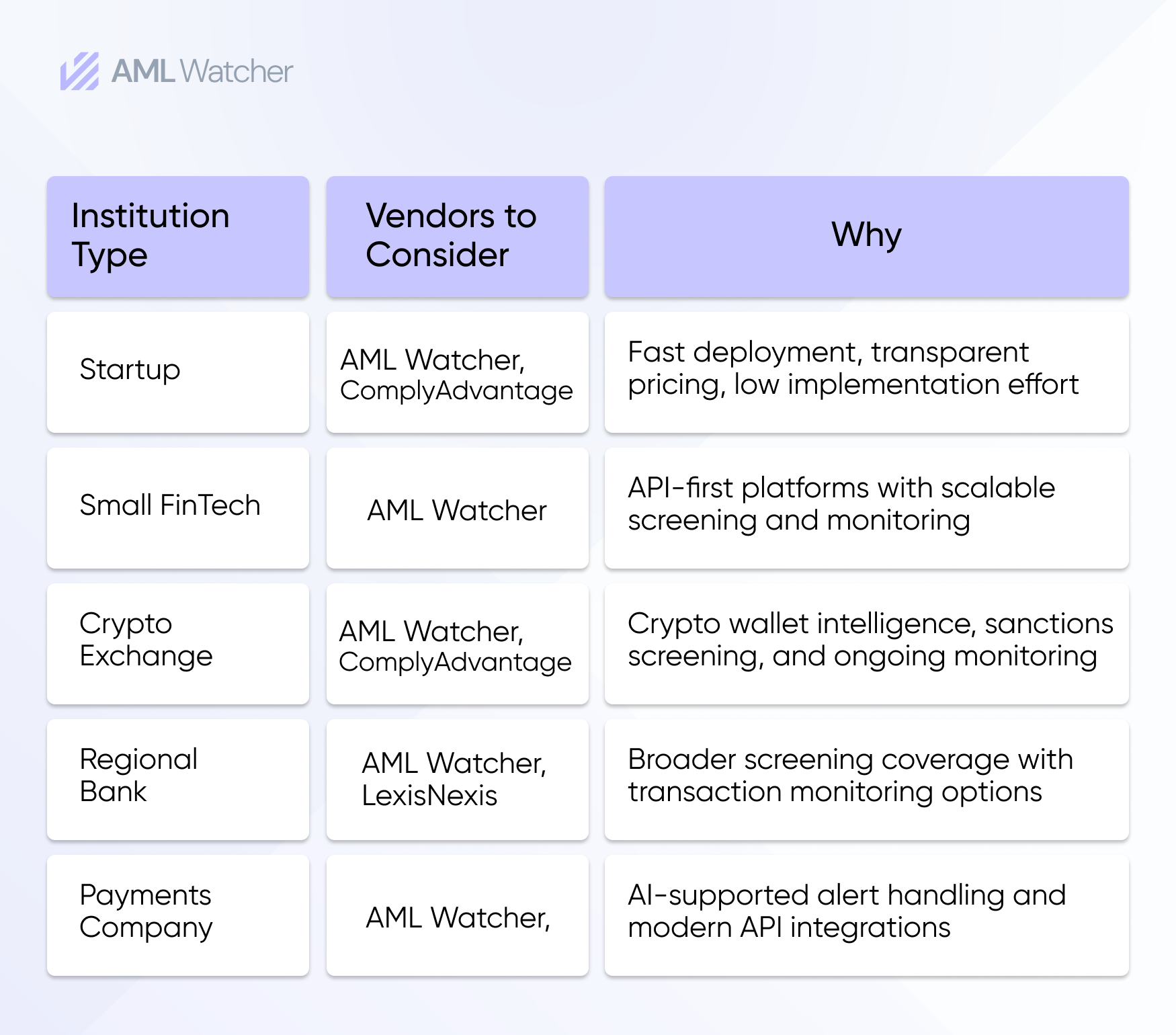
How AML Software Is Priced (and How to Compare True Cost)
Three pricing models dominate the market. Per-check / per-name: charge for each name/entity screened in the check, often seen at legacy providers, can be costly at volume. Tiered subscription: a monthly or yearly fee for a specific entity volume, typical with AML Watcher, ComplyAdvantage, and Sumsub.Enterprise licensing involves an annual fee regardless of volume; typical of NICE Actimize, SAS, and Oracle; high upfront, low unit cost at scale.
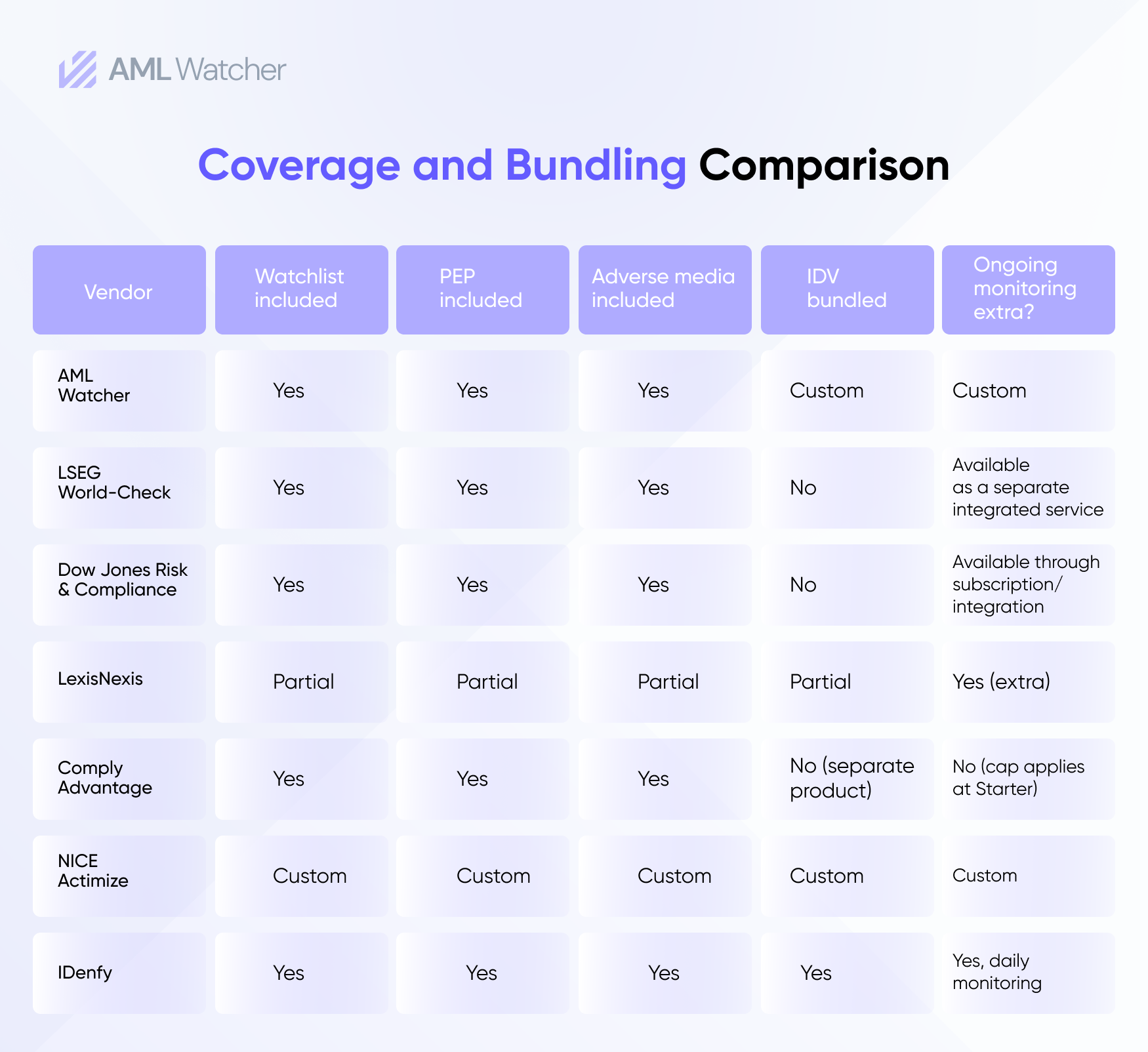
Hidden-cost traps buyers fall for: separate ongoing monitoring costs in addition to screening costs; separate identity verification fees (~$1.05–$1.50/entity) at market rates; watchlist, PEP, and adverse media charges per type, making a bundled offering much cheaper for the same coverage.
Institutions should compare total cost of ownership rather than just subscription fees. The advertised license fee rarely reflects the full cost of operating an AML platform, as implementation, integration, ongoing monitoring, identity verification, additional screening modules and datasets, and the operational effort required to investigate alerts can have a significantly greater long-term financial impact than the headline price.
What Makes a Good AML Provider Great in 2026
1. Beyond Traditional Rules: How AI Is Changing AML Screening
The downside of rule-based monitoring is that it has a hard limit: each new typology must be coded by an engineer in a new rule. AI-native platforms can identify previously unseen patterns and risk indicators. However, “AI” is not monolithic; simple ML scoring based on current rules is very different from a true agentic workflow that reasons about a match and provides an auditable rationale for each decision. Request documented evidence before accepting any “AI-powered” claim at face value.
2. Explainable AI Matters More Than AI Alone
As financial institutions adopt AI within compliance workflows, regulators increasingly expect decisions to be transparent and auditable. Frameworks such as the EU AI Act reinforce the importance of explaining how automated systems reach conclusions, particularly when those decisions influence customer risk assessments or investigations.
3. Faster Data Updates Mean Lower Compliance Risk
New sanctions designations can be issued at any time. The OFAC SDN list can change in hours. The difference between a vendor’s update cycle and real-world sanctions updates is actual financial crime exposure. Institutions should verify how frequently shortlisted vendors update sanctions and risk data, particularly when evaluating rapidly changing sanctions programs.
4. Coverage Means Little Without Accuracy
Screening coverage alone does not determine operational efficiency. Compliance teams should also evaluate how vendors measure and validate the reduction of false positives. When evaluating vendors, compliance teams should ask how false-positive reduction is measured and whether the published figures are supported by documented testing.
5. Why the Source of AML Data Matters
Vendors that maintain proprietary datasets have greater control over data quality, update frequency, and coverage decisions than providers relying primarily on third-party data. Vendors maintaining proprietary databases control data quality, update frequency, and coverage decisions directly. The implications are most significant at the edges: when you cover contested regions, when you choose to cover PEP Level 4 local officials, and when you choose to cover SIP/SIE data.
AML Software Provider Evaluation Checklist
Questions to Ask
Product demonstrations often focus on interface design and feature lists. However, procurement teams should validate how a platform performs under real compliance conditions before making a purchasing decision.
- How often are sanctions, PEP, and adverse media datasets updated?
- Are sanctions, PEP screening, and adverse media included in one subscription or priced separately?
- How is false positive reduction measured, and can the vendor provide supporting evidence?
- Does the platform explain why a match was generated, or only assign a risk score?
- What implementation resources are required from the institution?
- How long does deployment typically take for an institution of similar size?
- Can historical customer records be screened during implementation?
- Is an API available together with batch screening options?
- Can compliance teams test the platform using their own customer data before signing a contract?
- What additional costs apply for ongoing monitoring, identity verification, or implementation services?
Red Flags to Watch For
A polished product demonstration does not always reflect day-to-day compliance performance. Procurement teams should watch for indicators that may increase operational costs after deployment.
- The vendor cannot explain how matching decisions are made.
- False positive reduction claims are presented without supporting methodology.
- The data update frequency is described vaguely rather than documented in a schedule.
- Pricing separates sanctions, PEP screening, or adverse media into additional paid modules.
- A proof-of-concept or pilot using the institution’s own data is not available.
- Implementation timelines are not clearly defined.
- AI capabilities are described in general terms without demonstrating explainability or auditability.
- Customer support, implementation, and training costs are only discussed after commercial negotiations begin.
Common Mistakes Buyers Make When Selecting AML Software
Selecting an AML platform is a long-term operational decision. Procurement teams often focus on feature lists while overlooking factors that have a greater impact on compliance efficiency and total cost.
- Choosing a Platform Based only on Sanctions Coverage: Screening quality depends on data freshness, matching accuracy, and coverage depth rather than the number of watchlists alone.
- Ignoring False Positives: High alert volumes increase investigation costs and make genuine high-risk matches harder to identify.
- Comparing License Fees rather than Total Cost of Ownership: Implementation, ongoing monitoring, identity verification, and additional datasets often account for a substantial portion of long-term costs.
- Underestimating Deployment Timelines: Enterprise implementations can take several months, affecting compliance projects and regulatory deadlines.
- Accepting AI Claims Without Requesting Evidence: Institutions should ask vendors how their AI models reach decisions, whether their outputs are explainable, and what testing supports their published performance claims.
Choosing Your AML Software Vendor
Selecting AML software involves more than comparing features or pricing. The right platform should deliver high-quality screening data, reduce false positives, support evolving regulatory requirements, and scale with your compliance program. Before making a decision, validate each solution using your own customer data to measure screening accuracy, match quality, and operational efficiency in real-world scenarios.
See how AML Watcher performs with your own data. Request a personalized demo or start with 10 free AML searches to evaluate sanctions, PEP, and adverse media screening before committing to a solution.
Frequently Asked Questions
- AML Watcher: 2-4 weeks
- Flagright: 4-8 weeks
- LexisNexis: 6-12 weeks
- NICE Actimize, SAS AML, Oracle FCCM: 6–18 months
- No commitment needed
- Complete AML Database at your service
- Access our all-in-one dashboard


Tier-2 PSPs in ... must demonstrate automated monitoring, layered CDD, &...
See the Full Regulatory Expectation70–80% less manual work, 95% less fatigue, TruRisk Agent makes compliance effortless.
Experience Agentic AMLMove Beyond Articles. Activate AML Intelligence.
Switch to AML Watcher today and reduce your current AML cost by 50% - no questions asked.
- Find right product and pricing for your business
- Get your current solution provider audit & minimise your changeover risk
- Gain expert insights with quick response time to your queries