Alert!


Crypto Travel Compliance Guidelines in Australia
No category assigned
February 17, 2026


- Who is responsible for regulating Cryptocurrency in Australia and What are the main regulations?
- Crypto Travel Rule in Australia
- Circumstances Under Which the Travel Rule Does not Apply
- How to Transition to the New Travel Rule Standards?
- What Crypto Firms need to do for Travel Rule Compliance
- How AML Watcher ensures Comprehensive Compliance to Crypto Travel-Rule within Australia
- FAQ
- Is Cryptocurrency Legal in Australia?

The regulatory deadline of the crypto travel rule for crypto firms and VASPS is fast approaching for Australia (1st July 2026). The question is, are the crypto firms prepared to meet all the new anti-money laundering and counter-terrorim financing (AML/CTF) obligations?
In Australia since early 2025 the number of users that have emerged to own cryptocurrency has surged and will continue to do so with growing regulatory clarity. A recent report by the Independent Reserve Cryptocurrency Index showed that 31% of Australians own or have owned cryptocurrency. This highlights the increasing and conventional adoption of digital assets worldwide.
However, the pace of the adoption of digital assets has effectively surpassed the growth and development of the relevant and necessary regulatory frameworks within the country. As a result, the Australian government has strictly prioritized drafting and curating effective and long-term regulations.
Who is responsible for regulating Cryptocurrency in Australia and What are the main regulations?
The major player that is actively engaged with regulating cryptocurrency in Australia is AUSTRAC the financial intelligence watchdog. It maintains an oversight on digital currency exchanges however, it focuses majorly on fiat to crypto conversion.
AUSTRAC is also responsible for regulating Digital Currency Exchange Providers (DCEs) under the Anti-Money Laundering and the Counter Terrorism Financing Act of 2006. The enrollment of VASPS will open from 31st March 2026.
Cryptocurrency exchanges in Australia are regulated by the Anti-Money Laundering and Terrorism Financing Act of 2006. For all cryptocurrency related regulations, they are determined at a federal level in Australia, which means that all obligations must remain uniform across all states and territories that come within Australia.
Along with crypto-to-fiat exchanges the new changes are to be applied on crypto-to-crypto exchange platforms, transferring virtual assets on behalf of customers
Crypto Travel Rule in Australia
FATF’s travel rule plays a significant role in combating money laundering and terrorist financing. The main objective behind its implementation was to empower VASPs and financial institutions to prevent money launderers and criminals from using wire transfers including those involving virtual assets to transfer funds.
As part of its wider reform program Australia has extended AML/CFT obligations to additional virtual assets services. It modernizes the country’s AML/CTF framework and closely aligns it with FATF recommendations 15 and 16.
Overview of the Institutions Involved and their Roles
1. Ordering Institution
An ordering institution follows the instruction given to it which is to transfer value from its customer who is the payer. It is also important to note that the payer and the payee can be the same person.
2. Intermediary Institution
The intermediary institution is the mid-way between the ordering institution and the beneficiary institution. It receives the transfer message from the ordering institution and passes it on to the beneficiary institution. There is no direct link between the intermediary institution with the payer or the payee. Not all value transfers involve intermediary institutions.
3. Beneficiary Institution
A beneficiary institution is the recipient of the transfer message and it also provides transferred value to the payee. It is likely for the payer and payee to be the same.
What sort of Information is required in a Transfer Message?
A transfer message travels along with the transfer of value. This message typically includes the following:
- The payer’s information
- The payee’s full name
- Tracing information
- Card details (where applicable)
Circumstances Under Which the Travel Rule Does not Apply
There are certain circumstances where the travel rule obligation does not apply.
- Certain Incidental Value Transfer Especially when Providing Another Service
- Local Value Transfers within a single overseas country or within the EEA (in the context of foreign branches or subsidiaries)
- Administrative Payroll Payments
- Securities and Derivatives (where virtual assets or not involved)
- Any transfer of value between financial institutions
- Card-based Merchant Payments
- Any cheques drawn on the ordering institution
- Self-hosted virtual asset wallets
How to Transition to the New Travel Rule Standards?
In June 2025 the Financial Action Task Force updated its Recommendation 16 to standardise the information required for travel rules, including removing the need for verified birthplace information. Since global transition to the revised recommendation 16 will complete by 2030, during that period some companies may have already shifted to the new format, therefore, incoming information on that format should not be treated as missing.
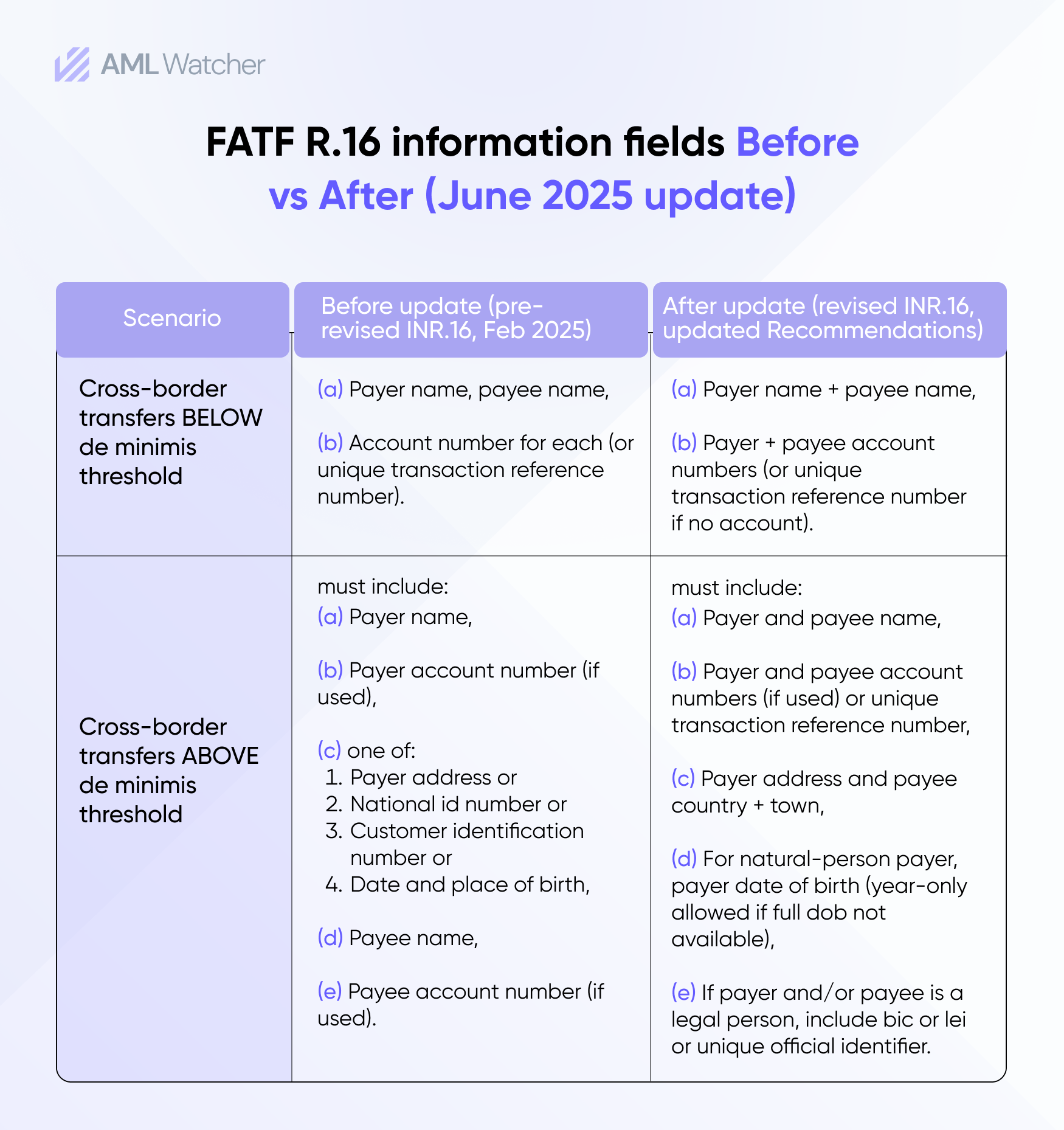
AUSTRAC mentions that in order to fulfill their travel rule obligations VASPs could utilize payer information and the payee’s full name. However, whichever approach they use, should be used consistently.
What Crypto Firms need to do for Travel Rule Compliance
In order to meet the terms of any new laws it is essential upon providers to update their internal procedures and technical infrastructure, similar is the case with the travel rule in Australia.
Registrations with AUSTRAC
Crypto businesses except fiat exchanges are mandated to register with AUSTRAC. This includes custodian wallet services, token issuing platforms and all other services that come under the designated VASPS criteria.
Adherence to AML/CFT Obligations
Apart from travel rule obligations VASPs are obliged to maintain compliance with other AML/CFT requirements, for example customer due diligence, record keeping and SAR reporting.
For VASPs it’s necessary to assess the risk of their customer which may require adverse media and PEP screening. Another key requirement is compliance with sanctions related restriction which will require screening payer and payee details against sanctions lists before initiating or accepting transfers of funds or virtual assets. Moreover, rules require that VASPs retain travel rule information for a period of 7 years.
Travel Rule Policies
It is imperative upon businesses to curate such policies that result in determining how they handle collection of travel rule information, how they deal with missing travel data, and how they manage and mitigate ML/TF risks. VASPS must ensure to assess these situations and have the necessary controls in place to mitigate these risks.
Availability for Swift Technical Solutions
In order to practically implement travel rule obligations, VASPs require technological solutions which enable secure transfer of standardized travel rule information. Once the volume increases, sharing data manually does not remain reliable.
Technology must also integrate sanctions screening, PEP checks, and transaction monitoring into the transfer workflow. Real-time screening of payer and payee information, automated exception handling for incomplete payloads, and audit-ready record retention mechanisms enable firms to demonstrate compliance during supervisory reviews.

How AML Watcher ensures Comprehensive Compliance to Crypto Travel-Rule within Australia
Crypto firms in Australia are expected to comply with tight data transmission obligations under AUSTRAC’s crypto travel rule. Manually transmitting data, missing sanctions screening, and inconsistent formatting can result in compliance gaps.
AML Watcher uses FATF compliant data fields and region-specific settings for secure transfer of travel rule information and compliance with AUSTRAC’s rules and ever evolving standards of FATF.
The platform adopts secure messaging protocols that protect sensitive data. It also automatically detects any incoming transactions with inconsistent or missing travel rule information.
Its comprehensive coverage ensures compliance with sanction regulations by pre-screening payer and beneficiary details pinned to the transaction for travel rule compliance.
FAQ
Is Cryptocurrency Legal in Australia?
Yes, cryptocurrency is legal in Australia. People are liable to utilize the freedom of buying, selling, storing or spending cryptocurrencies within the country but Australian businesses are not obliged to accept them.
Move Beyond Articles. Activate AML Intelligence.
Switch to AML Watcher today and reduce your current AML cost by 50% - no questions asked.
- Find right product and pricing for your business
- Get your current solution provider audit & minimise your changeover risk
- Gain expert insights with quick response time to your queries