

 Alert!

goAML and FIU Reporting Explained
Others
January 2, 2026


The global financial system has endured the Great Depression of 1929, the global recession of 2008 and numerous other financial upheavals, yet it has remained resilient and stood firm in the face of these daunting challenges. The issues confronted by the modern-day global financial system, however, are different, largely driven by technological evolution.
The way money moves across the global financial system has also transformed dramatically. What was once limited to cash and paper trails, is now driven by instant payments, digital platforms and complex cross-border networks. While this transformation is undoubtedly efficient and inclusive, it has also opened new avenues for financial crime, making money-laundering and other illicit finance more sophisticated and harder to detect.
We live in a world where, if not always, then most of the time solutions to problems come to light eventually when collaborative efforts generate fruitful/impactful results. One such result of a collaborative effort is that of goAML.
At the same time, financial institutions face significant challenges in reporting through systems like goAML including compromised data quality, technical and systemic difficulties, interpretations uncertainty and increased resource demands. This blog discusses the operational challenges associated with high-volume SAR and STR reporting.
The United Nations Office on Drugs and Crime (UNODC)’s program Software Products for Member States (SPMS) develops and maintains softwares that help member states fight against money laundering, terrorist financing and other organized crimes.
One such software is goAML, developed under SPMS by the information technology unit (ITU) of the UNODC in collaboration with UNODC Global Programme Against Money Laundering. As of December 2025, more than seventy member states are users of goAML while many are expected to join soon, reports United Nations goAML page.
What is goAML? Understanding the Backbone of AML Reporting Systems
goAML system is a software solution that has been developed in a manner to incorporate a set of processes and analyze reports about potential suspicious transactions and to classify financial transactions of any kind.
-
Central Point for AML Reporting
goAML acts as a single gateway through which banks, financial institutions submit SARs. The standardization of the submitted reports ensures consistency and regulatory alignment, a basic and foundational requirement of any AML framework.
-
Turns Reports into Financial Intelligence
It is important to understand that AML reporting is not just about collecting data, making sense of it is equally important. goAML enables FIUs and other relevant institutions to analyze large volumes of reports, identify patterns and identify illicit activities.
-
Supports Risk-Based AML frameworks
goAML allows to assess trends and emerging risks since it is designed to support FIUs in collecting, processing, and analyzing AML reports, including strategic/tactical analysis tools and statistical reporting.
By enabling FIUs to aggregate reporting data and run rule-based analysis, risk-scoring, profiling and trend reporting, goAML can support a more risk-based use of SAR/STR information aligned with FATF’s emphasis on risk assessment and risk-based implementation. All relevant authorities apply a risk based approach as required by the standards set by FATF.
This makes AML reporting more dynamic, diverse and responsive rather than it being purely procedural.
-
Strengthens Information Sharing
Suppose goAML has identified one suspicious activity, it will ensure the secure spread of intelligence to law enforcement agencies and regulators. This ability to share critical information efficiently is a specialty found specifically in goAML.
How FIUs Process Suspicious Activity Reports (SARs) Using goAML
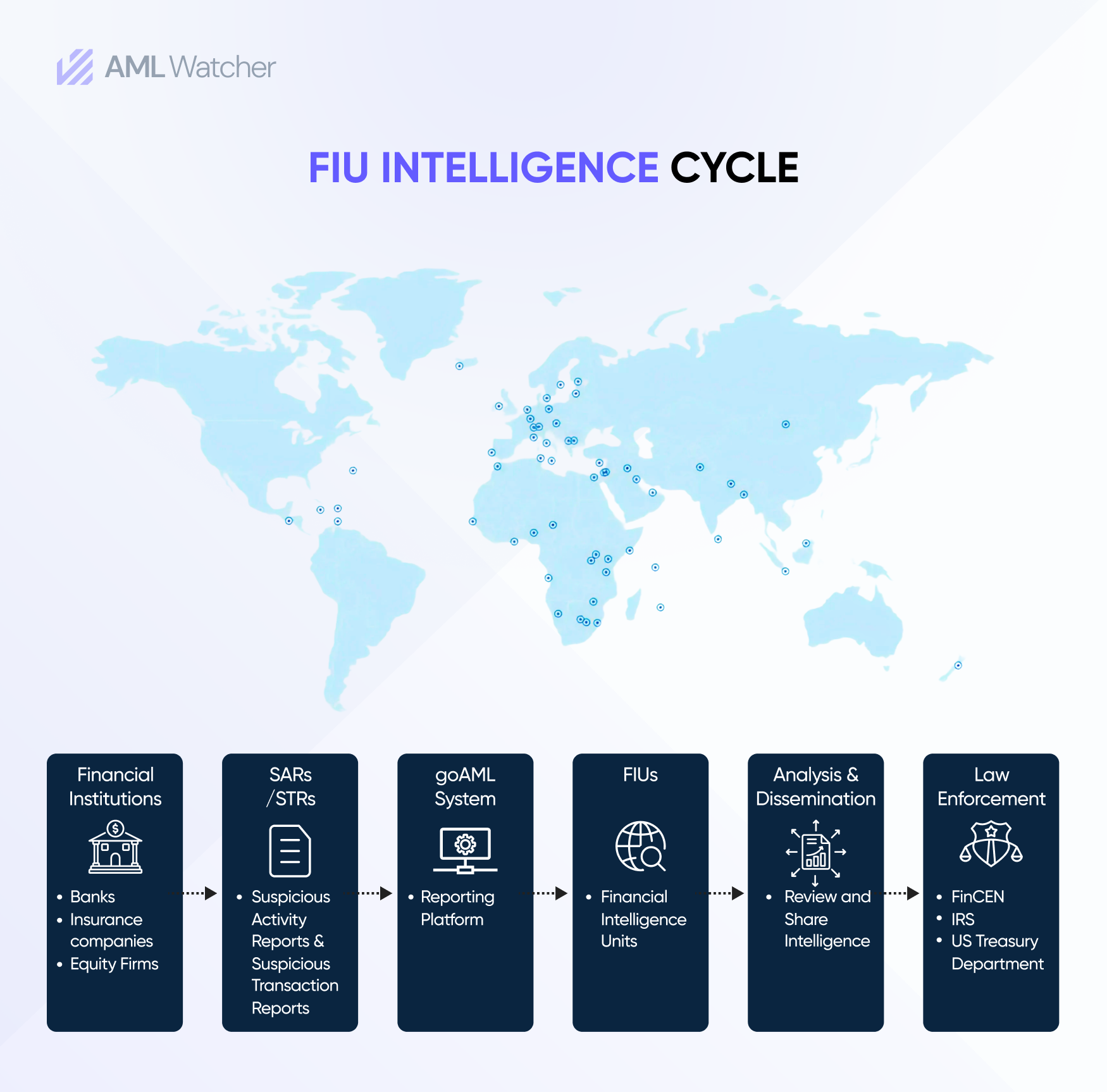
goAML has emerged as a safe haven for Financial intelligence Units (FIUs) since it gives them a centralized, secure and analytical system to turn raw reports into actionable and resourceful financial intelligence.
According to the United Nations more than seventy member states are users of goAML. The main consumers of it are FIUs, this is because the special features of goAML enables them to collect Suspicious Activity Reports ( SARs), Suspicious Transaction Reports (STRs), and Currency Transaction Reports (CTRs). Those features are as follows
-
Data Intake
The data collection component of goAML provides a secure channel for reporting entities and submitting reports to the FIUs. The reports submitted include detailed information on transactions, customers and related data. This part is relatively essential because structured and accurate data allows authorities and reporting entities to detect, analyze and report suspicious activities.
According to UNODC the suggested reporting format is:
- Cash Transaction Reports (CTRs)
- Suspicious Transaction Reports (STRs) or Suspicious Activity Reports (SARs)
- Electronic Funds Transfer Reports (EFTs)
-
Intelligence Analysis
goAML performs intelligence-led and operational analysis to support FIUs. It does not trump human judgment however, it augments it. It uncovers patterns, identifies links between persons, transactions and/or anomalies. While the risk-assessment and profiling is conducted by FIU analysts, goAML is the tool to help them consolidate and streamline that data.
-
Information Dissemination
This third part of the process compliments as well as completes the FIU intelligence cycle. The effectiveness of FIUs depends on their ability to pass relevant information to those who can act on with powers.
The exchange of data is between the FIU and the intelligence agencies or juridical authorities as well as between FIUs (through Egmont Secure Web) and regional institutions. By enabling secure and timely sharing of intelligence goAML ensures compliance with FATF requirements on domestic and international cooperation.
Common SARs Reporting Challenges via goAML System
While the goAML system is an emerging champion software, it is yet to overcome certain challenges that have been reported by multiple FIUs. Mainly, technical, operational and regulatory factors sometimes become a nuisance for financial institutions.
-
Compromised Data Quality
Standardization issues where there are variations in spellings, formats or codes can cause delays and system validation errors.
-
Technical and Systemic Challenges
The platform can be complex for some reporting entities. XML is goAML’s file-based interface. Institutions are required to submit bulk reports via XML files following goAML’s data schema. Even small mistakes like mistakes in field names, data types or structures can cause file rejections altogether.
-
Regulatory Interpretation Uncertainty
The determination of what exactly is suspicious is oftentimes confusing. This is because the threshold for filing an STR may be unclear especially for borderline cases.
-
Demands Resources
The development and maintenance of XML submissions requires dedicated staff, IT resources and ongoing monitoring. If there are high transaction volumes then it leads to an increase in the workload thus, amplifying the possibility for errors.
How AML Watcher’s Integrated Transaction Watcher Support goAML Reporting
High-volume SAR and STR reporting through goAML can slow down when alert queues are noisy, transaction narratives lack context, and XML submissions require repeated corrections. These reporting frictions increase review workload and make timelines harder to manage.
- No commitment needed
- Complete AML Database at your service
- Access our all-in-one dashboard


Tier-2 PSPs in ... must demonstrate automated monitoring, layered CDD, &...
See the Full Regulatory Expectation70–80% less manual work, 95% less fatigue, TruRisk Agent makes compliance effortless.
Experience Agentic AMLMove Beyond Articles. Activate AML Intelligence.
Switch to AML Watcher today and reduce your current AML cost by 50% - no questions asked.
- Find right product and pricing for your business
- Get your current solution provider audit & minimise your changeover risk
- Gain expert insights with quick response time to your queries