Alert!

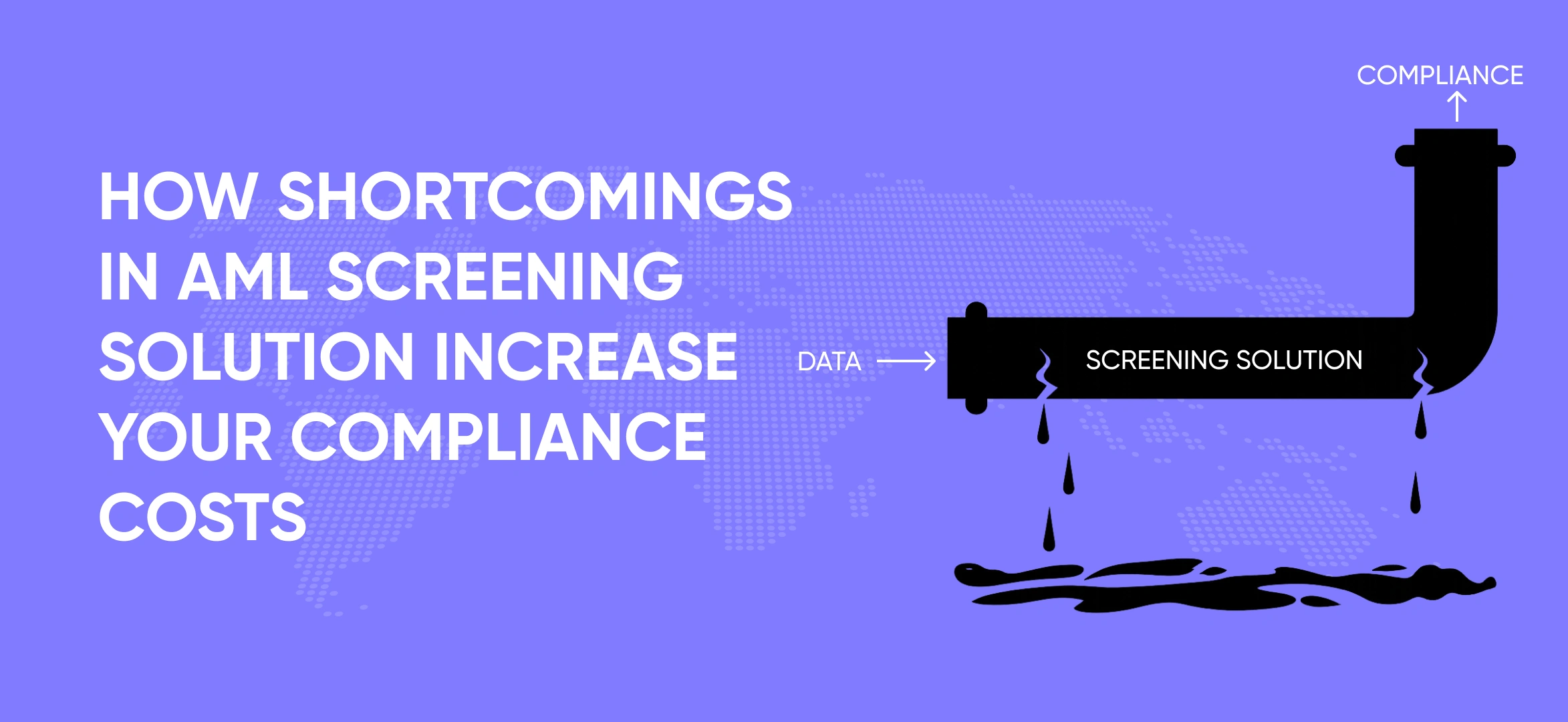
How Shortcomings in AML Screening Solution Increase Your Compliance Costs
AML Compliance
December 24, 2025


As global financial regulations continue to evolve, AML compliance has emerged as one of the most significant challenges for organizations worldwide. Financial companies and fintech companies face increasing regulatory pressure to strengthen their AML controls. This challenge also extends beyond the banking sector, impacting non-banking industries such as money service businesses (MSBs), insurance providers, trade and corporate sectors.
Financial Service providers spend a lot of money and resources on AML Compliance solutions. However, they still struggle with challenges like false alerts and hence deploy more resources in filtering risk from legitimate customers.
AML screening solutions with lower false rates, allow compliance teams to entirely move away from resource-intensive, low-value alert clearing.
It dramatically reduces the manpower that is required for repetitive error resolution, thus, enabling compliance officers to focus on higher risk investigations, complex case analysis, and regulatory critical decision-making.
5 Common Challenges Compliance Officers Face When Using Screening Solutions
Inaccurate or incomplete data can lead to severe fines for non-compliance with regulations like anti-money laundering (AML) and Know-your-Customer (KYC) laws. For example, according to the US Department of Justice HSBC, was fined 1.256 billion USD in 2012 for inadequate AML practices stemming from poor data quality, similarly, Office of the Comptroller of the Currency identified that CitiBank faced 400 million USD in fines in 2020 with (additional penalties in 2024) for data governance failures.
Institutions may have AML compliance programs in place but without the right data-driven solutions, those programs fail to meet regulatory expectations.
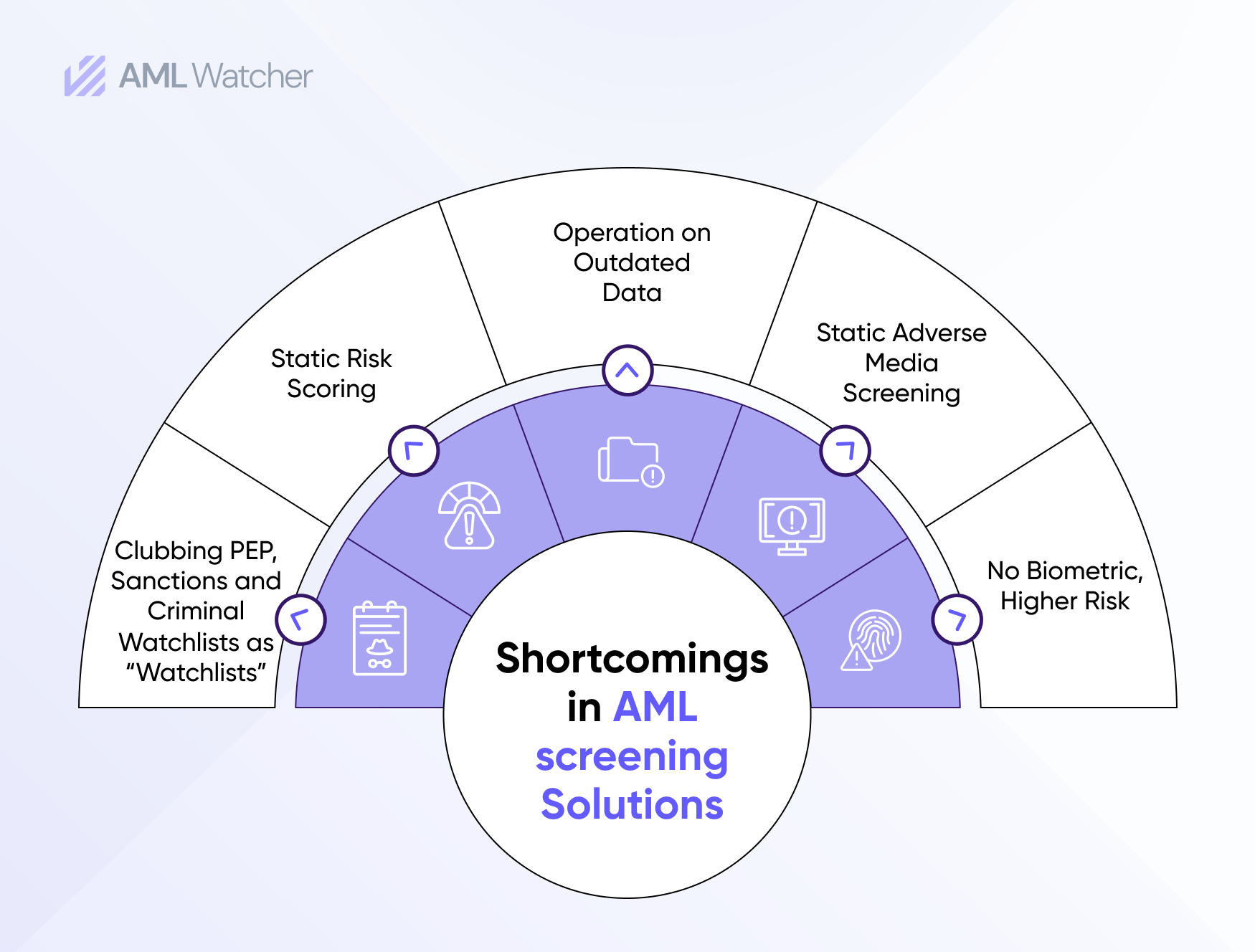
Clubbing PEP, Sanctions and Criminal Watchlists as “Watchlists”
Clubbing Politically Exposed Persons (PEPs), sanctions and criminal watchlists as a single watchlist is a recurring problem in Anti- Money Laundering (AML) screening. This is because these categories represent fundamentally different types of risks with distinct regulatory requirements therefore, necessitate varied compliance.
Legacy AML compliance solutions often give higher false positives because they club PEP lists, adverse media, warnings and regulatory enforcements lists and sanctions lists etc.
Static Risk Scoring
One of the major challenges faced by financial service providers is that they have relatively diverse risk exposures. For example, a bank in Lithuania may have to screen against UNSC, EU Council Export Control Measures List, OFAC lists ( many other lists too). On the other hand a bank in UAE may have to screen only against the UAE Central Bank and the UNSC list.
The risk of jurisdiction may vary due to which FSP in different countries may have to follow different risk scoring. This distinction between policy and execution is further reinforced by UAE’s removal from FATF grey list, followed by its later delisting from EU’s high-risk jurisdiction list demonstrating that enabling AML solutions and not merely the existence of compliance programs, drive regulatory compliance. Further, AML compliance programs of an FSP in different countries may have to follow different “risk scoring” as a result of which the risk of jurisdictions may vary .
Outdated Screening Data
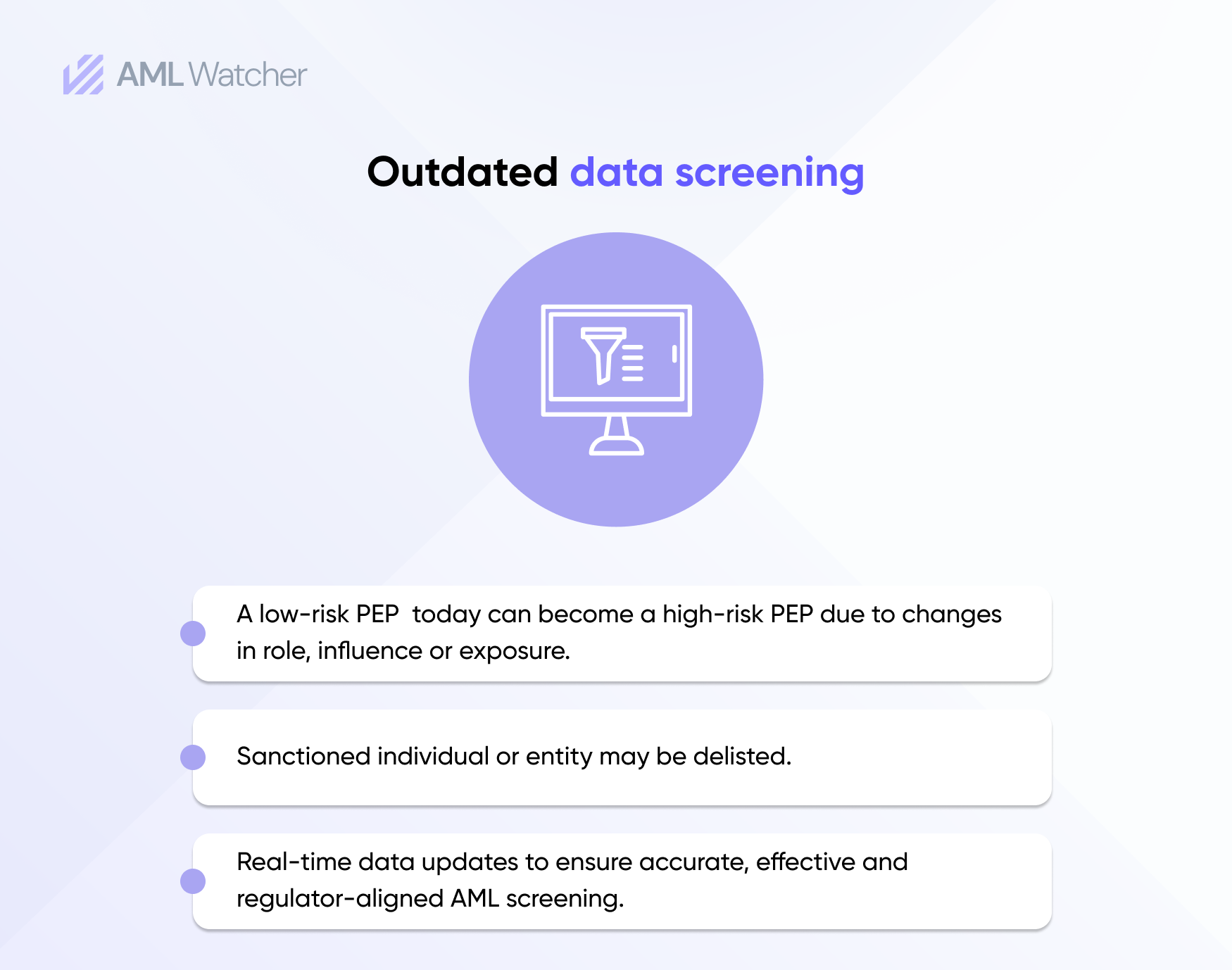
The possibility of traditional screening systems operating on outdated data is likely to be high. AML data is naturally subject to change. A low-risk PEP today could likely be a high-risk PEP the day after, similarly, a sanctioned entity may not remain subject to sanctions anymore as witnessed in modern history and the contemporary world. This risk factor enunciates the importance of data update in “real-time”.
Static Adverse Media Screening
A customer’s association with a predicate offense for money laundering gives a true picture of risk associated with them. For instance, PEPs are usually high-risk because of their proximity to power and exposure to crimes like corruption and bribery, which generate illicit proceeds. But whether those PEPs are actually involved in these crimes shows up in adverse media screening.
Adverse media plays a crucial role in identifying the actual money laundering risk that is associated with a PEP or any other entity. Thus, reiterating the core essentiality of ongoing monitoring of high risk entities for highlighting their association with any predicate offense for money laundering. This, in the long run results in an overwhelmingly high number of false positives, limiting the ability to conduct accurate risk screening.
Lacking Biometric Face Matching
Compliance officers unanimously agree that repeated false positives prove to be a major pain point for them. Financial service providers resort to spending a handsome chunk of money and resources in differentiating the alerts that indicate real financial crime risks from large volumes of alerts that are technically triggered but pose little or to some extent no actual risk. This challenge highlights the growing need for biometric face-matching solutions that can accurately distinguish genuine identity matches from false positives at the screening stage. Therefore, enterprises that cater to a diverse customer base across the globe must adhere to use solutions with biometric screening in order to ensure precise accuracy in match and save time.
Addressing Key Compliance Gaps with an Integrated AML Approach:
The Financial Action Task Force (FATF) on money laundering, which is recognized as the “international financial standard setter” for AML efforts, defines the term money-laundering as the processing of criminal proceeds to disguise their illicit origin in order to legitimize the “ill-gotten gains of crimes”.

Further, in FATF Recommendations, for fighting money-laundering incorporates the Vienna Convention’s technical and legal definition of money-laundering and recommends expanding the predicated offenses of that definition to include all serious crimes.
This elaborate definition of money-laundering highlights the extent to which AML laws and regulations are to be put into effect. In order to ensure regulatory alliance and legal robustness AML solution must apply technical definitions of money laundering forming a consistent foundation for risk assessment, screening and monitoring controls.
How AML Watcher Empowers Businesses with Foolproof AML Screening
AML Watcher is built to solve the problems in AML’s data layer. Catering to your top challenges as our top priority is what we do best. Following, is a guide on how AML Watcher actively dodges the relatively prevalent AML screening errors.
While many RegTech solutions fail to meet regulatory expectations, AML Watcher offers screening solutions that can be customized as per risk appetite of a business, helping them precisely meet regulatory obligations.
AML Watcher identifies and differentiates between the key risk data sources by:
- PEP Data which is in line with definitions and risk assessment by regulations, more than 6 million PEP profiles from 235+ countries and states. Access to PEP lists of even those territories that legacy AML vendors miss
- More than 215 sanctions regimes which comes right from official sources with categories and contexts
- Adverse media screening with FATF predicate offense and risk categories
- Warnings notifications by regulators, exchange commissions, central banks and judicial authorities
- Watchlists, 1300+ regulatory watchlists that include terrorist lists, debarred entities lists as well as sex offenders
- International Leaks data that uncover offshore links
- No commitment needed
- Complete AML Database at your service
- Access our all-in-one dashboard


Tier-2 PSPs in ... must demonstrate automated monitoring, layered CDD, &...
See the Full Regulatory Expectation70–80% less manual work, 95% less fatigue, TruRisk Agent makes compliance effortless.
Experience Agentic AMLMove Beyond Articles. Activate AML Intelligence.
Switch to AML Watcher today and reduce your current AML cost by 50% - no questions asked.
- Find right product and pricing for your business
- Get your current solution provider audit & minimise your changeover risk
- Gain expert insights with quick response time to your queries