

 Alert!

Maritime Sanctions Evasion Risks for FIs with the Rise of Dark Fleet
AML Compliance
Aug, 07 2026
March 4, 2026


- The Dark Fleet and Rise of AIS Manipulation
- Common Hotspots Linked to AIS Manipulation
- Red Flags Financial Institutions Should Monitor
- OFAC’S Guidance on Deceptive Practices Associated with Oil Shipments
- Why Detecting Maritime Sanctions Evasion Matters for Financial Institutions
- Strengthen Your Defense Against Maritime Evasion with AML Watcher

Maritime sanctions have become an important part of global sanctions enforcement as governments seek to restrict the movement of goods, vessels, and maritime services linked to sanctioned countries and entities. Since more than 80% of global trade by volume moves through maritime transport, shipping has become a key channel for sanctions evasion. As deceptive shipping practices become more sophisticated, financial institutions involved in trade finance, cross-border payments, and correspondent banking face growing challenges in identifying hidden sanctions risks.
Countries such as Iran, Russia, and Venezuela have faced extensive sanctions that restrict their access to international energy markets. To continue exporting oil, sanctioned networks often rely on discounted sales, complex ownership structures, and vessels operating outside traditional compliance oversight. This environment has accelerated the growth of the shadow fleet, with a subset commonly referred to as the dark fleet using deceptive practices to conceal the origin, ownership, and destination of sanctioned cargo.
The Dark Fleet and Rise of AIS Manipulation
What is AIS, and why does it matter?
The Automatic Identification System (AIS) is an international vessel tracking system designed to improve maritime safety and navigation. It continuously broadcasts information such as a vessel’s identity, position, speed, course, and voyage details, allowing nearby vessels and coastal authorities to monitor movements and reduce collision risks.
What is the Dark Fleet?
The shadow fleet generally refers to vessels that transport sanctioned or restricted cargo outside normal commercial shipping practices. Within this broader network, the dark fleet describes vessels that deliberately conceal their identity or movements through deceptive practices such as AIS manipulation, frequent flag changes, vessel renaming, and complex ownership structures. While the two terms are often used interchangeably, the dark fleet typically refers to vessels actively attempting to avoid regulatory detection.
They operate in legal and regulatory grey zones. The dark fleet delivers much of the world’s oil from countries under international sanctions. According to the International Federation of Shipmasters’ Associations (IFSMA), shadow fleet vessels now account for more than 10% of the global tanker fleet. Industry estimates also suggest that the fleet continues to expand as sanctions regimes become more extensive.
How AIS Manipulation Works in Maritime Sanctions Evasion?
AIS deception can involve multiple tactics. “Going dark” means turning off the transmission of AIS data to avoid visibility on the monitoring systems. Although in some regions this may be done for legitimate safety reasons, continued irregularities are signs of deceptive behavior. “AIS spoofing” means broadcasting incorrect location and identity data that appears normal to the tracking system, even though the actual cargo is moving somewhere else.
These practices make it more difficult for regulators, shipping companies, insurers, and financial institutions to verify where a vessel has traveled, whether ship-to-ship transfers occurred, and whether sanctioned cargo has been concealed. As a result, trade finance transactions and cross-border payments may appear legitimate even when they involve sanctioned shipments. Common reasons vessels manipulate AIS include:
- Concealing sanctioned oil shipments from regulators and financial institutions.
- Supporting ship-to-ship transfers intended to disguise cargo origin.
- Smuggling oil, fuel, or other prohibited goods.
- Operating near disputed waters or restricted maritime zones without attracting attention.
Common Hotspots Linked to AIS Manipulation
-
The Gulf of Oman
This region has become a hub for the transshipment of Russia’s crude oil. The tankers involved use AIS manipulation, ship-to-ship transfers, and other similar tactics to move oil off the radar. The delivery is made to their respective destinations, such as India or China, on seemingly legitimate, non-sanctioned ships or vessels. These activities make it difficult for financial institutions to verify cargo origin, increasing the risk of processing payments linked to sanctioned shipments without detecting the underlying maritime exposure.
-
Malaysia and the South China Sea Region
Waters near Malaysia and some parts of the South China Sea have also been linked to ship-to-ship transfers and other deceptive practices. Iranian, Venezuelan, and Russian cargoes are most commonly reported to have been routed through these regions. This prompted the Malaysian government to launch a crackdown on illicit transfers taking place along its coast. Frequent ship-to-ship transfers and manipulated vessel tracking data have made this region a higher-risk area for maritime due diligence and enhanced sanctions screening.
Red Flags Financial Institutions Should Monitor
Financial institutions can identify potential maritime sanctions evasion by monitoring behavioral indicators instead of relying solely on sanctions lists. Repeated AIS transmission gaps, multiple ship-to-ship transfers, frequent flag changes, unusual trading routes, complex ownership structures, and inconsistencies between shipping documents and vessel movements should all trigger enhanced due diligence. Combining these indicators with vessel intelligence helps compliance teams detect hidden sanctions exposure earlier.
OFAC’S Guidance on Deceptive Practices Associated with Oil Shipments
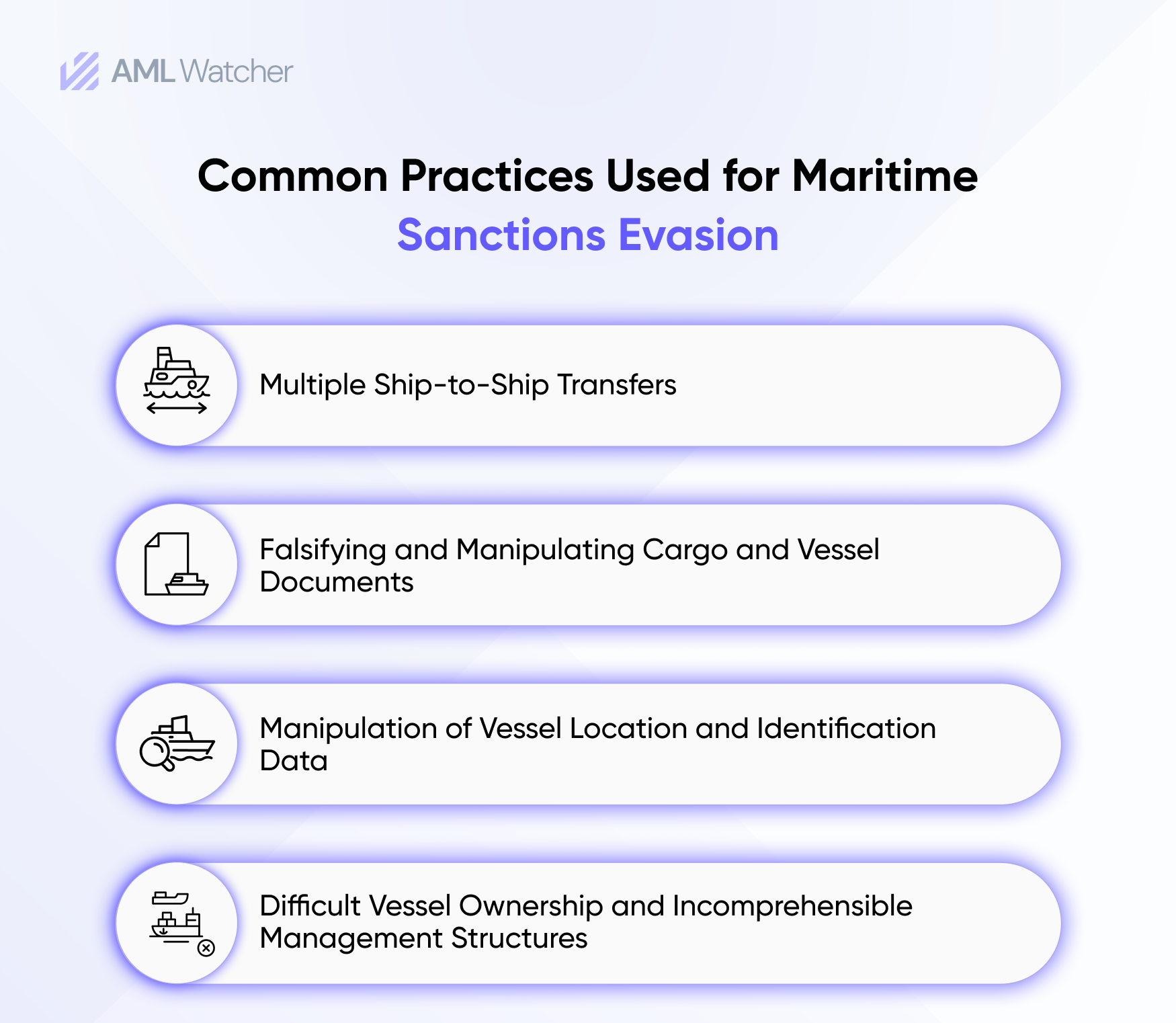
OFAC released a set of guidelines on April 16th ‘2025 “Guidance for Shipping and Maritime Stakeholders on Detecting and Mitigating Iranian Oil Sanctions Evasion”. Following are the common practices used for maritime sanction evasion, as per the advisory:
-
Multiple Ship-to-Ship Transfers
While ship-to-ship transfers are considered a legitimate means of pursuing trade, OFAC recognized that sanctioned tankers use the territorial waters of coastal states to transport exports to buyers alongside non-sanctioned vessels. Financial institutions financing maritime trade should assess whether repeated ship-to-ship transfers align with normal commercial activity or indicate an attempt to conceal sanctioned cargo.
-
Falsifying and Manipulating Cargo and Vessel Documents
Sanctioned networks falsify vessel and cargo documents to obfuscate the origin and destination of shipments. This can occur through manual manipulation or by obtaining new cargo documentation issued by a competent authority. This amplifies the need for accurate shipping documentation to ensure all stakeholders remain on the same page.
-
Manipulation of Vessel Location and Identification Data
Voluntarily disabling AIS transponders or making any modifications to the data to cover up their movements is a tactic often practiced by sanctioned vessels. OFAC recommends treating unexplained AIS gaps, inconsistent location data, and prolonged transmission outages as potential indicators of sanctions evasion that warrant enhanced due diligence.
-
Difficult Vessel Ownership and Opaque Ownership and Management Structures
Sanctioned entities are linked to networks that use different shell companies and special-purpose vehicles (SPVs), which are most prevalent in high-risk, low-transparency, and low-regulation jurisdictions. These ownership structures make it difficult to identify the ultimate beneficial owner, increasing the risk of unknowingly facilitating transactions involving sanctioned parties.
Why Detecting Maritime Sanctions Evasion Matters for Financial Institutions
Financial Institutions face exposure because maritime trade is linked to payments, trade finance, insurance activity, and cross-border settlements. The maritime industry involves complex supply chains, making it difficult for financial institutions to monitor and trace illicit activities. Without sufficient knowledge of evasive schemes and support for vessel intelligence, ownership verification, and sanctions screening solutions, financial institutions are likely to inadvertently participate in illicit activities, such as financing or processing payments for sanctioned entities.
Financial institutions involved in trade finance should not rely solely on sanctions list screening. Vessel ownership changes, repeated ship-to-ship transfers, unusual trading routes, AIS transmission gaps, and opaque corporate structures can all indicate elevated sanctions risk. These indicators should be incorporated into enhanced due diligence and transaction monitoring processes.
With OFAC’s added expectations for financial institutions to screen not only sanctioned vessels but also “high-risk” vessels, “spoofers,” and those flagged by credible third-party intelligence providers. Financial institutions need to adopt effective solutions to avoid risks associated with maritime sanctions evasion.
Strengthen Your Defense Against Maritime Evasion with AML Watcher
Maritime sanctions evasion has become more sophisticated as sanctioned networks combine AIS manipulation, vessel ownership layering, and deceptive shipping practices to conceal illicit trade. Financial institutions require greater visibility into vessel activity and ownership risks to identify these hidden exposures before processing transactions.
AML Watcher strengthens maritime sanctions compliance through vessel screening, ownership intelligence, and sanctions risk monitoring, helping compliance teams identify high-risk vessels and related entities with greater confidence.
Request a Demo to explore how AML Watcher supports stronger maritime sanctions screening.
- No commitment needed
- Complete AML Database at your service
- Access our all-in-one dashboard


Tier-2 PSPs in ... must demonstrate automated monitoring, layered CDD, &...
See the Full Regulatory Expectation70–80% less manual work, 95% less fatigue, TruRisk Agent makes compliance effortless.
Experience Agentic AMLMove Beyond Articles. Activate AML Intelligence.
Switch to AML Watcher today and reduce your current AML cost by 50% - no questions asked.
- Find right product and pricing for your business
- Get your current solution provider audit & minimise your changeover risk
- Gain expert insights with quick response time to your queries