Alert!


The Embargo Act of 1807
AML Compliance
January 19, 2026


The contemporary world stands on the remains of history. The current trending “trade wars” and the “who beats who” narrative that global powers pitch against each other, is not a modern invention, rather a historic practice that has been going on for centuries.
Trade embargoes are an old tradition utilized to put economic pressure on competitors and rivals, to cause change in a specific behaviour. One of such famous examples in American history is the Embargo Act of 1807 during the Napoleonic wars.
Who made the Embargo Act of 1807 and Why?
The Embargo Act, a trade policy of the United States was passed with the approval of President of the time Thomas Jefferson on 22nd December 1807. This happened during the period of increased tensions in the European region that extended beyond borders, due to the influential nature of both France and Britain on the rest of the world.
The French and British naval actions were incessant with their interference in neutral American presence on the sea and its commerce. On June 22, 1807, HMS Leopard fired on USS Chesapeake and boarded to search for deserters, which further aggravated the situation.
It was implemented to coerce Britain and France to come to terms with American neutrality and halt the forced seizures of American vessels.
The act prohibited American ships from taking clearance for foreign trades, shutting down international maritime trade effective immediately, although some exceptions were made.
Was the Embargo Act a Success or a Failure?
The United States felt pressured on the hands of both the nations because of its neutral stance.
While the intent behind the implementation of embargo was foreign policy and economic leverage, its effects started to deeply cripple the American economy. Exports became static, activity at ports remained at an all time low, merchants, ship owners and other workers faced a loss of income as collateral damage.
In short, the policy is widely viewed as a failure because it imposed heavy economic costs domestically while failing to shift British or French behavior in the near term.
Although the Act had adverse repercussions on the American economy, what remains true is that its implementation opened doors for new forms of asserting pressure that illustrated how economic restrictions can be used as a foreign policy tool.
Lessons from the Embargo Act of 1807
- The lengths to which economic pressure can be implemented is limited. The Act’s failure displayed that forced policy changes via trade can cause unintended self-harm.
- Policies must align with internal priorities and demands.
- Initial failure can become success with scope for adaptability. The successive changes in the Act’s clauses overcame its rigidity.
- Enforcement and strong mechanisms are key to achieving results from policy guidelines.
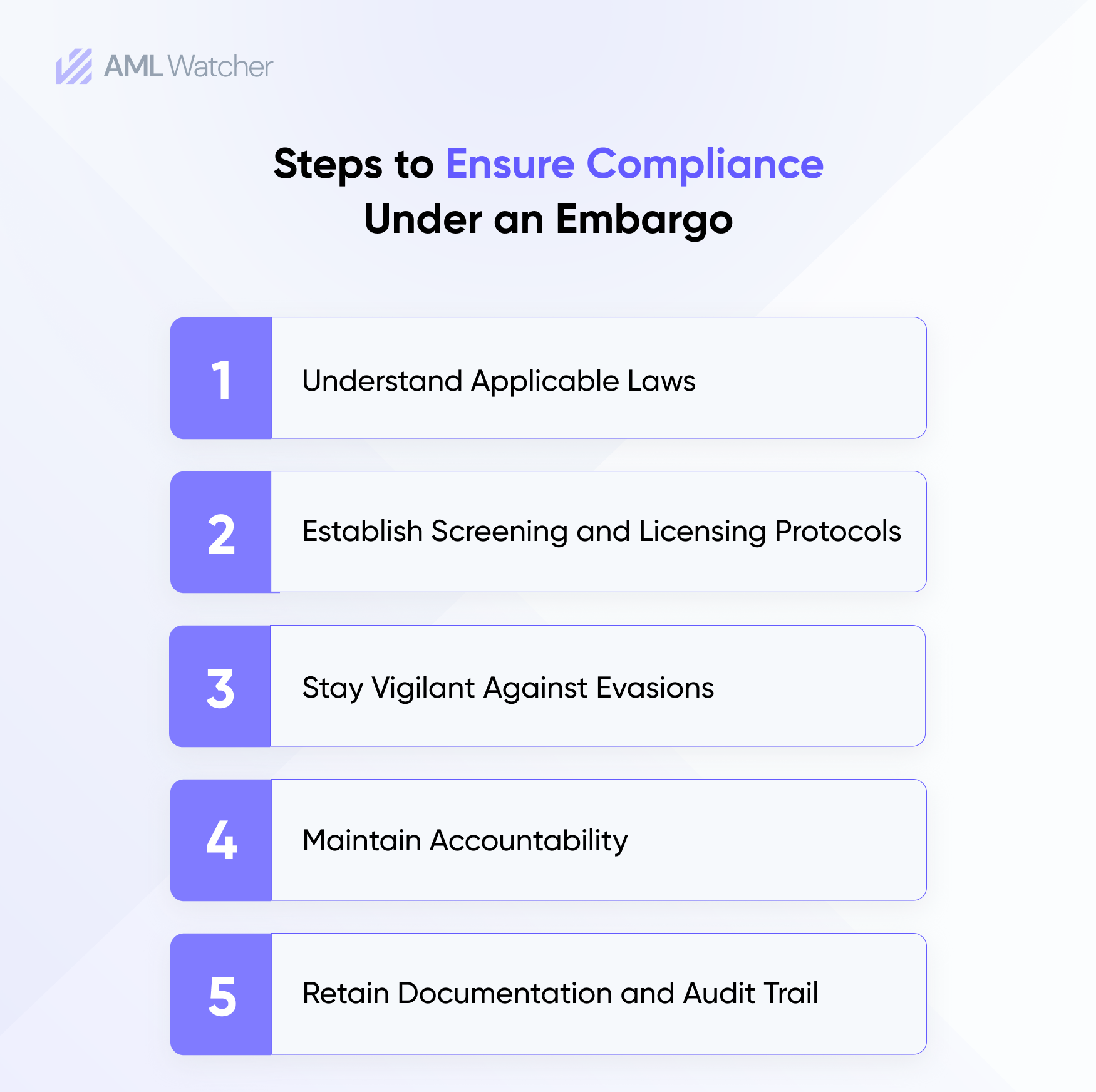
Guide to Ensuring Compliance under an Embargo
For survival in today’s regulatory landscape that includes trade embargoes, sanctions as well as export controls compliance is crucial thus, remains pivotal to thrive in such a landscape.
Understand Applicable Laws
Having thorough in-depth knowledge about the major and minor details about the law greatly helps in understanding which goods or services and transactions are covered. Governments regularly differentiate between complete bans, partial bans or any other exceptions.
Establish Screening and Licensing Protocols
When in an environment where trade is restricted all exports, shipments, maritime vessels Screening can happen through verifying registration and ownership, asking for licenses or waivers where necessary. For counterparties and intermediaries, screen not only vessels and shipments, but also their beneficial owners.
Stay Vigilant against Evasions
Smuggling was an active tool used against the Embargo Act and its clauses, it remains an active tool today against sanctions as well. Companies and authorities must remain vigilant against any re-routing or indirect routes and multiple transits especially through third countries.
Maintain Accountability
A hierarchical system where a chain of command is maintained should be established. From compliance officers to legal teams to senior management, liability and accountability should move up the hierarchy where risks are higher.
In comparison to 1807, where the President had discretionary authoritative powers to grant any exemptions, in modern regimes such powers are delegated to government institutions which can systematically authorize waivers or licensing restrictions.
Retain Documentation and Audit Trail
Organizations need to have written policies and workarounds on how to comply with applicable regulations. Compliance teams should document and record trails for each decision, including licensing basis and why a match was cleared.
Contemporary Acts that Mirror the Embargo Act of 1807
While the Embargo Act of 1807 is an old Jefferson-era trade law that remains in United States’ trade laws’ archives, it still remains a historic foundation for modern sanctions to be inspired from.
Modern sanctions regimes differ, but they share the same compliance pressure points. Restricted parties, indirect routing, third-country transshipment, licensing exceptions, and enforcement risk.
In relatively recent years, the United States has enacted certain laws and acts that mirror the Embargo Act of 1807.
- The International Emergency Economic Powers Act (IEEPA) enacted in 1977, gives the President extensive authority to regulate economic transactions in case of national emergency. Latest data indicates that till September 1, 2025 successive presidents of the US have chosen to declare national emergencies at least 77 times by invoking IEEPA, 46 out of those 77 emergencies remain ongoing.
- CAATSA Act, officially drafted in 2017, is an acronym that translates to Countering America’s Adversaries Through Sanctions Act. The Title I of the Act concerns countering Iranian destabilizing activities, Title II countering Russian influence in EU and Eurasia whereas the Title III concerns countering North Korea’s WMD and ballistic missile program.
- The Cuban Liberty and Democratic Solidarity Act of 1996 (LIBERTAD) or Helms-Burton remains an integral part of the legal basis for the US-Cuba embargo.
The Embargo Act of 1807 reiterates that economic restrictions are not a modern-day invention, but an integral part of a long-enduring take on foreign policy alongside risk management. With the passage of time, the outlook and enforcement strategies for sanctions have been subject to evolution yet the challenges remain oddly similar. Compliance obligations today are all shaped by indirect trade routes, restricted parties and enforcement inspection and licensing exceptions.
Empower Compliance with Sanctions and Embargo with AML Watcher
Sanctions and embargo compliance today places sustained pressure on financial institutions to identify restricted parties, manage false positives, and document defensible decisions without slowing down legitimate business. AML Watcher supports sanctions and trade-related compliance through risk-based screening, alert prioritisation, and structured decision logic that helps teams reduce manual review effort while maintaining audit-ready records.
Request a demo to see how AML Watcher helps financial institutions manage sanctions and embargo risk efficiently and cost-effectively.
Move Beyond Articles. Activate AML Intelligence.
Switch to AML Watcher today and reduce your current AML cost by 50% - no questions asked.
- Find right product and pricing for your business
- Get your current solution provider audit & minimise your changeover risk
- Gain expert insights with quick response time to your queries