Alert!

What is Regulatory Risk and How to Manage it?
Risk Assessment & Management
November 27, 2025


- What is a Regulatory Risk?
- How Regulatory Risk Varies Across Countries?
- What is Regulatory Risk Management (RRM)?
- Why Businesses Need to Manage Regulatory Risk?
- Key Drivers of Regulatory Risks
- Regulatory Risk in the Anti-Money Laundering Context
- What are the Crucial Elements of an Effective Regulatory Risk Management (RRM)
- Manage Regulatory Risk with AML Watcher

Today, the core challenge for businesses is the rising regulatory risk that arises with the change of regulations over time. Businesses, especially those that are working in different jurisdictions, have to keep up with the shifting regulatory requirements. For example, a finance corporation in Singapore can follow transparent guidelines to stay compliant, whereas that same company in a less transparent jurisdiction can face sudden fines and sanctions without warning. This case illustrates that regulatory risk is not uniform in every jurisdiction, and it demands that businesses stay focused on new updates.
To understand this conflict, readers must know what the regulatory risk for a business actually is. Once they comprehend this, the article will move forward towards how it fluctuates across jurisdictions and why businesses need to handle it.
What is a Regulatory Risk?
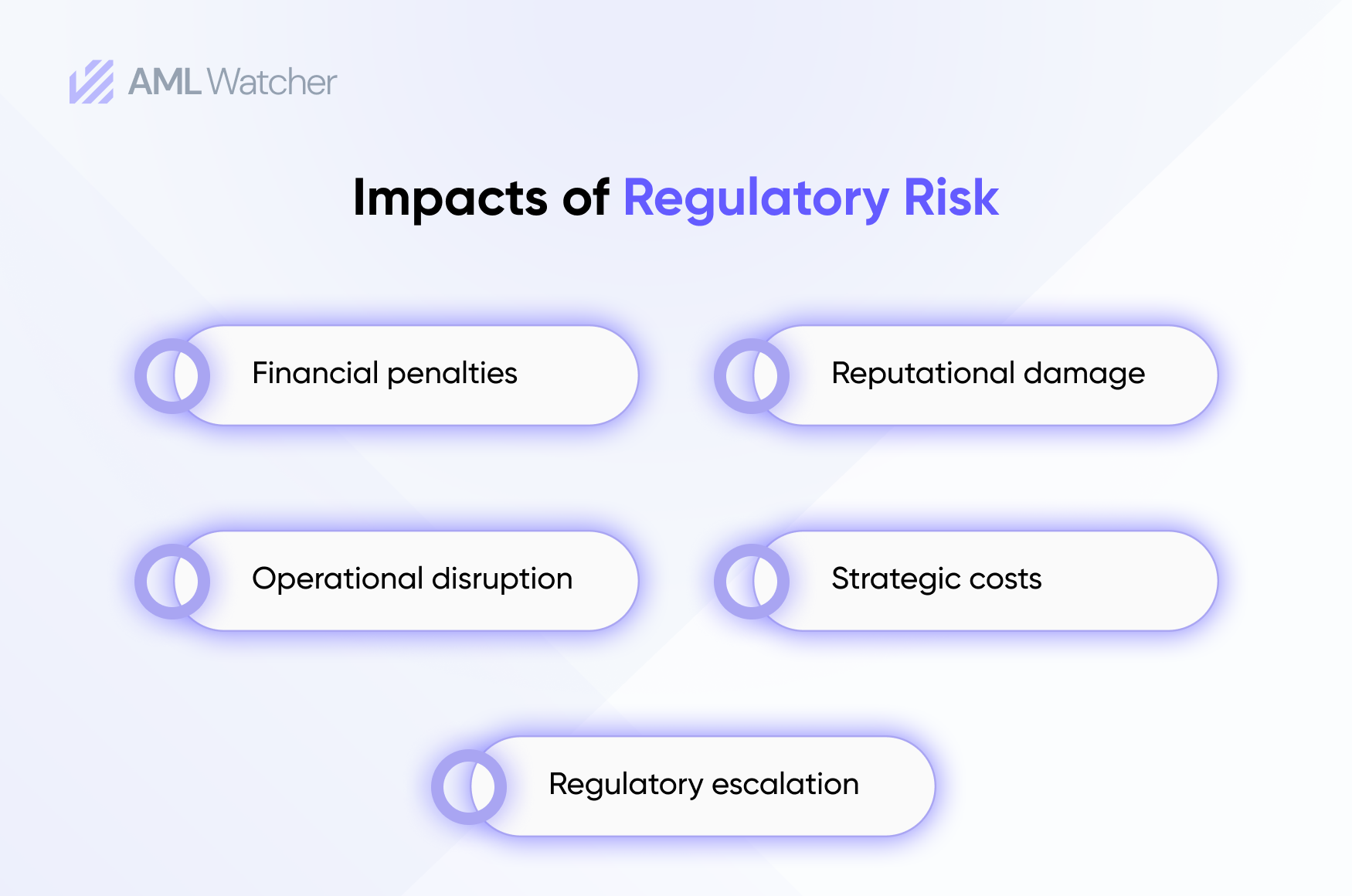
Regulatory risks are the chances that changes in regulatory standards and enforcement policies can adversely impact a business. It can arise from new laws, amendments to existing regulations, or when there is rigorous law enforcement. Such threats can result in operational disruptions, damage to a business’s brand image and financial penalties.
How Regulatory Risk Varies Across Countries?
Every country has its own methods of oversight and implementation; therefore, the regulatory risk fluctuates depending on the jurisdiction.
Enforcement Approach and Supervisory Intensity
When regulators publish detailed guidelines, strategies, and implementation measures, it’s a way for businesses to comprehend what regulators expect and how to comply. Transparency in guidance increases the intensity of risk and minimizes uncertainty.
For example, the United Kingdom’s OFSI sets out penalties and publishes enforcement outcomes. Whereas, the United States OFAC provides guidelines on factors that can increase or decrease penalties.
FATF Listing Status and National Risk
Businesses that operate in jurisdictions with higher financial crime risks or come under FATF increased monitoring are likely to face higher regulatory risks. The reason is that such a jurisdiction will be under increased pressure to enact new laws and regulations to align with international standards. The push to develop new laws could also come from the risks that jurisdictions face.
Sanctions landscape and geopolitical exposure
Jurisdictions closely aligned with active sanctions regimes carry higher real-time change risk. Firms operating in or through countries like the UK and the US must track a rapid list of new guidelines and keep proof of timely implementation to avoid breaches. Geopolitical factors and international disputes can also result in a change in regulations or laws.
What is Regulatory Risk Management (RRM)?
Regulatory risk management (RRM) is a process of assessing and addressing the negative impact of changes in supervisory standards on a business. It’s a crucial compliance strategy that helps in avoiding credibility loss and unexpected interruptions.
Why Businesses Need to Manage Regulatory Risk?
Businesses function in an environment where regulatory standards change with time. Failure in managing regulatory risk can result in huge penalties. Managing these risks beforehand assists businesses in staying compliant, avoiding costly enforcement actions and developing trust with their clients.
Effective regulatory risk management assists businesses in staying ahead of updated regulations, adopting processes in real-time and deciding in a way that aligns with the rules and standards. This is especially important for companies that are working in multiple jurisdictions, where even non-adherence with regional rules can create bigger problems.
In a nutshell, regulatory risk management is not just a way to evade penalties, it’s a key to protecting a company’s operations, reputation and long-term success.
Key Drivers of Regulatory Risks
The increase in regulatory risk depends on the combination of external and internal factors:
External Factors
Regulatory risks usually emerge when the global and national standards evolve. The Financial Action Task Force (FATF) regularly revises its recommendations, which set the direction for AML/CFT frameworks globally. For instance, at its February 2025 plenary, FATF agreed on changes to strengthen the risk-based approach guidance and monitoring updates on areas such as virtual asset risks and CDD-related guidance.
As a result, countries (including the U.S.) must consider these changes when shaping local AML rules, which in turn prompts regulators like FinCEN to update domestic AML programmes to reflect FATF’s changes.
Regulators pay close attention to new risks such as, digital payments, crypto, and high-risk entities, requiring firms to update their AML systems that can manage such risks. Companies working in multiple jurisdictions have to comply with different rules for each region, so they have to be notified every time to avoid AML compliance mistakes.
Internal Factors
Regulatory risks can also originate from within a company. Some of the major causes include the fragmented systems or manual workflows that are slow and error‑prone, increasing the chance of omissions or regulatory breaches. Poorly defined rules and gaps in oversight can significantly contribute to risk exposure. Rapid growth or introduction of new products (e.g., digital assets) can create exposures without analyzing applicable laws and regulations that may govern such products. Furthermore, reliance on outdated data for screening and monitoring can result in serious problems, as changes to sanctions brought by new regulations are completely missed.
If businesses understand both external pressures and internal vulnerabilities, they can easily adopt proactive compliance strategies, implement technology, provide training, and integrate processes to mitigate regulatory risk before it arises.
Regulatory Risk in the Anti-Money Laundering Context
Yet, every industry faces regulatory pressures, but the intensity is higher for financial institutions (FIs) due to fast-changing AML requirements. In the AML context, regulatory risk specifically means the threat that a financial institution’s anti‑money laundering / counter‑terrorist financing (AML/CTF) frameworks cannot adapt to changing requirements, leading to an increasing risk of undetected illicit flows or sanctions breaches.
Legal risk differs from regulatory risk as it tends to focus on disputes, litigation, or statutory violations, whereas regulatory risk emphasises enforcement trends, supervisory expectations, and decisions.
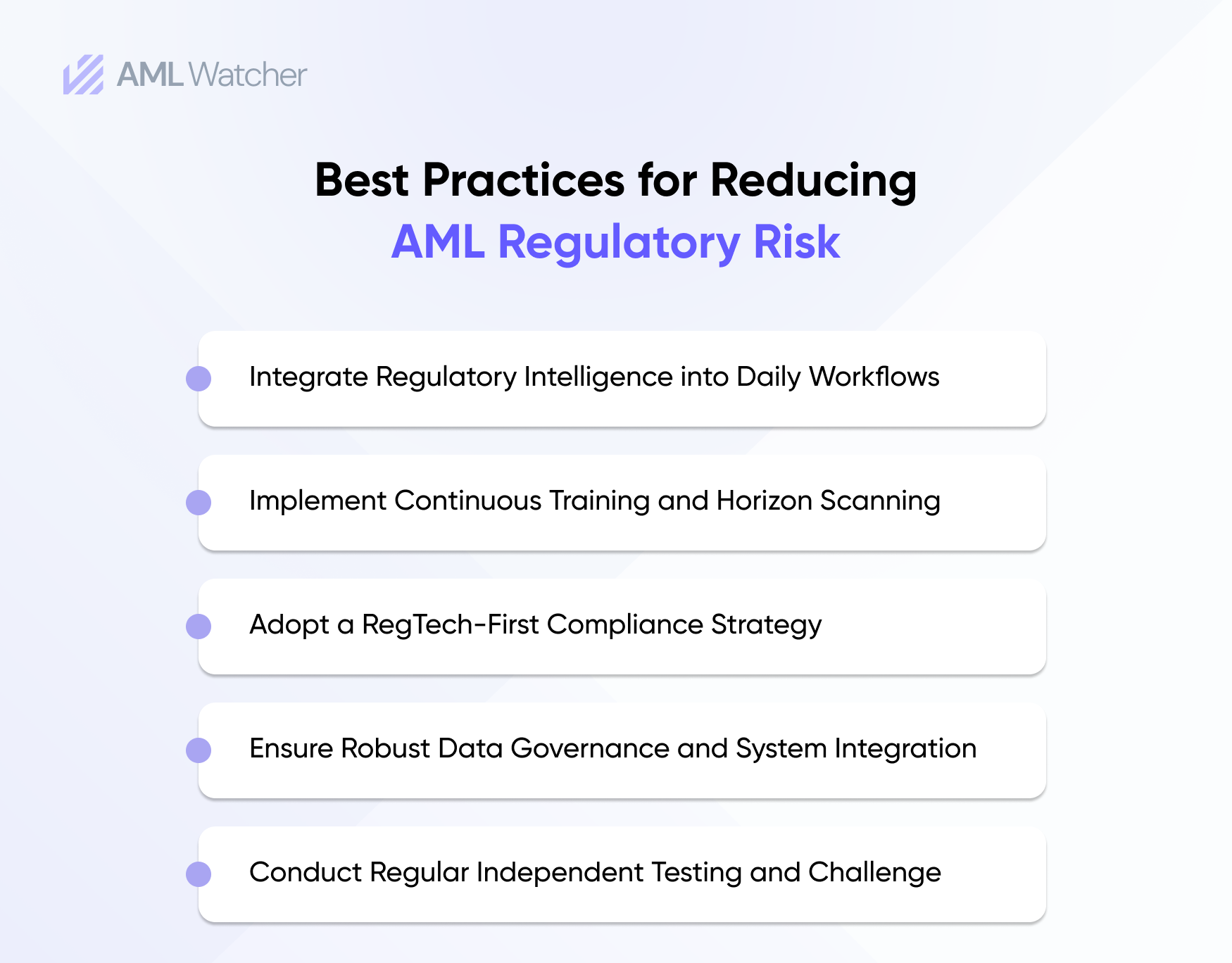
What are the Crucial Elements of an Effective Regulatory Risk Management (RRM)
A robust regulatory risk management (RRM) framework should include the following elements:
-
Governance & Internal Controls
Effective governance begins with clear board‑level and senior management oversight of regulatory risk. Organizations are required to define governance structures, roles and responsibilities for compliance, monitoring and remediation. Internal risk appetite and policies should be consistently aligned with regulatory expectations to ensure the controls remain effective.
-
Compliance Culture
Embedding a culture of compliance across the firm is necessary in RRM. There should be an environment where employees understand regulatory risks, escalate issues and act accordingly. Ongoing Training programmes and periodic refreshers help ensure the staff remain informed, particularly when regulations change.
-
Monitoring, Reporting & Technology
Continuous monitoring of regulatory developments (“regulatory horizon scanning”) prepares the organizations for changes in requirements. A technology‑led approach is beneficial in automated screening of PEPs, adverse media, sanctions, real‑time alerts, and audit‑trail reporting. Data‑driven risk analytics and dashboards for transparency across business lines, enabling teams to report to regulators with confidence and demonstrate the effectiveness of controls.
-
Scenario & Stress‑Testing
Regular testing of frameworks helps firms measure the effectiveness of controls and identify potential gaps. Scenario planning for new regulations, products, and geographies prepares organizations for emerging risks. Measuring the effectiveness of controls, root‑cause reviews of failures or breaches, and embedding lessons learned help in strengthening the framework.
How to Select a Solution to Mitigate Regulatory Compliance Risk
Businesses today face an ever-increasing pressure to comply with new rules and regulations in AML compliance. To adhere to all these obligations and ensure unobstructed continuity of their business, firms require:
- A system with access to updated PEP and high-risk entity data from multiple global sources so it can help compliance teams spot risks before the risk actually arises.
- Firms must ensure that their systems offer context-driven insights that combine customer behaviour, transaction history, and regulatory data. This will help in flagging the right entities with additional context for accurate risk assessment.
- Systems must offer real-time alerts and audit-ready reports so that the compliance teams can react quickly to upcoming risks and provide regulators with necessary evidence.
- Businesses must look for a system that tracks updated regulatory developments, such as FATF recommendations, and national updates to guide internal controls and policies.
- The system must offer coverage across multiple jurisdictions to maintain uniform compliance.
Manage Regulatory Risk with AML Watcher
Managing regulatory risk is quite challenging for businesses that operate in multiple jurisdictions. AML Watcher helps your teams in addressing this challenge by:
- Providing access to regulatory, PEP, and high-risk entity data updated every 15 minutes to minimize risks from changing regulations.
- Automating adverse‑media screening to detect risk as it happens and before it intensifies.
- Delivering context‑driven risk insights instead of generic alerts minimizes false alerts and triggers.
- Ensuring compliance coverage across products and jurisdictions to help you stay ahead of global regulatory changes.
- Offering customizability to tune the screening and monitoring as per your organization’s risk appetite and changes in regulations.
Move Beyond Articles. Activate AML Intelligence.
Switch to AML Watcher today and reduce your current AML cost by 50% - no questions asked.
- Find right product and pricing for your business
- Get your current solution provider audit & minimise your changeover risk
- Gain expert insights with quick response time to your queries