

 Alert!

News / Kuwait Added to FATF Grey List in February 2026
Kuwait Added to FATF Grey List in February 2026
The Financial Action Task Force places Kuwait under increased monitoring due to AML/CFT deficiencies. AML Watcher explains implications for financial institutions and compliance demands.04 min read
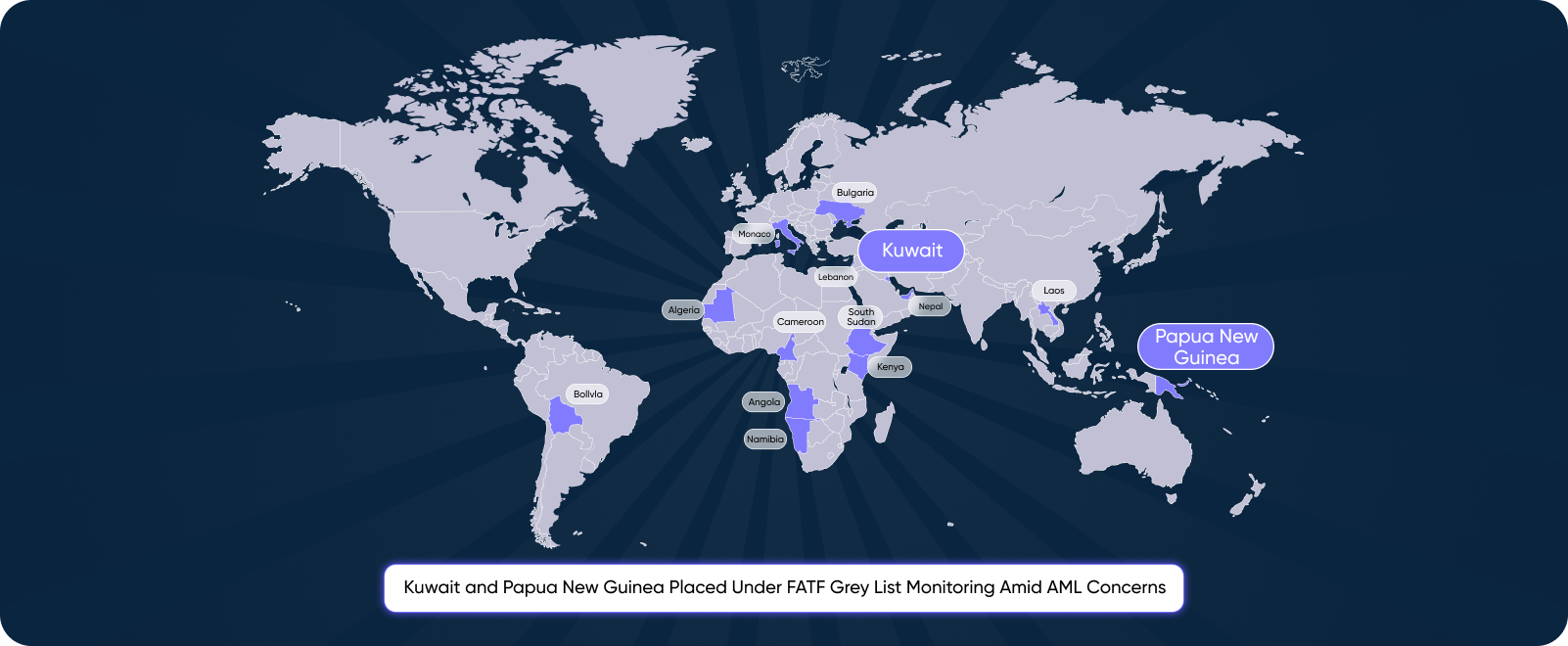
After following the Financial Action Task Force’s plenary meeting on 11-13 February 2026, FATF has added Kuwait to its “grey list” alongside Papua New Guinea under increased monitoring. This FATF update highlights the gaps in Kuwait’s AML/CFT framework and its renewed commitment to work with the Financial Action Task Force to address those strategic deficiencies.
The country was previously greylisted in 2012, and was removed in February 2015 after FATF recognized improvements in its AML/CFT framework such as through institutional and legal reforms, and establishing an independent financial intelligence unit (FIU).
In the FATF’s February 2026 decision, Kuwait’s progress in adhering to technical rules was highly recognized. However, the authority believed that the country still needs to work on following the international standards and successfully completing its action plans.
FATF acknowledged that Kuwait has proactively enhanced the efficiency of its AML/CFT regime. It has made significant progress on the majority of its 2024 MER recommended actions, such as:
- By adopting a new national AML/CFT/CPF strategy.
- Enhancing further its technical compliance framework to TF and PF targeted financial sanctions.
- Enhancing its risk sensitization and risk-sensitive outreach and supervision of financial institutions and DNFBPs.
To ensure its compliance with the FATF action plan, Kuwait will keep on cooperating with the FATF by:
- Reinforcing outreach to real estate agents and dealers in precious metals and stones (DPMSs) on the reporting of STR, including by distributing sector-based indicators of ML/TFs.
- Ensuring that beneficial ownership information in the registry is accurate, and imposing effective, proportionate, and dissuasive sanctions in situations where beneficial ownership information is inaccurate.
- Increasing ML investigations and prosecutions in connection with cross-border movements of currency and bearer negotiable instruments (BNIs).
For financial institutions, greylisting often brings more than just reputational risks; it can directly impact correspondent banking relationships, risk assessments, and due diligence procedures. While greylisting doesn’t trigger formal countermeasures, it does serve as a crucial prompt for institutions to reassess their AML controls and recalibrate their strategies.



 04 min read

- Money Laundering
- November 20, 2025
 04 min read

- Regulations
- October 29, 2025
- 03 min read
Subscribe to our Newsletter
Our best articles, news and stories, delivered to your inbox every week.