

 Alert!

How Fraud as a Service is Changing the Face of Digital Crime
Fraud Prevention
December 31, 2025


Fraud as a Service (FaaS) has emerged as an escalating challenge for financial institutions (FIs). In this underground market, criminal providers offer ready-to-use fraud tools and services ranging from phishing kits to synthetic identity generators that novice fraudsters can rent on demand. The result is a surge of complex digital fraud schemes executed at scale.
According to a recent report by Thomson Reuters, experts warn we’re entering a “golden age of fraud,” fueled by accessible FaaS offerings and technology like encryption and crypto anonymity. This has made understanding FaaS and adapting to advanced tactics of criminals a necessity for compliance leaders.
What is Fraud-as-a-Service (FaaS)
Fraud as a Service (FaaS) refers to operations where criminals sell knowledge, tools, and infrastructure designed specifically to commit fraud. At such platforms, criminals can go on dark web marketplaces and buy everything they need, such as tools, stolen data, and even tutorials, just like purchasing an app or an online service. In this case, the buyer only needs basic skills to execute the crime. These offerings include a range of illicit items such as phishing kits, compromised password databases, and malware, along with assistance for executing attacks.
For example, a standard Fraud as a Service (FaaS) package could include a fake banking website, a large-scale email phishing campaign, and services designed to assist in the laundering of stolen funds. The effect is that complex fraud schemes become “turnkey operations that even a beginner can manage”. In short, FaaS is a democratized fraud marketplace where anyone can pay to carry out advanced scams.
Why Fraud as a Service is Growing as an AML Concern
FaaS is not just a cybercrime issue; it has become an anti-money laundering problem too. FaaS platforms usually offer convenient tools for stealing data and committing fraud, which means even a novice individual can benefit from them. Automation and easy access to these tools have made fraud campaigns more frequent than ever and harder to predict, resulting in an increasing amount of illicit funds that need to be laundered.
Some FaaS offerings even include or facilitate access to mule networks, synthetic identity services, and crypto channels, all of which are common money‑laundering vectors. This industrialization of fraud outpaces traditional AML controls, which were not designed to spot the complex, high‑speed patterns that FaaS‑enabled crime produces. As a result, financial institutions face both an increase in fraud losses and a harder job detecting and reporting money laundering activity tied to these schemes.
Why FaaS Is Rising in Cybercrime
In recent years, as FaaS has professionalized, virtual scams have multiplied to a large extent. Providers now offer everything from phishing-as-a-service to deepfake identity kits.
There are several reasons why FaaS is on the rise; the top three are mentioned below:
The first reason is the technological advancement by which fraud has become easier to run and difficult to trace. Nowadays, it’s easy for criminals to trade underground and anonymously because of cryptocurrencies and encrypted communication. Social platforms, such as Telegram and WhatsApp, are usually used for training buyers and for advertising FaaS offerings.
The second reason is economics, which seems attractive to criminals. A single high-value breach or scam can yield millions, so criminals invest in robust “service” offerings. As mentioned above, it is clearly stated that fraud now accounts for 40% of all crime against individuals in England and Wales, where almost 80% of the cases are associated with FaaS platforms.
The third reason is that demographics and learning have changed. Younger, less experienced criminals can now buy their way in. It is also called a “perfect storm” in which technology and accessibility have created a fraud boom that even beginners can join. Hence, UK data shows a surge in fraudsters under age 21. Even state-sponsored actors employ FaaS. E-commerce scams such as account takeovers and promotional abuse schemes use phishing-as-a-service for initial contacts and FaaS platforms to execute the money-stealing stage. Furthermore, remote work and online commerce have also given criminals more opportunities to exploit.
Therefore, Fraud as a Service is increasing with time because it has become convenient, profitable, and is now more scalable than ever before.
Examples of Fraud-as-a-Service
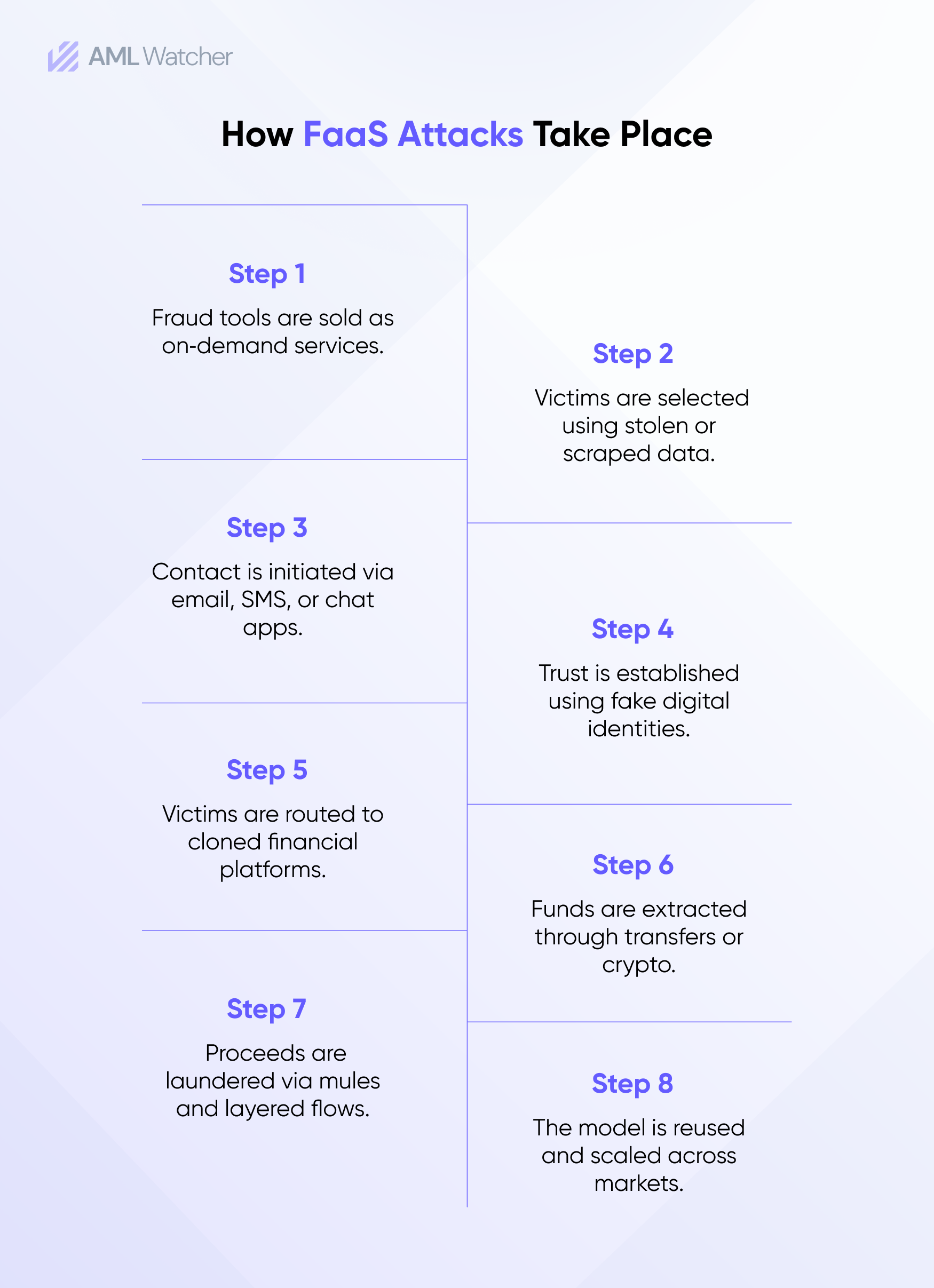
Fraud-as-a-Service takes many forms. Some highly recognized ones are:
- Phishing Kits and Scam Campaigns: Turnkey drives for spear phishing or mass email scams. FaaS vendors sell ready-to-send email and website templates to harvest credentials.
- Account Takeover (ATO) Tools: Criminals offer illegal services by using credential stuffing or automated bot tools to break into client accounts that are naive. These attack frameworks usually provide the criminals with tutorials on bypassing MFA.
- Synthetic Identities and ID Kits: Complete identity packages (fake IDs, stolen SSNs) sold online. First Advantage reports an entire FaaS niche selling “false identity packages” with end-to-end instructions.
- Malware and Exploit-as-a-Service: Rental of trojans or botnets to record the user types, which includes their credentials, often via a subscription.
- Mule Recruitment Networks: Coordinated services that supply mule bank accounts or couriers. Criminals outsource money-laundering logistics.
- Deepfake and AI-powered Offerings: Newer contributions include deepfake voice and video tools for social engineering, or “photo injection” apps to defeat facial ID.
- Promotional Abuse: In retail/tech (food delivery, ride-hail), FaaS clones apps and uses emulators to game signup bonuses en masse.
Each of these FaaS examples illustrates a digital fraud scheme that attackers can deploy with little coding or hardware of their own. For instance, in fake online marketplace and investment scams, criminals use phishing‑as‑a‑service to steal confidential information or financial access, and adaptable FaaS tools help deploy online portals or convincing fake sites that lure the victims into money remittance.
According to the UK’s National Crime Agency (NCA), the FaaS platform “Russian Coms” ran a “Tech Support as a Service,” making over 1.3 million spoofed scam calls to 500,000 UK phone numbers and causing tens of millions of pounds in losses, before being shut down with three arrests in 2024.
These examples show how FaaS empowers fraud rings at scale.
FaaS vs Traditional Fraud
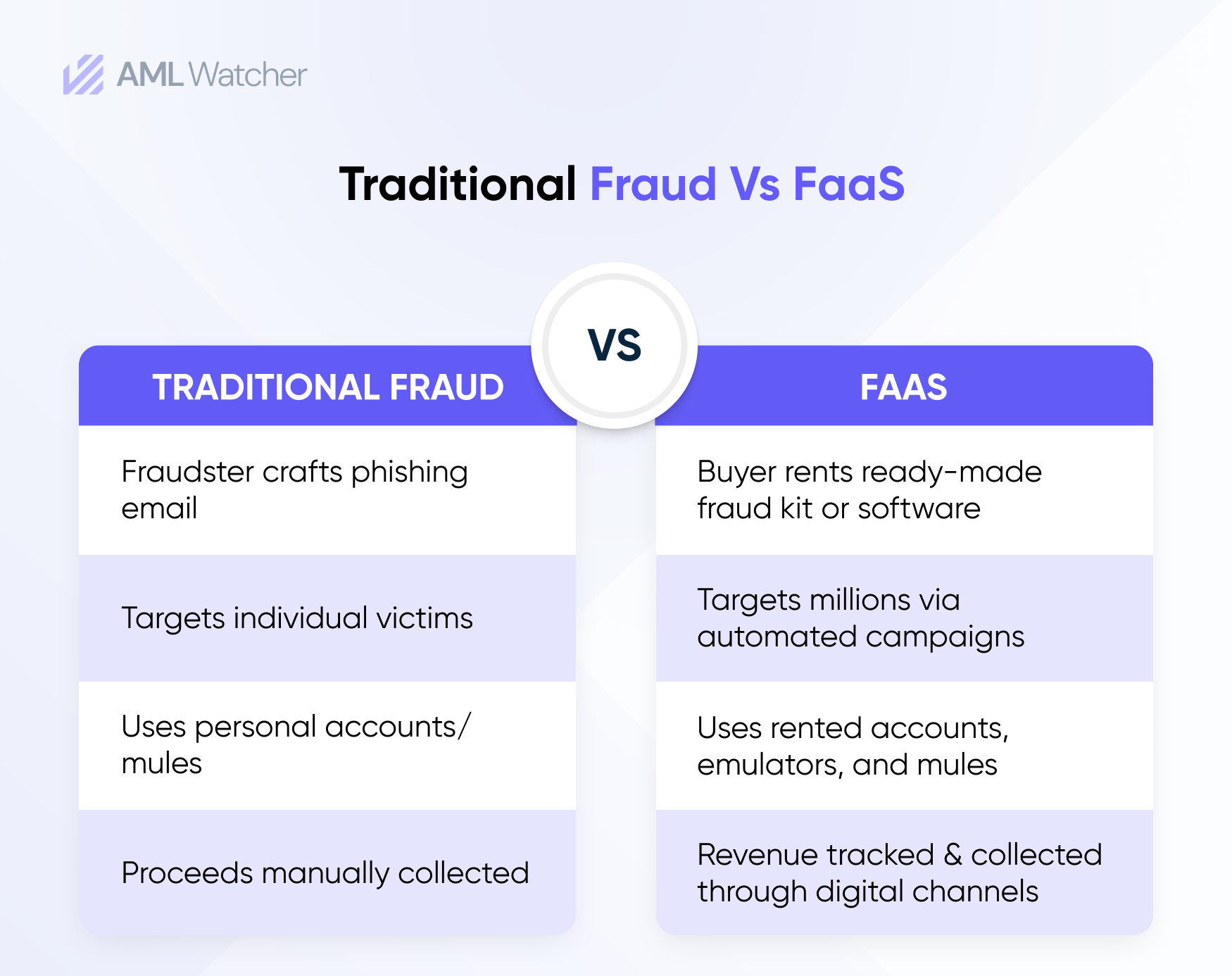
Let’s understand how the fraud landscape has changed. Previously, fraud often required personal skill and infrastructure; scammers manually wrote phishing emails, hired a few mules, or stole cards by hand. FaaS, by contrast, commoditizes every stage into an on-demand product.
It’s quite difficult to distinguish FaaS schemes from normal businesses with customer updates and support. It’s similar to if, instead of a lone hacker, a FaaS attacker develops a phishing site; and provide a polished hacking kit along with a tutorial for $100.
Experts point out that many legacy anti-fraud tools simply aren’t built for detecting such fraud that combines automation with complex or behavioral signals. These attacks are faster, cheaper, and harder to trace than traditional scams.
In practice, traditional fraud was largely manual and single‑channel. Fraudsters relied on hand‑crafted phishing emails, direct social engineering, or real-life stealing, and typically reused the same devices, accounts, or mule networks. Operations scaled slowly and were constrained by personal skill, geography, and inadequate infrastructure. Whereas FaaS means fraud can be highly automated and multi-channel. Providers sell app cloners and device emulators to defeat mobile banking controls, and social media “supply chains” of stolen accounts. Mule account services can be rented by the dozen.
FaaS enables large-scale fraud by using automation and flexible tools instead of solely relying on separate or reactive methods. This approach enables the criminals to perform fraudulent activities quickly across multiple channels.
This huge shift compels the compliance units to move from one-off investigations to pattern detection across networks.
Expert Tactics for Identifying Fraud as a Service
To fight against Fraud-as-a-Service, institutions need to improve their outdated controls and should implement the following strategies:
- Contextual Data (Adverse Media): Continuously scan news and adverse media to check if there are any mentions of mule identities, customers, and accounts associated with fraud. Contextual negative media screening catches links that are usually missed by the static watchlists. It’s quite similar to the case, if a newscast reports a company as being involved in fraud or mule activity, as a result, the transactions to that company’s accounts can be flagged preemptively.
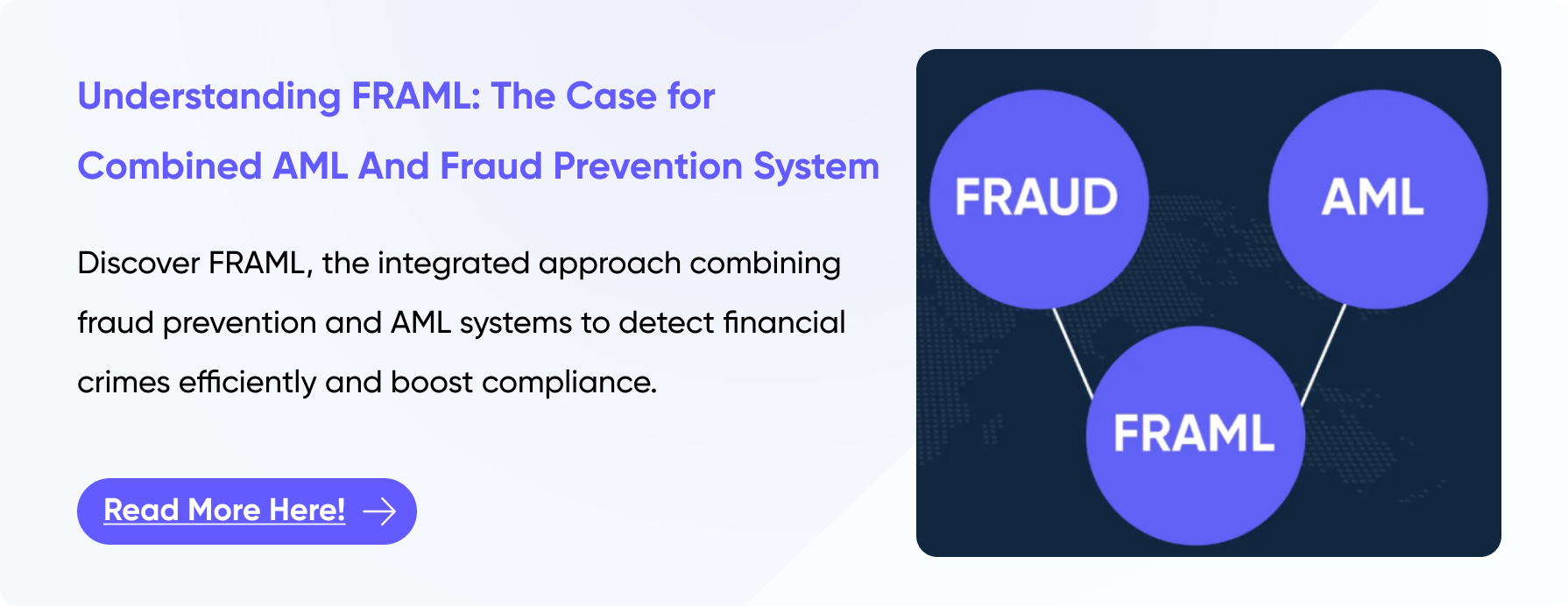
- Unified Risk Scoring (FRAML): Integrating anti-money laundering intelligence with fraud scoring results in the development of new systems that combine behavioral indicators with AML data. This revolves around some important components including the status of politically exposed persons, suspicious client histories, and adverse news updates to build a tailored client risk score. This helps analysts in giving more attention to high-risk cases where there are more chances of fraud and AML-related issues.
- Real-time Monitoring: Instead of tracking the transactions periodically, monitor them in real-time. FaaS attacks unfold quickly, so systems should update risk scores and flags with every login or transaction. Real-time monitoring of new account openings tells the institutions if they belong to high-risk regions where Fraud as a Service is more common.
- Cross-industry Collaborations: Institutes must share intelligence with companies and law enforcement. FaaS rings mostly have target platforms and banks at once, so sharing information will help in spotting the common patterns.
- Network and Relationship Analysis: Just paying attention to individual alerts can be risky sometimes; therefore, it is necessary to assess the relationships between transactions, devices, and accounts. The implementation of graph analytics is beneficial in revealing hidden fraudulent networks. For example, institutions might discover a cluster of accounts that share suspicious data or IP addresses. This uncovers FaaS networks that would evade simple threshold rules.
- Staff Training and Playbooks: It is essential for the regulators to stay informed of the modern trends and strategies in the area of fraud as a service. As FaaS evolves with time, therefore, the human analysts should update their playbooks on emerging schemes such as deepfakes and mule trafficking, etc. It is done to spot the major red flags that automated tools might ignore.
By adopting these advanced tactics, essentially a unified, intelligence-led compliance approach, firms can raise the bar for fraudsters. In practice, the solution is to employ platforms that fuse AML and fraud workflows, enabling analysts to chase leads with full context. Modern AML software that provides network graphs, case building, and integrated alerts empowers faster investigations and stronger evidence for regulators. Ultimately, confronting FaaS requires blending fraud analytics with AML insights so no piece of the puzzle is overlooked.
How AML Watcher Helps to Detect FaaS
Financial institutions face fraud rings that move faster than periodic reviews and manual casework can keep up with. AML Watcher supports fraud and AML teams with:
- Contextual adverse media monitoring to catch negative news related to customers, counterparties, or mule entities.
- Network & relationship analysis that uncovers hidden rings (linking accounts, devices, and entities) behind FaaS schemes.
- Risk prioritization combines fraud and AML intelligence, so that alerts involving both financial crime and fraud patterns rise to the top.
- Real-time investigations and systematic case management that provide quick alerts, automated processes, centralized records, and case files that are ready for audits.
By blending the above features, AML Watcher empowers compliance teams to detect Fraud-as-a-Service more efficiently and stay a step ahead of criminal networks.
- No commitment needed
- Complete AML Database at your service
- Access our all-in-one dashboard


Tier-2 PSPs in ... must demonstrate automated monitoring, layered CDD, &...
See the Full Regulatory Expectation70–80% less manual work, 95% less fatigue, TruRisk Agent makes compliance effortless.
Experience Agentic AMLMove Beyond Articles. Activate AML Intelligence.
Switch to AML Watcher today and reduce your current AML cost by 50% - no questions asked.
- Find right product and pricing for your business
- Get your current solution provider audit & minimise your changeover risk
- Gain expert insights with quick response time to your queries