

 Alert!

ESG Compliance in AML Screening
AML Compliance
March 12, 2026


Regulators, investors and financial institutions no longer treat environmental, social and governance issues as a side concern. ESG risk now affects how firms assess third-party relationships, customer exposure, reputational harm, and long-term compliance readiness.
This shift has become more visible as environmental crime, forced labor concerns, governance failures and weak supply chain oversight continue to attract enforcement actions across multiple jurisdictions.
For compliance teams, ESG is not only about sustainability reporting. It also reflects whether a business may be exposed to hidden financial crime risks. Illegal mining, wildlife trafficking, waste crime, corruption, and labor exploitation can all generate illicit proceeds or reveal broader control failures.
That is why ESG due diligence is becoming more relevant within AML programs, especially where customer screening, enhanced due diligence, and ongoing monitoring already form part of the risk framework. FATF has also highlighted the money laundering risks connected to environmental crime, which gives financial institutions a stronger reason to assess ESG-related exposure through a financial crime lens.
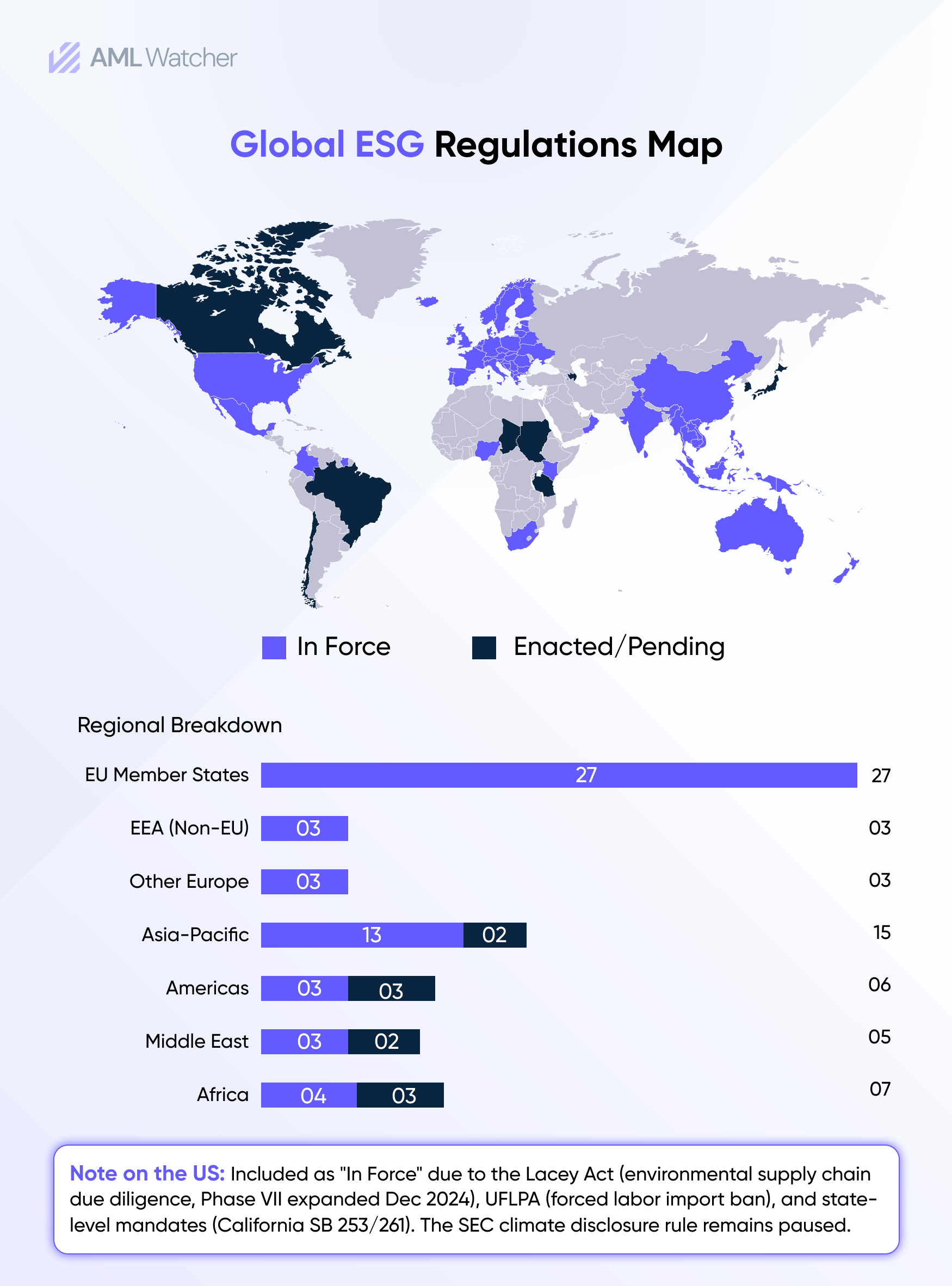
As of March 2026, 56 (including 27 EU members) out of 193 UN member states have active ESG related legislation or it is currently mandatory on the companies to comply with environment related disclosures. This doesn’t include 10 additional countries who have formally adopted or passed the legislation, however, the enforcement is still pending or is in transitional/pilot phase.
What is ESG?
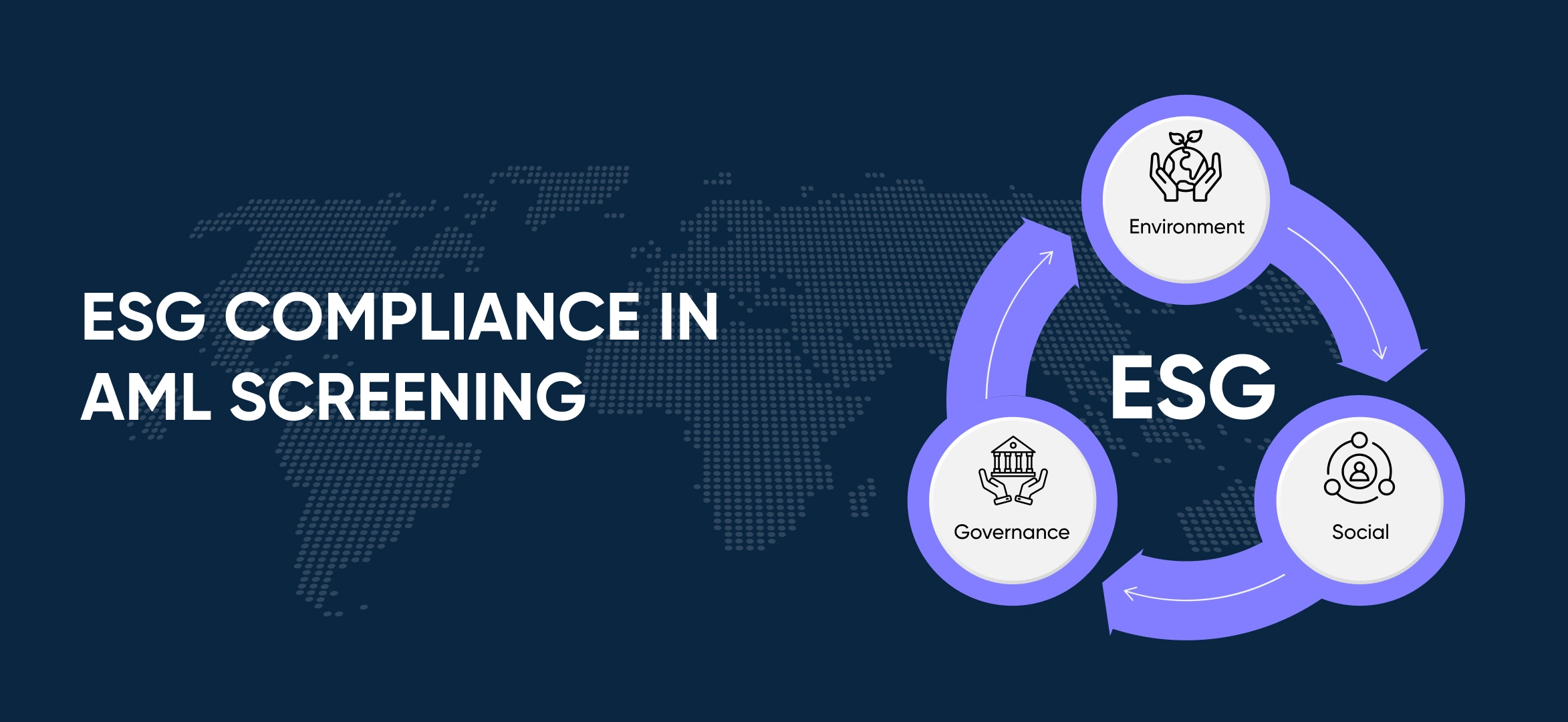
ESG is an abbreviation for environmental,social and governance. It is a framework that assesses a company’s management of risks and responsibilities that can affect its conduct, resilience, and reputation.
The environmental pillar looks at how a company affects the natural world. This includes emissions, pollution, resource use, deforestation, biodiversity loss, and exposure to climate-related disruption. The social pillar addresses a company’s treatment towards its people this includes labor conditions, health and safety, human rights, diversity, and community impact. The governance pillar examines how a company is directed and controlled, including board oversight, ownership transparency, corruption risk, accountability, and internal decision-making.
For compliance teams, ESG is relevant because these factors can point to broader weaknesses in customer behavior, third-party risk, and internal controls. A company with repeated labor abuse allegations, environmental violations, or governance failures may also present elevated reputational and financial crime risk.
What are ESG Regulations for Businesses and Why are they Important?
ESG are set regulatory standards that identify an organization’s social and environmental impact. The environmental risk assesses how a company has a direct impact on the environment and the preservation of nature. Greenhouse gas emissions, air and water pollution, resource loss, deforestation, degradation of biodiversity, extremes of weather and natural disasters are all factors proven to be influenced by big companies, institutes and corporations.
Social risk determines how companies and large corporations act as an employer. The general environment of the company and the attitude adopted in their day-to-day operations. The working conditions for the employees, their health, safety are all associated with social risk.
Prevalence of practices like child labor, discrimination and unsafe working environments result in legal and reputational consequences for companies, a circumstance every big corporation wishes to avoid.
Governance risk determines how a company is basically run and functions. This can include corporate governance, board of governors oversight, accountability and corruption. Weak governance remains a hazard since it can directly result in compliance failures and lead to a surge in regulatory breaches.
Governance risk identifies politically exposed persons and entities in high risk environments.
ESG Regulations in the United States (US)
ESG related US Federal Regulation (SEC’s Final Rule on Climate-Related Disclosures for Investors) was adopted in March 2024, however, the implementation was halted after being challenged in the court. SEC dropped the defense in court in March 2025 after a change in policy by the current US administration. However, certain other state and federal laws still require companies to conduct supply chain due diligence when importing materials or products from cross-border suppliers.
The US Tariff Act of 1930 specifically its Section 307 does not permit imports of any products or materials that are either mined or produced from forced labor or convict labor this also includes forced child labor in any foreign country. As a result, it requires companies to adopt and conduct through due diligence on their supplies, this includes checking all publicly accessible and available information that is indicative of use of forced labor by any company in their supply chain.
The US Fish and Wildlife Services indicated that a total of 6 people were sentenced for illegally trafficking corals from the Philippines under the Lacey Act. The Lacey Act is responsible for imposing any penalties be it civil or criminal for any wildlife trafficking activity that included the import/export of fisheries through illegal means, plants or a variety of plant products that includes illegally harvested timber as well.
This puts responsibilities on companies to perform substantial due diligence to completely ensure there is no dealing with any wildlife, plants or their products that are sourced illegally. For exclusively timber, the American National Standard for Due Diligence in Procuring/sourcing Legal Timber indicates that companies should inquire about their suppliers. This is an effort to identify any past illicit criminal behavior, any police or NGO reports as well as reputation among all other factors.
ESG Regulations in European Union (EU)
The EU has more of a systematic approach towards ESG-related regulations, this is especially true in the case of sustainability disclosures and maintenance of transparency around sustainable finance.
At its core, the most important framework remains the Sustainable Finance Disclosure Regulation or also known as SFDR. This regulation requires all participants of financial markets to fully disclose how sustainability risks are considered in investment decisions and reporting on product level.
The Corporate Sustainability Reporting Directive (CSRD) requires thousands of companies to report on sustainability by using the European Sustainability and Reporting Standards (ESRS).
The EU is also actively working towards improving trust in ESG ratings. The Regulation (EU) 2024/3005 was adopted in 2024 primarily in order to improve the transparency and integrity of ESG rating activities. The goal is to continue making the ESG ratings more consistent and reliable for market participants.
ESG oversight for businesses and financial institutions alike, operating in the EU requires stronger governance, more credible and reliable risk controls and enhanced documentation. This would enable a more natural seamless connection with AML processes especially where firms would be required to assess the ownership structures, any adverse media, sanctions exposure as well as the broader, general behavior of all customers and third parties.
ESG in AML Compliance
ESG and AML are two topics that are often discussed separately, however their continued overlapping with each has become harder to ignore over time. Multiple times, ESG failures can not be labelled as isolated conduct issues, they can also signal for hidden financial crime exposure.
Environmental crime remains a powerful example. FATF, for instance, has highlighted how illicit proceeds are generated through illegal logging, illegal mining and waste trafficking and they continue to move through formal and informal financial channels. This rules out the notion that environmental misconduct is a matter of sustainability only. It can be easily tied to money-laundering, corruption, shell companies and cross-border financial movement.
This same logic can be applied to social and governance failures. A business that has its links to forced labor, human rights abuse, corruption, and weak ownership transparency can have the tendency to pose a higher AML risk. These red flags can have a significant impact on customer onboarding, EDD decisions and any ongoing monitoring.
At this point, ESG due diligence becomes substantially relevant for financial institutions. ESG screening has the ability to provide financial institutions with a broader lens for highlighting customers and counterparties that are linked to environmental harm, corruption or governance failures. An assessment of ESG-related indicators along with sanctions, PEP exposure, multiple watchlists and adverse media would give firms a complete and a fuller view of financial crime risk.
Actions required to Strengthen AML Framework for ESG Alignment
Financial institutions could strengthen ESG alignment within AML programs by expanding the scope for risk identification at onboarding as well as throughout the time the customer remains with the institution.
1. Risk Assessment Revision
Risk Assessments should be updated so they can show any possible ESG-linked exposure. This includes sectors and geographical locations that are associated with environmental crimes, any labor exploitation, corruption, wildlife trafficking and high-risk sourcing patterns.
2. Adherence to ESG Due Diligence
Customer due diligence and enhanced due diligence should also capture ESG-related indicators where relevant. This may include adverse media linked to environmental harm, labor abuse, regulatory breaches, governance failures, or unethical sourcing practices. For higher-risk relationships, firms may also need a closer review of beneficial ownership, source of wealth, ownership networks, and third-party connections.
3. Draft Strong Policies and Procedures
Internal policies should then reflect these priorities. ESG-linked financial crime risk should not sit outside the AML framework as a separate topic. It should be reflected in escalation standards, review triggers, screening logic, and investigation procedures.
4. Use Technological Solutions
Technology also has an important role. Firms that combine sanctions, PEPs, watchlists, and adverse media with broader risk context can detect patterns that manual reviews may miss. That becomes especially useful where ESG concerns develop over time and require continuous monitoring rather than a one-time check.

How AML Watcher can help Companies meet ESG Obligations
Many firms struggle to connect ESG expectations with practical compliance controls. The challenge is not only understanding the regulation. It is identifying whether a customer, supplier, or related party shows signs of environmental misconduct, governance concerns, sanctions exposure, or reputational risk before that exposure becomes a compliance issue.
AML Watcher helps financial institutions bring that risk into view through stronger screening and monitoring. The platform screens customers and third parties against sanctions, PEPs, watchlists, and adverse media across 235+ countries. It also supports ongoing monitoring with continuously refreshed data, which helps firms detect new risk signals tied to governance failures, corruption concerns, criminal investigations, or harmful business conduct.
For firms looking to align AML controls with ESG-aware risk management, this creates a more practical path. Instead of treating ESG as a separate reporting exercise, businesses can strengthen due diligence through the same screening and monitoring processes already used to detect financial crime.
Request a demo to see how AML Watcher helps firms identify risk early and build a more informed compliance framework.
- No commitment needed
- Complete AML Database at your service
- Access our all-in-one dashboard


Tier-2 PSPs in ... must demonstrate automated monitoring, layered CDD, &...
See the Full Regulatory Expectation70–80% less manual work, 95% less fatigue, TruRisk Agent makes compliance effortless.
Experience Agentic AMLMove Beyond Articles. Activate AML Intelligence.
Switch to AML Watcher today and reduce your current AML cost by 50% - no questions asked.
- Find right product and pricing for your business
- Get your current solution provider audit & minimise your changeover risk
- Gain expert insights with quick response time to your queries