

 Alert!

Geopolitical Sanctions Compliance: Build a Scenario-Based Screening Program
Sanctions
April 17, 2026


- What Dynamic Sanctions Screening Means in Practice
- Why Geopolitical Sanctions Compliance Has Become Structurally Harder
- The US/EU Regulatory Divergence AML Teams Must Now Manage
- What Sanctions Scenario Planning Actually Involves
- Data Quality and False Positives in Dynamic Screening
- Building Dynamic Sanctions Screening Into the Operating Model
- Where AML Watcher Fits Into This Model

In mid-2025, the EU added over 3,400 designations to its Russia-related sanctions list since 2022 alone, sanctioned Chinese banks for circumventing restrictions, and designated 105 additional vessels to its shadow fleet. Meanwhile, the US quietly delisted sanctioned individuals whose “continued designation was inconsistent with US foreign policy interests.”
Compliance officers running static screening programs built for a more predictable era are facing a gap they can no longer close with manual updates. This article explains how scenario planning, a methodology borrowed from geopolitical risk analysis, can anchor a dynamic sanctions screening program that holds up when regimes shift without notice.
What Dynamic Sanctions Screening Means in Practice
Sanctions regimes now shift at a pace that leaves periodic review cycles obsolete, with new designations and delistings emerging across jurisdictions within days. Real-time screening improved that model by introducing faster data updates.
Dynamic sanctions screening combines continuously updated sanctions data with adaptive screening logic that adjusts to jurisdictional requirements, risk exposure, and predefined compliance scenarios. This approach moves beyond simple list updates and introduces structured responsiveness into screening operations.
It is scenario planning that becomes the layer that directs these changes, so compliance teams can be ready to implement changes when regulations change and not have to respond after the fact when they are revealed.
Why Geopolitical Sanctions Compliance Has Become Structurally Harder
Three years ago, most compliance teams could reasonably assume that the US Office of Foreign Assets Control (OFAC) and the EU would move in the same direction on major designations. That assumption is no longer safe.
The Atlantic Council documented the shift explicitly: the US has started delisting individuals that the EU continues to sanction, and the EU has independently expanded its reach to sanction third-country banks, including two Chinese institutions, for facilitating Russia-linked transactions.
For a multinational bank or FinTech operating under both frameworks, this creates a compliance problem with no clean resolution. An entity cleared by OFAC may remain designated by the EU. A transaction permissible under US law may expose a firm to EU Directive 2024/1226 penalties, which now carry harmonized minimums enforced across member states. In the first half of 2025, global AML-related fines rose 417% year-on-year. Jurisdictional misalignment is no longer a theoretical risk.
Regulatory enforcement across both the US and Europe shows a consistent pattern: firms are penalized for outdated screening systems, failure to capture indirect exposure, and delays in adapting to new sanctions designations.
The US/EU Regulatory Divergence AML Teams Must Now Manage
The AML Regulation 2024/1624 of the EU, taking effect in July 2027, but already influencing the supervisory expectations, explicitly introduces the targeted financial sanctions risk into the AML compliance framework. Since July 2025, the new Anti-Money Laundering Authority (AMLA) has been responsible for high-risk cross-border institutions and has provided binding technical standards. This implies that the EU is integrating sanctions compliance and AML requirements into the same
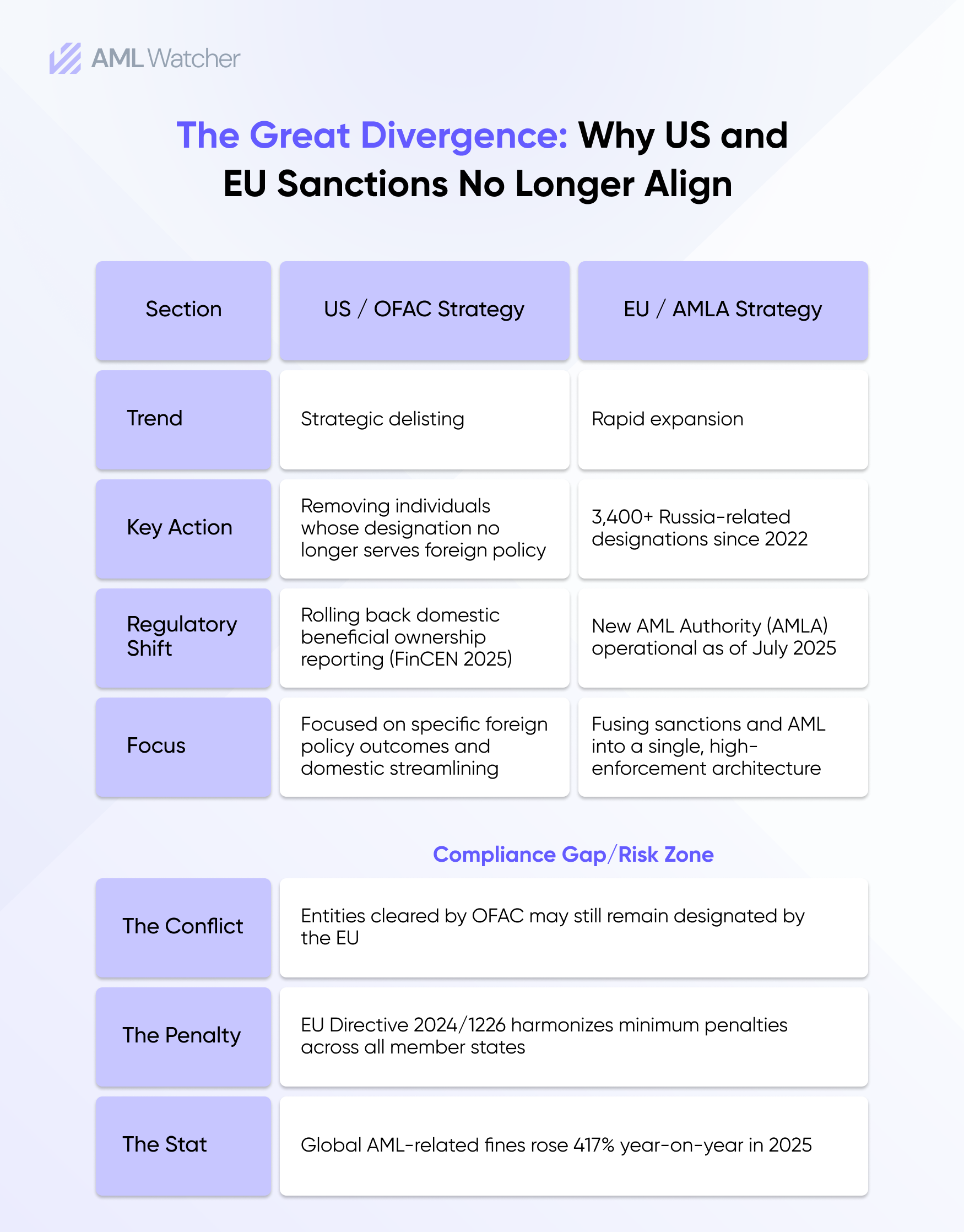
The US is moving differently. FinCEN’s 2025 interim rule rolled back domestic beneficial ownership reporting under the Corporate Transparency Act, leaving only foreign reporting companies covered. The 2016 Customer Due Diligence Rule remains under review. This creates misaligned timelines: EU institutions face an accelerating, consolidating regulatory push; US-focused programs face uncertainty about which obligations are even current.
A screening policy that satisfies US expectations may fall short under EU requirements, particularly where secondary sanctions or expanded designation criteria apply. This divergence reflects a sustained shift in regulatory direction, requiring firms to operate parallel compliance approaches across jurisdictions.
What Sanctions Scenario Planning Actually Involves
Scenario planning in sanctions screening focuses on preparing for plausible regulatory shifts rather than predicting exact outcomes. It enables compliance teams to define response strategies in advance of designation changes.
The methodology, adapted from geopolitical forecasting practices used by institutions like the US Federal Reserve and leading financial supervisors, works in four stages.
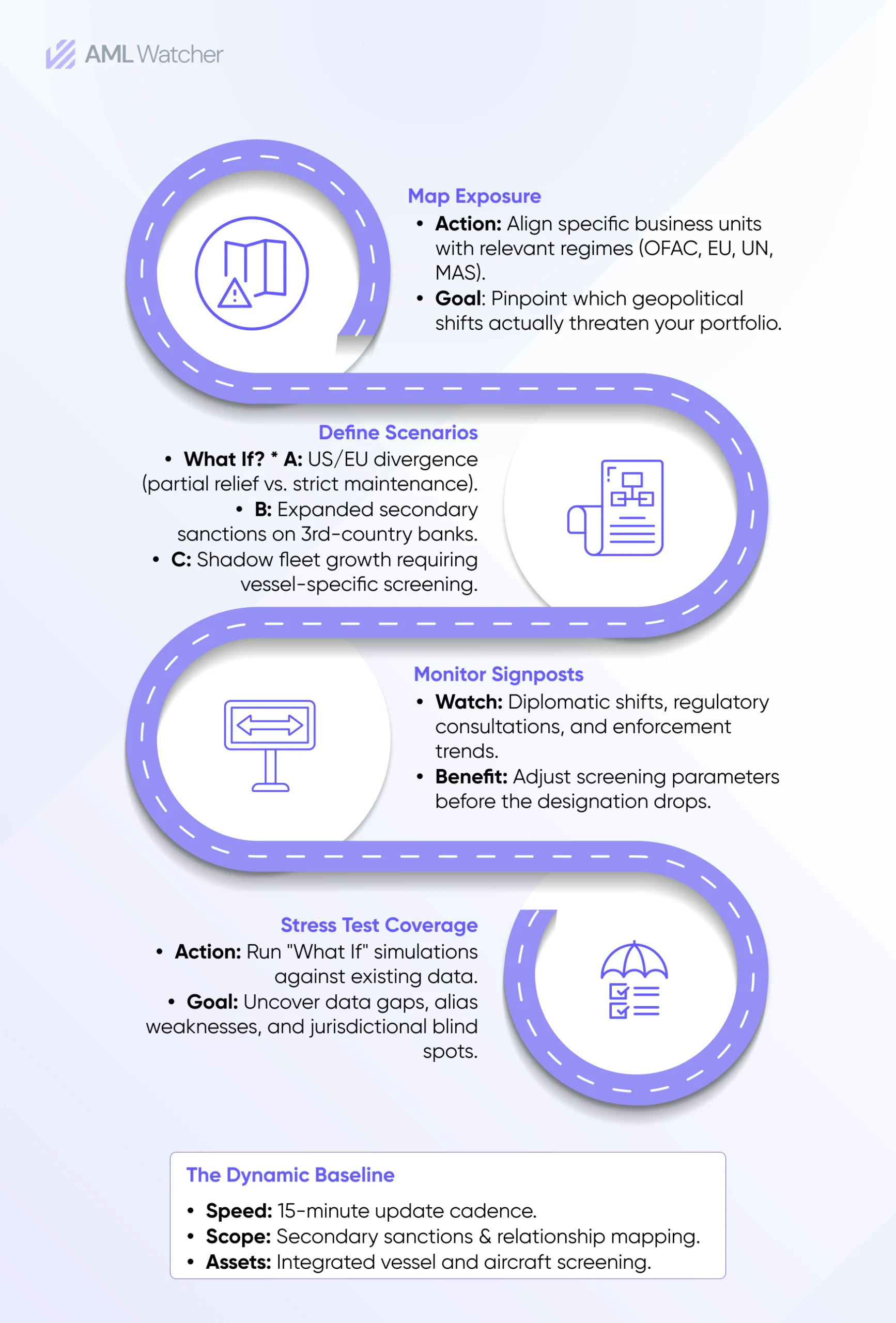
Map The Exposure By Regime
Before building scenarios, a compliance team needs a current map of which sanctions regimes apply to which parts of the business. This mapping determines which scenario categories are operationally relevant.
Define The Scenarios That Matter
Scenario planning works on plausible, not certain, futures. For a bank with Russia exposure today, relevant scenarios include: partial US-Russia sanctions relief with no EU equivalent (already partially underway), EU expansion of secondary sanctions to additional third-country financial intermediaries (already precedented with the Chinese bank designations), and continued shadow fleet expansion with vessel screening obligations in trade finance. Each scenario requires a distinct compliance response.
Identify Signposts, Not Just Triggers
A trigger is a term that has already occurred; at this point, a compliant firm has seconds or minutes to respond. A signpost is a pointer that a certain situation is acquiring likelihood: a diplomatic wording, a regulatory consultation, or a change of enforcement pattern. The implementation of compliance teams that screen signposts may pre-set their screening parameters, customer risk profile, and their escalation workflow prior to a designation landing.
Test Screening Coverage Against Each Scenario
This is where scenario planning connects directly to sanctions screening operations. Each scenario should generate a test case: if this regime change occurs, which customers, counterparties, or transactions in our portfolio would be affected? Running this against the current screening coverage reveals data gaps, alias coverage weaknesses, or jurisdictional blind spots before they become enforcement problems.
Data Quality and False Positives in Dynamic Screening
Dynamic screening increases coverage, but it also introduces operational challenges if the underlying data is not properly managed. Sanctions information is reported by various authorities inconsistently, with dissimilar identifiers, missing fields, and a range of name variations.
Inconsistent sanctions data, including missing identifiers and name variations, creates two parallel risks: missed matches and excessive false positives. Without proper normalization and intelligent matching, expanded screening coverage can overwhelm compliance teams without improving detection accuracy.
With the spread of screening to secondary sanctions, vessels, and intricate entity linkages. When screening systems are based purely on simple name matching, compliance teams might experience a flood of screenings that are not legitimate risks.
Building Dynamic Sanctions Screening Into the Operating Model
Scenario planning produces a risk map. Converting that into operational capability requires a screening program designed for continuous adaptation rather than periodic review. Several design principles matter here:
- The update frequency must match the regime’s cadence. The EU’s 18th Russia sanctions package introduced new designation criteria for third-country financial institutions. Firms that reviewed their screening configurations quarterly after that package dropped were exposed for weeks. Real-time data updates are now a baseline requirement for firms with material sanctions exposure.
- Secondary sanctions coverage needs to be explicit in the screening scope. Secondary sanctions create exposure not from direct dealings with designated parties, but from transacting with entities that themselves engage in transactions with sanctioned parties. This linkage is invisible in a simple name-match screen. Scenario planning for secondary sanctions exposure requires entity relationship mapping, not just list comparison.
- Vessel and asset screening must be integrated alongside entity screening for institutions with trade finance, insurance, or shipping exposure. The EU’s shadow fleet designations now cover 440 vessels. A trade finance team screening only beneficial owners, not the vessels themselves, has a structural gap that no amount of customer due diligence will close.
Dynamic sanctions screening should be implemented throughout the customer life cycle. Onboarding screening defines the original risk profile, and further monitoring is needed to identify changes in sanctions status or customer behavior over time. Re-screening triggered by triggers (e.g., changes to sanctions lists or alterations in ownership structure) is a prominent part of compliance upkeep.
Operational Workflows and Governance
Screening capability alone does not meet regulatory expectations. Authorities evaluate the manner in which alerts are managed, documenting decisions and processes that are uniformly applied throughout the organization. This involves well-defined escalation procedures, well-organized case management procedures, and audit trails that indicate how every alert was addressed. Scenario-based adjustments to screening parameters must also be documented and approved within controlled governance frameworks.
Where AML Watcher Fits Into This Model
Compliance teams managing multi-jurisdictional sanctions exposure often lack the infrastructure required for adaptive screening. AML Watcher supports dynamic screening with real-time data, expanded alias coverage, and scenario-driven capabilities that align with evolving regulatory expectations.
- No commitment needed
- Complete AML Database at your service
- Access our all-in-one dashboard


Tier-2 PSPs in ... must demonstrate automated monitoring, layered CDD, &...
See the Full Regulatory Expectation70–80% less manual work, 95% less fatigue, TruRisk Agent makes compliance effortless.
Experience Agentic AMLMove Beyond Articles. Activate AML Intelligence.
Switch to AML Watcher today and reduce your current AML cost by 50% - no questions asked.
- Find right product and pricing for your business
- Get your current solution provider audit & minimise your changeover risk
- Gain expert insights with quick response time to your queries