


 Alert!

A Complete Guide to Entity Resolution for Better Data Clarity
Others
March 30, 2026


Information hardly resides in a single clean location. Rather, it filters through systems, teams, and formats, and usually results in minor discrepancies that generate larger issues in the long run. Two databases might show a name differently, or a company record could be in two or more forms with no obvious relationship. These gaps can appear inconsequential in the initial stages, yet they can silently affect the decision-making process, compliance, and efficiency.
IBM estimated that in the United States alone, bad quality data costs the business approximately $3.1 billion every year. These kinds of losses indicate the ability of fragmented and inconsistent data to impact results at scale. The desire to link and integrate information is of greater concern as organizations proceed to use such data in making important decisions. This is where entity resolution comes to take on a significant role, assisting in converting scattered data into a more understandable and trustworthy perspective.
What is Entity Resolution?
Entity resolution refers to the process of detecting and connecting various records that in fact represent the same real-world object. These organizations might be persons, companies, or even places that are repeated within datasets with minor differences.
As an example, there is a record where Ali Khan appears in one system and A. Khan in another. On the face of it, these two might look like two distinct people. But when more information, like phone numbers or addresses, is factored in, it is apparent that both documents are of the same individual. In the same regard, a firm may be registered as ABC Pvt Ltd in one database and these names as ABC Private Limited in another when the two firms represent the same organization.
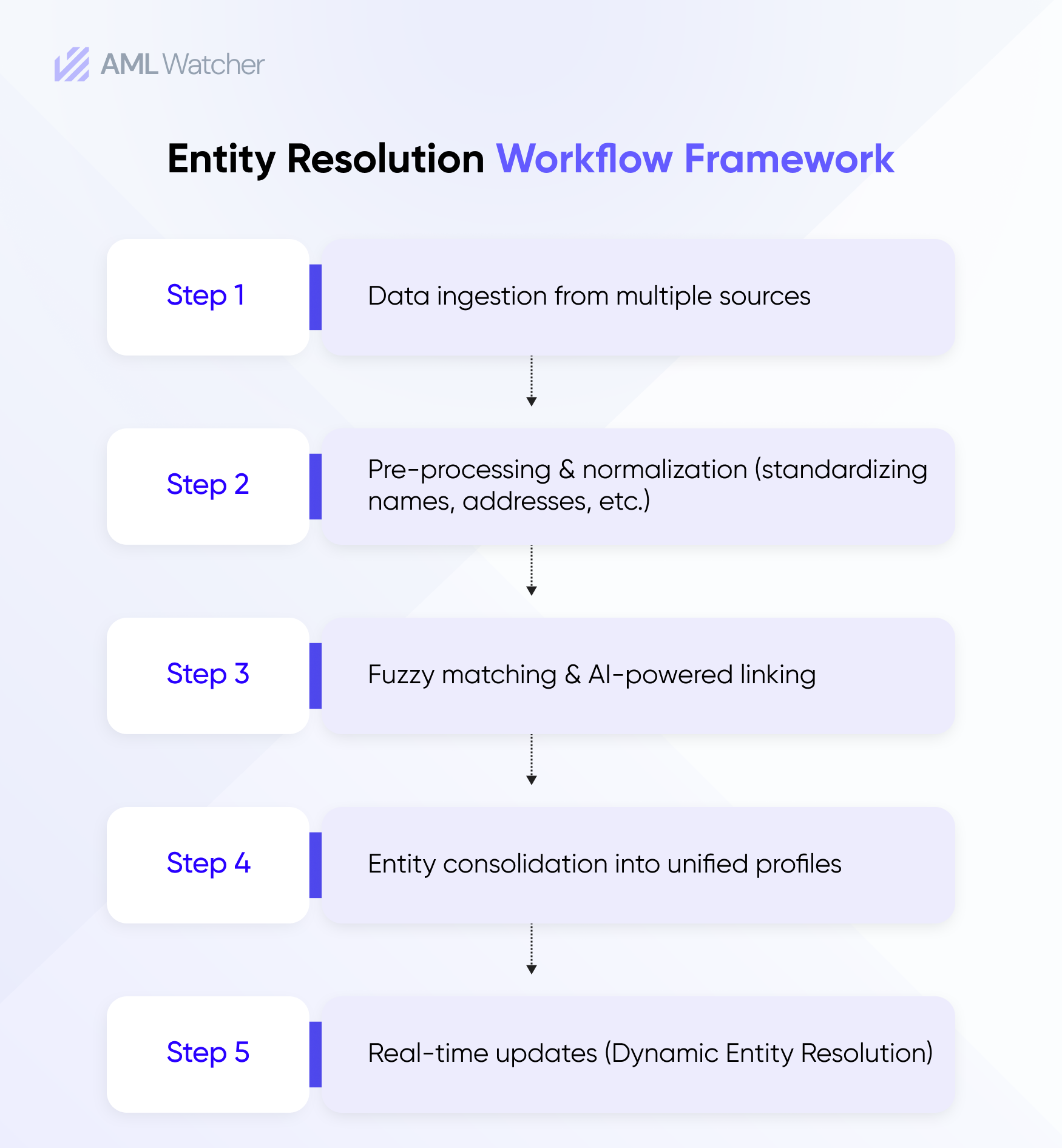
That is where entity resolution will play a crucial role. It does not record the variations as separate records but links them to one unique profile. This is normally done by an entity resolution tool, which compares the attributes, finds similarities, and connects related records to each other.
With the increasing data volumes, manual checks are no longer viable. An organized method of connecting data helps to ensure that every entity is represented correctly and, in the end, makes better decisions in various business functions.
How Entity Resolution Solves Common Business Data Challenges
As organizations grow, data is likely to increase both in volume and complexity. Data is gathered at several points of contact, such as customers, third parties, and internal systems. Although this provides an abundant data environment, it also presents problems like duplication, inconsistency, and fragmentation.
Here is where entity resolution software becomes more significant. In its absence, businesses tend to lose a clear and consistent picture of their data. Duplication of records might cause confusion, whereas inconsistency of the format may result in the inability to relate information. In the long run, these problems impact the level of operational efficiency and may result in compliance risks as well.
An example is that a financial institution can have more than one profile of the same person because of minor differences in name or address. This not only slows down internal processes, but it also poses the risk of missing important information. Entity resolution reduces such records into one accurate profile.
Dynamic entity resolution is another significant development in this space. In contrast to conventional solutions, which are based on stable matching, dynamic solutions are constantly updated and optimised when new data is available to build the entity profiles. It enables organizations to have a more up-to-date and relevant view of their data as opposed to using the old snapshots.
Common Entity Resolution Challenges and How They Are Addressed
Entity resolution is not always easy to implement despite its importance. Accuracy and reliability may be impacted by several entity resolution issues when not managed adequately.
Addressing variations and aliases of names is one of the most frequent problems. Different systems tend to record individuals and businesses differently, even in cases where there are abbreviations, variations in spelling, or a discrepancy in formatting. These variations may result in missed connections without the use of a flexible approach.
The other challenge is posed by multilingual and global data. The names and addresses can be in various languages/scripts that complicate direct comparisons. Moreover, incomplete or unavailable data can also complicate the process, because not all identifiers are always present.
Another major issue is false positives. In other instances, various entities can be found to be similar in the sense that they can be mistakenly identified as related. This may introduce inaccuracies that affect downstream decisions.
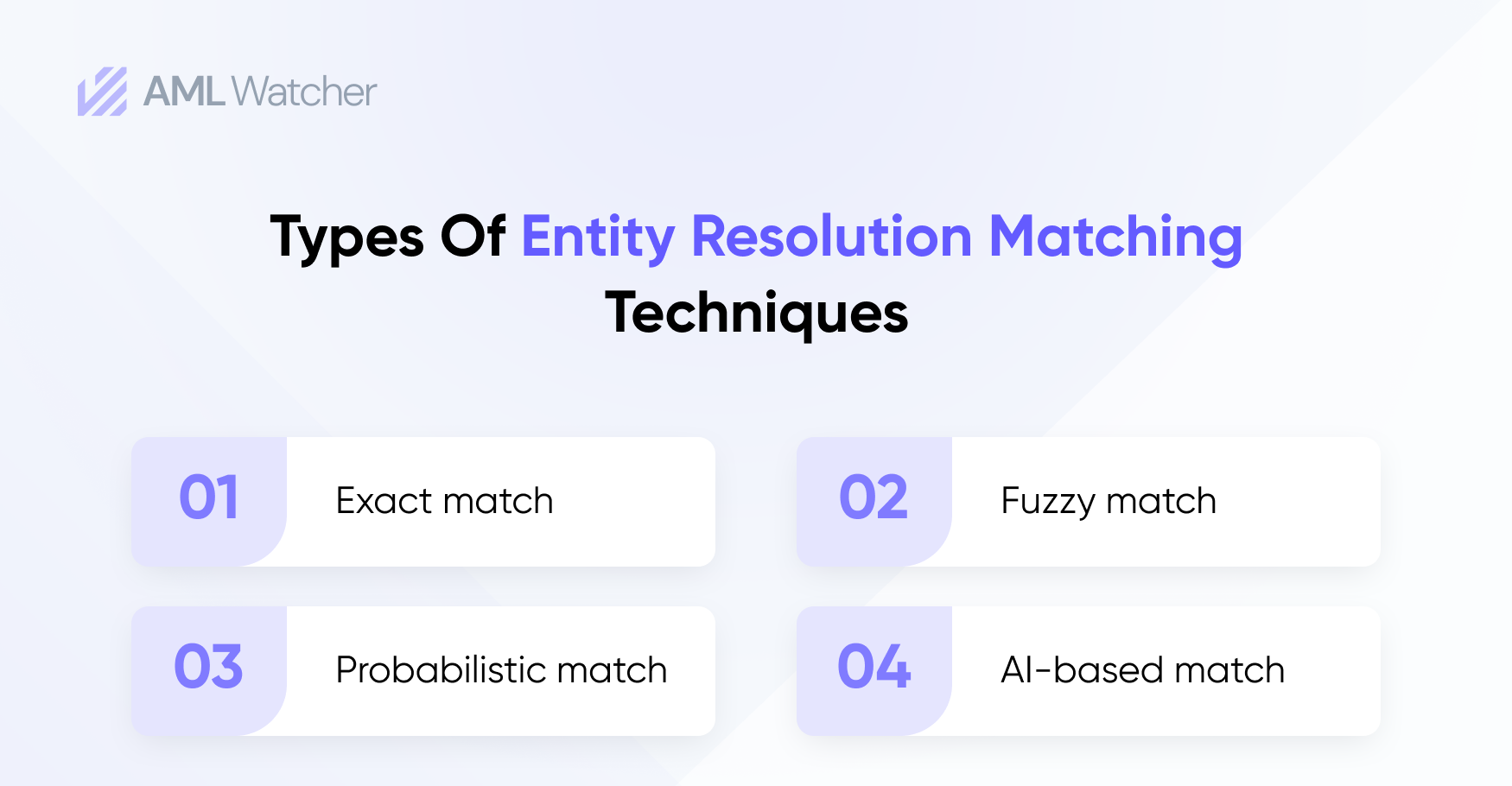
The use of modern entity resolution software meets these challenges by using a combination of advanced methods. Fuzzy matching enables systems to find similarities when exact matches do not exist. Models based on AI can be used to improve the identification of patterns and relationships in massive data. Enrichment of data provides more context, aiding in enhancing accuracy and uncertainty.
A combination of these methods allows organizations to work through the most frequent challenges and create a more sound structure of data connectivity. The outcome is a more accurate and transparent description of each entity, even in complex data environments.
How AML Watcher Assists in Entity Resolution
Although the idea of entity resolution is the basis, the proper implementation must have the appropriate capabilities. AML Watcher assists in this process by integrating intelligent matching with access to detailed data sources to aid organizations in developing a more accurate picture of entities among various datasets.
The platform uses flexible, fuzzy matching algorithms to find links between records, even when names or formats differ. This will reduce the risk of missing pertinent matches, and at the same time, it will be very accurate.
Moreover, AML Watcher allows access to global lists, such as sanctions lists, watchlists, politically exposed persons (PEPs), and adverse media. Combining these sources enables one to more easily associate entities with relevant risk indicators and contextual information.
Entity linking by alias and related data points is another important point. The platform does not present records in isolation, but rather relates them to a single profile, presenting a more comprehensive picture of any entity. This is also enhanced by real-time monitoring, which makes sure that updates or changes are reflected in a timely manner.
Custom risk scoring is an extra layer of insight that enables organizations to prioritize cases according to their risk. Not only does this enhance efficiency, but it also adds to better decision-making.
- No commitment needed
- Complete AML Database at your service
- Access our all-in-one dashboard


Tier-2 PSPs in ... must demonstrate automated monitoring, layered CDD, &...
See the Full Regulatory Expectation70–80% less manual work, 95% less fatigue, TruRisk Agent makes compliance effortless.
Experience Agentic AMLMove Beyond Articles. Activate AML Intelligence.
Switch to AML Watcher today and reduce your current AML cost by 50% - no questions asked.
- Find right product and pricing for your business
- Get your current solution provider audit & minimise your changeover risk
- Gain expert insights with quick response time to your queries


